
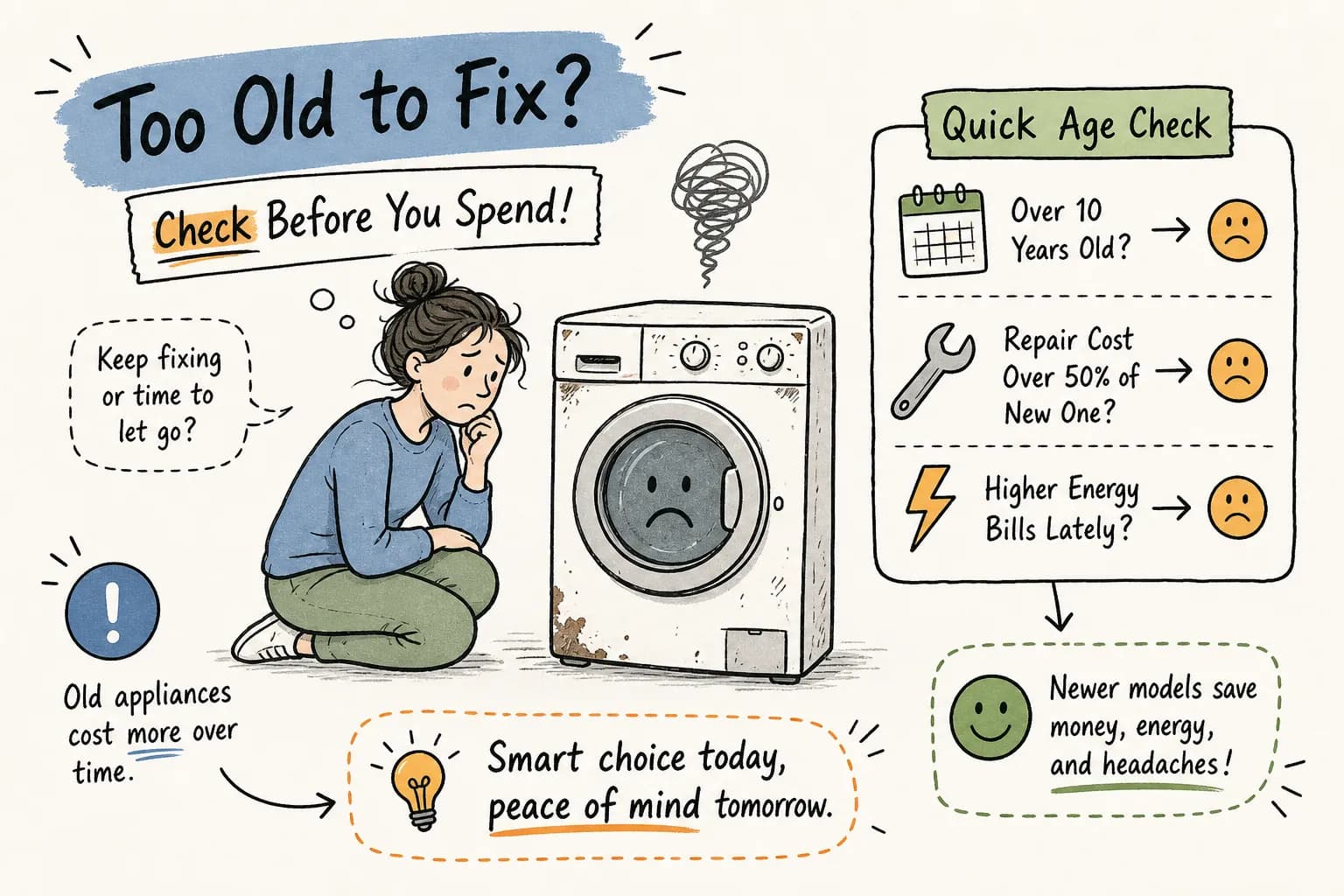
Is Your Appliance Too Old to Fix? Here's How to Tell
When your washing machine flashes an error code you have seen before and the engineer quotes more than you expected, it is natural to wonder: how do I know when an appliance is too old to fix? Most homeowners make this decision on gut feeling rather than any clear framework, and that often leads to either throwing good money after bad or replacing a machine that had years of reliable service left.
Repair engineers frequently report that this dilemma comes up on nearly every call-out. So here is a proper answer: the age benchmarks, cost rules, and practical checks you need to assess any appliance in your home and make a confident, informed decision rather than an expensive guess.
How long should your appliance actually last?
Lifespan benchmarks by appliance type
The table below shows typical expected lifespans for common household white goods in the UK, based on industry and consumer guidance from sources such as Which? and repair-sector data. These are averages, not guarantees. Premium models often last markedly longer than budget machines, while a poorly maintained mid-range appliance may fall short of its expected range.
ApplianceTypical expected lifespanWashing machine7, 12 yearsFridge / fridge-freezer10, 15 yearsDishwasher9, 12 yearsTumble dryer10, 13 yearsOven / cooker10, 15 yearsMicrowave7, 10 years
Use these figures as your starting reference point, not a verdict. An appliance at year three of a twelve-year expected lifespan is in a completely different position to one at year ten facing the same fault.
How age alone shifts the repair equation
Once an appliance passes its mid-life point, the logic changes. An eight-year-old washing machine sitting at the upper end of its expected lifespan deserves far more scrutiny than a four-year-old one showing the same fault. Age combined with fault type is the real indicator, not age in isolation.
Appliances well within their expected lifespan are almost always worth repairing, provided the fault is reasonable and the cost is manageable. Appliances past their mid-life require the checks in the sections below before you commit a penny to repairs. Think of the lifespan table as the gateway question: it does not give you the final answer, but it tells you how hard to look.
How do I know when an appliance is too old to fix? The 50% rule explained
What the rule says and why it works
The 50% rule is straightforward: if the repair quote exceeds half the current cost of a comparable replacement model, replacement is generally the better financial decision. The logic behind it is equally simple. An ageing appliance repaired at high cost is still an ageing appliance, and a second fault often follows within months of the first. Consumer guidance from sources including Which? endorses this rule of thumb as a practical starting point for repair-vs-replacement decisions.
A concrete UK example makes this tangible. A £280 motor repair on a washing machine that would cost £450 to replace new crosses the threshold and points toward replacement. A £120 pump repair on that same machine sits well below it and is almost certainly worth doing. The comparison is always against the current market replacement cost, not what you originally paid for the appliance.
Applying the rule with real UK repair and replacement costs
Minor repairs such as pump faults, door seals, and thermostat issues typically cost £70, £180 in the UK (labour inclusive, excluding VAT) and are sound investments in most cases. Major repairs such as drum bearings, compressor failure, and control board replacement can run anywhere from £220 to £600, and these are exactly the situations where the 50% check matters most before you commit.
For context, current UK replacement prices broadly sit in these ranges: washing machines from £250, £400 at the budget end and £400, £700 at mid-range; fridge-freezers from £180, £350 budget and £350, £700 mid-range; dishwashers from £250, £450 budget and £450, £800 mid-range. Apply the 50% rule against a mid-range equivalent, not the cheapest model available, unless your current appliance was a budget purchase. The aim is a genuine like-for-like comparison, not a downgrade disguised as a saving.
How often is too often to call out an engineer?
One repair is normal; a pattern is a warning sign
A single breakdown over an appliance's lifetime is rarely a reason to replace it. Parts wear out, seals harden, and pumps clog. What matters is the pattern. If the same appliance has needed two or more call-outs within the past 12 to 18 months, or has developed different faults in quick succession, that points to a machine that is deteriorating rather than suffering isolated bad luck.
The key insight here is that each individual repair might pass the 50% test on its own. Three repairs across two years, totalled together, rarely do. Look at the cumulative picture, not just the current quote sitting in front of you.
Calculating cumulative repair costs against replacement value
Track your total repair spend over a rolling two-year window and compare it against the cost of a mid-range replacement. If the combined past repairs plus the current quote begin to approach or exceed replacement cost, the case for a new appliance strengthens considerably. This is not about assigning blame for past spend; it is about making a clear-eyed decision from this point forward.
Factor in the appliance's remaining expected lifespan. A machine already past its typical end-of-life date and accumulating faults is a poor investment regardless of what any individual repair costs. Sunk costs are sunk. The only question that matters is what gives you the best outcome going forward.
When spare parts dry up: how do I know when an appliance is too old to fix on parts alone?
The 7, 10 year parts window explained
Under UK right-to-repair and ecodesign regulations, manufacturers are required to supply key spare parts for roughly 7, 10 years after a model is discontinued. For appliances still within that window, sourcing parts is rarely the problem. Once a machine passes that threshold, availability depends on remaining manufacturer stock, third-party suppliers, or remanufactured components, and none of those are guaranteed.
This is not a minor inconvenience. If parts cannot be sourced, a repair simply cannot proceed, regardless of budget or willingness. Parts availability is a hard constraint that sits entirely outside the cost equation. No amount of goodwill from either side can fix an appliance when the components no longer exist.
What this means for appliances over a decade old
For machines older than ten years, parts availability becomes a genuine and practical barrier. A 13-year-old fridge-freezer with a compressor fault may be technically repairable in principle, but sourcing the correct compressor for a discontinued model is often simply not feasible. Beyond 15 years, repair-industry guidance broadly holds that most appliances are beyond economical repair support, and replacement is the only sensible path.
A qualified engineer should check parts availability during diagnosis, before any commitment is made. At Alpha Appliances Ltd, our City & Guilds certified engineers carry out this check at the diagnostic stage as standard, so customers are never left part-way through a job when a component proves unobtainable.
The energy cost argument: when a newer model pays for itself
How much more do older appliances cost to run?
Older appliances, particularly fridges and fridge-freezers, consume significantly more electricity than modern equivalents. A 10-year-old fridge typically uses around 400 kWh per year, while a current A-rated model uses roughly 140, 200 kWh. At around 26p per kWh (always check your current tariff, as unit rates change), that gap can cost approximately £68 per year in wasted electricity on running costs alone, before any repair spend is considered.
Dishwashers and washing machines show smaller but still meaningful differences. An older dishwasher rated G under current energy labelling uses around 75 kWh per year compared with roughly 40 kWh for an A-rated equivalent, saving approximately £9 annually. Modest on its own, but meaningful when added into a borderline repair cost calculation.
Does the annual saving justify the cost of replacing?
A new mid-range fridge costing £450 and saving £68 per year on energy bills pays back its purchase cost in roughly six to seven years, and that assumes no repair costs on the old machine during that period. For appliances already approaching end-of-life, the energy saving alone can tip a borderline decision firmly toward replacement.
This calculation becomes even more compelling when the older appliance also carries a known fault. If a fridge-freezer is 11 years old, needs a £250 compressor repair, and costs £68 more per year to run than a modern equivalent, the financial case for replacement over repair is clear and straightforward to justify.
Your next move: repair, replace, or get a diagnosis first?
The quick decision checklist
Work through these criteria for any appliance you are uncertain about. They are designed to be used in order: age first, then cost, then history, then parts.
Replace if:
- The appliance has passed its expected lifespan
- The repair quote exceeds 50% of the cost of a comparable new model
- Spare parts are unavailable or unconfirmed
- There have been multiple repairs in the past two years
- There are safety concerns such as electrical faults, gas issues, or structural damage
Repair if:
- The appliance is well within its expected lifespan
- The fault is minor and the cost sits well below the 50% threshold
- The repair history is clean with no pattern of recurring faults
- Parts are confirmed as readily available
When a professional diagnostic changes everything
For cases that sit in the grey zone, where the appliance age, the repair cost, and the breakdown history do not point clearly in one direction, a professional diagnostic is the most sensible next step before spending any money. A City & Guilds certified engineer can assess the appliance, confirm whether the fault is isolated or symptomatic of wider deterioration, and verify parts availability on the spot, all before you make a commitment either way.
Alpha Appliances Ltd offers fixed-price diagnostics with no hidden fees across Greater London, Berkshire, Surrey, Hampshire, and Dorset. You receive an honest, qualified assessment before committing to either option. That one visit frequently saves homeowners from both unnecessary replacements and poor-value repairs on appliances already past their useful life. Book online in minutes for a straight answer from an engineer with no interest in selling you a repair you do not need.
The decision framework is not complicated once you have the right information in front of you. Check the appliance age against its expected lifespan, apply the 50% rule to the repair quote, factor in breakdown history and spare parts availability, and add the energy cost consideration for anything borderline. For most households, those four checks produce a clear answer without much deliberation.
When they do not, the right move is a professional assessment rather than a rushed guess. Knowing when an appliance is too old to fix saves money, prevents repeat call-out costs, and means the next appliance you buy is a planned purchase rather than an emergency one made under pressure. That is a far better outcome for your home and your wallet than finding out mid-job that the part no longer exists.
Need a repair today?
Book a visit from a certified Alpha engineer in minutes.