
Why your dishwasher leaves dishes dirty and what to do
If you're asking "why is my dishwasher leaving dishes dirty," you're not alone, it's one of the most common fault calls the engineers at Alpha Appliances Ltd receive. You run a full cycle, open the door expecting clean dishes, and find food residue still clinging to the plates and a cloudy white film coating your glasses. The good news: dishes coming out dirty after a wash cycle is rarely a sign of a serious machine fault. In the vast majority of cases, it comes down to one of a handful of well-known, fixable problems.
This guide walks you through each cause in order, starting with the simplest checks and building to the more complex. Work through these steps before reaching for the phone. If you get to the end and your dishwasher still isn't cleaning properly, a manufacturer-trained technician can identify the underlying fault quickly and accurately, without pulling the machine apart on guesswork.
Why is my dishwasher leaving dishes dirty? Start with the filter
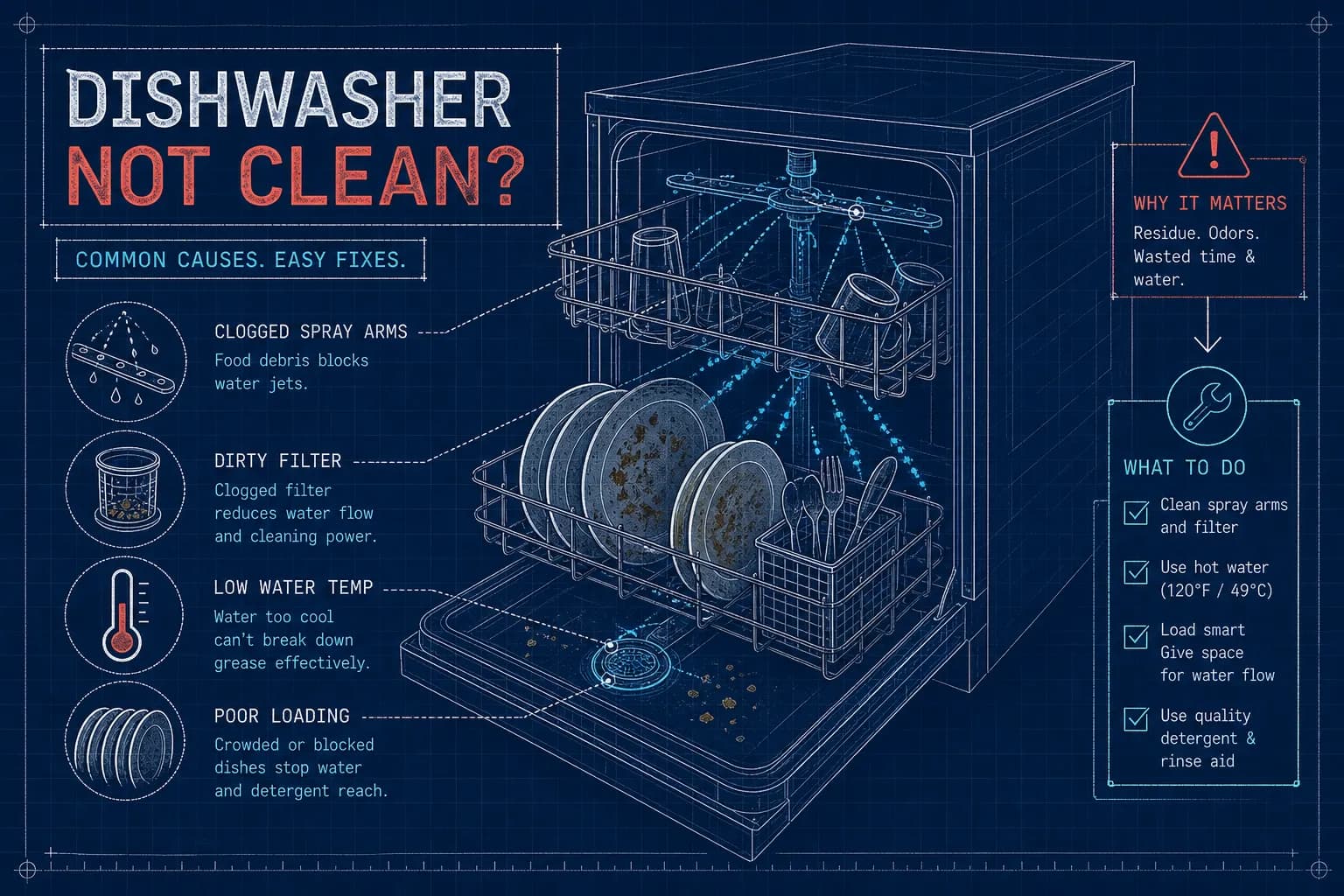
The dishwasher filter sits at the base of the tub and catches food debris during every wash cycle. Without regular cleaning, that debris builds up, recirculates through the water, and deposits itself back onto your dishes. Most homeowners don't realise the filter needs cleaning at all, let alone roughly once a month for a typical household. A clogged filter is one of the most common reasons dishes come out dirty, and it's often mistaken for a machine fault when the fix takes less than five minutes.
To clean it, remove the lower rack and locate the cylindrical filter at the bottom of the tub. On many models, you twist it anticlockwise and lift it free. Rinse it under hot running water, then use a soft brush and a small amount of washing-up liquid to clear any trapped grease or compacted food debris. A clean filter looks clear through the mesh with no visible residue clinging to the surface. A dirty one is discoloured, blocked, or has a greasy film that water alone won't shift.
If cleaning doesn't resolve the problem, inspect the mesh closely. Tears, warping, or a filter that no longer locks back securely into its housing are signs it needs replacing. Replacement filters can often be ordered by model number from most appliance parts suppliers, so don't soldier on with a damaged one.
Blocked spray arms: how restricted water flow ruins every wash
The spray arms rotate during the wash cycle, jetting pressurised water across every surface in the machine. When the nozzle holes become blocked with limescale, food particles, or mineral deposits, water coverage drops significantly and dishes stop getting clean. This is a particularly common problem in hard water areas, and it often shows
up as persistent residue on the upper rack, where the upper spray arm has the hardest job reaching.
Checking and clearing the spray arms is straightforward. Remove the lower and upper arms (most twist or clip off by hand), then hold each one up to the light and check every hole, blocked ones are easy to spot. Use a toothpick or skewer to clear each one individually, then flush the arm under the tap to confirm water flows freely. Once you reinstall them, spin each arm by hand to make sure it rotates freely without catching on crockery or rack bars.
Cracked or split arms, holes that remain restricted after thorough cleaning, and arms that wobble or no longer spin freely after reassembly are all signs that replacement is the better option. Spray arms are generally a straightforward fix, but an arm that keeps re-blocking is usually pointing to a separate limescale problem inside the machine,
which needs addressing at the same time.
Water temperature and detergent: the two factors most people get wrong
Your dishwasher needs water at around 55 to 65°C during the main wash cycle to clean effectively and dissolve detergent properly. If the water coming into the machine is too cold, the wash underperforms from the start. A practical fix: run the kitchen tap until the water is hot before starting the dishwasher. This clears the cold water sitting in the pipes and ensures the machine fills with hot water from the first moment of the cycle.
Detergent choice matters more than most people realise. Tablets and pods are a strong all-round option: pre-measured and consistent, and many include water-softening boosters and rinse-aid components, check product labels and manufacturer guidance for specifics. Powder is worth considering if you want to adjust the dose for particularly hard water. Liquid and gel formulas tend to be weaker performers in most independent assessments, especially on baked-on soils. Always use the dedicated dispenser drawer rather than dropping detergent loose into the tub. Never use hand washing-up liquid: it creates excessive foam, leaves residue, and can damage the pump over time.
Hard water is one of the most overlooked causes of a dishwasher leaving residue on glasses and plates. Many areas of the South and East of England have hard or very hard water, check with your local water supplier if you're unsure. The calcium and magnesium in hard water deposits onto dishes, glasses, and the internal components of the machine. Dishwasher salt softens incoming water inside compatible machines. It's the most important ongoing treatment in hard water areas. Rinse aid helps water sheet off dishes cleanly during the rinse phase and prevents spotting. Descaler removes limescale that has already built up inside the machine. Using all three regularly, salt ongoing, rinse aid topped up as needed, and descaler periodically, goes a long way towards eliminating cloudy spotted glasses and dishes still dirty after a cycle.
How you load the dishwasher has more impact than you think
Loading errors cause a surprising number of dirty-dish complaints on machines that are working perfectly. Overcrowding the racks is the most common mistake: when items are packed in too tightly, water simply can't circulate between them. Large pots and pans placed flat in the lower rack often block the spray arm below, reducing water pressure to the rest of the load. Nesting bowls or stacking glasses too close together creates pockets where water sits rather than drains, leaving deposits behind.
A few practical adjustments make a consistent difference. Angle bowls and glasses slightly so water drains off during the rinse rather than pooling. Keep tall items on the outer edges of the lower rack so they don't obstruct the central spray arm. Place heavily soiled cookware facing inward toward the spray, not shielded away from it. Leave a visible gap between each item so water can reach every surface. Correcting these loading habits frequently resolves cleaning issues, particularly in households where the dishwasher is loaded quickly and the same errors repeat each cycle.
When the problem is mechanical: pump, inlet valve, and internal faults
If you've worked through each of the checks above and the machine is still not cleaning properly, the fault is likely internal. The wash pump pressurises water through the spray arms during the cycle. When it begins to fail, water pressure drops across the whole machine. Dishes come out consistently undercleaned, the wash phase feels weak even though the cycle completes, and you may notice an unusual humming or grinding noise during operation. These aren't signs that cleaning the filter again will help.
The inlet valve controls how water enters the machine at the start of the cycle. If it's partially blocked or beginning to fail, the dishwasher may not fill to the correct level, leaving the water too shallow for the spray arms to work properly. Long fill times, unusually quiet fill phases, or error codes relating to water supply are the symptoms to watch for. This is not a DIY repair: the valve sits on the water supply line and requires the machine to be properly isolated before any work is carried out.
Modern dishwashers display error codes when sensors detect problems with temperature, pressure, or water flow. Before you call an engineer, note the error code down. It helps a technician pinpoint the fault on the first visit rather than spending time on exploratory diagnosis, which keeps the repair cost down and the visit short.
When DIY checks don't fix it: getting a professional diagnosis
When the steps in this guide don't resolve the problem, the fault is almost always internal: a failing pump, a faulty heating element, a seized inlet valve, or a sensor issue. These components need proper diagnostic tools and hands-on inspection to identify correctly. Replacing parts on speculation wastes money and often doesn't address the underlying fault. A qualified engineer can identify the exact problem on the first visit and carry out the repair with the right parts, fitted correctly.
The team at Alpha Appliances Ltd are manufacturer-trained technicians covering London, Surrey, Berkshire, Hampshire, and Dorset. They offer fixed-price repairs with no hidden call-out surprises, and the company reports a 78% first-time fix rate. They carry genuine replacement parts for all major brands including Bosch, Miele, AEG, and Samsung, so repairs are completed properly rather than patched together with generic components. Booking takes a few minutes online and engineers arrive with a full service report, with next-day availability on many jobs.
The diagnostic sequence, in brief
Work through the checks in order: filter first, then spray arms, then water temperature and detergent, then loading habits, then mechanical faults. Most cases of a dishwasher not cleaning properly have a simple cause, and working through this sequence is often quicker than you'd expect. Many cases resolve at the first or second step.
For the cases where they don't, a certified engineer at Alpha Appliances Ltd can diagnose and repair the underlying fault on a fixed price, often the next day, without the guesswork. If you've worked through every check in this guide and your dishwasher is still leaving dishes dirty, book a visit online today and have a manufacturer-trained technician resolve it properly.
Frequently asked questions
Why is my dishwasher leaving dishes dirty even after a full cycle?
The most likely culprits are a clogged filter, blocked spray arms, a loading error, or insufficient detergent. Work through the checks in this guide in order, most cases of dishes still dirty after a cycle trace back to one of these four causes.
Why are my glasses cloudy after the dishwasher?
Cloudy spotted glasses are almost always caused by hard water mineral deposits. Make sure your dishwasher salt reservoir is topped up (on machines with a built-in softener), use rinse aid regularly, and run a descaler through the machine every couple of months or as the manufacturer recommends.
How often should I clean my dishwasher filter?
For a typical household, roughly once a month is a good rule of thumb. If you run the machine daily or wash a lot of heavily soiled cookware, cleaning the filter every two to three weeks will keep it performing well.
Can wrong detergent cause a dishwasher not cleaning properly?
Yes. Using too little detergent, an old or damp tablet, or the wrong product type (such as hand washing-up liquid) can all leave dishes dirty or coated in residue. Tablets and pods are a reliable choice for most households; always use the dispenser drawer rather than placing detergent loose in the tub.
When should I call an engineer for a dishwasher leaving dishes dirty?
If you've cleaned the filter, cleared the spray arms, checked your detergent and loading, and the machine is still not cleaning properly, it's time to call a professional. Pump failure, inlet valve faults, and heating element problems all require proper diagnostic tools to identify accurately.
Need a repair today?
Book a visit from a certified Alpha engineer in minutes.