
Why Is My Dishwasher Leaving Dishes Dirty? Causes and Fixes
You've run a full 90-minute cycle, the machine has hummed and hissed through the lot, and you open the door expecting clean dishes. Instead, you find gritty plates, cloudy glasses and a faint smell of yesterday's dinner. If you're asking why your dishwasher is leaving dishes dirty after a full cycle, you're not alone, it's one of the most common complaints we hear at Alpha Appliances Ltd, and the cause almost always falls into one of five categories.
The good news is that most of those categories are fixable at home in under 30 minutes, without tools, and without spending a penny on a new machine. This guide walks you through each one in order of likelihood: the filter, the spray arms, water temperature, detergent dosing, and hard water. At the end, you'll also know exactly when a fault goes beyond DIY and needs a certified engineer.
Why is my dishwasher leaving dishes dirty after a full cycle?
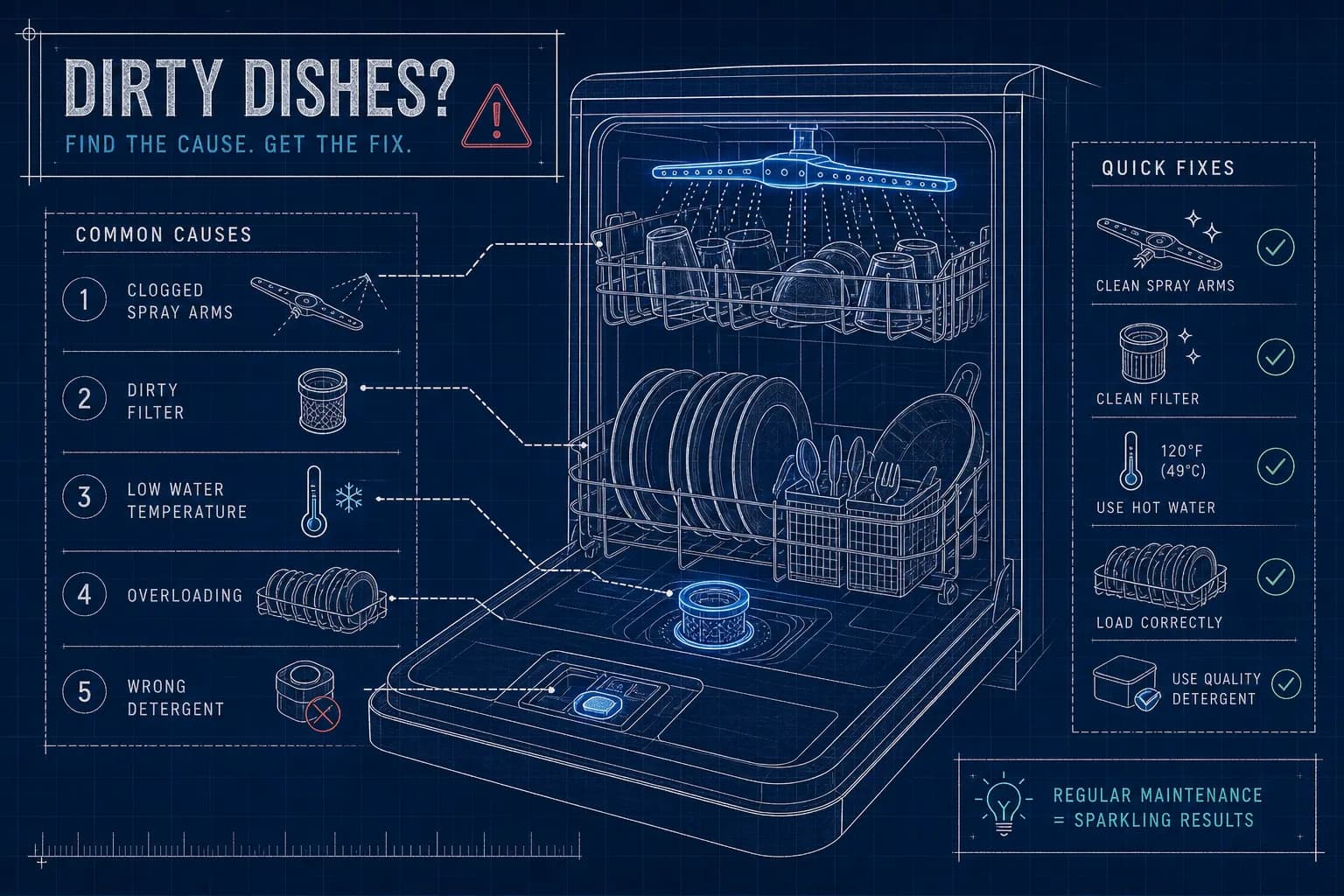
A dishwasher leaving dishes dirty after a full cycle always points to one of five underlying problems: water isn't reaching the surfaces, water isn't hot enough to activate the detergent, debris is being recirculated back over the load, the detergent chemistry is off, or the machine is overloaded and items are blocking each other. Every fault listed below maps to one of those causes, which makes diagnosis straightforward once you know what to look for.
A quick way to narrow it down before you start: if dishes come out gritty or with food particles still attached, the filter is almost certainly the culprit. If cleaning is uneven and certain zones consistently come out dirtier than others, a blocked spray arm is the likely cause. If you're seeing a white chalky film or a greasy residue on everything, you're dealing with either detergent misuse or hard water mineral deposits. And if the problem seems random across the whole load, check whether items are stacked too closely or positioned in a way that blocks the spray arms.
The filter is the first place to look
A clogged filter traps food debris in the sump at the bottom of the machine and then recirculates it back over your dishes during the wash cycle. Many manufacturers recommend cleaning the filter monthly, though in practice a great many households rarely clean it at all. It's one of the most common causes of a dishwasher not washing properly, and it takes less than five minutes to fix.
Spray arm blockages and uneven water distribution
Each spray arm has multiple small jets that fire water at pressure onto your dishes. When those jets are partially blocked by food particles, limescale or even a stray piece of glass, the arm can't distribute water evenly across the tub. The result is a machine that cleans the rack directly in front of a working jet but leaves everything else untouched. The full inspection and cleaning process is covered in detail below.
Hard water mineral buildup: a widespread problem in the UK
Much of London and the South of England sits firmly in a hard water zone. London tap water typically measures between 260 and 306 parts per million of dissolved calcium and magnesium. Surrey water around Guildford comes in at roughly 310 ppm, and Dorset at around 285 ppm. Those minerals reduce detergent effectiveness and deposit chalky white residue on dishes and glassware, making it look as though the machine hasn't cleaned at all, even when the cycle ran perfectly.
How to clean your dishwasher filter properly
This single maintenance step resolves the majority of dishwasher cleaning complaints. Most modern dishwashers use a two-part filter system: a cylindrical upper filter and a flat mesh lower filter that sits beneath it. Both need to come out, and both need cleaning. One important rule before you start: never run the machine without the filter locked back into its seated position, or debris will bypass the system entirely and block the pump.
Step-by-step: removing, cleaning and reseating the filter
- Remove the bottom rack and locate the filter assembly at the centre of the tub floor.
- Twist the cylindrical upper filter anticlockwise and lift out both components together.
- Rinse both parts under warm running water; use a soft toothbrush with a small amount of dish soap to work out stuck-on debris.
- If the filter is heavily soiled, soak it in warm soapy water for 10 minutes before brushing again.
- Inspect the mesh carefully for tears, cracks or warped tabs before reinserting anything.
- Refit the flat lower filter first, aligning the guides correctly, then insert the cylindrical filter and twist clockwise until it locks firmly into place.
When cleaning is not enough: signs the filter needs replacing
A clean filter and a damaged filter are two different things. If you can see a tear in the mesh, a cracked housing, or tabs that no longer allow the filter to lock firmly in position, cleaning it won't solve the problem. A damaged filter cannot prevent food debris from bypassing the system and recirculating onto your dishes, no matter how thoroughly you scrub it. Replacement filters for most major brands are available at low cost and are straightforward to fit without tools.
Clearing blocked spray arms and checking your water temperature
Spray arms on modern dishwashers are blocked by the same things that clog filters: food particles, limescale deposits and occasionally small foreign objects like toothpicks or glass fragments lodged in the jets. A partially blocked arm will not distribute water evenly, so dishes in certain zones come out consistently dirtier than others. If you've noticed a pattern, this is why.
How to inspect and unblock spray arm jets
Most spray arms on common UK brands, including Bosch, Siemens, AEG and Samsung, either lift straight off or release with a quarter-turn of a locking nut. Once removed, hold the arm up to the light and look through each jet hole. Blocked holes will be obvious. Clear them with a wooden toothpick or cocktail stick, never a metal tool, because metal will enlarge the holes and permanently reduce spray pressure. Rinse the arm under warm water, refit it, and check that it spins freely by hand before replacing the rack.
Water temperature: the overlooked fix
For detergent to activate and cut through grease properly, the inlet water needs to be at roughly 49°C to 60°C. You can test this without any specialist equipment: run the hot tap at the kitchen sink nearest the dishwasher for 30 to 60 seconds, fill a glass and measure the temperature with a kitchen thermometer. If the reading is below 49°C, the machine is working with cool water and cleaning performance will suffer regardless of how clean the filter is. Check your boiler thermostat setting and make a habit of running the hot tap briefly before starting a cycle, particularly in winter when pipes run cold.
Detergent type, dosing and rinse aid: getting the chemistry right
More detergent does not mean cleaner dishes. Using too much is one of the most consistent causes of film and residue on dishes after a cycle, and it's a mistake that's very easy to make. The brand matters far less than using the right type for your water temperature and measuring the dose correctly.
Choosing the right detergent and using the correct amount
Powder dissolves well in hot, longer cycles and performs strongly on heavily soiled loads, but leaves residue if used in short or cool washes where it doesn't fully dissolve. Liquid is easy to overdose and can leave a greasy film if too much is used. Tablets and pods offer consistent dosing and are commonly used for everyday loads, though they're not always the strongest option for heavily soiled washes. Always follow the manufacturer's recommended dose for your chosen product; over-dosing leaves residue rather than improving cleaning, because the machine's rinse cycle isn't designed to flush out excess detergent.
Why rinse aid makes a measurable difference
Rinse aid works by reducing the surface tension of water so it sheets off dishes during the drying phase rather than pooling and evaporating into spots. In hard water areas, it's not optional: without it, mineral-rich water dries as a chalky film on every surface. Check the rinse aid reservoir each month and adjust the dispenser's hardness setting to match your local water supply. In London, Surrey and Dorset, all areas with notably hard water, you'll generally need the setting towards the higher end of the scale; consult your dishwasher's manual for the recommended setting for your specific water hardness level.
Hard water and descaling: essential maintenance for UK households
Limescale builds up silently on your dishwasher's heating element, inside the spray arm jets, and across internal surfaces. Over time, scale deposits narrow the jets, reduce water flow, insulate the heating element so it uses more energy, and shorten the machine's lifespan. For households across London, Berkshire, Surrey, Hampshire and Dorset, this is not an occasional problem: it's a structural challenge that requires a regular maintenance routine.
Monthly descaling and cleaning cycles
Run an empty hot cycle once a month using a proprietary dishwasher descaler or citric acid. For routine maintenance, citric acid performs well against mineral deposits and is a low-cost, widely available option. For heavier buildup, stronger commercial products like Oust or Kilrock deliver faster results. If you wish to use white vinegar, check your appliance manual first, as some manufacturers advise against it on certain seals and internal components. One important distinction: descaling removes existing limescale, but it does not prevent new scale from forming. It must be a monthly habit rather than a one-off fix to be effective.
Long-term treatment: rinse aid settings and water softeners
For households where hard water spots return week after week regardless of how often you clean the machine, rinse aid and monthly descaling are management strategies, not a permanent solution. A whole-home water softener addresses the problem at the source by removing calcium and magnesium from the supply before it reaches any appliance. It's a significant upfront investment, but for severe hard water areas it's the only option that genuinely stops scale from forming rather than simply removing it after the fact.
When the fault goes beyond a filter clean and needs a professional repair
Working through the checks above resolves most common causes of a dishwasher leaving dishes dirty after a full cycle. But some persistent faults point to a mechanical or electrical component failure that no amount of cleaning will fix. Recognising those signs early saves you time, protects the machine's warranty, and avoids the risk of making a fault worse by attempting a repair without the right diagnostic equipment.
Fault signs that point to an internal component failure
These are the warning signs that mean it's time to call a certified engineer rather than run another cleaning cycle:
- Dishes consistently come out dirty despite a clean filter, clear spray arms and the correct detergent dose. This points to a failing wash pump or circulation pump that can no longer move water at adequate pressure.
- Water isn't reaching temperature even after confirming your boiler setting is correct. A faulty heating element or thermostat is the likely cause.
- Unusual grinding, humming or rattling noises during the wash cycle, which suggest a pump or motor fault.
- Error codes appearing on the display, which indicate the machine has detected a fault it cannot self-correct.
- Water pooling at the bottom of the tub after a cycle has finished, pointing to a drainage fault rather than a cleaning issue.
Attempting to diagnose or repair these faults without the right equipment can invalidate your machine's warranty and, in some cases, create a safety risk. These are not DIY jobs.
How Alpha Appliances Ltd resolves persistent dishwasher faults
If you've worked through every check in this guide and your dishwasher is still leaving dishes dirty after a full cycle, that's the point at which Alpha Appliances Ltd removes the guesswork. Our City & Guilds certified engineers carry genuine replacement parts and professional diagnostic equipment to every job. Every repair is quoted on a fixed-price basis before any work begins, so you know exactly what you're agreeing to, no hidden call-out fees, no surprises.
We cover Greater London, Berkshire, Surrey, Hampshire and Dorset, with next-day availability where possible and a straightforward online booking process. Whether the fault is a circulation pump failure on a Bosch, a heating element fault on a Miele, or something that simply hasn't responded to cleaning, our engineers have the experience and parts to tackle it properly. Book at alphaappliancesltd.co.uk or call us directly to arrange a visit.
Summary: your dishwasher troubleshooting checklist
Work through these in order and you'll resolve the problem in most cases. Start with the filter: remove it, clean it thoroughly and inspect it for damage before reinserting. Check the spray arms next, clearing any blocked jets and confirming the arms spin freely. Also check that dishes aren't overloaded or positioned in a way that blocks the spray arms.
Measure your incoming water temperature at the hot tap and address any shortfall at the boiler. Review your detergent type and dose, following the manufacturer's guidance, and make sure the rinse aid reservoir is filled and set correctly for your water hardness. Finally, introduce a monthly descaling cycle if you're in a hard water area, and consider a water softener if the problem keeps returning despite regular maintenance.
Most of these checks take well under an hour in total and cost nothing. If they don't resolve the issue, the fault is likely mechanical, and mechanical faults need a proper repair. Book online with Alpha Appliances Ltd or call us directly for next-day availability across Greater London and the South of England.
Frequently asked questions: why is my dishwasher leaving dishes dirty?
Why is my dishwasher leaving dishes dirty after a full cycle?
The most common causes are a clogged filter, blocked spray arm jets, insufficient water temperature, incorrect detergent dosing, hard water mineral deposits, or an overloaded machine. Work through each in turn using the steps in this guide, most households find the filter or spray arms are the culprit.
How often should I clean the dishwasher filter?
Many manufacturers recommend cleaning the filter monthly. If you run the machine daily or wash heavily soiled loads regularly, check it every two to three weeks. A quick rinse under the tap takes less than five minutes and prevents the most common cause of poor cleaning performance.
Will a water softener fix hard water dishwasher problems?
A whole-home water softener is the most thorough long-term solution for hard water areas. It removes calcium and magnesium at the source, preventing limescale from forming in the machine at all. Rinse aid and monthly descaling are effective management strategies in the meantime, but they don't stop scale from building up, they only remove it after the fact.
When should I call an engineer rather than troubleshoot myself?
If dishes remain dirty after you've cleaned the filter, cleared the spray arms, confirmed water temperature and corrected your detergent dose, the fault is likely mechanical. Signs including error codes, unusual noises, or water pooling in the tub all point to a component failure that needs professional diagnosis. Contact Alpha Appliances Ltd for a fixed-price repair quote with next-day availability across Greater London and the South of England.
Need a repair today?
Book a visit from a certified Alpha engineer in minutes.