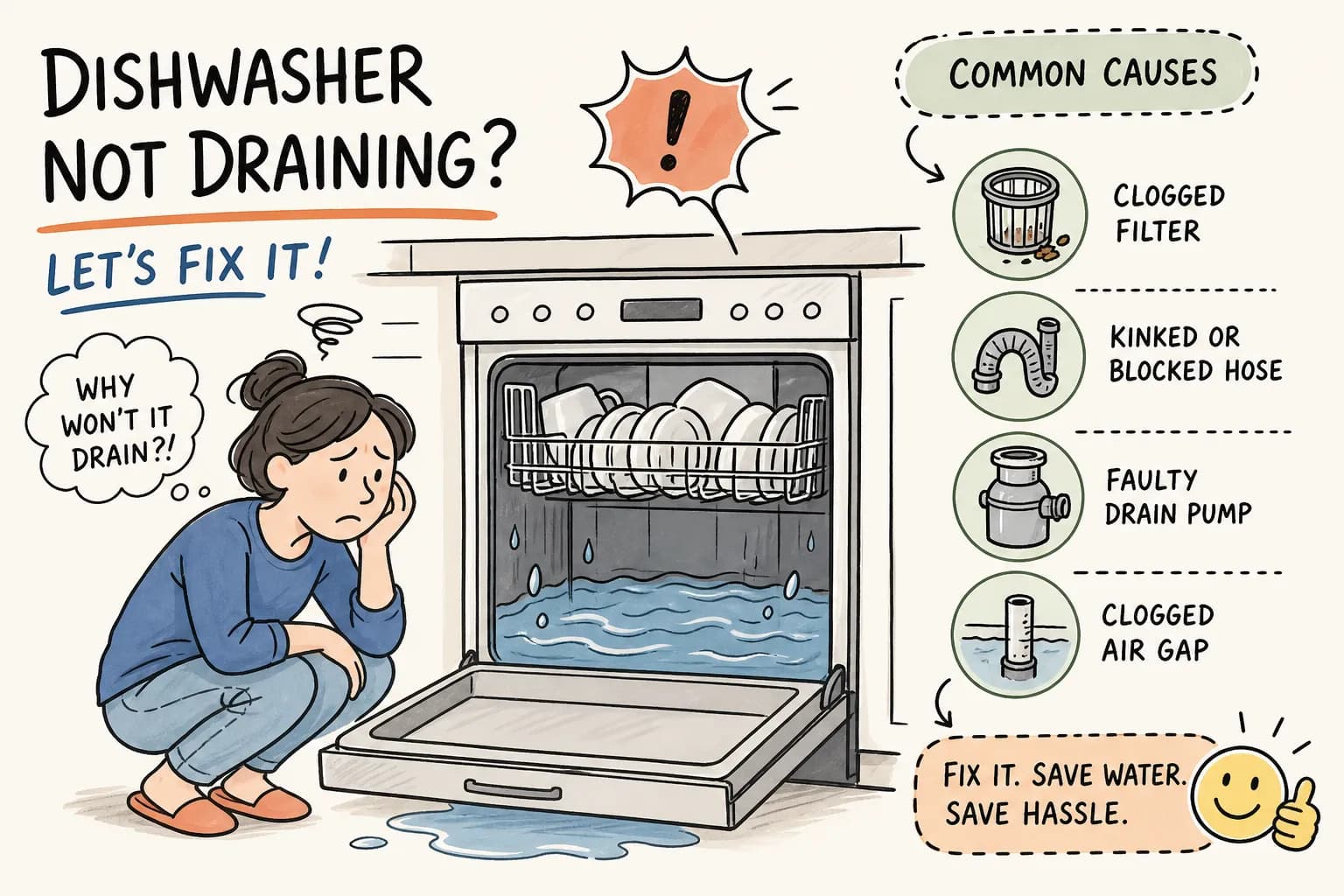
Find out why your dishwasher won't drain, from clogged filters to pump faults, and learn which fixes you can try and when to call an engineer.
A dishwasher not emptying water is most commonly caused by a blocked filter, a kinked or obstructed drain hose, a jammed drain pump, or a problem at the waste connection under the sink, though air-gap blockages, check-valve faults, and electrical or control failures can also occur. These are diagnosable, fixable faults, not reasons to write off a perfectly good machine. Alpha Appliances serves dishwashers across London and the Home Counties, and many common drainage fixes are well within a homeowner's reach.
Work through this guide in order. Each section starts with the simplest check and escalates from there. By the end, you'll have a clear picture of the fault, a realistic cost estimate, and a straightforward decision on whether to fix it yourself or call a certified engineer.
Drainage faults fall into two broad categories: blockages and component failures. Blockages cover the filter, sump, drain hose, and waste connection under the sink. Component failures cover the drain pump, check valve, and in more serious cases the control board. Knowing which category you're dealing with before you pick up a spanner saves time and prevents unnecessary part replacements.
The seven most common causes are:
The first three account for the majority of cases. Work through them in that order and you'll resolve most drainage problems without specialist tools.
The sounds your dishwasher makes during a drain cycle are useful diagnostic clues. A low hum or buzz with no water movement strongly suggests a jammed pump impeller, often caused by debris caught in the mechanism. Complete silence during what should be the drain phase points toward an electrical or control fault, either at the pump winding, the door latch circuit, or the control board. Partial drainage, where the machine empties most but not all of the water, usually indicates a restriction in the hose or at the waste connection rather than a full component failure.
Most dishwashers retain a small amount of clean water in the sump area between cycles, which is by design. The water only becomes a problem when it smells, sits visibly above the filter, contains food debris, or leaves dishes consistently wet at the end of a cycle. If you're seeing any of those signs, the sections below will help you trace the fault quickly.
A dirty filter is the single most common cause of a dishwasher failing to drain properly. Most manufacturers recommend cleaning the filter about once a month for an average household, and more frequently, every one to two weeks, if you run the machine daily or wash heavily soiled pots. Despite that guidance, many households go months without touching the filter, and the restriction gets worse with every cycle.
Switch the dishwasher off at the circuit breaker or unplug it at the wall. Do not rely on the control panel being off as a guarantee of safety. Let any hot water and components cool, put on waterproof gloves (cut-resistant if there's any chance of broken glass inside), remove the lower rack, and bail out standing water with a cup or sponge before reaching into the tub.
The sump is the recessed area directly beneath where the filter sits. Shine a torch into it and look for food debris, labels, toothpicks, small bones, or broken glass. Remove visible debris carefully using tweezers or needle-nose pliers, and use a damp sponge or cloth to clear any sludge at the base. Keep fingers away from the pump opening at all times, even with the power disconnected. Once the sump is clear, reassemble and run a short rinse cycle to test whether drainage has been restored.
If a clean filter hasn't resolved the fault, the drain hose and waste connection are the next logical checks. Both are accessible without specialist tools, and either can completely stop drainage even when the filter is spotless and the pump is working perfectly.
Trace the drain hose from the back of the dishwasher into the under-sink cabinet. The hose must rise to the underside of the worktop before descending to the waste connection; this is known as the high-loop principle. Without this routing, dirty water from the sink can flow back into the dishwasher tub. Straighten any kinks, sharp bends, or sections where the hose has been crushed by items stored in the cabinet. This single check resolves a notable number of drainage complaints.
If a new sink waste has just been fitted, check that the blanking cap was removed from the dishwasher spigot. A retained knockout plug completely blocks dishwasher drainage and is a more common cause of the problem than most people realise. To disconnect the hose safely, turn off power to the disposal at the breaker, place a towel and shallow pan under the connection, and loosen the clamp before gently pulling the hose free. Flush the disconnected hose with warm water into a bucket, clear any buildup from the inlet spigot, and reconnect securely before restoring power and running a test cycle.
Also check that the sink itself is draining freely. A slow-draining sink trap creates back pressure at the dishwasher outlet and can prevent the machine from emptying fully, even when the dishwasher and its hose are in perfect condition. If the sink drains slowly, clear the trap before testing the dishwasher again.
If cleaning the filter and clearing the hose haven't resolved the fault, the drain pump is the next component to investigate. It's worth understanding the distinction between a mechanical jam, which is often DIY-fixable, and an electrical failure, which almost always requires a replacement pump or professional assistance. Knowing the difference avoids unnecessary part purchases and wasted time.
Run a drain cycle and listen carefully. A low hum or buzz with no water moving is a strong indication of a jammed impeller, often caused by a shard of glass, a seed, or a piece of debris wedged in the mechanism. Complete silence is a different problem entirely, pointing toward a failed pump winding, a wiring fault, or a control board issue. With the power safely disconnected and using the guidance in your appliance's service manual, checking that the impeller spins freely is a useful first step. It should move with slight resistance; if it is completely solid or has visibly damaged blades, that's the source of the fault.
With the machine unplugged and the pump connector disconnected, set a multimeter to resistance (ohms) and measure across the two pump terminals. A reading of OL (infinite resistance) indicates an open winding; a near-zero reading indicates a short circuit. Both mean the pump needs replacing.
Published resistance values vary significantly by model and brand. Common small dishwasher pump designs typically read between 10 and 40 ohms, while some replacement pump designs read up to around 160 to 260 ohms. Always verify against the service manual for your specific pump part number before drawing conclusions. Also measure from each terminal to the pump body: there should be no continuity there, as any measurable reading to the casing indicates an insulation fault. Do not perform live-voltage tests unless you are trained and equipped to work safely around mains electricity.
Setting realistic cost expectations makes the repair-or-replace decision much easier. Integrated dishwashers, premium brands and call-outs in London and the South East tend to cost more because of access and part availability. At Alpha Appliances, a fixed booking fee of £95 inc VAT covers attendance, diagnosis and most repair labour; any parts or additional work are quoted before we proceed.
Where the correct replacement part is in stock, most repairs complete during the first visit. If a part needs to be ordered, allow approximately three to seven additional days before the repair can be finished.
The most reliable rule of thumb is the 50% test: if the repair would cost more than half the price of a comparable new machine, replacement deserves serious consideration. Age matters too. For a machine under eight years old with a single identifiable fault, repair almost always makes financial sense.
Around the nine to ten year mark, major faults such as a failed pump or control board tip the balance toward replacement. Beyond ten years, expensive repairs are generally difficult to justify because other components are likely to develop faults of their own in quick succession. A typical dishwasher lasts nine to twelve years in the UK, so a straightforward drainage repair on a five or six year old machine is almost always the right financial decision.
Knowing when to stop is as valuable as knowing where to start. Some faults carry genuine safety risks, and pressing on past the point of your tools or expertise can turn a manageable repair into a considerably more expensive one. If any of the following apply, step back and contact a professional.
A first visit from a certified engineer covers a full diagnostic of the fault and transparent pricing before any work begins. Genuine replacement parts are fitted where needed. At Alpha Appliances, our City & Guilds certified team offers next-day availability across London, Berkshire, Surrey, Hampshire, and Dorset. Every job is priced with complete transparency, with no hidden fees on the final invoice.
Most cases of a dishwasher not emptying water are caused by blockages that are well within a homeowner's ability to fix safely. Start with the filter and sump, move to the drain hose and waste connection, and only then consider the pump. For the majority of households, that sequence resolves the fault without any parts cost at all.
Acting quickly matters. Standing water accelerates grease and bacterial build-up inside the machine, and a partially jammed pump left running repeatedly can develop into a full component failure that costs significantly more to put right. The sooner the fault is identified and addressed, the better the outcome for your appliance and your budget.
For anyone in London or the South of England who has reached the limit of DIY and still has a dishwasher not emptying water, Alpha Appliances is the practical next step. Get in touch with our team online or by phone to book your appointment and get your dishwasher draining properly again.
You should clean the filter about once a month for an average household, and every one to two weeks if you run the machine daily or wash heavily soiled pots. Many households leave the filter for months, and the blockage gets worse with every cycle.
Yes, most dishwashers retain a small amount of clean water below the filter between cycles by design. The water becomes a problem only when it smells, sits visibly above the filter, contains food debris, or leaves dishes consistently wet at the end of a cycle.
No, you should not keep running the machine when the pump hums and no water moves, because a partially jammed pump left running can develop into a full component failure that costs significantly more to repair. With the power safely disconnected, check for accessible debris and follow safe procedures; if the pump is humming but inaccessible without removing panels, call a certified engineer.
Book a visit from a certified Alpha engineer in minutes.
TRUSTED BY HOMEOWNERS
Fast, reliable, and warranty-backed repairs for every major brand.
Discover more tips from Alpha engineers.