
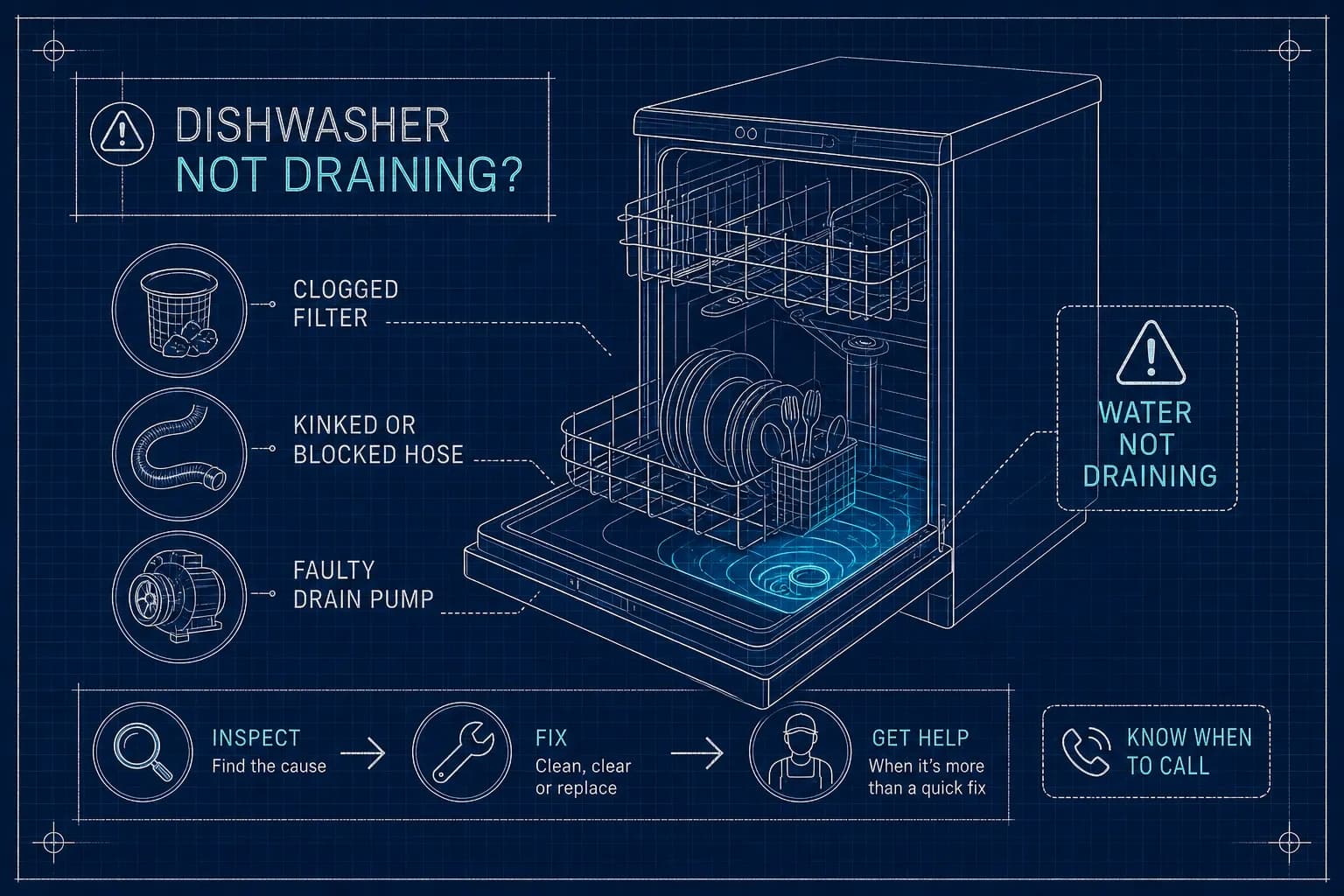
Dishwasher not draining: causes, fixes and when to call
If your dishwasher wont drain, you'll often find a pool of murky water sitting at the bottom when you open the door expecting clean, dry dishes. It's frustrating, especially when you're not sure whether it's a quick fix or the start of a costly problem. The good news is that a dishwasher not draining is one of the most common faults we attend at Alpha Appliances, and the vast majority of cases resolve without a new machine or even a professional call-out. A blocked filter, a kinked hose, or a clogged waste connection accounts for most no-drain faults we see across London and the Home Counties. This guide walks you through how to safely clear the standing water, check each likely cause in the right order, identify whether the drain pump is failing, and know exactly when to bring in a certified engineer.
Why your dishwasher wont drain after a cycle
There are four main culprits behind a dishwasher that won't empty: a clogged filter, a blocked or kinked drain hose, a problem at the waste connection (including the waste disposer), and a failed drain pump. These aren't equally likely. The filter and drain hose together account for approximately seven in ten no-drain faults that repair engineers attend, which is why this guide works through those checks first before considering anything more serious.
The usual suspects ranked by likelihood
The filter and sump area is the most common cause. Food debris, grease, and limescale build up in the filter mesh over time, restricting water flow until the dishwasher simply can't push water out. In hard-water areas of the UK, this happens faster than most homeowners expect.
A blocked or kinked drain hose sits close behind in frequency. The hose can develop a sharp bend if the appliance has been pushed back against the wall, or a partial blockage can form at the point where the hose connects to the sink trap. An incorrectly routed hose that drops too low before connecting to the waste is another common culprit.
Waste disposer connection problems are especially common on newer or recently re-plumbed kitchens. If the dishwasher connects to a waste disposal unit, a small plastic knockout plug inside the disposal inlet must be removed during installation. If it wasn't, the machine physically cannot drain. Some installations also include an air gap, a fitting mounted on the worktop or sink that prevents backflow into the dishwasher. If the air gap becomes blocked with debris, it restricts drainage just as effectively as a kinked hose. Finally, drain pump failure is less common than a blockage, but it does happen and it requires a different approach entirely.
What it probably isn't
An electrical control board fault or a failed inlet valve rarely causes a drainage problem on its own. If you've found standing water after a completed cycle, it's almost certainly a physical blockage rather than an electronic fault. Rule out the simple causes first before assuming anything more serious.
Removing standing water safely before you inspect anything
Before you check filters or hoses, the water has to come out. Inspecting a flooded sump is difficult and messy, and you risk spreading contaminated water further if you start pulling components while the tub is full. Always disconnect power first, either by unplugging the machine or switching off the circuit breaker. This isn't optional.
What you'll need
Gather a large bowl or cup for scooping, old towels or rags to protect the floor, a sponge for the shallow water left at the end, and a bucket to collect what you've removed. A wet/dry vacuum, if you have one rated for liquids, makes the job significantly faster. Rubber or disposable gloves are worth wearing for hygiene.
Clearing the water step by step
- Disconnect the power at the wall socket or trip the circuit breaker.
- Lay towels around the base of the dishwasher to protect the floor.
- Remove the bottom rack and set it aside.
- Scoop out the bulkof the water using a cup or bowl, emptying into a bucket.
- Use a sponge to absorb the remaining shallow water and dry the tub base so you can see clearly.
With the tub dry, you can now inspect the filter and the components beneath it without working blind. Take a torch with you; the sump area can be difficult to see clearly without one.
How to fix a dishwasher wont drain problem: start with the filter
This is the first and most important check. A dirty filter restricts water flow through the sump and is the single most common reason a dishwasher doesn't drain. Most modern dishwashers, Bosch, Beko, Hotpoint, Indesit and the rest, have a two-part filter system: a cylindrical upper filter and a flat lower mesh plate, both located at the base of the tub beneath the lower spray arm.
Locating, removing and inspecting the filter
Remove the bottom rack to give yourself clear access. On most models, the upper cylindrical filter twists anti-clockwise to unlock; look for the arrows that indicate the locked and unlocked positions. Lift it clear, then lift out the flat lower mesh filter underneath it. Check both filters carefully for food debris, grease buildup, and calcium deposits. Also look into the filter housing itself, because food debris often collects in the sump around the filter rather than on the filter surface.
Cleaning the filter correctly
Rinse both parts under warm running water and use a soft brush with a small amount of washing-up liquid to work through any stubborn residue. Never use abrasive pads or wire brushes, as these damage the mesh and reduce filtration effectiveness. If there's heavy limescale build-up, soaking in warm soapy water for a few minutes before scrubbing helps.
Reassemble in reverse order, ensuring the upper cylindrical filter locks firmly back into position before you run a test cycle. If it's loose, water will recirculate without draining properly. Clean the filter every four to six weeks as standard practice; in hard-water areas of the UK, fortnightly cleaning is a better habit. This single step prevents the majority of repeat drainage faults.
Inspecting the drain hose and waste connection
If cleaning the filter doesn't resolve the problem, the next check is the drain hose and the point where it connects to your household waste. A kinked hose, a partial internal blockage, or an incorrectly installed waste connection all produce exactly the same symptom: standing water after the cycle completes.
Checking the drain hose for kinks and blockages
Pull the dishwasher forward slightly and open the cabinet under the sink to trace the hose from the machine to its drain connection. Look for sharp bends or kinks, particularly where the hose passes through a cabinet base or behind the appliance. A correctly installed drain hose should form a high loop rising to approximately 600 mm from the floor before dropping to the waste connection. This prevents backflow and siphoning. If the hose has sagged or been pushed into a low position, it won't drain efficiently regardless of how clean the filter is.
With the power off, you can disconnect the hose and flush it through to check for an internal blockage. Reconnect and clamp it securely before running a test cycle.
The waste disposer connection: a commonly missed cause
If the dishwasher connects to a waste disposal unit under your sink, check whether the knockout plug inside the disposal inlet was removed during installation. This small plastic disc is factory-fitted and must be punched out before the dishwasher hose is connected. If it's still in place, the dishwasher has nowhere to drain regardless of what else you do. This is the leading cause of drainage failure on brand-new dishwasher installations and one that's surprisingly easy to miss.
Even with the knockout plug correctly removed, a partial blockage at the sink trap or disposal unit further downstream causes the same symptom. The drain hose looks clear, but water backs up because it has nowhere to go. Running hot water through the sink while checking for slow drainage helps identify this quickly.
Signs the drain pump may have failed
The drain pump is what actively pushes water out of the machine during the drain phase of the cycle. When it fails, no amount of filter cleaning or hose straightening will resolve the problem. Pump failure is less common than a blockage, but knowing how to recognise it saves time and helps you communicate clearly when you do call for a repair.
Recognising pump failure by sound and behaviour
Listen carefully during the drain phase of a test cycle. If the dishwasher completes the cycle but water remains and you hear no motor activity during draining, the pump has likely stopped working entirely. A pump that hums but doesn't move water suggests a jammed impeller or a seized motor. A pump that runs and removes most of the water but consistently leaves a residual pool may have a worn impeller that can no longer generate enough pressure to fully clear the sump.
What a basic pump test involves
With the appliance isolated from power and the pump terminals accessible, a multimeter continuity check can indicate whether the pump motor has failed. A functional pump typically reads somewhere in the range of 15 to 260 ohms, depending on the brand and model. A reading of zero or open-circuit suggests the motor winding has failed. That said, a good continuity reading doesn't confirm the control board is actually supplying voltage to the pump during the drain cycle. If the filter and hose checks are clear and the pump shows the symptoms above, continuing to investigate yourself risks doing more harm than good. A certified engineer can confirm the fault definitively on the first visit.
When to stop and call a certified engineer
If you've worked through every step above, cleaned the filter, checked the hose for kinks and blockages, confirmed the waste connection is clear, and your dishwasher wont drain still, the fault is internal. Continuing to run a machine with a failing pump can damage the motor further and push the repair cost higher. The right move is a professional diagnostic rather than another round of guesswork.
What a certified engineer can diagnose and fix
A trained technician can confirm pump motor failure, inspect and replace the impeller, test the float switch, identify control board faults, and check for internal wiring problems. These aren't tasks that benefit from trial-and-error at home. UK drain pump replacements typically cost in the region of £120 to £180 all-in for parts and labour, which is well within the range where repair makes clear financial sense compared to replacing the machine.
How Alpha Appliances resolves it, fast
Our City & Guilds certified engineers carry common dishwasher parts on the van and achieve a 78% first-time fix rate across all appliance brands. We offer next-day availability across Greater London, Berkshire, Surrey, Hampshire, and Dorset, with fixed-price repairs and no hidden call-out fees. You'll have upfront pricing confirmed before the engineer arrives, so there are no surprises on the day.
A quick recap: what to do when your dishwasher wont drain
Work through the checks in order: clear the standing water safely, clean the filter thoroughly, inspect the hose for kinks, and confirm the waste connection is clear. Most dishwasher drainage problems resolve at one of these three steps without any professional help needed. If none of those checks solve it, the fault is internal and a certified repair is the right next step. Book an engineer in London or across the South of England today, we'll confirm fixed-price upfront and aim to have your dishwasher sorted on the first visit.
Need a repair today?
Book a visit from a certified Alpha engineer in minutes.