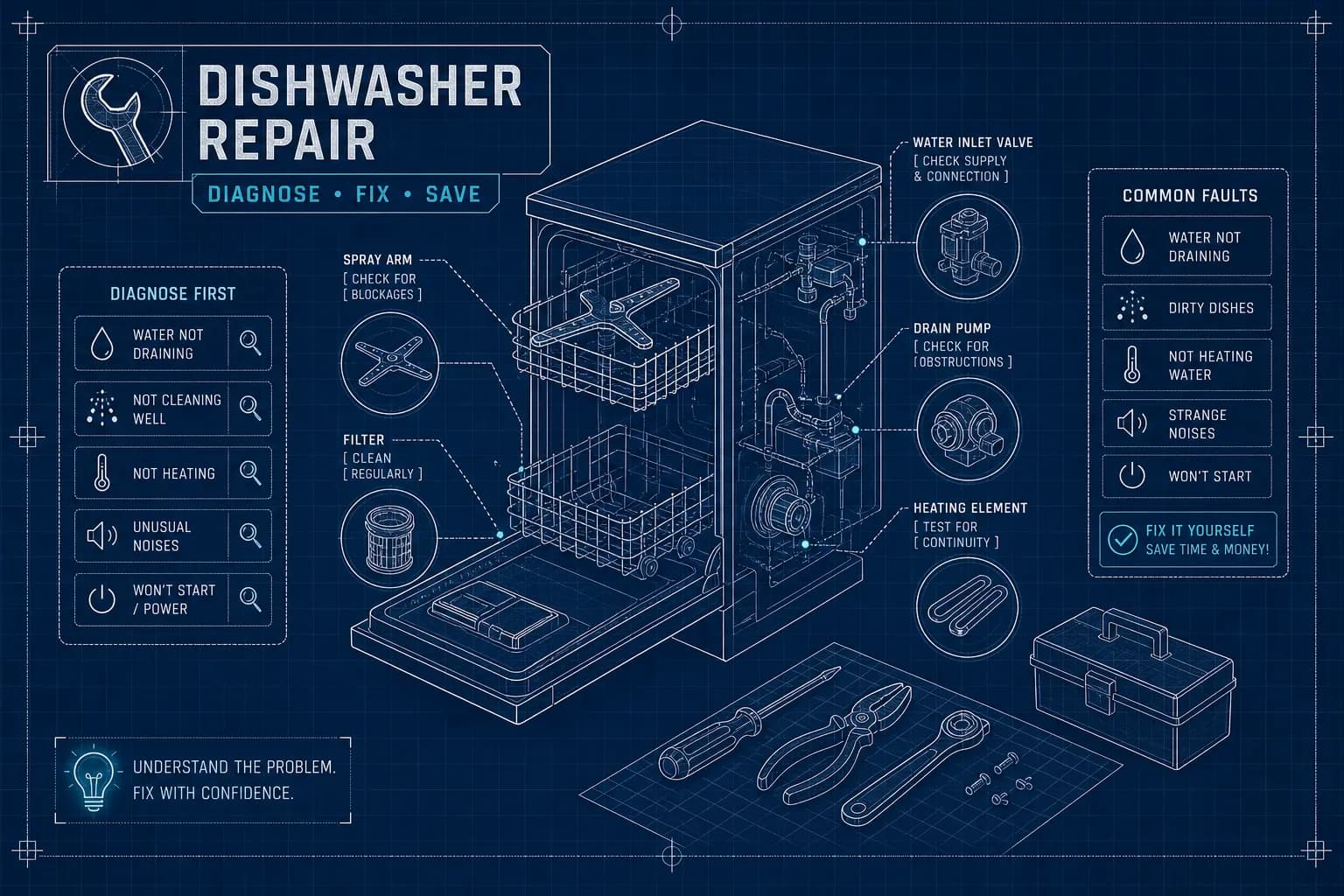
Quick dishwasher repair tips to diagnose clogs, pump, spray arm and drain issues. Learn simple fixes, safety checks, and when to call a technician.
You run a full cycle, the machine beeps, and you open the door expecting clean dishes. Instead, you find grimy plates, a puddle of standing water at the bottom, or worse, the machine refused to start at all. Most homeowners assume the worst at that point, reaching straight for a replacement quote or dialling a manufacturer helpline. The reality is rather different: the vast majority of dishwasher faults trace back to a handful of fixable problems, and many of them don't require a technician at all. These dishwasher repair tips will help you work out whether the problem is a simple clog or something that needs a professional eye.
At Alpha Appliances Ltd, our engineers handle these exact faults week in, week out across Greater London and the Home Counties. Many call-outs are resolved by simple home checks that take no more than twenty minutes and a toothbrush. This guide walks through the most common dishwasher faults, what causes them, which fixes you can handle safely yourself, and when the smartest move is to bring in a manufacturer-trained technician with the right parts.
Almost every dishwasher fault falls into one of these categories: poor drainage, inadequate cleaning performance, or a failure to start or complete a cycle. These aren't random failures. They almost always trace back to blockages, worn components, or sensor issues that develop gradually, not overnight. Understanding which category your fault belongs to will save you money on unnecessary parts and help you communicate clearly with an engineer if it comes to that.
Drainage problems show up as standing water after a cycle and are most commonly caused by a blocked filter, a kinked or clogged drain hose, debris in the pump area, or a garbage disposal connection that hasn't been cleared. A failed drain pump is less common, but it does happen on older machines and produces a noticeably different symptom: silence when the drain cycle should be running.
Poor cleaning results, including spotty dishes, a white film, or food left on plates, usually point to hard water scale on the spray arm nozzles, a filter so clogged it's starving the wash cycle of water pressure, or incorrect detergent use and overloading. In UK hard water areas, limescale accelerates all three of these issues considerably. A failure to start, or a machine that stops mid-cycle, is most often caused by a door latch or interlock fault, a tripped float switch, or a control board issue. When a mid-cycle stoppage occurs, the display will usually show an error code, which the later section of this guide covers in detail.
Before spending money on a technician, there are three user-accessible areas every homeowner can inspect safely with no specialist tools required. These checks resolve a significant proportion of the faults described above, and they take less than half an hour to complete.
Before spending money on a technician, there are three user-accessible areas every homeowner can inspect safely with no specialist tools required. These checks resolve a significant proportion of the faults described above, and they take less than half an hour to complete.
The filter sits at the base of the machine, typically beneath the lower spray arm. Twist it anticlockwise to release it, then lift it out. A blocked filter usually looks unmistakeable: grey sludge, food particles, and seed casings packed into the mesh. While the filter is out, take a moment to peer into the pump area beneath the filter housing and remove any visible debris. A blocked filter is one of the leading causes of both drainage failure and poor wash performance, and cleaning it costs nothing.
Remove the upper and lower spray arms by unscrewing or unclipping them, depending on your brand. Run a finger across each nozzle to find the ones that are plugged with scale or food debris. Blocked nozzles reduce water pressure to the wash zone dramatically, and this is frequently mistaken for a pump fault. A cocktail stick or thin wire clears most blockages in a few minutes.
Pull the machine forward slightly and trace the drain hose along its entire length, looking for kinks or sharp bends that restrict water flow. If your dishwasher drains through a garbage disposal, confirm the disposal has been run recently and that its knockout plug was removed during installation. Where an air gap is fitted on the countertop, remove the cover and check it's clear of debris. These are quick visual checks that take two minutes and regularly reveal the entire source of a drainage fault. For a short troubleshooting primer on common drainage causes see why your dishwasher isn't draining.
Once you've identified what needs attention, the cleaning process itself is straightforward. These steps double as routine dishwasher maintenance tips that should be applied regularly, not just when something goes wrong. How often you need to clean depends on usage: households running four to seven loads a week without pre-rinsing dishes should clean the filter at least once a month.
Rinse the filter under warm running water and use a soft brush (a toothbrush works perfectly) to work through the mesh and dislodge trapped debris. For heavy grease or slime, soak the filter in warm water with a liquid enzyme cleaner for several hours rather than forcing it under hot water, which deactivates the enzymes and reduces their cleaning effect. Once the filter is clean, vacuum or wipe out any loose debris from the sump basin before reinstalling. Never reinstall a filter that still has debris visible in the mesh, as it is likely to block again very quickly. If you want step-by-step guidance from a manufacturer's perspective on removing and replacing filters, this Whirlpool guide on removing and replacing dishwasher filters is useful.
Use a cocktail stick or thin wire to clear each nozzle individually. For mineral build-up from hard water, soak the arms in a citric acid solution (citric acid powder dissolved in hot water) for three to six hours. Citric acid outperforms white vinegar on heavy scale and is more effective in UK hard water conditions. Rinse thoroughly after soaking and spin each arm by hand before reattaching to confirm it rotates freely without obstruction. For model-specific advice on cleaning the spray arms consult the manufacturer's support pages.
If basic cleaning hasn't resolved the fault, the display code is your next diagnostic tool. Error codes vary by brand and model, so check your manual for the definitive list, but useful patterns hold across major brands.
Bosch codes are among the most informative. E22 means the filter is blocked: remove and clean it. E24 means the machine isn't draining: check the hose and filter before anything else. E25 points to a blocked drain pump or jammed impeller. Remove the pump cover and inspect the impeller, using needle-nose pliers to clear any foreign objects, glass fragments, bone, and bottle labels are common culprits. E15 means water has been detected in the base pan: tilt the machine forward with the door closed to drain it, then identify the leak source, typically the door gasket, an inlet hose, or the pump area. E09 indicates a heating element fault, and this one requires professional attention rather than a dishwasher DIY repair.
Hotpoint uses F-series codes: F04 and F03 both indicate drainage failures, while F05 and F10 point to heating element or thermostat faults. Beko, Whirlpool, and other brands use their own systems, but the first response is always the same regardless of brand. Perform a full power reset by switching the machine off at the wall or circuit breaker, recommended reset times vary by manufacturer, so check your manual, though one to two minutes covers most models, then restart. If the code returns, consult the model-specific manual or the manufacturer's support page. Codes relating to water fill, drainage, and heating consistently map to the same root causes whether you're dealing with a Bosch, a Hotpoint, or anything else on the market.
Two repairs sit well within reach of a non-technical homeowner: replacing a door seal and performing a full power reset to clear transient faults. Beyond these, the risk of causing further damage or invalidating a warranty increases sharply.
A worn or cracked door gasket is a common source of leaks and the repair requires no specialist tools. Start by disconnecting power at the wall or circuit breaker and removing both racks to give yourself clear access. Pull the old seal from the channel (needle-nose pliers help on some models) and clean the channel thoroughly with warm soapy water before the new seal goes in. Orient the replacement correctly: the flat side faces outward, the angled side faces inward toward the tub. Press it into the channel starting from the bottom left corner and work around the full perimeter. Always buy the correct seal for your specific model number; model-specific seals are far more reliable than universal alternatives, which may not fit perfectly at the corners.
Drain pump replacement, heating element faults, and control board failures are not DIY territory. These components sit close to live electrical connections and pressurised water systems, and attempting them without training risks making the fault significantly worse. It also invalidates any remaining warranty on the appliance. If your checks and cleaning haven't resolved the fault, the next call is to a certified engineer.
Understanding what a repair is likely to cost before you book anyone helps you make a genuinely informed decision rather than an emotional one.
Door seal repairs typically come in at £120 to £280 including labour. Drain pump replacement sits between £180 and £380 depending on the brand and whether the pump and motor assembly need replacing together. Control board faults are the most expensive common repair, ranging from £220 to £450. Most engineers charge a diagnostic call-out fee of £40 to £80, which is standard practice and is usually applied toward the total repair cost if you proceed. For cost context, if a repair quote exceeds roughly £300 on a machine over eight years old, replacement is worth serious consideration: a new mid-range dishwasher in the UK costs between £400 and £800 installed, and it will be considerably more energy-efficient. For a UK-focused cost guide to dishwasher repairs see this dishwasher repair cost guide.
For any fault that goes beyond the checks and fixes covered in this dishwasher repair guide, Alpha Appliances Ltd is the professional option across Greater London, Berkshire, Surrey, Hampshire, and Dorset. Our manufacturer-trained technicians aim for a high first-time fix rate and arrive carrying many common genuine parts for all major brands including Bosch, Miele, AEG, and Samsung. Every repair is quoted at a fixed price with no hidden fees, and strong availability means you're typically booked quickly rather than waiting weeks for a slot. If you need local support in North London our team are listed among Brondesbury's Go-To Appliance Repair Technicians.
Our engineers hold recognised industry certifications and are Safe Contractor approved, which matters particularly for landlords who need documented service reports for compliance purposes. Booking is straightforward: use our online system in four steps or give us a call. Either way, you'll have a confirmed appointment and a clear quote before anyone sets foot in your home. We also support targeted appliance services such as Colindale Appliance Faults? We're Here to Fix! and manufacturer-specific repairs like Fixing White Knight Washer Dryers Fast in Aldwych.
Most dishwasher faults are predictable, and most start with the filter and drain hose. These dishwasher repair tips can be summarised simply: clean the filter on a regular schedule, descale the spray arms when performance drops, and check for hose kinks before assuming the pump has failed. Read the error code on the display before you start ordering parts. If the door seal shows cracking or compression marks, replace it, it's a straightforward job that prevents water damage to your floor and cabinets.
For anything beyond that, a certified engineer with the right training and genuine parts will always be the faster and safer route. If these dishwasher repair tips haven't solved the fault, book a diagnostic visit with Alpha Appliances Ltd online today. We cover Greater London and surrounding counties, and we'll have an engineer with you as soon as the next working day.
Book a visit from a certified Alpha engineer in minutes.
TRUSTED BY HOMEOWNERS
Fast, reliable, and warranty-backed repairs for every major brand.
Discover more tips from Alpha engineers.