
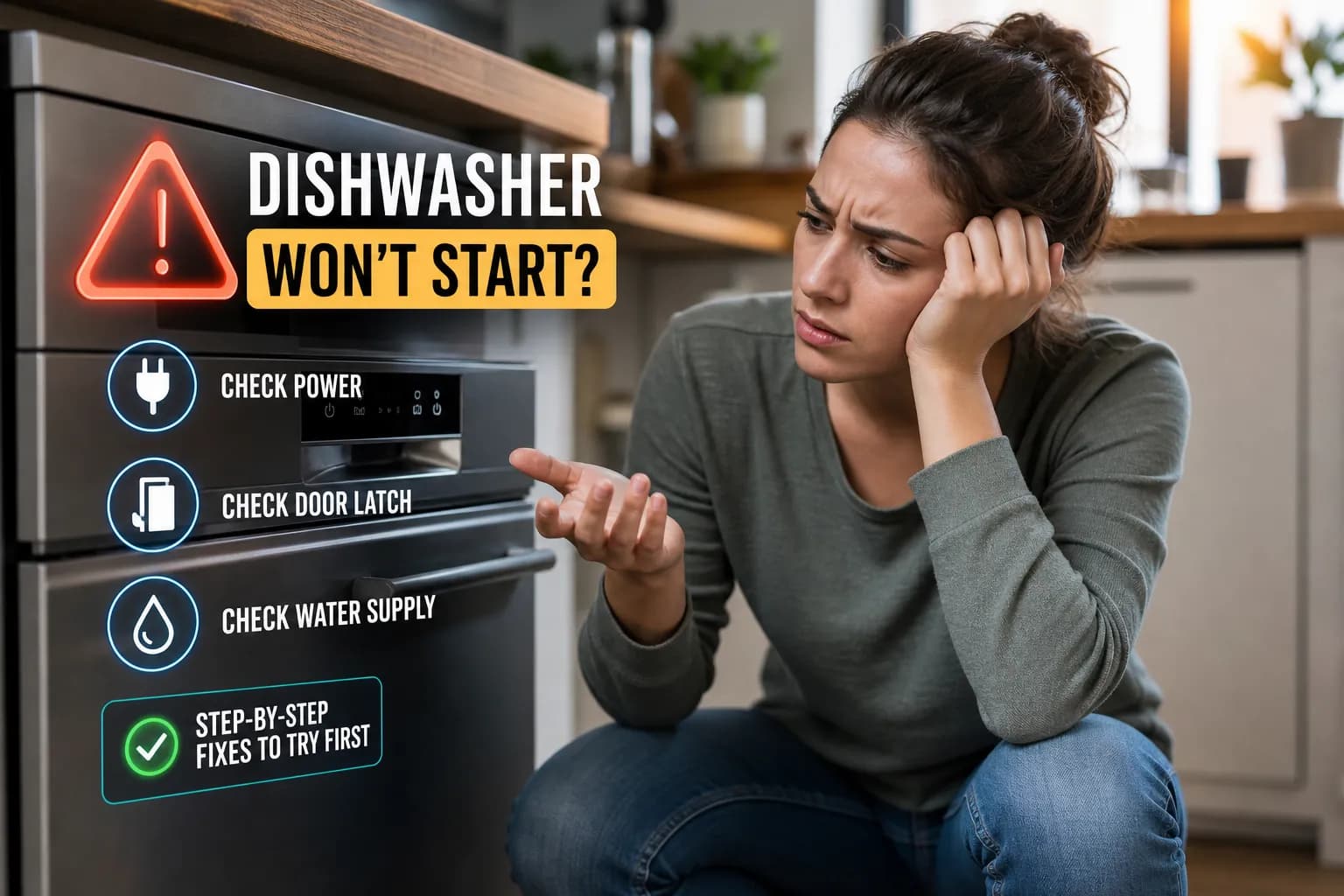
Dishwasher won't start: step-by-step fixes to try first
If you're asking "how do I fix a dishwasher that won't start?", you're not alone. You press Start and nothing happens, the panel lights up, the display is on, and the machine has power, but it sits there completely silent. This is a frequent call-out request our engineers at Alpha Appliances Ltd receive, and in many cases the fix is straightforward, takes only minutes, and costs nothing at all.
Before you start worrying about control boards or booking anyone out, work through this guide in order. Each section moves from the simplest checks, no tools, no technical knowledge required, to the more involved diagnostics. By the end, you'll know exactly what's causing the problem, whether you can fix it yourself, and what to tell an engineer if you can't.
How do I fix a dishwasher that won't start: quick checks first
Three issues account for most "my dishwasher won't start" calls: the door isn't fully latched, the control lock is active, or a Delay Start timer is counting down. Check all three before touching anything else. These are the most common non-technical causes of a dishwasher not turning on, and each one takes seconds to rule out.
Is the door actually fully latched?
Modern dishwashers use a door latch microswitch: the machine won't run unless the latch physically clicks into place and triggers the switch inside the door frame. If that switch isn't activated, the control board reads the door as open and refuses to start the cycle. Push the door firmly at the top edge until you hear or feel a definite click, not just a gentle nudge, but a proper push. Common culprits include a dish rack pulled too far forward, an oversized pan handle sticking into the door gap, or crockery stacked too high near the front. Check the tub first, then try closing the door again.
Control lock and Delay Start: the two settings that fool everyone
The control lock, sometimes called the child lock, disables the buttons to prevent accidental changes mid-cycle. When it's active, pressing Start does nothing at all, and it's easy to mistake this for a fault. Look for a padlock icon on the display or an illuminated lock indicator. To cancel it, hold the lock button (or the button combination your model specifies) for 3 to 5 seconds until the indicator goes out. Then try Start again. Note that the exact sequence is model-specific, so if holding the lock button alone doesn't work, check the inner door label or your manual for the correct combination.
Delay Start is the other common culprit. If a timed cycle is set, the machine will sit idle and appear completely unresponsive while it waits, a dishwasher that has power but won't run is often simply counting down a delay. Check whether a timer or delay indicator is showing on the display, cancel the delay, and press Start fresh. Together, these two settings account for a surprisingly large share of the calls our engineers receive, and resolving either one takes seconds.
Power supply: check the basics before assuming the worst
Check that the wall socket is switched on and hasn't been knocked off. Then go to your consumer unit and look for a tripped circuit breaker; it'll be in a different position to the rest. Finally, if your dishwasher sits beneath a worktop near a sink, check whether a residual current device (RCD) outlet has tripped. RCD outlets typically have small reset buttons built into the socket face, press to reset, restore power, and try the dishwasher again. This costs nothing and frequently solves the problem immediately.
How to reset a dishwasher that won't start
If the quick checks haven't solved it, the machine may have locked up after a cycle interruption, a door opened mid-run, or a temporary firmware glitch. A reset clears the fault and returns the machine to standby. Dishwasher not starting troubleshooting often comes down to one of the two reset methods below.
The soft reset: clearing a fault mid-cycle
For Bosch dishwashers, the soft reset works like this:
- Open the door.
- Press and hold the Start/Reset button for 3 to 5 seconds.
- Wait for the short drain cycle to complete.
- Press On/Off to return the machine to standby.
- Select a programme and press Start.
Most other brands, Beko, AEG, Electrolux, Hotpoint, use a similar hold-the-Start-button sequence, typically 3 to 5 seconds, though the exact sequence varies between models. Always check the inner door edge label or your model's manual to confirm the correct steps before assuming a universal sequence applies to your machine.
The power-cycle reset: fixing a frozen control board
If the soft reset doesn't work, unplug the machine at the wall or switch off the circuit breaker and leave it off for 1 to 5 minutes. This discharges any residual current in the control board and clears temporary firmware freezes. Restore power, close the door firmly, select a programme, and press Start. Power-cycling is a broadly useful reset method when the soft reset fails; bear in mind that some manufacturer procedures are model-specific, so check your manual if this doesn't produce the expected result.
When a reset doesn't hold
If the machine starts after a reset but stops again in the same way shortly after, the reset is masking a fault rather than fixing it. A fault that keeps returning points to a mechanical or electrical component problem. Common repeat-fault culprits include a failing door microswitch, a degraded thermal fuse, or a control board that requires professional diagnosis, all of which are covered in the sections below.
Checking the door latch, striker plate and microswitch
If the resets haven't resolved the issue, the door latch assembly itself may be at fault. Before you inspect anything, unplug the machine or switch off the breaker. Don't rely on the socket switch alone.
How the door latch system actually works
When you close the door, the latch hook catches the striker plate at the top of the tub. This depresses a microswitch inside the door frame, completing the circuit that tells the control board it's safe to begin a cycle. If any part of this chain fails, a misaligned striker, a worn latch hook, or a failed microswitch, the board sees an open door and won't run.
Inspecting the striker plate and latch assembly
With the machine unplugged, open the door and examine the striker plate at the top edge of the tub. Look for misalignment, cracks, debris around the catch point, or loose mounting screws. Check the latch hook on the door itself for visible wear. Close the door slowly and listen: a clear, firm click means the latch is engaging; a weak or absent click is a reliable sign the assembly needs attention. If the striker plate has shifted slightly, you can often realign it by loosening and repositioning the mounting screws, a straightforward DIY fix that restores the click and gets the machine running again.
Testing the microswitch with a continuity check
If the latch clicks firmly but the machine still won't start, the microswitch inside the latch assembly may have failed. With power fully off, remove the inner door panel screws to access the switch, then disconnect the switch leads. Set a multimeter to continuity or the lowest ohms range, place the probes across the terminals, and manually actuate the latch. A reading of 0 to 1Ω, or an audible beep, means the switch is healthy. An OL or infinite reading means it has failed and needs replacing. Note that some models specify slightly different acceptable resistance values, so consulting the service manual is worthwhile. Replacing the microswitch can be a straightforward part swap for a confident, safety-aware DIYer, but it does require removing the inner door panel and handling internal wiring with power fully isolated. Always isolate power completely and follow safe reassembly steps before restoring the supply.
Deeper electrical faults: thermal fuse and control board
If the latch and microswitch are both fine, the fault is likely inside the machine's electrical system. Two components are the most common culprits at this stage.
How to check the thermal fuse
The thermal fuse protects the dishwasher from overheating by cutting power if the internal temperature exceeds a safe limit. On most Bosch, Beko, and Hotpoint models, it sits behind the inner door panel, mounted near the control board with two wires attached. To test it, isolate power completely, remove the panel, disconnect the fuse leads, and run a continuity check. A healthy fuse shows continuity; an OL or open-circuit reading means it has blown. Before fitting a replacement, check why it blew. A thermal fuse that's failed once will fail again if the underlying heating fault isn't addressed, whether that's a faulty heating element, a defective thermostat, or a related control fault.
Signs the control board has failed
Control board faults produce a specific pattern of symptoms: buttons are completely unresponsive even after a full power-cycle reset, the display shows nothing at all despite the machine having power, or the dishwasher starts briefly then cuts out repeatedly with no clear pattern. Diagnosing a control board properly requires reading the appliance's error codes (where the model supports them) or tracing specific voltage paths using the service manual. This is where most homeowners should stop and call a certified engineer. Attempting live electrical diagnostics without the right training risks personal injury and can cause further damage to the appliance.
Safety rules: what you can and can't do yourself
What's safe to try at home
Everything covered in this guide up to this point sits within safe DIY territory, provided you follow two non-negotiable steps before touching anything internal: isolate power at the breaker or by unplugging (not just switching off at the socket), and turn off the water supply valve under the sink. Use insulated tools, keep the area dry, and work methodically. Checking settings, performing a reset, inspecting the door latch visually, realigning a striker plate, and testing a microswitch or thermal fuse with a multimeter are all reasonable home repairs when the machine is fully isolated.
When to stop and call a certified engineer
Stop immediately and call a professional if you notice any of the following:
- A burning smell or scorch marks near the control board or wiring
- A circuit breaker that trips repeatedly when the machine is powered on
- Any evidence of water near electrical components inside the machine
- A fault that returns immediately every time after a reset
In the UK, any repair involving a combined water and electrical fault in the same fault path should be handled by a qualified technician. The UK electrical safety charity Electrical Safety First advises unplugging the appliance and contacting a qualified repair service if you observe overheating, fuses blowing, or repeated breaker trips. Attempting these repairs without the right training risks both your safety and further damage to an appliance that may still be repairable.
When the basics don't fix it: what to do next
What information to have ready before you call
Having the right details to hand makes an engineer's visit faster and more likely to resolve the fault on the first call. Before you book, note the dishwasher's make and model number (usually printed on a label on the inner door edge), any error codes currently showing on the display, which of the checks above you've already worked through, and whether the fault is consistent or only happens sometimes. This information lets the engineer bring the right parts and diagnose accurately without unnecessary return visits.
Getting a certified engineer out quickly
If you're in London, Berkshire, Surrey, Hampshire, or Dorset and you've worked through these checks without a result, our team at Alpha Appliances Ltd are ready to help. Our City & Guilds certified engineers carry a broad range of genuine parts and operate on a fixed-price model, so there are no hidden call-out surprises when we arrive. Booking takes a few minutes through our online system, and you'll have a confirmed appointment time before you finish here.
Pulling it all together
Work through the checks in order: confirm the door is latched, check for control lock or Delay Start, verify the power supply, then attempt a soft reset followed by a power-cycle reset. If those don't resolve it, inspect the door latch assembly visually, test the microswitch, and check the thermal fuse if you're confident working with a multimeter and the machine fully isolated. Stop at the first sign of any electrical or water-related warning signs.
Most dishwashers that won't start have a straightforward, fixable cause, and if you've followed this guide on how to fix a dishwasher that won't start and the fault is still there, it's diagnosable rather than terminal. It's rarely the end of the machine. A certified engineer from Alpha Appliances Ltd can work through the electrical diagnostics on a single visit, confirm the exact fault, and fix it with genuine parts, no guesswork, and no surprise fees.
Need a repair today?
Book a visit from a certified Alpha engineer in minutes.