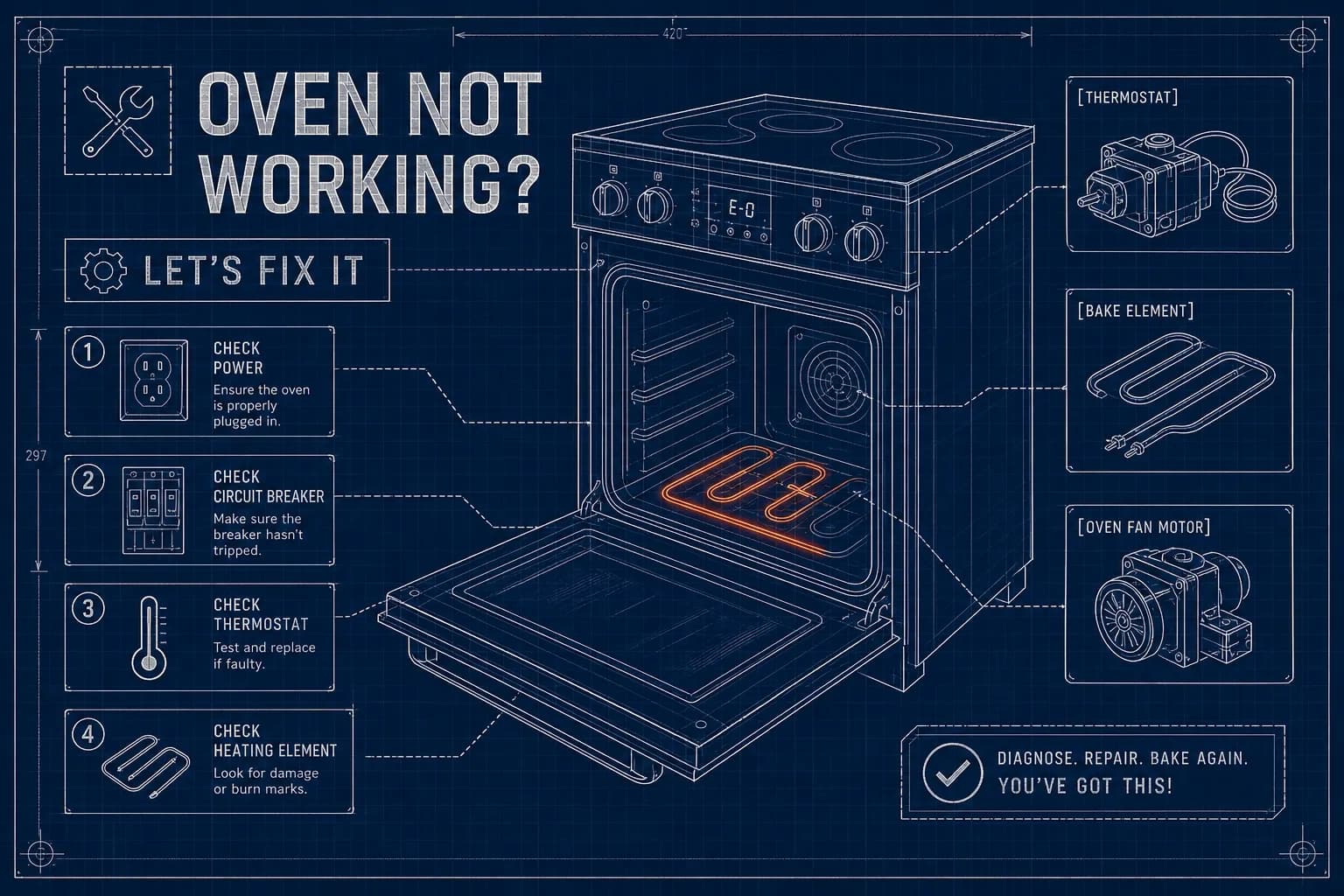
Troubleshoot an electric oven not working with safe home checks, common fault diagnosis, 2026 repair costs, and tips for hiring the right engineer.
You set the oven to 200°C, wait twenty minutes, and pull out food that's stone cold in the middle. Or the display lights up, the timer ticks down, and absolutely nothing heats. It's one of the more frustrating domestic faults because it disrupts dinner, not just a convenience. If you need electric oven repair, this guide gives you a practical path forward: how to identify the fault, which checks are safe to run at home, what a repair realistically costs in 2026, and how to hire the right engineer when the job goes beyond visual territory.
Alpha Appliances engineers report that many homeowners reach for the phone before checking two or three things that could save them a wasted call-out fee. The steps below are designed to help you work through those checks first.
Most electric oven faults trace back to a short list of components. Knowing which part matches which symptom means you arrive at an engineer conversation already informed, rather than simply describing that "it doesn't work."
The bake element sits at the bottom of the oven cavity; the broil element sits at the top. When either burns out, the oven either produces no heat at all or heats unevenly, leaving cold zones that no amount of extra time can fix. The physical evidence is usually clear: cracks, blisters, burnt patches, a broken loop, or a black scorch mark on the oven floor directly beneath the element. A failed element is the most straightforward fault to diagnose and, in most cases, the most affordable to fix.
Older ovens use a mechanical thermostat; most modern electric models use a temperature probe or sensor. When either fails, the oven behaves erratically: it shuts off before reaching the set temperature, runs significantly hotter than the dial indicates, or refuses to maintain a consistent heat through a cooking cycle. Some models display temperature-related error codes when the sensor is at fault. If your food is consistently over- or undercooked despite following timings correctly, a sensor fault is the first thing worth investigating.
In fan-assisted ovens, a failing fan motor produces uneven baking, obvious hot and cold spots, and noticeably longer cooking times. In a conventional oven, the same symptoms are less pronounced, which makes the fault harder to spot. Door seal deterioration is frequently overlooked: a cracked or compressed seal allows heat to escape steadily, degrading cooking performance and increasing energy use without any single "broken" moment that draws attention.
These are checks, not repairs. The distinction matters. Safe territory ends the moment you reach for tools near wiring or internal components. Everything below requires no tools whatsoever, or only a cheap thermometer.
A surprising proportion of "oven not heating" call-outs trace back to a tripped breaker or a loose connection at the wall. Go to your consumer unit and confirm the circuit protecting the oven hasn't tripped. If the oven is plug-in, check the plug is fully seated. If it's hardwired, visually confirm there's no obvious scorch mark or loose connection at the connection point. No tools, no risk, and it rules out the most avoidable fault before anything else. If the oven won't power up at all, manufacturer's troubleshooting advice on why an oven may not turn on can help you decide the next step.
Unplug the oven or switch it off at the consumer unit, then let it cool completely before opening the door. With the power confirmed off, look at both elements for cracks, blisters, burnt patches, a broken loop, or any scorch mark on the oven floor beneath the lower element. Visible physical damage is near-conclusive evidence the element needs replacing. You don't need a multimeter to reach that conclusion; your eyes are sufficient at this stage.
A basic oven thermometer, often available for under £10, can tell you whether the oven heats but fails to reach the set temperature. Place it in the centre of the cavity, set the oven to 180°C, and compare the reading after 20 minutes. If the oven heats but reads substantially below the set temperature (for example, tens of degrees off), the diagnosis shifts away from a failed element toward a thermostat or sensor fault. This single test changes the entire repair conversation. Multimeter testing of the element or sensor is also possible for confident homeowners, but anything beyond visual checks and temperature monitoring should be left to a professional.
There are faults where the safe and sensible move is to stop, pick up the phone, and hand the job to someone qualified. Recognising that boundary isn't a failure; it's how you avoid turning a straightforward repair into a significantly more expensive one.
Control board failures, internal wiring faults, and intermittent error codes cannot be diagnosed visually. The symptoms here are distinct: the oven turns on but nothing happens, the display flickers or freezes, or the oven behaves inconsistently from one cooking cycle to the next. A certified engineer uses diagnostic tools to read fault codes and trace the root cause accurately. Guessing at these faults and ordering parts speculatively costs more time and money than a single professional visit. For a detailed look at common oven control board failure symptoms and repair considerations, specialist write-ups can be illuminating.
UK electric ovens run on mains voltage (nominally 230V). Working on energised components without proper training causes serious injury, and no online tutorial makes that risk acceptable. The moment a repair involves handling wiring, opening the back panel with power connected, or replacing a control board, it's firmly in certified-engineer territory. For repairs like these, look for manufacturer-trained engineers who carry the right diagnostic tools and hold valid professional insurance to complete the work safely.
These are realistic figures based on UK repair pricing, including parts and labour. Prices at the higher end reflect London and South East rates; regional variation is real.
The UK average for an oven repair overall sits at roughly £130. Bear in mind that some engineers charge a separate diagnostic or call-out fee of £30 to £60 on top of repair costs. Companies offering fixed-price electric oven repair roll the diagnostic into the total, which makes budgeting considerably more straightforward. For a broader breakdown of typical repair prices and what to expect, consult an independent oven repair cost guide.
As a commonly used heuristic, if the total repair cost exceeds 50% of the current replacement price of a comparable oven, replacement often makes more financial sense. Oven age matters just as much, for an appliance under eight to ten years old, repair is almost always the better call. Over that threshold, a major fault like a control board failure tips the balance toward a new appliance. A firm quote before any work begins lets you weigh that number clearly against a replacement price, so there's no guesswork involved.
For time-poor homeowners and landlords, repair timelines are a practical concern, not an afterthought.
On-site diagnosis typically takes 30 to 60 minutes. The repair itself runs between 30 minutes and two hours for straightforward faults like an element or thermostat replacement. For jobs where the engineer carries the right parts, the entire visit, diagnosis and repair combined, can be completed in a single call-out. That's the scenario to plan for when booking.
If the required part isn't in stock, expect a lead time of a few days to over a week. This is particularly common with older models or less common brands where parts aren't held as standard inventory. Ask the engineer upfront whether they carry common components for your oven model before confirming the booking. Alpha Appliances Ltd offers online booking with next-day and same-week availability, and engineers are stocked for the most common faults across the major brands they service regularly.
The right engineer makes the difference between a repair that lasts and one that fails again in three months. These are the checks that matter before you authorise any work.
A reputable engineer provides documentation without hesitation. One who deflects or can't produce evidence is a clear red flag. Before booking, confirm the following:
For clarity on what training and qualifications to expect from a service technician, see typical appliance repair technician qualifications and what they indicate about competence.
Before any work starts, get clear answers to four questions. Is this a fixed price or an hourly rate? What does the parts warranty cover and for how long? What is the labour guarantee period? Does the quote include diagnostics and call-out? Written answers to these questions before you sign off protect you from bill creep and ambiguous warranty terms later.
Alpha Appliances Ltd is built around those standards: City & Guilds certified engineers, manufacturer-specific training across major brands, fixed-price transparency with no hidden costs, and coverage across London and the Home Counties. For homeowners who want the repair done right the first time, without chasing quotes or second-guessing credentials, that's the benchmark to hold any engineer to.
Most electric oven faults come down to a small set of components: the heating element, temperature sensor, fan motor, or door seal. A few safe checks at home can narrow the diagnosis considerably and help you arrive at any engineer conversation already informed about what's likely wrong.
Live electrical work is not DIY territory, and knowing that boundary clearly protects both you and your budget. A professional with the right tools will resolve in an hour what guesswork might complicate over days. For reliable electric oven repair, the right move is a certified engineer with a fixed-price guarantee and verifiable credentials, so you know exactly what you're paying before work begins.
Alpha Appliances Ltd offers online booking, manufacturer-trained engineers, and fixed-price diagnostics across London and the Home Counties. The booking process takes a few minutes, and the diagnostic is included in the fixed price.
Book a visit from a certified Alpha engineer in minutes.
TRUSTED BY HOMEOWNERS
Fast, reliable, and warranty-backed repairs for every major brand.
Discover more tips from Alpha engineers.