
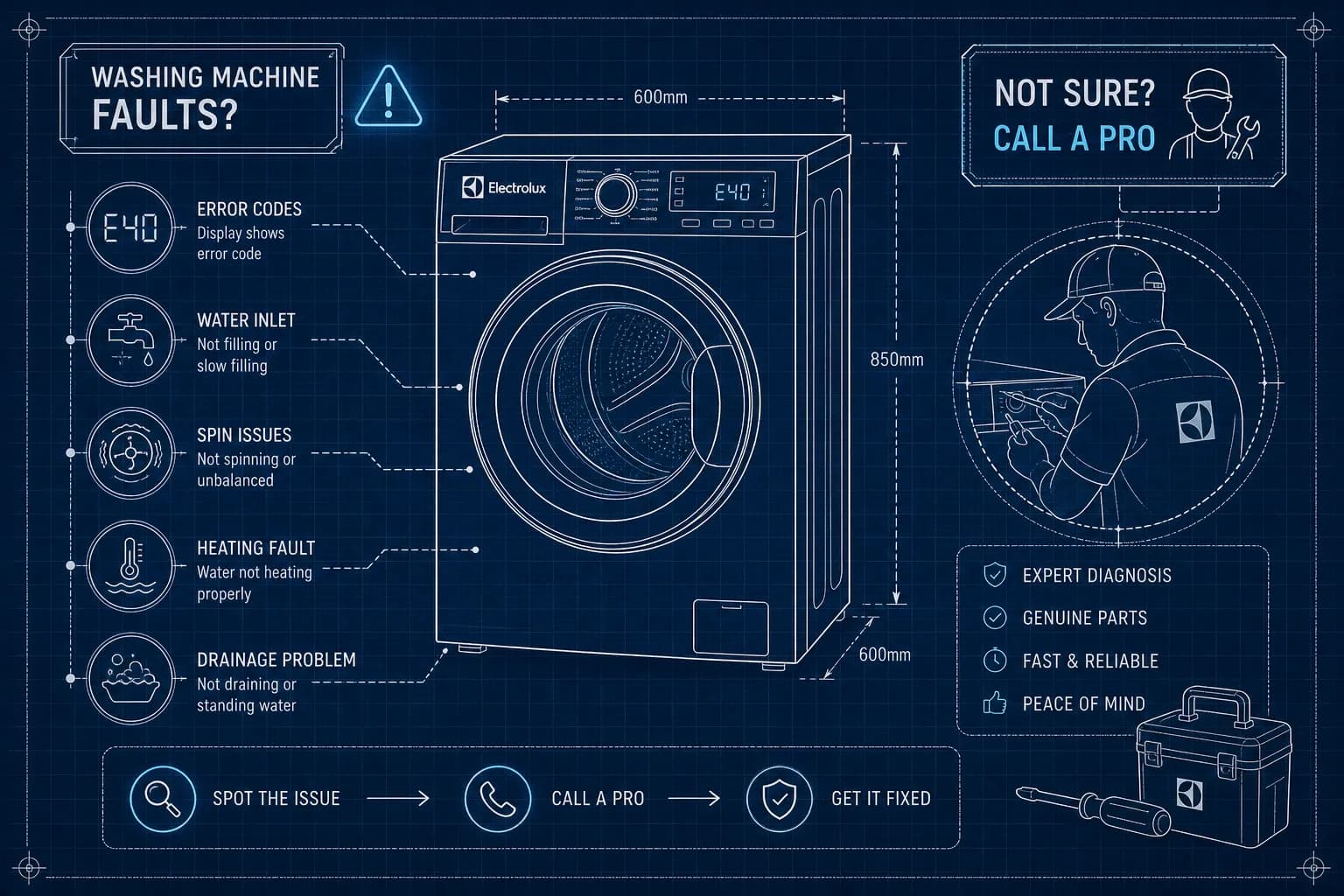
Electrolux Washing Machine Faults & When to Call a Pro
Your Electrolux washing machine stops mid-cycle, the drum sits full of water, and the display flashes a code you've never seen before. It's one of those moments that instantly derails your day. When you need Electrolux washing machine repairs, knowing which faults are common, and which checks to try first, can save both time and money. Repair engineers commonly report a small number of recurring faults across Electrolux models, and most of them follow a very predictable pattern that's faster to resolve than people expect.
This article gives you a clear run-through of the most common problems, the quick home checks worth trying before you book anything, what a professional repair costs in the UK, how to read the error codes your machine is showing you, and exactly when the job needs a trained engineer rather than a screwdriver and a YouTube video.
The most common Electrolux washing machine faults
Electrolux washers are reliable machines with a typical lifespan of around 9 to 13 years, but they do have a shortlist of recurring weak points. Understanding which category your fault falls into is the most useful first step before you try anything else.
Drum not spinning or stopping mid-cycle
The most frequent causes are an unbalanced load triggering the safety cut-out, a worn or snapped drive belt, or a fault with the motor or drive components. The easiest way to tell a load issue from a mechanical fault is to redistribute the laundry and restart. If the machine resumes normally, the cause was imbalance. If the drum turns sluggishly or not at all regardless of what's inside it, a belt or motor component has likely failed and the machine needs a trained engineer.
Drainage problems and standing water
Standing water left in the drum almost always points to a blocked drain filter, a kinked drain hose, or a failing drain pump. Drainage faults are among the most frequent reasons people search for a washing machine repair, and they nearly always trigger an error code alongside the symptom. The filter blockage is the one you can clear yourself in a few minutes, more on that in the next section.
Door lock failures and leaking door seals
A faulty door interlock prevents the cycle from starting at all, behaving as though the door is open even when it's firmly closed. A cracked or perished door gasket, sometimes called a bellows seal, causes leaks at the front of the machine, typically visible as a puddle on the floor during a spin or rinse. Both the door lock switch and the door seal are among the most frequently replaced components on Electrolux machines, and both are straightforward jobs for a manufacturer-trained engineer using manufacturer-approved parts.
Quick home checks to try before booking a repair
These checks are not about avoiding professional help. They're about ruling out the simple causes that account for a surprising number of unnecessary call-outs. Work through them in order before you book anything.
Power, door and water supply basics
Confirm the machine is firmly plugged in and test the socket with another device. Check the door is properly latched, as Electrolux machines will refuse to start if the door isn't registering as closed. Verify that both water supply taps are fully open, then inspect the inlet hoses for any kinks or crush points. It's also worth checking the small mesh screens where the inlet hoses connect to the machine: debris collects there and restricts flow enough to trigger a fill error.
Resetting the machine and cleaning the drain filter
Unplug the machine, leave it for 60 seconds, then plug it back in and start a fresh cycle. This clears temporary faults in the control system. If a drainage error was showing, clean the drain pump filter before restarting. On many Electrolux models it's located behind the small access panel at the front lower section of the machine, though you should check your model's manual to confirm the exact position. Place a towel underneath, unscrew the cap slowly, let the water drain, remove any debris from the filter mesh, and refit it securely. A blocked filter is one of the most common causes of E20-type drainage errors, and clearing it typically takes less than five minutes.
Rebalancing the load and checking detergent
Electrolux machines stop the spin cycle automatically when the load becomes too uneven, as a mechanical safety measure. Open the door, redistribute the laundry evenly around the drum, and restart the spin. If you're also seeing poor wash results or excessive suds, reduce your detergent quantity: high-efficiency Electrolux models are sensitive to overdosing, and too much detergent causes performance problems and can trigger the EF2 error code.
What Electrolux error codes are actually telling you
Error codes narrow down a fault to a specific system. Reading them correctly saves time and stops you replacing the wrong part. One important rule: if a code disappears after a reset but comes back within a cycle or two, the underlying fault needs attention rather than another reset.
E10: water inlet errors
E10 (and its close variants E11 and E12) means the machine isn't filling within the expected time. Start with the tap and the inlet mesh filter, those are the most likely culprits. If cleaning them doesn't clear the code after a reset, the inlet valve has likely failed and needs replacing by an engineer. The causes in order of likelihood are a closed tap, low water pressure, a blocked inlet filter screen, or a faulty inlet valve.
E20 and E21: drainage fault codes
E20 signals that the machine cannot drain within the expected time window. E21 is the same fault occurring specifically during the wash phase. Before booking a repair, clean the drain filter and check the hose isn't kinked or positioned too low. If those checks don't clear the code, the drain pump is the most likely culprit and requires professional assessment. Attempting to bypass or force a failing pump typically leads to a more expensive repair.
E40: door lock codes
E40 means the machine isn't registering the door as properly closed. Check the latch for any clothing caught in the seal, close the door firmly, and try a reset. If the code returns immediately, the door interlock switch has failed. This is a straightforward part replacement for a trained engineer, door interlock replacements are among the more common Electrolux repairs carried out across the industry.
Electrolux washing machine repair costs in the UK
Cost is understandably the first question most people have. The cost varies considerably depending on the fault, the parts required, and who carries out the work. Here's a realistic breakdown for 2026.
Official Electrolux fixed-price repair
Electrolux's own repair service operates on a fixed-price model starting at £129 and capped at £199. That price includes labour, genuine parts, and travel, with no additional charges added after the engineer arrives. Every repair through the official service comes with a 3-month parts and labour warranty. It's a transparent model, which makes it straightforward to weigh against a replacement cost before committing.
Independent certified engineers and what they typically charge
Certified independent engineers, including those operating a fixed-price model, typically quote in the £80 to £180 range for common faults such as pump replacements, door seal swaps, or inlet valve failures. More complex repairs involving control boards or drum bearings can reach £150 to £250 once parts are included, and in some cases higher for particularly involved jobs. A reputable independent service will quote upfront before any work begins. It's worth confirming whether a call-out or diagnostic fee applies separately before booking, as some providers charge this in addition to the repair quote.
What the repair warranty actually covers
A 3-month warranty is the standard from most UK repair providers, though some offer 12 months on parts and labour. The warranty covers the reported fault and the specific parts replaced during the repair. It does not cover unrelated faults that develop after the repair, or damage caused by misuse, overloading, or failure to follow the manufacturer's guidelines. If a new fault develops that wasn't present before the repair, that's treated as a separate job.
When the fault needs a manufacturer-trained engineer
Some Electrolux faults sit well beyond what a home check can resolve. These are the jobs where an incorrect diagnosis or a non-genuine part creates more damage than the original fault ever did.
Faults that are beyond a safe DIY fix
PCB and control board failures, motor and bearing replacements, inlet valve swaps, and anything touching the machine's electrical wiring or internal sensors all require a professional. These repairs need specialist diagnostic equipment to confirm the fault accurately, the correct genuine Electrolux spare parts, and the technical knowledge to fit them without creating secondary faults. Using incompatible parts can also invalidate any remaining warranty on the machine, a point worth bearing in mind before attempting any component swap yourself.
Why a manufacturer-trained engineer makes a difference for Electrolux washing machine repairs
A manufacturer-trained engineer arrives with the correct parts matched to the fault code and has seen the same failure pattern many times before, making a return visit far less likely. Alpha Appliances Ltd engineers are manufacturer-trained and focused on first-time fixes, that means fewer repeat visits and no guesswork. A repair completed correctly with genuine parts protects the machine's remaining lifespan and keeps any existing warranty valid.
Should you repair or replace your Electrolux washer?
Most Electrolux washing machines are worth repairing if they're under about seven to eight years old and the repair cost doesn't exceed half the price of an equivalent new machine. That's the calculation our engineers use when advising customers.
The age and cost rule of thumb
If the machine is under seven or eight years old and the repair quote is under 50% of a comparable replacement cost, repair is almost always the better financial decision. Electrolux machines have a reasonable expected lifespan of around 9 to 13 years with proper maintenance, so a mid-life repair on a well-maintained machine makes clear economic sense. Replacing a seven-year-old washer over a £120 pump repair is rarely justified.
Signs the machine isn't worth fixing
The balance tips toward replacement in a few specific scenarios: repeated faults on the same machine over a short period, structural drum damage, a seized bearing where parts availability is limited due to age, or a repair quote that approaches the cost of a new entry-level washer. If your machine is over ten years old and the engineer is quoting for a major component such as a motor or control board, a replacement often makes more long-term sense than investing further in an ageing appliance.
Book the right Electrolux washing machine repair first time
Most common Electrolux washing machine faults are diagnosable and fixable. For straightforward issues, a reset or drain filter clean is often all it takes, and working through the checks above will resolve more problems than you might expect. For error codes that keep returning, failed components, or anything beyond the basics, booking with a certified, manufacturer-trained engineer is the fastest and most cost-effective route.
At Alpha Appliances Ltd, our City & Guilds certified engineers quote a fixed price before touching the machine and carry the right parts for the job. We operate across Greater London, Berkshire, Surrey, Hampshire, and Dorset, with next-day availability and a strong focus on getting the repair right first time, no repeat visits and no surprise charges.
For Electrolux washing machine repairs across our service area, get in touch with our team today to book a fixed-price assessment and get your machine back in service without the wait.
Need a repair today?
Book a visit from a certified Alpha engineer in minutes.