Learn common extractor hood faults, safe DIY checks and 2026 repair cost estimates. See what you can fix, when to call a pro and how to hire a trusted engineer.
When your extractor hood stops working, extractor hood repair is often simpler and less costly than you might expect. One moment your kitchen is running smoothly, the next the hood goes silent and the room fills with steam, cooking smells and a faint layer of grease. It is the kind of fault that makes you realise just how much you relied on that appliance without ever thinking about it. The question most people ask at that point is a reasonable one: is this a straightforward fix, or am I looking at a big bill and a wait?
Extractor hoods are often overlooked until they stop working entirely. The team at Alpha Appliances has extensive experience diagnosing and repairing cooker hood faults across London and the Home Counties, and the same handful of problems come up time and again. This guide covers what those faults are, what you can safely check yourself, what extractor hood repair will likely cost in 2026, and how to find an engineer you can actually trust.
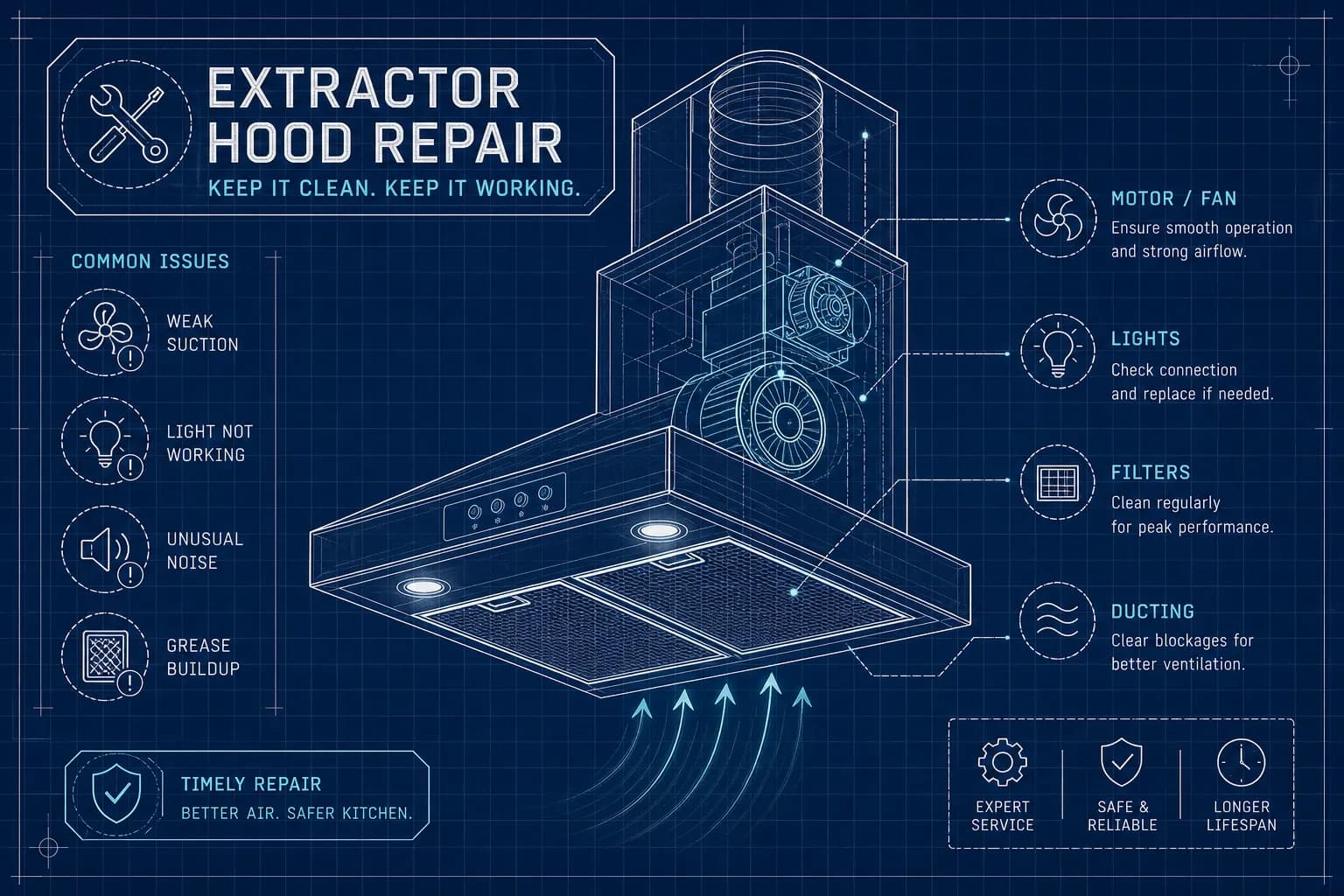
Most cooker hood failures fall into a small number of categories. Knowing which one you are dealing with shapes everything else: what you pay, how long it takes, and whether you need a professional.
This is the most overlooked cause of poor extraction, and it is also the most preventable. Grease filters trap the fat and moisture produced by cooking, but when they become saturated, airflow drops dramatically. The hood still runs, but extracts almost nothing. In some cases, the motor works harder to compensate, which accelerates wear on the bearings and internal components. The tell-tale signs are weak suction, a persistent smell even when the hood is running, and sometimes a low, straining hum. The good news is that this is the one fault homeowners can almost always fix themselves, and regular extractor hood maintenance stops it from recurring.
A worn motor is the costliest fault on this list. It presents in three distinct ways: loud grinding or whirring caused by worn bearings, sluggish fan speed at all settings, or complete silence when the power is on. Steam exposure causes rust, and years of use wear down the internal components regardless of how well the filters are maintained. Unlike a blocked filter, a motor fault nearly always requires a professional repair or a full hood motor replacement. Attempting to dismantle and refit a motor without the right tools and training is a false economy.
Lights fail more often than people expect on extractor hoods. The compact halogen or LED bulbs sit close to heat, making burnt-out bulbs a common source of faults. Loose seatings, blown internal fuses, and faulty control switches are equally common. Replacing a bulb is a safe DIY job in most cases; anything involving the wiring or the control panel is not.
Not every extractor fan repair requires a call-out. Running through these checks yourself first can save both money and waiting time, and in many cases the problem is resolved without any professional involvement at all.
Remove the filter panel, usually a simple clip or slide mechanism, and take out the grease filter. Soak metal mesh filters in hot soapy water for 20 to 30 minutes, scrub gently with a soft brush, rinse thoroughly, and dry completely before refitting. Disposable paper filters should simply be replaced rather than cleaned. For regular cooking, clean or replace grease filters every four to six weeks; light use means every two to three months is sufficient. Always check your manufacturer's instructions, as recommended intervals can vary by model. If your hood is a recirculating model, the activated carbon filters also need replacing every three to four months. Cracked carbon filters rattle and lose their effectiveness well before they look worn.
For ducted hoods, the wall or roof vent can become blocked by leaves, debris, or even a bird's nest over time. If the vent is at ground-floor level or easily accessible from outside, look for obstructions at the vent flap and clear any visible material by hand or with a brush. If the flap is stuck closed due to grease build-up, a careful clean with a degreaser usually sorts it. For vents that require working at height or accessing a roof, it is safer to call a professional rather than risk a ladder incident. It is also one of the most common causes of a hood that runs but barely extracts, so it is well worth investigating early.
Most extractor hood bulbs are accessible without tools. Switch off at the mains and allow the bulb to cool fully before touching it. Remove any lens cover if fitted, then swap the bulb for the correct replacement, checking your manual for the wattage and fitting type, as these vary considerably between models. If the new bulb still does not work, the fault is electrical rather than the bulb itself, and that is the point to call in a professional.
Some faults are beyond the scope of safe DIY. In a kitchen environment specifically, the stakes are higher than in other rooms. Understanding where that line sits helps you make a confident, informed decision.
Any fault involving the wiring, internal fuse board, or electronic control panel requires a qualified engineer. Opening the appliance casing and probing live electrical connections without the right training creates a genuine risk of electric shock or fire. This risk is compounded in kitchens, where grease residue is present and appliances often sit adjacent to a gas hob. A quick internet search is not a substitute for proper electrical training, and getting this wrong costs far more to put right than the original repair.
Replacing an extractor hood motor means accessing the inner casing, disconnecting wiring, and fitting a replacement part that runs safely at the correct speed and power draw. An incorrectly fitted motor can trip your circuit, run hot, or fail again within weeks. This is a job for a trained appliance engineer with diagnostic tools and access to genuine replacement parts. At Alpha Appliances, engineers carry common motor components on their vehicles, which means most motor replacements are completed in a single visit rather than requiring a return trip after parts are ordered. We also offer model-specific services where needed, for example Fixing Haden Cooker Hoods in Aldgate, Reliable Repairs.
Extractor hoods sit directly above hobs, often within centimetres of the cooking surface. While the hood itself is an electrical appliance and does not require a Gas Safe registered engineer specifically for the hood repair, choosing an engineer who holds Gas Safe registration and understands the safety requirements of kitchen environments adds an important layer of assurance. Asking for evidence of Gas Safe registration and City & Guilds certification before work begins means you can be confident the engineer is qualified to assess the full picture of your kitchen setup, not just swap out the faulty component.
Knowing what to expect before the engineer arrives puts you in a much stronger position. The following typical ranges for cooker hood repair costs in 2026 are based on current UK labour and parts pricing, though your final quote will depend on the make and model of your appliance.
Most reputable extractor fan repair services charge a call-out fee of £45 to £65, which covers the diagnostic visit and the first portion of labour. Hourly rates typically run from £50 to £70. Simple repairs are usually completed in under an hour on-site; a full motor replacement takes one to two hours. These ranges reflect genuine variability in parts cost: a motor for a budget range hood costs far less than one for a premium Miele or Siemens model, so the make and age of your appliance directly affect where in the range you will land. For a fuller comparison, it is worth checking current replacement hood prices alongside any repair quote you receive, several independent cost guides are useful references.
For published estimates of typical repair and call-out charges you may also find general UK cost guides helpful when setting a budget; for example, an online overview of typical cooker hood repair costs provides a comparable frame of reference.
There is no single right answer, but a practical framework makes the decision straightforward in most cases. The two most reliable guides are the cost of the repair relative to the replacement value, and the overall age and condition of the appliance.
If your repair quote exceeds 50% of what a comparable replacement hood would cost new, replacement is generally the better financial decision. A motor replacement costing £250 on a hood that retails for £180 is a clear case for buying new. A £90 switch repair on a £400 hood is an equally clear case for repairing. This rule holds in the vast majority of situations and gives you an objective way to cut through the uncertainty when you are weighing up the options.
Recommendations vary depending on model, usage and maintenance, but hoods that are ten or more years old are more likely to have multiple components approaching the end of their service life. If you have had two or three repairs in recent years, or if the engineer finds that both the motor and the control board need replacing at the same time, the cumulative cost often makes replacement the smarter long-term choice. Newer models also offer meaningfully better extraction efficiency and quieter operation, which adds genuine value beyond the immediate repair cost. Your engineer should be able to tell you honestly whether the repair makes sense or whether you are patching an appliance that will need attention again within months.
Not every tradesperson who advertises appliance repairs has the qualifications or experience for a safe, lasting cooker hood repair. A few straightforward checks before you book can save you considerable hassle.
A reputable appliance repair engineer in the UK should hold City & Guilds certification in appliance servicing. For kitchen environments, Gas Safe registration is a strong indicator that the engineer understands the safety requirements around heat-producing appliances. Safe Contractor approval adds further reassurance around professional standards. Always confirm that the repair comes with a workmanship guarantee backed by insurance, so you are protected even if the business changes hands or closes before the warranty period ends.
Before confirming your booking, ask whether the engineer carries common extractor hood parts on the vehicle (to avoid a second visit), what the call-out fee covers, whether the quote is fixed-price or hourly, and how long the workmanship warranty lasts. A confident, transparent answer to each of these questions is a strong indicator that you are dealing with a reputable service. Alpha Appliances offers fixed-price cooker hood repairs with no hidden fees and next-day availability across London and the Home Counties, book online in minutes and you will receive a confirmed appointment time straight away (we also handle brand-specific work such as Aldwych Britannia Cooker Hood Repair Specialists).
In short, extractor hood repair is usually more cost-effective than full replacement, provided the appliance is not too old and the fault is isolated. Start with the simple checks: clean the filters, inspect the external vent, swap the bulb. If the problem goes deeper, a noisy or dead motor, an electrical fault, or anything involving the wiring, that is when a certified engineer makes the difference between a safe, lasting fix and a problem that keeps coming back.
For a fast, fixed-price repair backed by genuine certifications, Professional Cooker Hood Repair Service and get a confirmed appointment, often as soon as the next day. Call us or book online, there are no hidden fees and no obligation until you accept the quote.
Book a visit from a certified Alpha engineer in minutes.
TRUSTED BY HOMEOWNERS
Fast, reliable, and warranty-backed repairs for every major brand.
Discover more tips from Alpha engineers.