
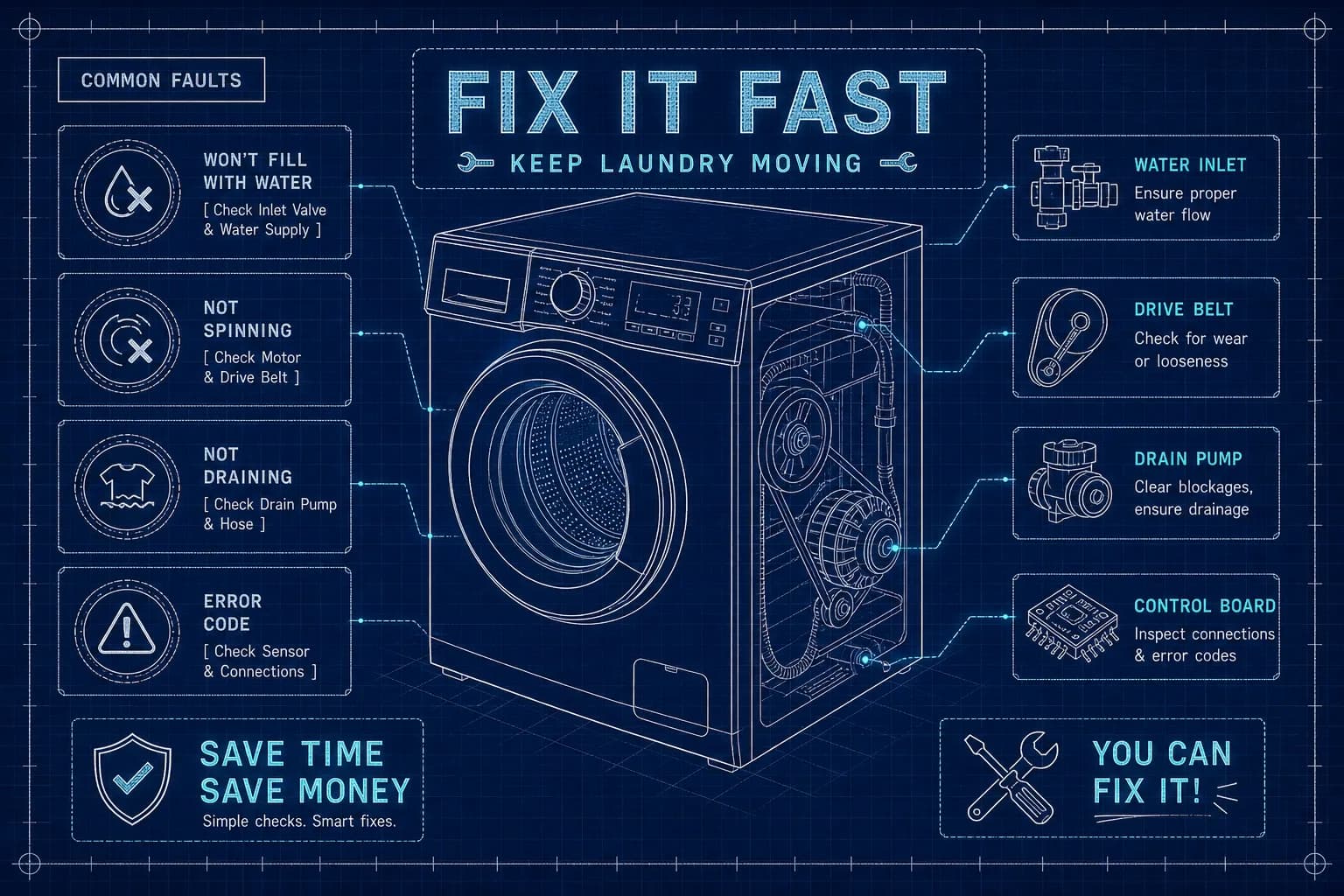
Fix Your Laundry Machine Fast: Common Faults Solved
When the pile of unwashed clothes starts building on the bedroom floor, a broken washing machine makes a bad situation feel worse fast. The machine sits there, door locked mid-cycle, showing no signs of life, and you're left wondering whether it's a simple fault or an expensive repair. Good washing machine fault diagnosis saves both money and time, and in our experience at Alpha Appliances Ltd, a significant number of the callouts our engineers attend turn out to involve something the homeowner could have checked themselves in under 20 minutes.
This guide covers the four most common washing machine faults, the safe checks to run before anyone touches anything, fixes you can genuinely attempt at home, realistic UK repair costs for 2026, and clear guidance on when to hand the job over to a certified engineer. Whether you want to fix a washing machine that won't drain or tackle a door latch that won't engage, start here.
What your machine is telling you: the four faults behind most callouts
Most washing machine repairs trace back to one of four problems. Knowing which category your fault falls into before you do anything else is the fastest route to a fix.
The machine won't start at all
No lights, no response, no movement, the machine does nothing when you press start, or cuts out without warning mid-cycle. The two most likely causes are a power supply problem or a door latch that isn't fully engaging. Modern machines won't initiate a cycle unless the door is confirmed locked, so even a slightly misaligned catch is enough to prevent everything. This is frequently one of the more straightforward faults to resolve without calling anyone.
The drum won't spin (or barely moves)
You open the door at the end of a cycle to find soaking wet clothes and a drum that clearly hasn't spun properly. Sometimes the drum sits completely static during the spin phase; other times it moves sluggishly and stops short. An unbalanced load and a worn drive belt are the two most common causes. A faulty door switch can also trigger this symptom, since the machine interprets an unsecured door as a safety risk and halts the cycle automatically.
Water is sitting inside and won't drain
Standing water visible through the door glass, a cycle that seems to run but never completes, or a machine that cuts out before reaching spin: these all point to a drainage fault. The pump filter and the drain hose are the first places to investigate. Both are accessible to homeowners without specialist tools, which makes this one of the most satisfying faults to resolve yourself.
Water appearing where it shouldn't
Puddles underneath the machine, damp patches around the door seal, or water running from the back all indicate a leak. There are three common sources: the inlet hoses, the rubber door gasket, and the detergent drawer. Pinpointing which one is at fault before attempting any fix saves you working through the wrong area entirely.
Fix your washing machine: safe checks to run before you open anything
These checks require no tools and carry no safety risk. Before you start, grab a towel, a shallow tray, and your phone for looking up any error codes. Work through them in order before attempting any repair or booking an engineer.
Power supply, door latch, and settings (the overlooked basics)
Start at the plug socket and the circuit breaker. A tripped breaker is easy to miss, particularly if the consumer unit is tucked in a cupboard. Check that the door is fully latched, push it firmly until it clicks, then try again. If the machine still does nothing, turn it off at the mains, wait a full minute, and restart; this clears minor software errors on most current machines. Note any error codes showing on the display panel. Search the code alongside your brand name (Bosch E18, Samsung OE, Miele F03, Hotpoint drain light flashing) before doing anything else; these codes point directly to the fault and save significant diagnostic time.
How to locate and clear the pump filter
The pump filter sits behind a small access panel at the base of the machine, usually on the bottom-right. Place a towel and a shallow tray directly underneath before you start, because water will come out. Unscrew the cap slowly to control the flow, pull out the filter, and remove any debris. Rinse it under the tap, check the cavity for anything lodged further inside, and refit the cap firmly. A blocked pump filter is one of the most common causes of both drainage failure and poor spin performance, and clearing it costs nothing.
Checking the drain hose for kinks and blockages
Trace the drain hose from the back of the machine to where it enters the standpipe, looking for any kinks or tight bends along its length. The hose should not be inserted more than 15cm into the standpipe; going deeper creates a siphoning effect that draws water back into the drum and prevents proper drainage. If you suspect a blockage inside the hose, disconnect it from the standpipe, place the end in a bucket, and run the machine briefly to test flow. If water runs freely, the hose is clear.
Simple fixes to try on your washing machine at home
Before you attempt anything, unplug the machine from the mains. Water and live current are a dangerous combination, and this step is non-negotiable regardless of how minor the task looks.
Redistributing the load and recalibrating the drum
An unbalanced load causes the machine to halt its spin cycle automatically as a built-in safety measure. Open the door, redistribute the clothes so weight is spread evenly around the drum, and run a short rinse-and-spin cycle to test. Even a single heavy item sitting on one side, a duvet, a bath towel, a pair of jeans, is enough to trigger this protection. Consistently overloading the machine accelerates wear on the bearings and motor, so use this as a prompt to review load sizes going forward.
Tightening hoses and cleaning the door seal and detergent drawer
Tighten inlet and outlet hose connections by hand, working around the fittings evenly. Hand-firm is enough; over-tightening splits plastic fittings. To clean the door gasket, pull back the rubber seal, remove any trapped debris, and wipe the full surface with a damp cloth. If the seal shows visible cracks or tears, it needs replacing, a replacement gasket ordered by model number and fitted with a screwdriver is a realistic DIY job on most front-loaders. For the detergent drawer, remove it fully, rinse away any caked-on residue under the tap, and dry it before refitting. A partially blocked drawer causes water to siphon back, producing unexplained leaks from the front of the machine.
When the fault needs a certified engineer, not a YouTube fix
Some repairs carry genuine risk without the right tools or training. The line here is clear, and knowing where it sits protects both you and the machine.
Internal components that require specialist tools and training
Drum bearings (indicated by a grinding noise or a drum that wobbles on its axis), a drive belt that requires housing disassembly to access, motor failure, and PCB control board faults all sit beyond safe DIY territory. Misdiagnosing these components doesn't just fail to fix the problem; it risks causing further damage and can void any remaining manufacturer's warranty. A City & Guilds certified engineer carries the diagnostic equipment and a stock of genuine parts to resolve most of these faults on the first visit, rather than working through a process of elimination across multiple callouts.
Warning signs that mean switch off and step back immediately
Stop and unplug the machine immediately if you notice any of the following:
- A burning smell or visible smoke from the machine
- The machine tripping the circuit breaker the moment it starts
- A leak originating from inside the drum casing rather than from a hose connection
- Any sign of electrical arcing
These are not faults to investigate further. Leave the machine disconnected and call a qualified engineer. With electricity and water involved, no repair is worth taking a shortcut.
What washing machine repairs cost in the UK in 2026
Understanding the cost picture before you book means you can assess value clearly and recognise pricing that doesn't add up.
Call-out fees and hourly labour rates by region
Most UK engineers charge a call-out fee of £60 to £80, covering travel and initial diagnosis. Hourly labour rates typically run from £50 to £70. London and the South-East sit at the higher end: expect call-out fees of £70 to £90 and labour rates of £60 to £75 per hour. Rates in the Midlands, the North, Scotland, and Wales are lower, with call-out fees starting around £45 to £55. Fixed-price models remove the ambiguity of hourly billing, you know the full cost before any work begins, which matters when assessing whether repair or replacement makes more sense.
What parts cost and what that means for the total bill
Simple repairs, such as a door seal replacement, carbon brush swap, or door lock fix, typically come to £50 to £120 all-in. Medium-complexity faults like a drain pump replacement land at £80 to £150. Complex repairs involving drum bearings, PCB failure, or motor replacement range from £120 to £300 or more. Bearing repairs on machines with sealed drum assemblies can reach £400. As a practical benchmark: if the repair quote exceeds 50 to 60 per cent of what the same machine costs new, replacement is usually the smarter financial decision. For a machine that cost £400 new, that threshold sits at around £200 to £240.
Choosing a qualified engineer and what a good first visit looks like
Qualifications and credentials that actually matter
Look for City & Guilds certification, the Level 2 Diploma in Electrical and Electronic Servicing is the recognised industry benchmark for domestic appliance repair. If your appliance is gas-connected, Gas Safe registration is a legal requirement, not an optional extra. Safe Contractor approval adds a further layer of accountability. Ask directly whether the engineer has received manufacturer training for your specific brand. This matters most for Miele, Bosch, AEG, and Samsung owners, where brand-specific diagnostic knowledge translates directly into a higher first-time fix rate. Booking on price alone is a false economy; uncertified engineers frequently misdiagnose faults, order incorrect parts, and generate repeat callouts that cost more in total.
What a reliable first visit should include, and how to book one
A professional first visit follows a clear pattern: the engineer arrives with diagnostic tools and a van stocked with commonly required parts, carries out a full fault assessment, and provides a fixed-price quote before any work starts. At Alpha Appliances Ltd, our City & Guilds certified engineers serve London, Berkshire, Surrey, Hampshire, and Dorset, with a 78% first-time fix rate and fully transparent pricing, no hidden fees, no surprises on the invoice. If you've worked through the checks in this guide and the fault is still present, a fixed-price booking with a certified engineer who brings the right parts from the outset is the fastest and most cost-effective route back to a working machine.
From diagnosis to a working machine: what to do next
You now have what you need to approach a washing machine fault methodically. Identify which of the four fault types you're dealing with, run the basic checks in order, pump filter, drain hose, door latch, load balance, attempt the safe DIY fixes where they apply, and understand the cost benchmarks before anyone quotes you. Catching a fault early and keeping on top of routine checks, particularly the pump filter, prevents most faults from escalating into expensive repairs.
If the fault persists after the basic checks, the right move is straightforward. A certified washing machine engineer, arriving with diagnostic tools, genuine parts, and a fixed-price quote, is the most reliable way to fix a washing machine for good. Book with Alpha Appliances Ltd, know what to expect, and get back to clean clothes and a machine you can rely on.
Frequently asked questions
How do I fix a washing machine that won't drain?
Start by clearing the pump filter, located behind the small access panel at the base of the machine. Place a towel and tray underneath, unscrew the cap, remove any debris, and refit. Also check the drain hose for kinks and ensure it isn't inserted more than 15cm into the standpipe. If these steps don't resolve the issue, the drain pump itself may need replacing, which typically costs £80 to £150 including labour.
Can I fix a washing machine door latch myself?
In many cases, yes. First check that the door is fully closing and that nothing is obstructing the latch. A soft reset (switching off at the mains for one minute) can also clear a door lock error on most modern machines. If the latch mechanism is visibly broken, a replacement door lock is a straightforward repair, and parts are widely available by model number.
How much does it cost to fix a washing machine in the UK?
Simple repairs such as a door seal or door lock typically cost £50 to £120 all-in. Mid-range repairs like a drain pump replacement run £80 to £150. Complex jobs involving drum bearings, motor failure, or PCB faults can reach £120 to £300 or more. If the quote exceeds 50 to 60 per cent of the machine's replacement cost, it's worth considering a new appliance instead.
When should I stop trying to fix my washing machine and call an engineer?
Stop and call a qualified engineer if you notice burning smells, visible smoke, the machine tripping your circuit breaker on start-up, or any sign of arcing. Faults involving drum bearings, the drive belt, the motor, or the PCB also require specialist tools and training, attempting these without experience risks further damage and may void your warranty.
Need a repair today?
Book a visit from a certified Alpha engineer in minutes.