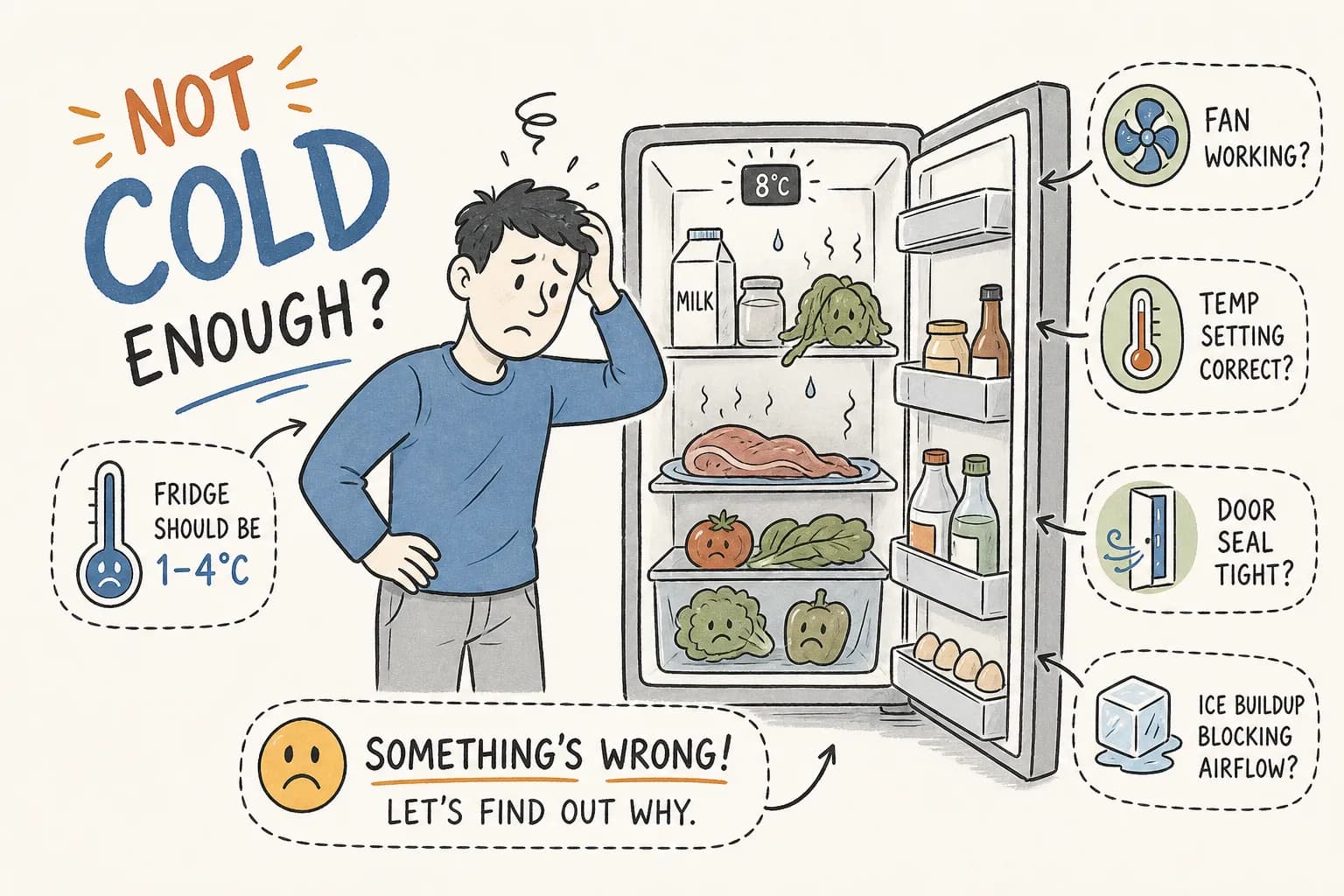
Is your fridge not keeping food cold? Learn quick checks, DIY fixes, warning signs that need a certified engineer, and how to protect food while you wait.
Why is my fridge not keeping food cold? If you're asking that question right now, you're in the right place. A fridge that isn't keeping food cold is one of those household problems that goes from minor inconvenience to genuine emergency within hours. Raw meat, dairy, leftovers, medication that needs refrigeration, the clock starts the moment temperatures begin to rise. The team at Alpha Appliances Ltd has spent many years and thousands of fridge repairs across London and the Home Counties diagnosing every variation of this fault. The good news is that most cases follow a predictable pattern, and in many common situations the likely cause can be narrowed down within minutes using checks you can do yourself.
This guide covers the most common reasons a refrigerator stops keeping food cold, what you can safely check and fix before calling anyone, the warning signs that need a certified engineer, and how to protect your food while repairs are arranged. Work through it in order and you'll have a clear picture of what's wrong and what to do next.
Most fridge cooling failures come down to a handful of well-known culprits. Knowing them upfront lets you self-triage before spending time on checks that won't apply to your situation. For a complementary perspective and a straightforward checklist you can follow at home, see this detailed troubleshooting guide from an appliance-service specialist.
Condenser coils are responsible for releasing heat from the fridge's sealed system into the surrounding air. When a thick layer of dust, grease, or pet hair builds up on them, that heat transfer is blocked. The compressor works harder to compensate, temperatures creep up inside the cabinet, and the refrigerator stops keeping food cold even though everything else appears to be running normally.
Coils are usually located at the back of the fridge or underneath it, behind a grille. Most appliance maintenance guidance recommends cleaning them at least once a year for the average household, though kitchens with heavy cooking or pets may need more frequent attention. It's a straightforward job when you know where to look.
A damaged, warped, or dirty door gasket creates a slow but constant leak of warm air into the fridge compartment. Because the fridge still runs and looks normal from the outside, a faulty door seal gasket is one of the most underdiagnosed causes of a fridge temperature that's persistently too high. The compressor works overtime trying to maintain temperature against the steady warm-air intrusion, and it usually can't keep pace.
The paper-slip test takes 30 seconds: close the door on a strip of paper or a banknote and pull it out. If it slides free with no resistance, the seal isn't gripping properly. Test several points around the full perimeter of the door, because a gasket can seal well in one spot and leak badly in another. Manufacturer guidance and appliance repair professionals recommend checking multiple points as standard practice.
Most modern fridge-freezers have an automatic defrost cycle that prevents frost from accumulating on the evaporator coils. When the defrost heater, timer, or thermostat fails, frost builds up unchecked and eventually blocks cold air movement entirely. The compressor runs fine, but the cold air simply can't get where it needs to go.
A faulty thermistor, the small sensor that reads the internal temperature and reports it to the control board, can cause a different version of the same problem. If the thermistor sends incorrect readings, the fridge may undercool consistently even when the compressor and coils are working perfectly. This fault often mimics a more serious mechanical failure, which is why accurate diagnosis matters.
This is one of the most common symptom patterns in refrigerator troubleshooting, and it has a distinct cause worth understanding separately. If your freezer is holding temperature but the fridge section is warming up, the problem is almost always about airflow between the two compartments rather than a failure to generate cold air.
In a frost-free fridge-freezer, a small evaporator fan draws cold air from the evaporator coils (which sit in the freezer section) and circulates it through a duct into the fridge compartment above. The freezer stays cold because it directly surrounds those coils. The fridge, however, depends entirely on that fan to receive cold air. When the fan motor fails or seizes, the fridge warms up fast while the freezer remains unaffected.
You can often confirm a failed evaporator fan by pressing the door switch manually while the fridge door is open. This should trigger the fan, though behaviour varies by model, so check your user manual if you're unsure. If you hear nothing where there should be airflow noise, or if the fan starts but sounds laboured and slow, the motor is the prime suspect. This is a relatively straightforward repair for a qualified engineer.
Even with a working fan, cold air can't reach the fridge compartment if the vents are blocked. Overpacked shelves, items pushed against the rear vent panel, and ice accumulation from defrost failure are the three main causes. This is the first thing to physically check when the fridge is warm but the freezer is completely fine.
In some cases, a manual defrost, switching the unit off, removing all food, placing towels around the base, and letting ice melt over approximately 24 hours, resolves the issue temporarily by clearing the blockage. How long this takes depends on the severity and model. If the problem returns within a few weeks, the underlying defrost system fault still needs to be addressed properly.
Start with the simplest possibilities. Verify that the fridge thermostat dial or digital display is set correctly: the safe range is 0, 4°C (32, 40°F), with around 3°C being a practical target for most households. For official manufacturer guidance on recommended refrigerator and freezer temperatures, consult a brand resource which explains ideal set-points and how to adjust them.
Then check that nothing inside the fridge is pushed against the rear vent panel, which is usually a plastic grille at the back of the compartment. Both checks take under two minutes and are overlooked more often than you'd expect.
Run the paper-slip test around the full door perimeter as described above. Also inspect the gasket itself for visible cracks, tears, warping, or debris stuck in the grooves. A dirty gasket sometimes seals poorly simply because it needs cleaning with warm soapy water.
For the condenser coils, unplug the fridge first. Locate the coils at the back or underneath the unit, then use a vacuum with a brush attachment to remove any heavy dust buildup. The whole process takes about 15 minutes. Always power off the fridge before reaching behind or underneath it. Never use a pressure washer or sharp tools near the coils.
Press the internal door switch to trigger the evaporator fan and listen for airflow, keeping in mind that some models only run the fan when the compressor is active, so consult your manual if there's any doubt. Silence when you'd expect airflow suggests the fan isn't running. For the compressor, listen from the back of the unit during a cooling cycle: a low, steady hum is normal operation. Audible clicking as the compressor tries and fails to start, short-cycling (starting and stopping every few minutes), or complete silence when the unit should be cooling all point to a more serious fault that needs professional diagnosis.
Three compressor red flags warrant a same-week call to a certified engineer. First: the compressor runs constantly but the fridge never gets cold. Second: audible clicking every few minutes as the compressor attempts to start and fails. Third: the back of the fridge feels unusually hot to the touch, far beyond the normal warmth of a working unit.
Replacing a start relay is sometimes within reach for a confident DIYer, but a mechanically failed compressor is not. Compressor replacement requires a certified engineer, and on older units it often prompts a repair-versus-replace conversation. Getting a fixed-price quote first lets you make that decision with accurate numbers rather than guesswork.
Refrigerant leak symptoms include: the compressor running non-stop without the fridge cooling, an oily or greasy residue near the base or tubing, frost forming in unusual locations inside the cabinet, or a faint sweet or chemical smell near the appliance. If you notice any of these, do not attempt to investigate the sealed system yourself; see a specialist article on signs your refrigerator is leaking refrigerant for photographic examples and next-step advice.
In the UK, handling F-gas refrigerants without the correct qualification is illegal and carries civil penalties. The sealed system must be diagnosed and repaired by a technician with the proper F-gas certification and equipment. Based on current UK repair market data, refrigerant leak repairs typically range from £165 to £410 depending on the complexity of the job and parts required, though costs vary by model and region. In most cases, this is still considerably less than replacing the appliance outright, though it's worth getting a quote to compare.
The safe refrigerator temperature range is 0, 4°C (32, 40°F). According to the UK Food Standards Agency, bacterial growth in perishable food accelerates significantly once temperatures rise above 8°C. The two-hour rule applies here: if perishable food has been held above that threshold for more than two hours, the risk is real. Four hours is the outer limit cited by the UK Food Standards Agency before perishables should be discarded, and that assumes the door has stayed closed throughout.
The highest-risk items are raw meat, raw fish, dairy products, cooked leftovers, and anything already close to its use-by date. Move these first; everything else can wait a few minutes while you assess the situation.
Act on this order of priority. Move raw meat, fish, and dairy to a neighbour's fridge or a cool box with ice immediately. Use cooked food and opened dairy within the next few hours while temperatures are still borderline. Discard anything that has been at an unknown or elevated temperature for an extended period.
When in doubt, throw it out. The cost of food poisoning is significantly higher than the cost of replacing a pack of leftovers. Hard cheeses, whole fruits, and unopened condiments are generally more tolerant of short temperature rises. Everything else should be treated with caution.
Run the numbers honestly. A week of emergency grocery top-ups for a family, the cost of food that had to be discarded, takeaways to replace meals that couldn't be cooked, and the cumulative stress of working around a broken appliance, it adds up quickly. Compare that with the cost of a fixed-price diagnostic and repair from a certified engineer, and repair typically comes out ahead by a clear margin. For typical market figures and a breakdown of common repair prices, see an independent guide to refrigerator repair costs.
Most common fridge faults, including evaporator fan replacement, condenser coil cleaning, door seal replacement, and thermostat repair, are straightforward jobs with a high first-time fix rate when handled by an experienced technician. An evaporator fan motor replacement, for example, typically costs £120, £250 all-in, though prices vary by model, parts availability, and location. Delaying rarely saves money; it usually does the opposite.
A qualified fridge repair should come with City & Guilds certified engineers, a transparent fixed-price quote before any work begins, and same-week or next-day availability. Those aren't premium extras; they're the baseline of a trustworthy service.
Alpha Appliances Ltd is built around exactly those principles, fixed pricing, engineers certified across all major fridge brands, and an online booking system that confirms your appointment without the need for phone calls or waiting on hold. If you're still asking why is my fridge not keeping food cold after working through this guide, booking a professional diagnostic sooner rather than later is the most cost-effective next step. In most cases, an early repair prevents the far costlier outcome of a full appliance replacement.
A refrigerator that isn't keeping food cold is a genuine time-sensitive problem, but it's also one that, in the vast majority of cases, falls into a well-understood category with a clear solution. Work through the checks in this guide from the simple (temperature settings, vent clearance, door seal) to the more involved (fan and compressor behaviour), and you'll arrive at a clear picture of what's happening.
If you're still asking why is my fridge not keeping food cold after running through the basics, and the checks point to a mechanical fault, a refrigerant issue, or anything involving the sealed system, that's the moment to book a certified engineer rather than experiment further. Protecting your food starts now; protecting your appliance starts with getting the right person to fix it properly the first time. For an accessible step‑by‑step checklist you can follow when diagnosing cooling faults, see Maytag's step‑by‑step cooling checklist.
Book a visit from a certified Alpha engineer in minutes.
TRUSTED BY HOMEOWNERS
Fast, reliable, and warranty-backed repairs for every major brand.
Discover more tips from Alpha engineers.