
What Temperature Should a Fridge Be Set At?
Most households set the fridge dial on the day the appliance arrives, adjust it once when something smells off, and then never think about it again. The dial stays where it is, the food goes in, and the assumption is that everything is fine. At Alpha Appliances Ltd, we often hear from homeowners who describe a fridge that "just doesn't seem cold enough", and in the majority of cases, the temperature has never actually been measured. So, what temperature should a fridge be at? The answer is straightforward, but verifying it accurately requires a little more than a glance at the dial. The good news is that understanding what temperature your fridge should be at, and confirming it actually is, requires only a small amount of time and inexpensive equipment.
By the end of this article, you will know the UK-recommended fridge and freezer temperatures, how to check them accurately with a thermometer, what your fridge's dial numbers actually mean, and how to tell whether a temperature problem is something you can fix yourself or a sign of a component fault that needs professional attention.
What temperature should a fridge be at? UK food safety guidance explained
The FSA's 5°C rule explained simply
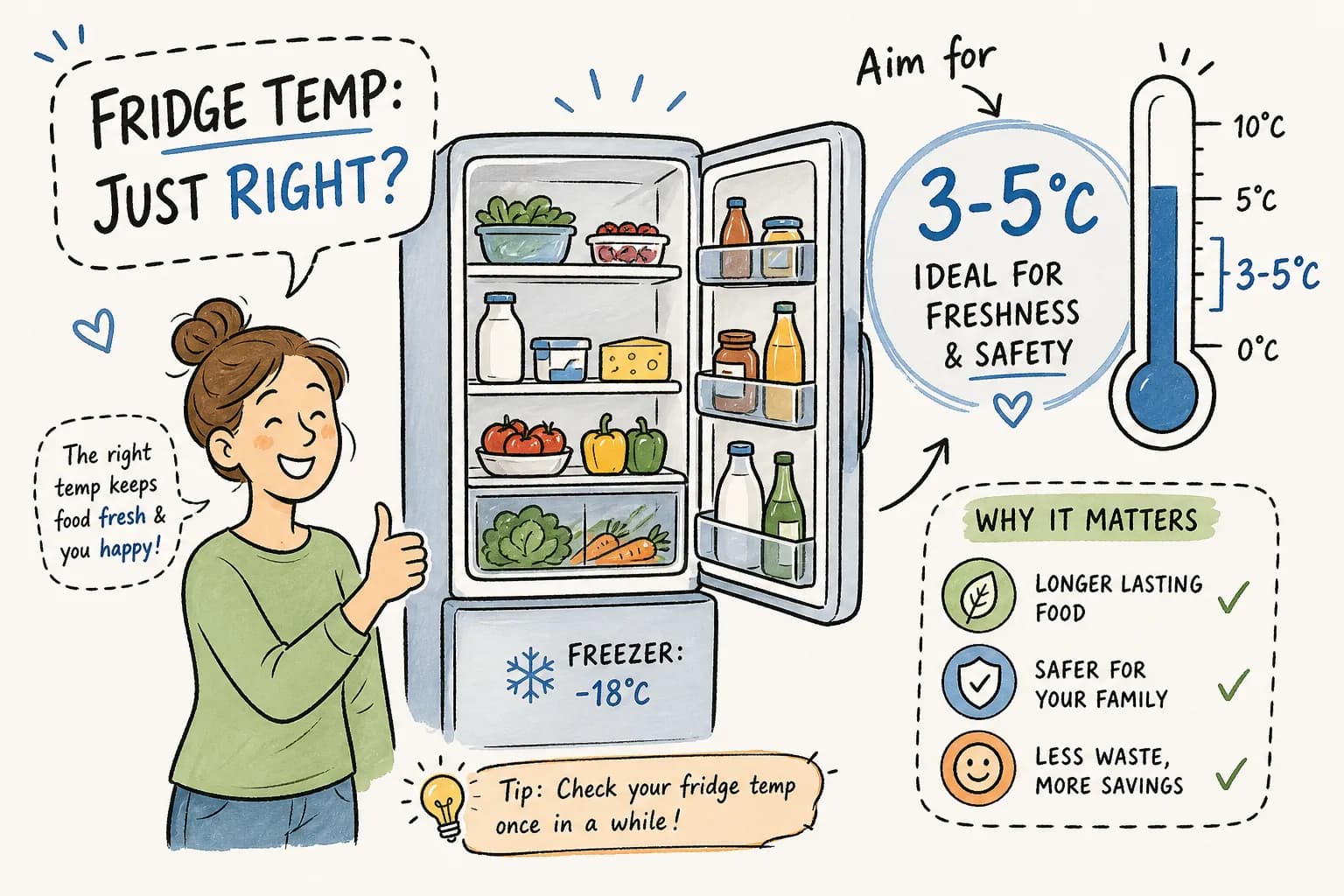
The UK Food Standards Agency (FSA) is clear on this: your fridge should be kept at 5°C or below. The FSA sets the legal upper limit for chilled food storage in UK food businesses at 8°C, but the recommended domestic setting is 5°C because it gives you a buffer. Door openings, warm items placed inside straight from a shopping bag, and seasonal changes in room temperature all push the internal temperature up temporarily, so starting from 5°C means you stay safely below that 8°C danger threshold even when conditions aren't perfect.
The practical reason this matters is bacterial growth. Pathogens such as Listeria and other food-poisoning bacteria multiply rapidly once temperatures climb above 8°C. Food that has spent several hours above that mark can harbour harmful bacteria without looking or smelling any different, which is precisely why the risks are easy to underestimate. Keeping the fridge at 5°C or below does not just preserve food quality; it protects the health of everyone in your household, particularly the elderly, children, and anyone with a compromised immune system.
Freezer temperature: the -18°C standard
The freezer target is equally specific: -18°C or below. A freezer sitting at -12°C may not appear to be failing, but it is operating outside the safe zone. At that temperature, ice crystals reform more easily inside frozen food, quality degrades faster, and the appliance is working harder than it needs to, which costs more to run. The two numbers to remember are straightforward: 5°C for the fridge, -18°C for the freezer. Everything else in this article builds on those two benchmarks.
What the dial numbers on your fridge actually mean
Cooling power, not degrees Celsius
This is the point most people miss, and it leads to avoidable problems. A dial numbered 1 to 5 on a typical UK fridge does not display the temperature inside the cabinet. It controls cooling strength. Setting 1 is warmest; setting 5 is coldest. Beko's own guidance indicates that a dial position of 3 typically produces around 4°C inside the fridge, a useful reference point, but one that is model-dependent. Room temperature, how full the fridge is, and how frequently the door opens all shift the actual internal temperature regardless of where the dial sits.
Why "setting 3" isn't reliable across different models
There is no universal conversion table for fridge dials. A setting that keeps one manufacturer's fridge running at a safe 4°C may keep another brand's at 7°C. LG's guidance puts setting 3 at roughly 3°C on their models; Beko puts it at roughly 4°C. Samsung bypasses the numbered dial entirely on many models and uses direct Celsius settings instead. The only honest answer to what temperature your fridge should be at is the one a thermometer gives you, not an assumption about what the dial number represents. Without one, you are guessing, and with food safety, that is not a position worth being in.
How to check what temperature your fridge is at
Where to place a fridge thermometer for an accurate reading
Placement matters more than most people realise. The middle shelf, positioned away from vents, the back wall, and the door, gives you the most representative reading of the temperature your food actually experiences. The door is consistently the warmest zone because it is exposed to room temperature every time you open it. The back wall, near the cooling element, can read misleadingly cold and does not reflect conditions in the main food compartment.
For the most stable result, place the thermometer probe or bulb in a small glass of water on the middle shelf. Water buffers short-term air fluctuations caused by the compressor cycling on and off, which means the reading reflects the actual temperature of stored food rather than a momentary air-temperature snapshot. This approach is recommended by the FSA and gives you a far more reliable figure than leaving a thermometer loose on a shelf.
How long to wait before trusting the reading
Leave the thermometer in place for at least 12 hours, and ideally 24 hours after any thermostat adjustment. A fridge cycles on and off throughout the day, and a reading taken during a brief compressor-off period can be several degrees warmer than the fridge's true average performance. An overnight reading, taken after a full cycle and without the door having been opened repeatedly, gives you a genuine picture of what your appliance is actually delivering. Patience here pays off: the 24-hour wait prevents you from over-correcting based on a single, unrepresentative reading.
What happens when the temperature is off
Running too warm: the food safety and energy cost problem
A fridge running above 8°C puts chilled food in the bacterial danger zone. In practical terms, this means shorter shelf life for dairy, meat, and prepared foods, higher food waste, and a genuine health risk for vulnerable household members. There is also an energy cost: a fridge that cannot reach its set temperature works continuously to try, which drives up electricity bills without delivering the cooling performance you are paying for. Checking the temperature proactively, rather than waiting for food to spoil, is the simpler and cheaper habit to develop.
Running too cold: not as harmless as it sounds
Many people assume that a colder fridge is a safer fridge. That logic has a limit. A fridge running very close to freezing, around 0, 1°C, can freeze items stored near the back wall, particularly leafy vegetables, soft fruits, and dairy. Beyond the food quality damage, a fridge cycling excessively cold causes the compressor to overwork, which shortens the appliance's lifespan and wastes energy. The ideal fridge temperature is a specific window, not a direction. Pushing the dial to maximum and leaving it there is not the responsible choice.
Simple adjustments to try first, and when the problem is a fault
Checks and adjustments you can do yourself
Before calling anyone, work through these steps. Adjust the thermostat setting by one position toward colder, then wait 24 hours and re-measure. Inspect the door seal by closing the door on a piece of paper, if the paper slides out without resistance, the seal has lost its grip and is letting warm air in. Clear any blocked internal vents, which are often obstructed by overpacking or items pushed too far toward the back, and ensure the fridge has adequate ventilation space at the rear (at least a few centimetres) so heat from the condenser can escape properly. If your model has accessible condenser coils at the back or beneath the unit, clean them with a soft brush to restore heat transfer efficiency.
These steps resolve a large proportion of temperature problems without any engineer involvement. Overpacking alone is a surprisingly frequent culprit: it restricts the airflow that distributes cold air evenly across all shelves, and simply reorganising the contents can make a measurable difference to the internal temperature.
When the problem is a component, not a setting
There are clear warning signs that point to a mechanical or electrical fault rather than a calibration issue. If the fridge runs continuously without reaching temperature, if adjusting the thermostat has no measurable effect after 24 hours, if you hear unusual humming or clicking from the compressor area, or if frost is building up in places where it should not be, these are not symptoms a setting adjustment will fix. A fridge that returns to the wrong temperature within hours of being corrected is telling you that a component, most likely the thermostat, evaporator fan, or compressor, is no longer doing its job.
At this point, a certified engineer can diagnose the exact fault and advise on the most cost-effective repair. At Alpha Appliances Ltd, our manufacturer-trained engineers stock a wide range of genuine parts and aim to complete most repairs on the first visit, saving you time and avoiding the inconvenience of a second call-out.
The two numbers every fridge owner should know
To summarise: what temperature should a fridge be at? It should sit at 5°C or below. Your freezer should run at -18°C or below. These are not approximations or guidelines to aim roughly toward; they are the specific targets that UK food safety guidance is built around. A fridge thermometer, placed correctly on the middle shelf in a glass of water and left for 24 hours, is the only reliable way to confirm that your appliance is actually hitting those targets rather than simply appearing to.
Most temperature problems have a straightforward fix: a thermostat adjustment, a replaced door seal, or better airflow around and inside the unit. Work through those steps first, give the fridge 24 hours to respond, and re-measure. If the temperature stabilises in the right range, the job is done. If it does not, the fridge is signalling something more serious, and leaving a developing component fault to worsen will almost always cost more to put right than catching it early.
If your fridge's temperature will not stabilise despite working through the adjustments covered here, Alpha Appliances Ltd is here to help. We offer same-week diagnosis with transparent, fixed-price repairs carried out by City & Guilds certified engineers, with no hidden fees. Book online and have a qualified engineer assess the appliance before a minor fault becomes a full replacement.
Need a repair today?
Book a visit from a certified Alpha engineer in minutes.