
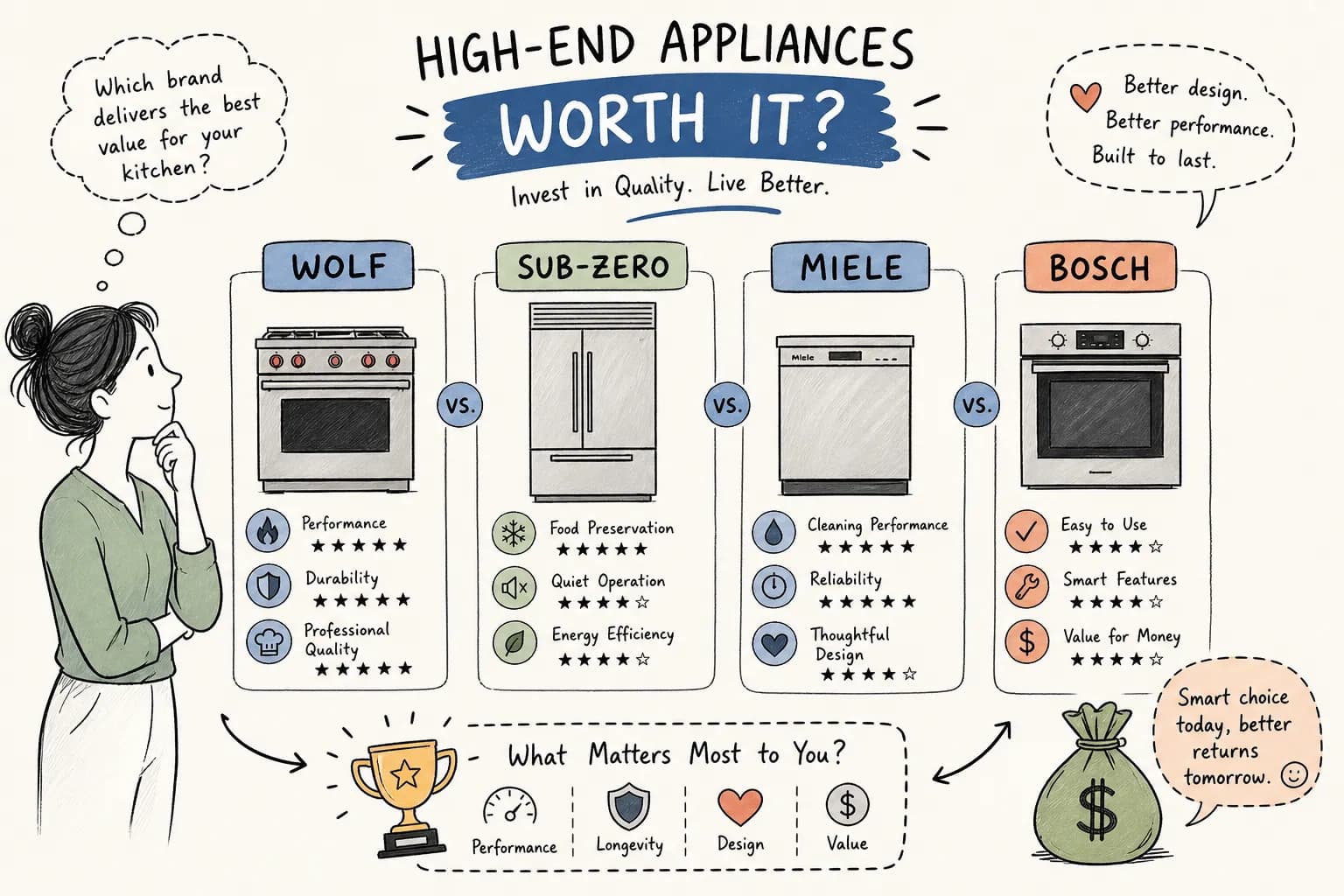
High-End Appliance Brands Compared: Which Is Worth the Investment?
Spending £900 to £2,999 on a single washing machine is a significant commitment. Yet when it comes to a high end appliance comparison, most UK homeowners still rely on a showroom visit and a glossy spec sheet rather than the data that actually matters: how the machine performs in year eight, what a drain pump replacement costs at year ten, or whether genuine parts are still available at year twelve. At Alpha Appliances Ltd, our engineers have spent over fifteen years servicing Miele, Bosch, AEG, and Siemens machines across London and the Home Counties, a breadth of hands-on repair experience that no retailer can replicate, and the foundation of everything in this guide.
This article cuts through the brand marketing to show you which premium appliance brands genuinely deliver over the long term, which carry hidden ownership costs, and which brand best fits your household's specific priorities. Whether you are fitting out a new kitchen or replacing a machine that has finally given up, the information here will give you a clearer picture than any product description.
What actually makes an appliance "high-end"?
The word premium gets applied loosely in retail environments, so it is worth establishing what separates a genuinely high-end appliance from a mid-range machine with a higher price tag. The difference is almost never visible on the showroom floor. It lives in the components you cannot see: higher-specification motor bearings, stainless-steel drum assemblies, thicker insulation panels, and tighter manufacturing tolerances at the point of assembly. According to industry and manufacturer documentation, these details directly affect noise levels, heat retention, energy efficiency, and mechanical longevity. The gap between a premium machine and a value machine rarely shows up in year one; it shows up in years five through fifteen.
High-end appliances from Miele, Bosch, AEG, and Siemens also tend to include load-sensing technology, adaptive wash cycles, and energy-management systems less commonly found in standard machines. These features reduce wear on internal components as much as they reduce your utility bills. A machine that adjusts its water use, drum rotation, and temperature to the actual load puts less strain on its own parts with every cycle, and that cumulative reduction in mechanical stress is a significant part of why premium appliances last considerably longer than budget equivalents.
High end appliance comparison: the brands up close
Miele
Miele is the benchmark against which the others are measured. The brand publicly states that it tests its machines to the equivalent of 20 years of average use before release. Which? owner surveys and independent reliability data consistently place Miele at the top for reported fault rates among the four brands covered here. The trade-off is price: Miele washing machines start at around £795 and climb to £2,999 for integrated or specialist models, with dishwashers ranging from £749 to £1,879 and fridge freezers from £629 to £2,329.
Bosch and Siemens
Bosch and Siemens share the same parent company, BSH Group, and frequently share core engineering platforms. Broadly speaking, Bosch has positioned itself around reliability and simplicity, while Siemens has leaned into smart-home integration and design-forward aesthetics, a distinction borne out by their respective product ranges and marketing. Both brands benefit from broad parts availability across the UK, which keeps repair costs competitive when something does eventually go wrong. Their price range typically sits between £600 and £1,500, making them the most accessible entry point into genuine premium territory.
AEG
AEG, part of the Electrolux Group, occupies a specific and useful niche: strong innovation in fabric care and dishwasher technology, with a clean Scandinavian-influenced design language. Its ProSteam and OKOMix features are designed to attract buyers who care about garment protection as much as wash performance. AEG is priced similarly to Bosch and Siemens, but its parts network is somewhat narrower, which can affect repair turnaround times on older models, something worth weighing up if you intend to keep the appliance for a decade or more.
How often do built-in luxury appliances actually break down?
Specifications tell one part of the story; fault data tells the other. Which? owner surveys place Miele at the top for reliability, with the fewest reported breakdowns among the four brands. Bosch and Siemens score closely behind, with AEG sitting slightly lower due to higher reported fault rates in dishwasher drain pumps and washing machine door seals. None of these brands approaches the fault frequency seen in budget or mid-range appliances, but the gap between Miele and the rest is measurable and meaningful across a fifteen-year ownership period.
The lifespan data reinforces this picture. According to Which? owner survey data, the average time before replacement is approximately 15 years and 6 months for Miele, compared to 12 years and 3 months for Siemens, 12 years and 1 month for AEG, and 11 years and 4 months for Bosch. Miele is also the only brand in this group to publish a manufacturer testing standard equivalent to 20 years of average use, a meaningful engineering commitment, not just a marketing claim.
From our own service records at Alpha Appliances Ltd, the most common callouts across these four brands follow a consistent pattern: door seal deterioration in washing machines (more frequently seen in Bosch and AEG than Miele, in our experience); control board faults in older Siemens models; and drain pump failures in dishwashers across all four brands after the eight-year mark. Most of these are manageable repairs with genuine parts. The point is that fault frequency, not just purchase price, belongs in any honest premium fridge freezer comparison or washing machine assessment.
The true cost of owning a premium appliance
A Miele washing machine at £1,800 sounds expensive against a Bosch at £900, but the lifetime arithmetic tells a different story. Miele's reduced repair frequency means fewer call-out fees across a ten or fifteen-year ownership period. Miele's standard repair and call-out service costs around £179 to £189, with fixed-price repair options ranging from £125 to £349 depending on appliance type. When you factor in the reduced number of times that fee is likely to be paid, the lifetime cost gap between Miele and a lower-priced alternative narrows considerably.
Genuine spare parts for Miele appliances are typically more expensive than equivalent Bosch or AEG parts, a pattern our engineers observe regularly, though precise price differentials vary by component and supplier. Miele appliances do require repairs less frequently, however, so the total spend on parts over a machine's working life tends to balance out. For Bosch and Siemens, parts are widely stocked across the UK, which shortens repair windows and keeps labour costs competitive. Based on our service experience, AEG parts availability can be patchier, particularly for older or discontinued models, which is worth factoring in if you plan to keep an AEG appliance beyond the ten-year mark.
Bosch and Siemens represent the stronger value proposition for buyers who plan to replace appliances at the ten-year mark rather than keeping them for fifteen years or more. For that ownership horizon, both brands deliver performance that sits well above mid-range machines, at an entry price easier to justify. For buyers planning a fifteen-year-plus ownership period, the maths shifts decisively in Miele's favour.
Which brand suits your household? A practical high end appliance comparison
If longevity and low maintenance are your priority, Miele is the clear answer. Its build standards, reliability data, and manufacturer support are unmatched among the four brands covered here. If you plan to stay in your home for fifteen years or more and want an appliance that effectively takes care of itself, the higher purchase price is justified by the reduced lifetime cost and fewer repair disruptions. Miele's 20-year testing standard is not matched by any of the other brands in this category.
If you want strong performance at a smarter price point, Bosch or Siemens belongs on your shortlist. Both deliver well above mid-range performance, with the added benefit of strong parts availability and a broad UK service network. Siemens suits buyers who want smart-home integration and design-conscious aesthetics; Bosch suits those who prioritise functional reliability and uncomplicated controls. AEG is the strongest alternative if fabric care technology or dishwasher innovation is your specific priority, provided you are comfortable with a slightly patchier parts network as the machine ages.
How to protect your premium appliance investment
Premium appliances perform longest when they are used correctly and maintained consistently. For washing machines, clean the door seal and detergent drawer monthly, descale every three months in hard-water areas, and avoid regularly overloading the drum even when the machine technically handles the weight. For dishwashers, clean filters frequently during periods of heavy use, use a dedicated rinse aid, and run a hot maintenance cycle monthly. These habits extend the life of pumps, seals, and heating elements regardless of which brand you own. Manufacturer care guides and Which? maintenance advice broadly support these intervals.
The engineer you call when something goes wrong matters as much as the brand you bought. Repairing a premium appliance with non-genuine parts or through an untrained technician risks voiding the warranty, increasing the chance of further faults, and undermining the reliability record that made the purchase worthwhile in the first place. Miele, Bosch, AEG, and Siemens all have specific diagnostic requirements and component tolerances that a generalist engineer is unlikely to meet. At Alpha Appliances Ltd, our manufacturer-trained technicians carry genuine parts and complete structured diagnostics across all four brands. If something does go wrong with your premium appliance, the repair is carried out to the same standard as the machine itself.
With a 78% first-time fix rate (based on our internal service records) and next-day availability across London, Berkshire, Surrey, Hampshire, and Dorset, you do not have to choose between a fast repair and a thorough one. Fixed-price, transparent repairs with no hidden fees mean you know the cost before the engineer starts work, the kind of aftercare a premium appliance deserves.
The bottom line: luxury kitchen appliances and which brand earns your budget
In this high end appliance comparison, all four brands emerge as genuinely premium options, each performing well above mid-range alternatives on build quality and reliability, based on Which? owner survey data and our own service experience. The difference between them is a matter of degree and of fit with your ownership plan. Miele leads on longevity and lifetime reliability. Bosch and Siemens lead on value within the premium tier, with strong parts networks that keep repair costs manageable. AEG stands out in specialist categories, particularly fabric care and dishwasher innovation, for buyers whose priorities align with those strengths.
The most useful question before you buy is not "which brand is best?" but "how long do I plan to keep this machine, and what are my expectations if it needs a repair?" Answer that honestly and this high end appliance comparison gives you a clear steer. Whichever brand you choose, Alpha Appliances Ltd is the service partner ready to keep it running at its best. Book online in four steps or call us directly to speak with an engineer who knows your appliance inside out.
Need a repair today?
Book a visit from a certified Alpha engineer in minutes.