
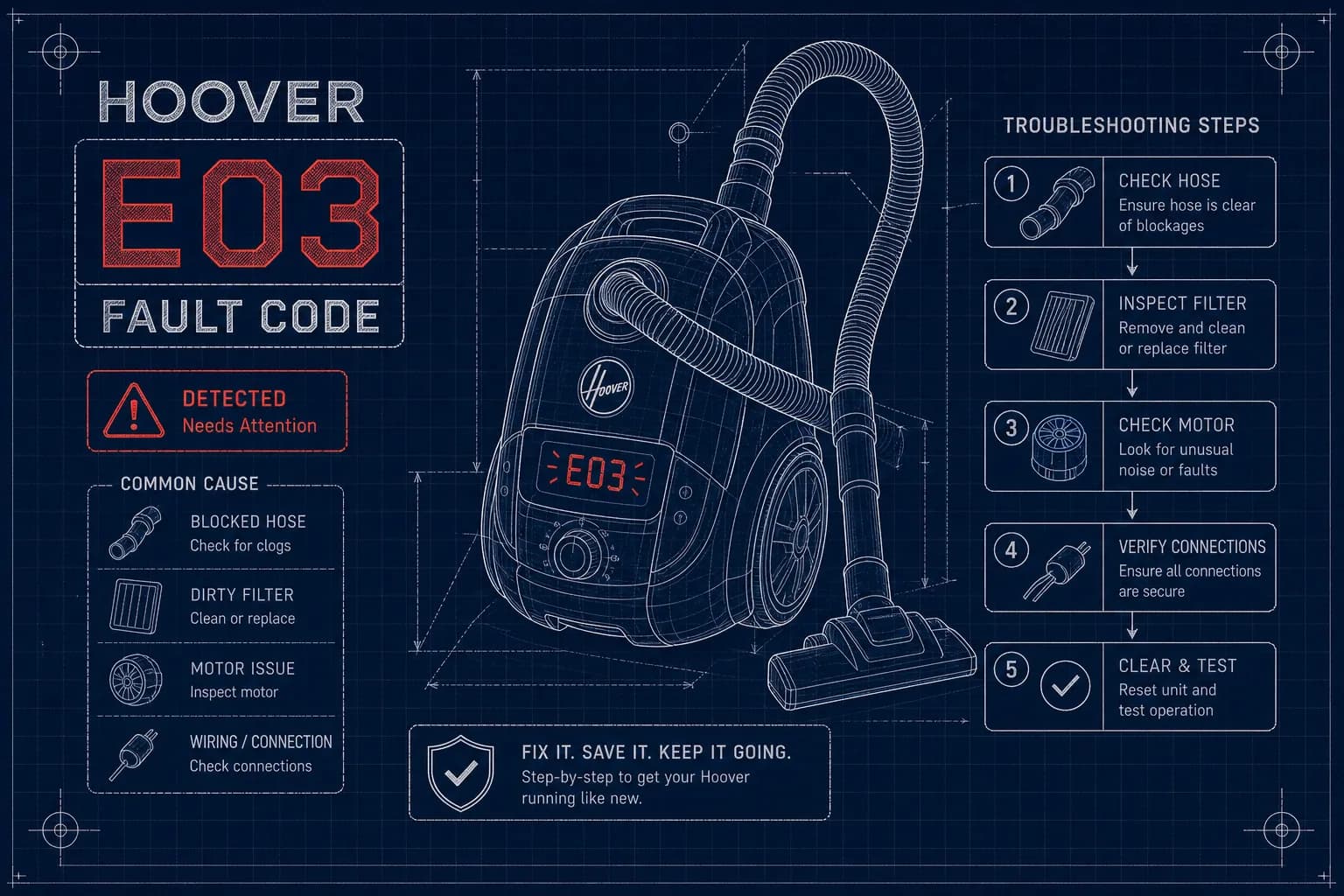
Hoover E03 Fault Code: Step-by-Step Troubleshooting Guide
If your EO3 Hoover washing machine is showing an E03 fault code, this guide explains exactly what it means and how to fix it. E03 is a commonly reported Hoover drain fault, and the good news is that the vast majority of cases are resolved without replacing a single part. The code means your machine failed to drain within its expected time window, so it stopped the cycle to protect itself. Your drum is almost certainly still full of water, and that water needs to go somewhere before you can diagnose anything properly.
This guide walks you through the exact sequence we recommend at Alpha Appliances Ltd: understand what the code means, drain the machine safely, check and clean the filter, inspect the hose, and then assess the pump. Work through it in order and you will either fix the fault yourself or arrive at a clear picture of what a certified engineer needs to do.
EO3 Hoover washing machine, what the E03 code is actually telling you
The E03 error (displayed as E3 on some models without a leading zero) is a drainage fault. Your machine's control board sets a timer when the drain cycle begins, and if the water does not clear within that time limit, the programme halts. It is not a door lock error, not an electrical failure, and not a heating fault. The machine is telling you one thing specifically: water is not leaving the drum fast enough, or not leaving at all.
The code appears across most modern Hoover front-load washing machines with a digital display, including the H-Wash, H-Wash 300, and H-Wash 500 ranges. Many Candy-manufactured Hoover models share the same control logic and produce the identical code. If your display shows E3 rather than E03, treat the cause and fix as exactly the same, you are dealing with a drainage fault and the steps below apply without modification.
The most likely causes of an E03 drain fault
Before touching anything, it helps to know what you are looking for. The four causes below account for the overwhelming majority of E03 faults on an eo3 Hoover washing machine.
- Blocked pump filter: fluff, coins, hair clips, and small fabric items collect in the filter housing until the pump can no longer push water through. Many owners have never cleaned the filter, making this the most common cause by some margin.
- Kinked or blocked drain hose: the grey hose at the back of the machine can develop a tight kink, become crushed against the wall, or accumulate soap deposits that restrict flow. Even a partial restriction is enough to trigger E03 if the pump cannot overcome it within the timed cycle.
- Foreign object in the pump impeller: coins, bra underwires, and small fabric pieces sometimes pass through the filter and reach the impeller itself, jamming or grinding it so it cannot spin properly. The machine tries to drain, fails, and throws the fault.
- Failed pump motor: if the filter and hose are both clear butE03 keeps returning, the pump motor may have burned out electrically. This is less common but does happen. Prolonged strain from partial blockages can increase the risk of pump failure over time.
How to drain the machine safely before doing anything else
If the drum is still full of water, drain it before you attempt to clean the filter or inspect anything. Trying to unscrew the filter cap on a full machine will send several litres of water across your floor in seconds. Lay several towels across the floor in front of the machine and have a shallow tray and an empty bowl ready.
Open the small access flap at the bottom front of the machine. On most Hoover H-Wash models this sits at the bottom-left, though some models position it bottom-right. If your machine has a small emergency drain hose tucked beside the filter cap, pull it out, remove its stopper, and lower the end into your bowl. Water will flow out by gravity. Raise the hose end above the drum level to pause the flow when the bowl is full, empty the bowl, then lower the hose again and continue until the drum is clear.
If your model has no emergency drain hose, clip the main grey drain hose out of the standpipe at the back, lower it to floor level into a bucket, and let gravity do the same job.
EO3 Hoover washing machine: cleaning the drain pump filter
The filter clean is the first practical fix and it resolves E03 in the majority of cases. With the machine unplugged and the drum drained, work through the following steps.
- Confirm the machine is unplugged from the mains. This step is not optional, an unplugged machine is essential before any internal access.
- Place a towel and shallow tray directly in front of the access flap at the bottom of the machine.
- Open the access flap using the pull-tab or a flat-head screwdriver if needed.
- If a small emergency drain hose is present, use it to clear any remaining water before touching the filter cap.
- Turn the filter cap anti-clockwise, a quarter-turn at a time, to unscrew it gradually and control any residual water that escapes.
- Remove the filter completely and pull out all lint, coins, hair clips, and any trapped fabric items.
- Shine a torch into the filter housing and check the impeller recess at the back of the chamber for anything lodged inside. Remove anything present by hand.
- Rinse the filter thoroughly under a tap until the water runs clear.
- Screw the filter back in clockwise until it seats firmly, refit the emergency hose cap, and close the access panel securely.
If the filter cap will not turn, do not force it. Limescale or trapped debris may be jamming the thread. Pour a small amount of warm water into the housing, give it a few minutes to work, and try again slowly. Forcing a stuck filter cap risks cracking the housing.
Checking the drain hose for kinks and blockages
Once the filter is cleaned and refitted, pull the machine slightly away from the wall and inspect the full length of the grey drain hose. Look for tight kinks, crushing where the hose presses against the wall, or any point where it bends more than 90 degrees. Straighten any kinks and confirm the hose outlet sits correctly in the standpipe or over the sink at the right height.
Hoover's installation guidance recommends the hose end sits approximately 60 cm above floor level. Too low and siphoning can occur, which empties the drum mid-cycle and triggers drain faults on machines that interpret it as a failure to retain water correctly.
Run your hand along the length of the hose; if any section feels solid or inflexible rather than hollow and pliable, a soap deposit blockage is likely present. Remove the hose from both ends, take it outside, and flush it through with a garden hose or pour warm water through it until it flows freely. Refit it with the correct standpipe height before testing.
How to tell if the pump itself has failed
With the filter clean and the hose clear, plug the machine back in and run a drain-only or rinse-spin cycle. Stand close and listen at the base of the machine during the drain phase. A healthy pump working against a clear path produces a steady hum and begins moving water within the first minute or so of the drain cycle. A grinding or rattling sound with no water movement suggests something is still obstructing the impeller. Silence during the drain phase, when you would expect to hear the pump running, suggests the motor itself is not being energised.
If you hear grinding, unplug the machine again and reach into the filter housing to turn the impeller with a finger. It should rotate smoothly with light, even resistance. If it is stiff, locked, or grinds when turned, a foreign object remains lodged in the pump body, or the pump has seized internally. At this point the repair goes beyond filter cleaning: the pump needs to be accessed from inside the machine, which involves removing the front or rear panel depending on the model.
If the pump is completely silent during the drain phase, a multimeter test can help confirm whether the motor has failed electrically. Disconnect the pump wiring, place a multimeter probe on each of the two pump terminals, and read the resistance. A healthy pump motor shows a finite resistance reading; expected values vary between pump models, so check the part label or your machine's service documentation for the correct range. An open circuit reading, shown as OL or infinite resistance on the display, confirms the motor windings have burned out and the pump needs replacing. Drain pump replacement on a Hoover washing machine in the UK typically costs between £80 and £150 including parts and labour.
When to stop DIYing and call a certified engineer
If you have cleaned the filter, flushed the hose, confirmed the impeller turns freely, and the E03 code returns on the next cycle, the fault lies beyond what visual inspection and cleaning can reach. A failed pump motor, damaged wiring to the pump, a faulty pressure sensor, or a control board fault can all produce a persistent E03 that no amount of cleaning resolves. Continuing to run the machine in this state risks water damage to flooring and the machine's electrical components.
At Alpha Appliances Ltd, our City & Guilds certified engineers carry the pump components and diagnostic tools needed to resolve Hoover drain faults efficiently. We offer fixed-price repairs at a fixed price with no hidden call-out fees across Greater London, Berkshire, Surrey, Hampshire, and Dorset, with next-day availability when you book online. If the E03 keeps coming back after your checks, booking takes under two minutes and gets an engineer to your door the following day. For eo3 Hoover washing machine repairs across London and the South of England, book online for next-day service.
Final checklist before calling it done
The E03 fault on an eo3 Hoover washing machine is almost always a drainage issue, and it responds well to the sequence in this guide. Before considering the job done, run through these key checks:
- Filter cleaned, rinsed, and refitted securely
- Impeller recess inspected and cleared of any foreign objects
- Drain hose checked for kinks, crushing, and blockages
- Hose outlet height confirmed at approximately 60 cm above floor level
- Test cycle completed and pump sound assessed
Those steps resolve the majority of Hoover E03 faults without any specialist tools. If the code returns after all of that, the pump or a related electrical component needs professional attention, attempting further DIY risks causing additional damage. Alpha Appliances Ltd handles Hoover drain faults across London and the South of England every day, at a fixed price with no surprises on the invoice. If you have worked through this guide and the fault persists, book online or call the team directly to get a certified engineer scheduled for the following day.
Need a repair today?
Book a visit from a certified Alpha engineer in minutes.