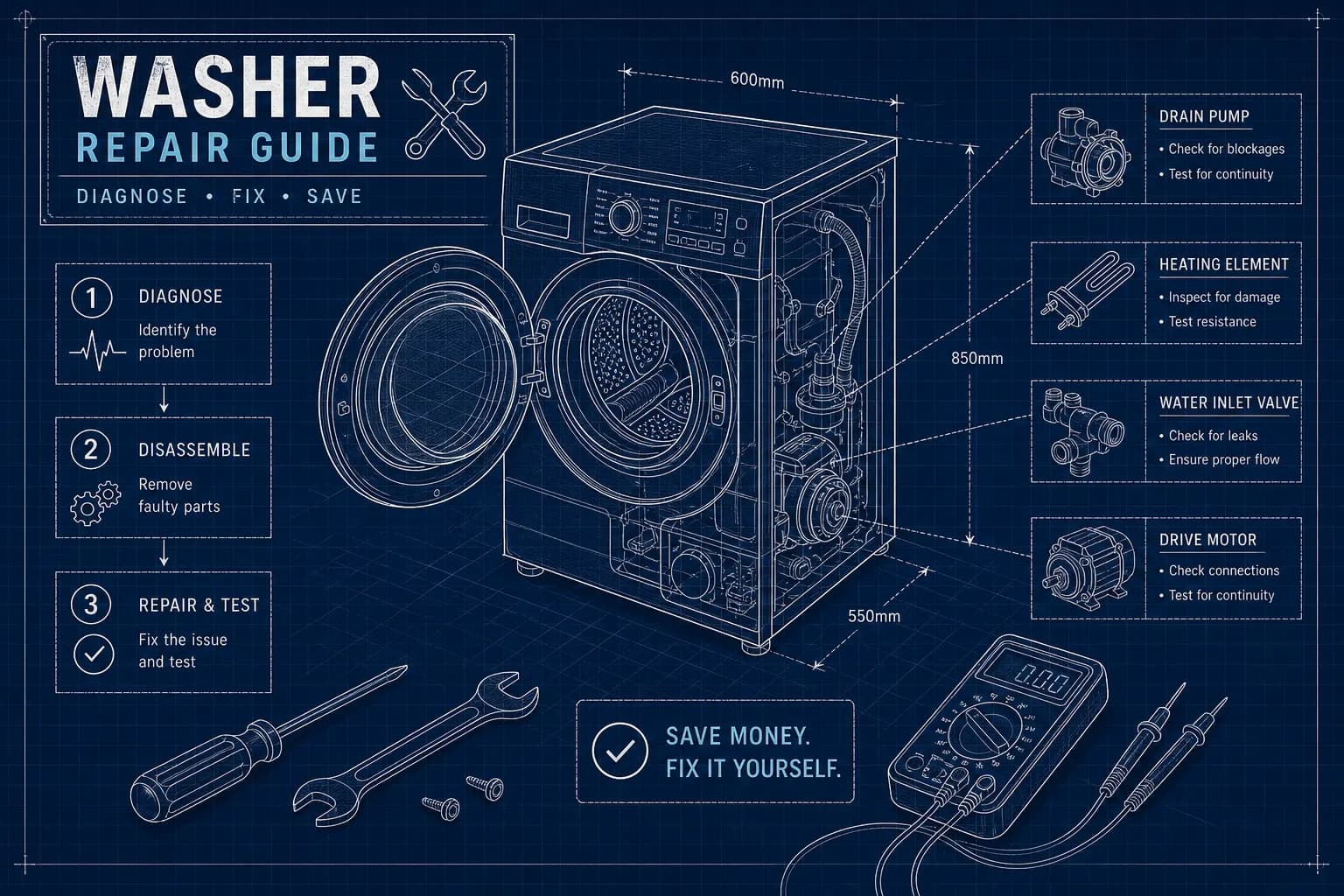
Learn to repair a clothes washer safely and affordably. Step-by-step checks for drain, spin, leaks, tools, UK parts costs, and when to call an engineer.
To repair a clothes washer effectively, start with the simplest checks before assuming the worst, a blocked pump filter alone accounts for a significant proportion of washing machine not draining and washing machine not spinning call-outs. Most washing machine faults fall into several key categories: drainage, spinning, leaks, noise, power failures, and door-lock problems, among others. Many common faults, such as a blocked pump filter, an unbalanced load, or a kinked hose, can be diagnosed quickly and some are fixable in under an hour by a careful homeowner with basic tools. This guide walks through each fault type, explains which repairs are safe to attempt yourself, and covers the tools, UK parts costs, and safety steps involved. By the end, you'll know exactly what's wrong, whether to fix it yourself, and what it will realistically cost either way.
The key is working methodically. Always isolate power and water before opening anything up. Some faults are straightforward; others need a certified appliance engineer. Knowing the difference saves both time and money.
The two faults homeowners encounter most often are a drum that won't spin and water that won't drain. They're frequently linked: many machines refuse to spin while the drum still holds water, so a blocked pump filter or kinked drain hose can cause both problems at once. Symptoms include laundry that comes out soaking wet, a programme that stops mid-cycle, or a door that stays locked after the cycle ends.
Leaks tend to appear in one of two places: during filling, which points to inlet hoses or the inlet valve; or during spinning, which usually means the door seal or drain connections. Excessive vibration and banging during spin typically indicates an unbalanced load, worn suspension components, or a machine sitting on an unlevel surface. A deep grinding or roaring noise that gets louder as spin speed increases is a strong sign of worn drum bearings. If the machine won't start at all, the fault is often as simple as a tripped RCD or a door latch that isn't fully engaging. Filling problems and heating failures are also worth noting as part of any thorough washing machine troubleshooting process.
According to Which? survey data, drum and bearing problems account for around 12% of reported faults, unexplained breakdowns for 11%, and leaks or flooding for 6%. Between them, those three categories make up nearly a third of all reported failures, which makes bearing noise and drainage faults the two most worth understanding in detail.
Cleaning the pump filter is among the most effective DIY fixes for drainage and spin faults, and it costs nothing. Place towels and a shallow container below the lower service panel, unscrew the filter cap slowly, and remove lint, coins, and debris. Check that the external drain hose isn't kinked or pushed too far into the standpipe, which can cause siphoning. Reinstall the filter firmly, run a short drain cycle, and most drainage faults clear straight away.
Excessive vibration during spin is almost always a load-balance or levelling issue before it's a mechanical one. Stop the cycle, redistribute the laundry evenly, and remove a few heavy items if the drum is overloaded. Then place a spirit level on top of the machine and adjust the levelling feet until it sits flat on all four corners, tightening the locking nuts afterwards. If the machine is newly installed, check that the transit bolts have been removed from the rear panel; leaving them in is one of the most common causes of violent shaking during spin.
If the machine won't start, confirm the plug is fully seated and test the wall socket with another appliance. Reset the circuit breaker or RCD if it has tripped, but only once: repeated tripping means a deeper electrical fault that needs a qualified engineer. Check that the door clicks firmly shut and that no fabric is caught in the seal. For a machine that won't fill, check the inlet tap behind the appliance is open and inspect the small mesh filter at the inlet hose connection for limescale blockage.
For most of the DIY repairs covered here, the toolkit is minimal: insulated screwdrivers, pliers, an adjustable spanner, a spirit level, a shallow container, and a generous pile of old towels. A basic multimeter, available for around £10–£15, is worth having if you want to test continuity on a door interlock or heating element. Before ordering any spare part, photograph the rating plate inside the door frame and write down the full model number, including every letter, slash, and suffix. Searching by brand name alone is unreliable; designs change during a model run and a part that fits a similar-looking machine may not fit yours.
The list below shows typical fitted repair costs from a certified engineer in the UK in 2026, which gives you a useful benchmark when weighing DIY against professional appliance repair.
Typical fitted repair costs (UK, 2026):
At Alpha Appliances, a fixed booking fee of £95 inc VAT covers attendance, diagnosis and most repair labour; any parts or additional work are quoted before we proceed.
Parts alone typically cost £15–£80, depending on the component and brand. These figures reflect UK-wide averages; costs in London and the South East may sit towards the higher end of each range. Always confirm compatibility against your exact model number before purchasing, and check the supplier's returns policy in case the part turns out to be incorrect.
Isolating power correctly is non-negotiable. Switch the machine off at the programme controls, then remove the plug from the wall socket entirely. Don't rely on the socket switch alone. Turn off the water supply at the inlet tap behind the machine, then relieve pressure slowly before disconnecting any hoses. Drain residual water through the filter or drain hose before opening panels, and always wait for all moving parts to come to a complete stop before reaching inside.
Keep the work area dry and well lit. Wear suitable gloves, particularly when reaching into the filter housing or around sheet metal edges, which can be sharp. Never bypass the door interlock or earth connection during a repair. If you remove any capacitor or electrical component, treat it as potentially charged until confirmed otherwise using the manufacturer's approved discharge procedure. Refit all panels, reconnect hoses securely, and run a short supervised test cycle before leaving the machine unattended.
Some repairs carry a genuine risk of electric shock, water damage, or a fault that returns worse than before. These include: replacing a heating element or temperature sensor, repairing or replacing the motor or control board, addressing any leak originating from inside the outer tub, and diagnosing or repairing repeated circuit-breaker trips. Worn drum bearings fall firmly into this category. A bearing job involves almost completely disassembling the machine, and many modern washing machines have a sealed outer tub, meaning the entire tub assembly must be replaced. In that situation, professional assessment is essential before spending anything.
For any of those faults, the risk and guesswork of a DIY attempt typically outweigh the labour cost. If you need professional help, choosing an engineer with transparent pricing and a strong first-time fix rate matters. At Alpha Appliances Ltd, our City & Guilds certified engineers carry out fixed-price repairs across London and the South of England, with next-day availability in most areas. There are no hidden call-out fees and no waiting weeks for a manufacturer slot. If a repair isn't economically sensible, we'll tell you that upfront rather than take your money for a job that doesn't make sense.
A practical rule used across the UK appliance trade: repair if the total cost is below 50% of a comparable replacement machine; replace if it meets or exceeds that figure. For a machine past roughly 75% of its expected service life, most washing machines last 10–15 years, tighten that threshold to 25–30% of replacement cost. A £100 repair on a £500 machine is almost always worth doing. A £250 repair on a 12-year-old machine with a history of faults rarely is.
Calculate the total repair cost: parts, labour, call-out fee, and any likely follow-on repairs, not just the headline quote. Then compare that figure against a genuinely equivalent replacement, factoring in energy efficiency and warranty period. If you're not sure whether a repair is economic, a fixed-price diagnostic from a certified appliance engineer gives you a firm number to work with before committing to anything.
Many common washing machine faults can be diagnosed quickly, and a good number are fixable in under an hour. Start with the simple checks: a blocked pump filter, a kinked drain hose, an unlevel machine, or a door latch that isn't closing properly. Follow the isolation steps before opening anything, and always match parts to your exact model number using the rating plate. Doing this well, working methodically through the fault before reaching for a phone, is what separates a needless call-out from a repair you handle yourself with confidence.
When washing machine troubleshooting points to bearings, the heating circuit, the motor, or an internal leak, leave it to a certified appliance engineer who can diagnose it accurately and fix it right the first time. Use the repair threshold guide above to decide whether the job makes financial sense before spending anything.
If you're based in London, the Home Counties, or across the South of England, get in touch with the team at Alpha Appliances Ltd. We offer next-day appointments, fixed prices, and honest advice on whether your machine is worth repairing or better replaced. Book online or call us directly to arrange an engineer visit at a time that suits you.
Look on the rating plate inside the door frame for the full model number and record every letter, slash and suffix exactly as shown. I advise photographing the plate so you have an exact reference when searching for parts, because brand name alone is unreliable and designs can change during a model run.
Many common faults are fixable in under an hour by a careful homeowner with basic tools. I recommend allowing extra time for safety steps, isolating power and water, draining residual water and making careful checks, so plan for a bit longer than the hands-on repair time.
Parts alone typically cost between £15 and £80 depending on the component and brand. I remind you to confirm compatibility against your exact model number before purchasing and to check the supplier's returns policy in case the part turns out to be incorrect.
Repeated tripping indicates a deeper electrical fault that needs a qualified appliance engineer. I recommend resetting the RCD or breaker only once to confirm the fault, then stopping further DIY attempts and booking a certified engineer to diagnose and repair the issue.
Book a visit from a certified Alpha engineer in minutes.
TRUSTED BY HOMEOWNERS
Fast, reliable, and warranty-backed repairs for every major brand.
Discover more tips from Alpha engineers.