
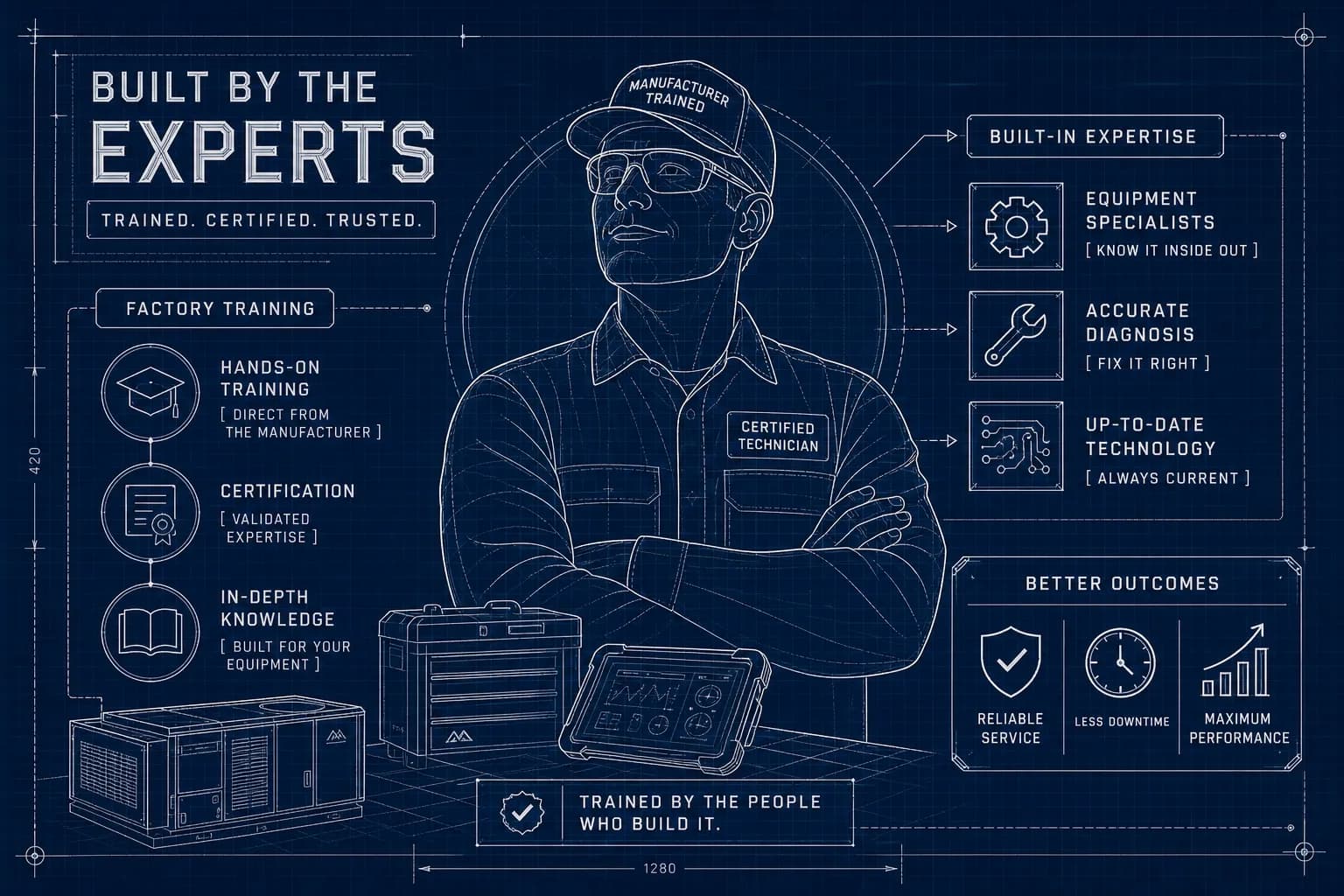
You're on a repair company's website. It says "manufacturer-trained engineers." You nod, assume that's a good thing, and move on to the booking page. Most people do. The problem is that this phrase is used so loosely across the industry that it genuinely means different things depending on who's saying it. For some companies, it reflects rigorous, brand-specific training and formal certification. For others, it's marketing copy built on a two-day product overview from three years ago. What you actually want is a genuine manufacturer trained technician, and knowing what that means is the only way to tell the difference.
This article explains what the term should mean, what questions to ask before you book, and why the distinction has a direct bearing on whether your appliance gets fixed properly the first time. At Alpha Appliances Ltd, our engineers hold OEM training from major brands alongside City & Guilds certification, so we have a clear view of what separates genuine manufacturer-level expertise from claims that don't hold up under scrutiny.
What "manufacturer-trained technician" actually means
The industry draws a clear line between product familiarisation and genuine OEM training, and the difference matters. Product familiarisation is a one-step process: a technician is shown a machine's features, given a brief overview, and sent on their way. It tells them what the appliance does, not how to diagnose or repair it correctly.
Genuine manufacturer training is a two-step process. Knowledge is imparted first, and then specific skills are developed and assessed before the technician is considered qualified. A factory-trained technician doesn't just know what a control board does; they know how to test it, what fault codes mean on that specific model, and the approved repair sequence the manufacturer specifies. That training is delivered directly by the brand (Bosch, Miele, AEG, Samsung), and it is brand- and model-specific, not generic.
The reason this source of training matters is straightforward: only the manufacturer holds the full service documentation for their products. The full service documentation sits with the OEM: wiring diagrams, fault-code libraries, diagnostic software, and approved repair sequences. A manufacturer-authorised technician has trained against those exact documents. A generalist technician has not. That gap may look small on paper, but it becomes significant when something goes wrong with a complex or higher-value appliance.
Why it matters more than most homeowners realise
The practical consequences of using an unqualified engineer are rarely dramatic in the moment. The appliance often appears to be fixed. The real cost shows up weeks later, when the fault returns or a secondary problem emerges that the first repair masked rather than resolved. Manufacturer trained technicians understand how components interact across a specific product range, which is why OEM-certified engineers tend to achieve higher first-time fix rates than generalist repairers.
A correct first-time repair extends your appliance's working life. A botched one accelerates the route to replacement. For a machine that cost several hundred pounds, the difference between a competent repair and a misdiagnosis is not trivial. This is the practical, financial reason why the credentials of the person standing in your kitchen with a toolkit actually matter.
The warranty question is equally important and less well understood. Many manufacturer warranties include clauses that require repairs to be carried out by a qualified, authorised technician using genuine OEM parts. Using an unqualified repairer or non-genuine parts can void the warranty, the precise effect depends on the brand's terms, but the risk is real, even on appliances that are only a year or two old. Genuine parts are manufactured to exact tolerances, carry their own quality assurance, and are typically the only components that will trigger a repair warranty from the repairer. Aftermarket alternatives are cheaper upfront; they can also be a common cause of premature repair failure where quality is lower.
The routes that produce a properly qualified technician in the UK
Understanding how a manufacturer trained technician is built helps you judge whether a company's claims are credible. The starting point in the UK is a recognised vocational qualification. City & Guilds certification is the widely accepted industry benchmark for domestic appliance repair, with the Level 2 Diploma in Electrical and Electronic Servicing providing the recognised baseline for competence, it is the industry standard used to demonstrate qualification to insurers and authorities, though there is no single statutory requirement that mandates it universally. The City & Guilds 224 qualification in Consumer Electrical Appliance Repair and Servicing sits above that, covering electronics at a deeper technical level and requiring a multi-year commitment. For organisations offering formal accreditation and broader industry certification services, these vocational pathways are often the foundation on which brand-specific training is layered.
These are assessment-led qualifications. They cannot be purchased or bypassed; they are earned through demonstrated competence. OEM training from manufacturers typically sits on top of this vocational foundation rather than replacing it. Brands such as Bosch, Miele, and Samsung run their own certified training programmes specifically for engineers who already hold a relevant technical qualification. Many manufacturers publish their course and assessment guidelines, for example, manufacturers and training providers detail their curriculum in documents such as the Bosch training programme guide, and this layered approach is what produces a well-rounded, factory-trained technician: strong foundational electrical knowledge combined with brand-specific product expertise. An engineer with City & Guilds Level 2 and completed Miele OEM training knows both how electricity behaves in a domestic setting and exactly how that brand's specific components are designed to interact.
Gas Safe registration applies to any engineer working on gas appliances, including dual-fuel cookers and gas hobs. This is a legal requirement, not an optional credential, and it is maintained through a publicly searchable register. Safe Contractor accreditation, a widely used third-party health and safety scheme, sits alongside these qualifications and is particularly relevant for landlords and commercial contexts where documented compliance is a requirement. If you're exploring formal course options for technicians, college and training providers also run targeted courses such as a domestic appliance repair course that feed into vocational qualifications.
Certifications to look for and how to check they're genuine
When you're booking an appliance repair, the certifications worth asking about are City & Guilds (Level 2 or 3 in appliance servicing), Gas Safe registration for any gas appliances, and Safe Contractor accreditation if you're a landlord or letting agent with compliance obligations. OEM training certificates issued directly by manufacturers typically carry a unique certificate number; verification methods vary by issuer and may include direct contact with the brand, employer portals, or QR codes on the certificate itself. If you want a concise explanation of related terminology, see industry discussions on what it means to be factory-trained or certified.
Verification is straightforward for the credentials that matter most. Gas Safe registration can be checked in seconds via the official register at gassaferegister.co.uk: enter the engineer's registration number and the result is immediate. For OEM certificates, any reputable company should be able to provide the certificate number and the issuing brand. City & Guilds qualifications are awarded through an assessment process that leaves a clear paper trail.
The red flags are just as instructive as the green ones. Be cautious of vague claims about being "trained to manufacturer standards" without a named qualification or a specific brand attached. Equally, treat with caution any company that hesitates to provide documentation when you ask directly. A company confident in its engineers' credentials will give you that information without hesitation. One that cannot is telling you something important.
How to verify a manufacturer trained technician before you book
Checking credentials takes a matter of minutes. Ask the company for the engineer's Gas Safe registration number and verify it at gassaferegister.co.uk. Request the City & Guilds qualification level and year of award. Ask which brands the engineer holds OEM training for, and request the certificate number so you can follow up with the issuing brand directly if you wish. A reputable manufacturer trained technician and the company employing them will field these questions without hesitation.
Getting manufacturer-level expertise without the manufacturer's wait time
Going directly to the manufacturer for a repair is an option, but it can involve longer waits and more limited local coverage than many homeowners expect. The typical experience involves call-centre triage and booking windows that vary considerably by brand and geography, in many cases stretching to several weeks, particularly outside major urban centres. For a homeowner with a broken washing machine or a landlord dealing with a tenant complaint, that kind of delay is rarely workable. This is the gap that independent certified repair companies exist to fill.
The key is finding an independent company whose engineers hold the same credentials as manufacturer service networks, rather than settling for less simply because an appointment is available sooner. Reputable independents recruit and train engineers to the same standard: City & Guilds certification as the vocational foundation, layered with brand-specific OEM training across the major appliance brands they service.
Alpha Appliances Ltd operates on exactly this model. Our engineers carry dual credentials across brands including Bosch, Miele, AEG, and Samsung, combining City & Guilds vocational certification with brand-specific manufacturer training programmes. We offer next-day availability across Greater London, Berkshire, Surrey, Hampshire, and Dorset, which means homeowners and landlords in our service area get manufacturer-standard repairs without the manufacturer-channel delays. Fixed-price diagnostics and no hidden fees mean you know what you're agreeing to before work begins.
The short version: what to ask and what to expect
A genuine manufacturer trained technician is built on three foundations working in combination. The first is a recognised vocational base qualification, City & Guilds is the UK industry benchmark. The second is brand-specific OEM training delivered directly by the manufacturer, which is what gives a technician access to the service documentation, fault-code libraries, and approved repair sequences that a generalist simply doesn't have. The third is the ability to source and fit genuine OEM parts. Together, these protect your appliance, preserve your warranty, and give you the highest realistic chance of a correct first-time repair.
When you're booking an appliance repair, ask the company directly what their engineers are qualified to. The right answer will be specific: a named qualification, a named brand or brands for OEM training, and the ability to provide certificate numbers if you want to verify. The wrong answer is vague, hedged, or met with reluctance.
You're inviting someone into your home and trusting them with an appliance that represents a significant financial investment. The credentials of that person matter. Ask for them, and expect a straight answer.
Need a repair today?
Book a visit from a certified Alpha engineer in minutes.