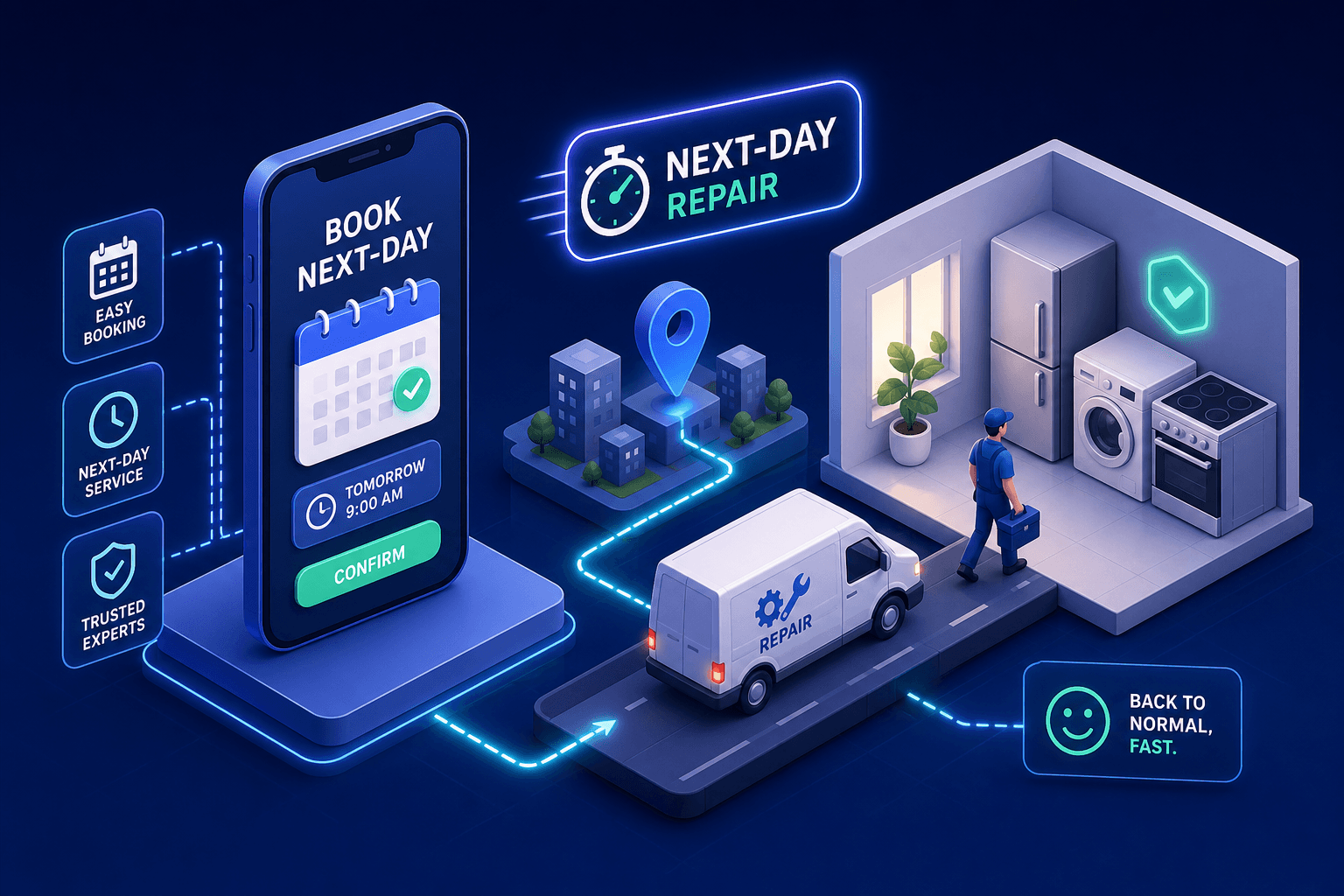
Need next-day appliance repair? Learn how to book a repair service, what to expect in the visit, typical costs, and tips for choosing a reliable local engineer.
A washing machine that stops mid-cycle with a drum full of soaking clothes. A fridge that goes warm overnight, with a full shop of groceries at risk. When an appliance breaks down, the instinct is to panic, and then to resign yourself to a two-week wait for an engineer. But next day appliance repair is far more achievable than most people assume, if you know exactly how to book one and what to have ready when you do.
This guide covers everything you need to get a fast repair confirmed and completed properly: how to secure an urgent appointment, what to prepare before the engineer arrives, what it costs in the UK, and what separates a trustworthy provider from a time-waster. Companies like Alpha Appliances Ltd, which have built their entire operation around next day availability across London and the South of England, show it can be done without cutting corners on quality or certification.
When you contact a manufacturer's helpline after a breakdown, you are entering a national scheduling system built around planned maintenance routes and warranty rotas. Lead times of 7 to 14 days are standard, not exceptions. Local and regional certified engineers work very differently. They route their teams by postcode proximity, carry van stock for the most common faults, and operate flexible daily schedules that allow urgent jobs to be slotted alongside planned work. If an engineer is already covering your area on a given day, your job can often be added to the run for the following morning.
Which? and Checkatrade data consistently show that independent repair services tend to achieve higher first-time fix rates than factory-authorised national teams, partly because local engineers have more scheduling agility and stronger incentives to resolve the job in a single visit. Speed and quality, in this case, tend to go together.
The most common reason a next day repair becomes a two-visit job is not engineer availability: it is whether the fault requires a component the engineer does not carry on the van. Common faults, including pump failures, door seals, heating elements, thermostats, and drain filters, are typically held in stock by any well-prepared engineer. Less common components, particularly for premium models or older appliances, may need to be ordered, which shifts the repair to a return visit.
A reliable provider will flag the parts situation before you confirm the booking, not after they arrive. If a company cannot tell you whether they stock parts for your appliance brand when you call, that is a warning sign worth taking seriously. Ask directly: "Do you carry parts for [brand] on the van?", a confident yes, backed by a first-time fix rate they are willing to quote, is the answer you are looking for. For context on the effects of parts shortages and delays in the industry, see reports describing how parts delays are still affecting repair timelines and what consumers can do to manage the risk: how parts delays are impacting repairs.
What to have ready before you book
Before you pick up the phone or open an online booking form, gather the following: the brand and model number of the appliance (usually on a sticker inside the door or on the back panel), its approximate age, and whether it is still under any manufacturer warranty. The warranty point matters because some policies are voided if an unauthorised engineer carries out the repair. For any gas appliance, confirm the provider is Gas Safe registered before you go any further, this is a legal requirement in the UK, not a bonus credential.
A vague fault description forces the engineer to pack for every possibility. A specific one allows them to bring the most likely parts and arrive prepared. "It's making a noise" tells an engineer very little. "It fills with water but the drum won't spin and it's displaying error code E4" tells them a great deal. Most booking systems, including well-designed online forms, ask for fault details precisely because the accuracy of that description directly affects the chance of a first-time fix on the next day appointment.
Note whether the fault is constant or intermittent, and when it first appeared. Intermittent faults are harder to diagnose, and giving the engineer advance warning helps them approach the visit with the right diagnostic tools.
A professional appliance repair service should confirm your appointment in minutes, not hours. The booking process at Alpha Appliances follows a clean four-step path: select the appliance type, describe the fault, choose an available date and time window, then receive written confirmation. No back-and-forth, no vague "we'll call you back." If a provider cannot tell you their availability and call-out fee within the first conversation, they are not set up for urgent work.
Most modern repair businesses use an appointment system to manage availability and reduce double-booking; for an overview of widely used appointment tools and what to look for when choosing scheduling software, review guides to the best appointment scheduling apps: best appointment scheduling apps.
One question worth asking at the point of booking: is the diagnostic or call-out fee deducted from the repair cost if you proceed? With transparent providers, the answer is yes. With less straightforward ones, you may end up paying twice.
Once you have booked, a well-run service will send written confirmation of the appointment window, whether that is a morning or afternoon slot or a tighter two-hour window. You should also receive the name and credentials of the attending engineer, a contact number to use if there are delays, and clear terms covering what happens if parts need to be ordered: specifically, whether the return visit is included or charged separately. If a provider's confirmation is a single text message with no detail, ask for more before the day arrives.
A small amount of preparation on your side makes a meaningful difference to how quickly the engineer can work. Clear the area around the appliance so there is no furniture to move before work can begin. For washing machines and dishwashers, leave the drum or interior empty and do not run a cycle immediately before the visit, as the engineer may need to inspect the drum, seals, or drainage in their current state. For fridges and freezers, move perishables to a cool bag or a neighbour's freezer if you can, so the engineer can access the interior and rear panel without concern.
Make sure someone over 18 is at home for the full duration of the visit. Engineers cannot legally begin work without an adult present, and a missed appointment on a next day slot is a frustrating waste of an early booking.
Most common faults on mainstream appliance brands are resolved in a single visit, typically within 45 to 90 minutes. A well-stocked, manufacturer-trained engineer working to a high standard can achieve a first-time fix rate of around 78%, the figure Alpha Appliances maintains across their call-outs. When a specialist part is required, the engineer will diagnose the fault fully, confirm the component needed, place the order, and book a return visit at no extra diagnostic charge.
A reputable provider will also issue a written service report after every visit. For landlords managing rental properties, this documentation is particularly important: it provides a timestamped record of the fault, the work carried out, and the parts used, which supports compliance obligations and protects against disputes with tenants.
Budgeting realistically for an urgent repair means understanding how costs are structured. In London and the South of England, call-out or diagnostic fees typically fall between £60 and £125, averaging around £105 according to Checkatrade data on appliance repair costs. The repair cost itself depends on the appliance and the fault:
For most households booking a standard next day repair on a common fault, the total cost, parts and labour combined, typically falls between £95 and £250. Emergency or weekend slots can add 25 to 50 percent to those figures with some providers, which is worth confirming before you book.
Hourly billing on an urgent repair creates a specific kind of stress: you do not know the final number until the job is done, which is exactly when you are least able to negotiate. Fixed-price or upfront-quoted repairs, where you approve the cost before any work begins, remove that uncertainty entirely. With honest providers, the diagnostic fee is deducted from the repair total if you proceed. With others, it is charged on top, which means you are effectively paying a premium just for someone to tell you what is wrong.
When you need an engineer in your home quickly, the temptation is to book whoever is available soonest. That is understandable, but speed without credibility is a poor trade. The certifications worth checking are: City and Guilds qualification, which confirms formal training in domestic appliance repair; Gas Safe registration, which is a legal requirement for any work involving a gas appliance; and Safe Contractor approval, which signals the company meets recognised health and safety standards. For premium brands including Miele, Bosch, AEG, and Samsung, manufacturer-trained technicians make a genuine difference because they understand model-specific faults and use genuine replacement parts. Proof of public liability insurance rounds out the minimum standard: it protects you if anything goes wrong during the visit. For more detail on typical technician qualifications you can expect, see an overview of appliance repair technician qualifications.
Before you give a provider the go-ahead, run through these questions quickly. Do you carry parts for my appliance brand in the van? What is your first-time fix rate? Will I receive a written service report after the visit? If parts need to be ordered, is the return visit charged separately? Is the call-out fee deducted from the repair cost if I proceed? A provider who answers these confidently and consistently has built a service worth trusting. One who hedges or redirects has not.
Alpha Appliances Ltd meets every one of those benchmarks: City and Guilds certified engineers, Gas Safe registered, Safe Contractor approved, a 78% first-time fix rate, and fixed-price repairs with no hidden fees. For anyone across Greater London, Berkshire, Surrey, Hampshire, and Dorset, they are the practical first call when an appliance breaks down. They also provide dedicated services for central areas, see their London Bridge same-day appliance fixes, and localised coverage including same-day appliance repairs in East Ham for east London streets and suburbs.
Next day appliance repair is not a headline designed to get clicks. It is a realistic outcome when you book correctly, choose the right provider, and give the engineer what they need to do the job properly. The biggest factor is usually booking early in the day with your appliance details ready and a certified provider who quotes upfront, that combination is what turns a stressful breakdown into a problem resolved by tomorrow.
For homeowners and landlords across London and the South of England, Alpha Appliances Ltd offers a four-step online booking system that takes minutes to complete, with next day availability and City and Guilds certified engineers who arrive prepared to fix the problem on the first visit. The sooner it is booked, the sooner it is resolved. Book online today or call to confirm your next day slot.
Book a visit from a certified Alpha engineer in minutes.
TRUSTED BY HOMEOWNERS
Fast, reliable, and warranty-backed repairs for every major brand.
Discover more tips from Alpha engineers.