
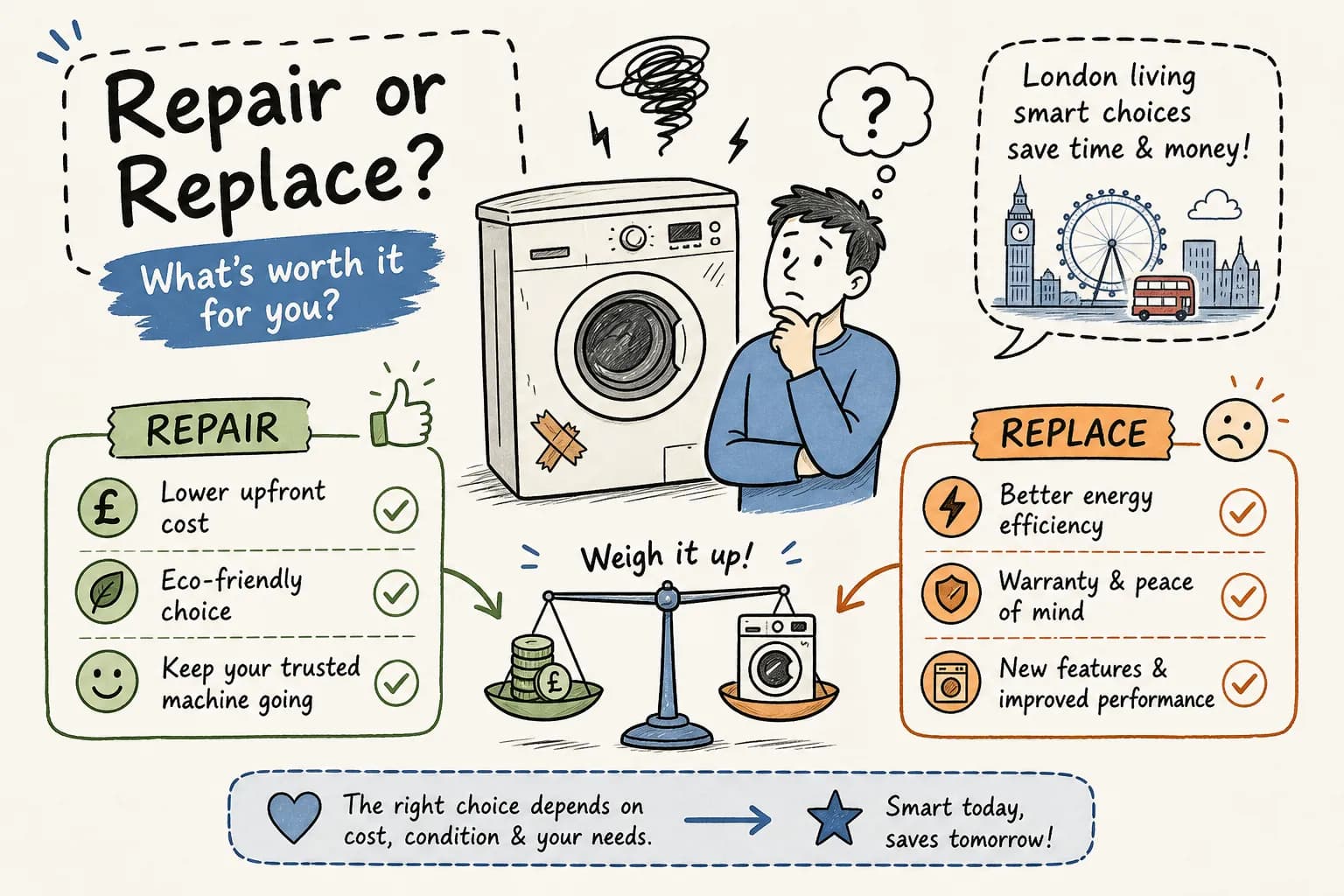
Is It Worth Repairing an Old Washing Machine in London?
Your washing machine stops mid-cycle, leaves a puddle on the kitchen floor, or simply refuses to start. Within about thirty seconds, you've already started calculating whether to call an engineer or head straight to the nearest appliance retailer. In London, where replacement costs, installation fees and living costs are all higher than the national average, that decision carries real weight, and getting it wrong in either direction costs you money you didn't need to spend. So is it worth repairing an old washing machine in London, or should you replace it? The answer depends on four factors you can work through right now.
After more than a decade of repairing washing machines across Greater London, the patterns behind this decision are well-established. Many people make it far harder than it needs to be because they're guessing at costs they don't actually know yet. The answer almost always comes down to: how old the machine is, what the repair will cost relative to a replacement, which specific fault you're dealing with, and whether the energy savings from a new machine are genuinely meaningful in your situation.
Work through each of these honestly and the right answer becomes clear quickly. Here's how to do it.
How your washing machine's age shapes the whole decision
Modern washing machines are built to last roughly 10 to 14 years under typical household use. That lifespan matters because a repair doesn't just fix a fault; it buys you time. A pump replacement on a four-year-old machine may extend its life substantially. The same repair on a twelve-year-old machine is more likely to buy you a short window before the next fault appears, how long depends on the model, usage pattern, and overall condition of the machine.
The ten-year mark is where the calculus of repair changes fundamentally. Once your machine crosses it, you are paying to extend the life of something already in its final chapter. That's not automatically a reason to refuse a repair, but it does mean the cost threshold for what counts as worthwhile shrinks considerably.
Machines between seven and ten years old sit in a genuine grey zone. Washing machine components tend to wear in clusters: the pump, door seal and drum bearings all face continuous mechanical stress, and failure rates climb sharply in the seven-to-ten year period. A machine that needed no repairs in its first five years can suddenly need multiple faults addressed in quick succession once wear-related degradation sets in. If your machine is in this age range, the age factor alone should make you cautious about committing to a major repair. If it's over ten years old, the age factor is working firmly against you.
The repair cost threshold every London homeowner should know
The most reliable rule of thumb used by appliance engineers and consumer advisers is the 50% rule: if the repair quote comes to more than half the cost of a comparable replacement machine, replace it. Below that threshold, repair is usually the smarter financial move, assuming the machine isn't already too old.
In London in 2026, a decent mid-range washing machine typically costs between £400 and £550, with some premium models reaching higher. That puts the repair threshold at roughly £200 to £275 for a standard machine. For a premium machine priced between £800 and £1,200, the threshold rises to £400 to £600. These numbers give you a working target before you've even spoken to an engineer.
London repair costs run higher than the UK average because of elevated labour rates, call-out fees and the practical costs of working in the capital. A washing machine diagnostic fee in London typically falls between £60 and £110. A straightforward repair, such as a pump or door seal replacement, usually comes in at £100 to £200 all-in. Mid-range repairs covering drum bearings or motor brushes generally land at £150 to £300. Major work on a motor or control board (PCB) can reach £300 to £450 or more once labour and parts are combined. The 50% rule applies to these realistic London figures, not to generic national averages you might find online.
Repair vs replace: is it worth repairing an old washing machine in London?
To answer that question properly, you need a real quote, not an estimate based on forum posts or a quick internet search. The sections below on fault types and replacement costs will help you understand what that quote is likely to look like before the engineer arrives.
Which faults are worth fixing and which signal something worse
Which faults are worth fixing and which signal something worse
Not all washing machine faults carry the same risk, and understanding the difference between a routine repair and a warning sign can save you from spending money in the wrong direction.
Certain repairs are straightforward, relatively inexpensive, and do not indicate deeper systemic failure. A pump replacement, a new door seal, or a drive belt swap typically costs between £100 and £200 in London. If your machine is failing to drain, leaking slightly from the door, or running noisily due to a worn belt, a repair almost certainly makes financial sense on a machine under eight years old. These are wear-and-tear parts, not signs that the machine is fundamentally failing.
Drum bearing failure, motor replacement, and PCB faults are a different matter entirely. These repairs regularly cost £200 to £450 or more in London, pushing them close to or beyond the 50% threshold for a standard-priced machine. More importantly, these faults often signal broader mechanical ageing rather than an isolated component failure. On a machine that is already eight years old or more, a motor or control board fault is frequently the first of several expensive repairs to arrive in quick succession. Spending £350 on a ten-year-old machine with a failed PCB is a high-risk financial bet, not a sensible repair decision.
Will a new machine actually save money on your energy bills?
Older washing machines are significantly less efficient than current models. A machine manufactured before 2015 can use between 0.9 and 1.34 kWh per cycle, compared to 0.40 to 0.49 kWh for a modern A-rated equivalent. Across a typical London household doing four washes a week, that gap adds up to roughly 40 to 50 kWh per year in electricity, worth around £11 to £13 at current UK rates.
On water usage, older models consume approximately 65 to 80 litres per cycle compared to 45 to 55 litres for newer energy-efficient washing machines, saving around 4,000 to 5,000 litres annually. Combined electricity and water savings typically come to £30 to £35 per year for a UK household.
Those savings are real, but they take a long time to justify a replacement on their own. At £35 per year in savings, a £600 machine takes over fifteen years to pay back through energy bills alone. Running cost savings should support your replacement decision when you're already close to the threshold on cost or age grounds, they should not be the reason you replace a machine you could have repaired for £150.
Why replacement costs more in London than people expect
Many London residents underestimate what a genuine like-for-like replacement actually costs once you factor in the full picture. A reliable mid-range washing machine in 2026 costs between £400 and £550, with some models reaching higher. Delivery and standard installation in London typically adds £40 to £80, though some buildings, particularly flats in converted Victorian houses or high-rise developments, add complexity that can push fitting costs further still, especially where plumbing work is involved.
This elevated total replacement cost actually works in favour of repair for many London households. If a repair comes in at £180 and a comparable replacement costs £600 all-in, the 50% threshold puts repair firmly in the worthwhile column, even on a machine that is eight years old. The same £180 repair looks different when compared against a £350 replacement budget, which is closer to what some households are genuinely working with.
On disposal, many London boroughs offer free or low-cost bulky waste collections for old washing machines, including Barking and Dagenham, Merton, Wandsworth, Harrow, Enfield and Newham. Some appliance retailers will take the old machine away when delivering the replacement. The WRAP Recycle Now postcode finder shows the nearest certified recycling drop-off point. These logistics are worth factoring into your timeline, because an immediate replacement is rarely as straightforward as it feels in the moment.
The smartest first step before you commit to either decision
The biggest mistake people make when a washing machine breaks down is reaching a conclusion before they have the information needed to reach one. An internet search might suggest drum bearing failure when the actual fault is a worn pump: a £180 repair instead of a £400 one. Or it might flag what seems like a cheap fix that, on inspection, turns out to be a symptom of a failing PCB on a twelve-year-old machine where replacement is the only sensible path.
A professional diagnostic visit gives you a concrete repair quote and an honest appraisal of the machine's overall condition. That is the only information that lets you apply the 50% rule with genuine confidence rather than guesswork. Without a real quote, you're calculating a percentage of an imaginary number.
Our team at Alpha Appliances Ltd offers fixed-price diagnostic visits across Greater London, carried out by City and Guilds certified engineers with no hidden fees. You know the cost of the assessment upfront, and the engineer will give you a clear, honest quote along with their professional view on whether repairing your old washing machine makes sense for your specific machine, fault, and age, before any money changes hands on parts or labour. A diagnostic assessment is a low-risk way to get a certified verdict before committing to a costly replacement you may not actually need.
Making the call: a straightforward decision framework
Start with the age. If the machine is under seven years old, lean towards repair unless the fault is severe. Between seven and ten years, apply the 50% rule carefully and weigh the fault type. Over ten years, the burden of proof sits firmly with repair. Then get a real quote, apply the 50% rule using London's realistic all-in replacement figures, and consider whether the fault is a routine wear part or a sign of deeper mechanical ageing.
Energy savings are worth considering, but they rarely change the decision on their own. Replacement logistics in London take time and cost more than people expect. Both of these points generally favour giving repair a fair hearing first.
Before you commit to a replacement, contact the Alpha Appliances team to book a fixed-price diagnostic visit. One engineer visit could save you several hundred pounds, or give you the clear confirmation you need to move on. Either way, you'll be making the decision on actual facts rather than an expensive guess. That's the right way to decide whether it's worth repairing an old washing machine in London or whether replacement is the smarter call.
Need a repair today?
Book a visit from a certified Alpha engineer in minutes.