
7 Common Panasonic Microwave Faults and How to Repair Them
You go to heat your lunch, the microwave hums, the turntable sits completely still, and nothing happens. No warmth, no steam, just a maddening lack of hot food. It is one of those faults that catches you off guard precisely because microwaves are so reliable day to day. Panasonic microwaves in particular have a strong reputation for longevity, but even the best appliances develop faults over time. Knowing which fault you are dealing with is half the battle when it comes to Panasonic microwave repairs, because the fix for a blown fuse is entirely different from the fix for a failing magnetron. Alpha Appliances Ltd provides Panasonic microwave repairs across London and the Home Counties, covering everything from simple component swaps to complex internal faults. This guide covers the seven most common faults, what causes them, which checks are safe to carry out yourself, and when to call in a qualified technician.
Panasonic Microwave Repairs: The 7 Most Common Faults
Heating and power faults
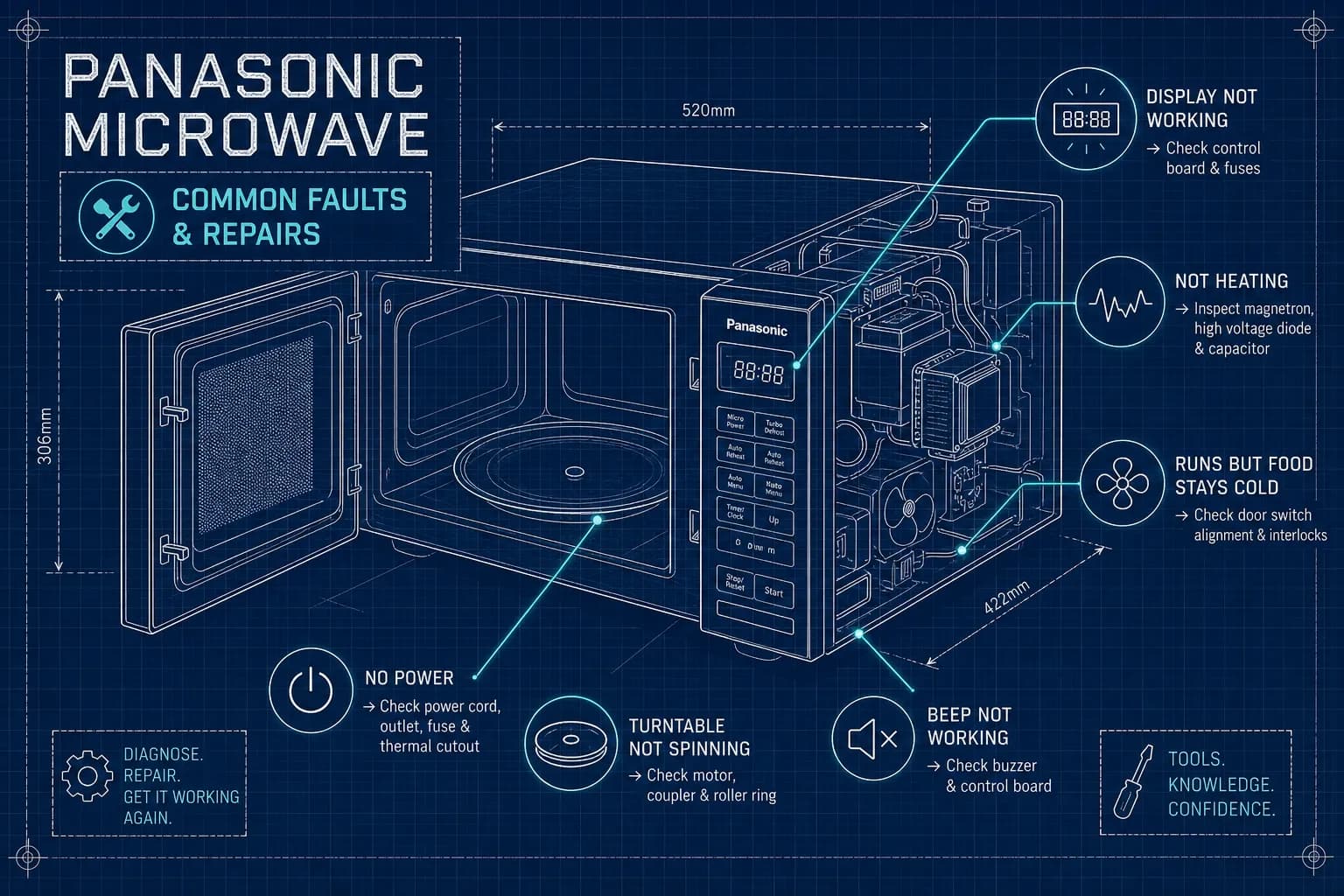
The most alarming fault is also one of the most common: the microwave runs through its cycle but produces no heat. This commonly points to a failed magnetron, the component that generates the microwave energy itself, though other causes, including inverter-circuit faults (error codes H97 or H95), a blown internal fuse, or a faulty high-voltage capacitor, are also regularly reported. When the magnetron fails, the appliance behaves normally in every other respect, which is why owners often assume the fault must be minor.
Sparking or arcing inside the cavity is a different problem entirely and one you should take seriously. The usual culprit is a damaged or burnt waveguide cover, the small mica panel that sits inside the cavity wall. Food residue baked onto the cavity lining can also cause arcing, as can a crack in the cavity itself. In rarer cases, sparking signals a magnetron issue rather than a surface fault, so do not assume a simple clean will solve it if the problem persists.
A microwave that will not start or has lost power entirely is most often caused by a blown internal fuse, a tripped door interlock switch, or a failed control board. The door interlock switch is a safety mechanism that cuts the appliance if the door is not properly closed, so a misaligned door can mimic a total power failure. It is worth checking the door seating before assuming the worst.
Mechanical and display faults
A turntable that refuses to spin is one of the most frequently reported mechanical faults on Panasonic models. The ring, roller guide, or turntable motor can all wear out independently, and a cracked drive bushing or jammed coupling is often the specific point of failure. The good news is that the turntable assembly is accessible and safe to inspect yourself.
Display errors and an unresponsive keypad most often indicate control panel failure, moisture ingress behind the display membrane, or a software glitch. Panasonic models use error codes, including H97 for inverter or magnetron faults and H95 for inverter-circuit problems, to flag internal issues. A display showing unusual codes is the appliance telling you it needs professional attention, not just a power reset.
A door that will not close or latch properly is both a functional fault and a safety one. Worn or broken door latch hooks and failed door switches are the usual cause, and both trigger the safety cut-out that prevents the unit from running at all. Loud or unusual noises during operation, particularly rattling or grinding, typically indicate a worn turntable motor or a component that has worked loose inside the cavity.
Safe DIY Checks vs Faults That Need a Certified Engineer
What you can safely check at home
Before calling an engineer, there are several checks a homeowner can safely carry out without opening the casing. Start by inspecting the glass turntable ring and roller guide for debris, cracks, or misalignment. These are straightforward to remove, clean, and reseat. While you are in there, take a look at the waveguide cover. A burnt or discoloured mica panel can cause sparking and costs very little to replace; cleaning it with a damp cloth when it is only lightly soiled can prevent the problem from developing further.
Check the door seal and latch visually for obvious cracks or warping, then try a full power reset: unplug the unit, wait 60 seconds, and restart it. Display errors sometimes clear after a reset, particularly if they are software-related rather than a symptom of a physical fault. Finally, confirm the fuse in the plug has not blown. Beyond these steps, any further investigation means opening the casing, and that is where the risks begin.
Faults that must go to a qualified technician
Never open the outer casing of a microwave yourself. The high-voltage capacitor inside can retain a lethal charge even when the appliance is fully unplugged and has been sitting unused for hours. This is not a generalised caution; it is the reason repairing a microwave carries a higher risk than almost any other domestic appliance.
Magnetron replacement, capacitor work, control board replacement, and door switch repairs all require a trained microwave engineer with the correct discharge tools and safety equipment. Attempting any of these without proper training also voids any remaining Panasonic warranty, turning a covered repair into an out-of-pocket one.
What Panasonic Microwave Repairs Cost in the UK
Typical part-by-part repair costs
Understanding typical costs before you book helps you have a more productive conversation with your engineer. Here is what you can realistically expect for the most common Panasonic microwave repairs in 2026:
- Magnetron replacement: £60, £180
- Door latch or door switch: £30, £65
- Control panel or keypad: £60, £180
- Turntable motor: £55, £120
- Capacitor: £30, £110
Most engineers also charge a diagnostic or call-out fee of £45, £95, though reputable services often deduct this from the final bill if you proceed with the repair. The cheapest fix of all is a waveguide cover replacement, typically a very modest outlay for the part alone, making it worth addressing early rather than waiting for the damage to spread.
The repair vs replace decision
The 50% rule, if a repair costs more than half the replacement price of an equivalent model, is the standard benchmark most appliance engineers use. For a mid-range Panasonic microwave costing £150, £300, a door switch repair or turntable motor replacement will almost always make sense economically. A magnetron replacement in an older model is where the calculation becomes tighter, particularly if the appliance already has several years of heavy use behind it. A fixed-price diagnostic from a qualified engineer gives you the numbers to make that decision clearly, without committing to anything upfront.
Panasonic's UK Warranty: What It Covers and How to Claim
Standard cover and the extended warranty promotion
Panasonic UK provides a 12-month warranty from the date of purchase, covering manufacturing defects and faulty parts. Panasonic decides at its own discretion whether to repair or replace the faulty unit. For eligible Airfry Combination Microwave models, Panasonic runs a promotional extension of up to five years in total (one year standard plus four additional years), but it requires registration within 90 days of purchase and is limited to UK and Republic of Ireland residents who bought the appliance from a participating retailer.
The warranty does not cover accidental damage, misuse, repairs attempted by non-approved engineers, cosmetic parts, consumables such as filters and turntable trays, or damage caused by incorrect installation. If your built-in microwave cannot be accessed because of the way it was installed, Panasonic may be unable to provide a warranty repair until the unit is freed from its housing.
How to make a warranty claim
Contact Panasonic UK Customer Care on 0344 844 3899 (Monday to Friday, 9am to 5pm, excluding bank holidays) with your proof of purchase and model number. For eligible extended warranty claims, the registration and claim process is handled online via Panasonic's promotions portal; you will need to upload a copy of the full purchase receipt showing the model number and date of purchase, and you should allow up to 28 days for processing. The critical point: having any internal repair attempted by an uncertified technician before making a warranty claim will void your cover entirely, so always check warranty status before booking any paid repair.
Finding a Trusted Engineer for Panasonic Microwave Repairs Near You
Official Panasonic support routes in the UK
Panasonic UK does not publish a universal list of microwave service centres. The official route for out-of-warranty repairs is to contact the Customer Care line on 0344 844 3899 or use the support portal at panasonic.dkavs.co.uk to be directed to the nearest authorised option. If you are searching for Panasonic microwave repair near you, it is worth verifying that any engineer you contact holds relevant manufacturer training and carries genuine parts. Coverage, availability, and pricing vary between providers, so confirm all three before booking.
Why manufacturer-trained local engineers are worth it for complex faults
For internal faults such as magnetron failure or control board issues, a general handyman is not the right call. These repairs require brand-specific knowledge, correct safety procedures for high-voltage components, and access to genuine Panasonic parts. Using an unqualified repairer risks a poor outcome and the loss of any remaining warranty protection.
Alpha Appliances Ltd carries out Panasonic microwave repairs across London and the Home Counties, with manufacturer-trained technicians, fixed-price diagnostics, and no surprise call-out fees. You know the full cost before any work begins, and next-day availability means you are not waiting a fortnight to get your kitchen back to normal. Get in touch to request a fixed-price quote.
What to Expect When You Book a Microwave Repair
Typical turnaround times
Simple faults such as a blown fuse or a door switch repair are often completed on the same visit in 30 to 60 minutes. Standard repairs typically take one to two hours on site, with same-day or next-day availability common from local engineers across London and the South of England. Parts-dependent repairs, where a magnetron or control board needs ordering, usually take two to five working days. For older or discontinued Panasonic models, parts can take longer to source, so the earlier you book, the better.
What to have ready before you book
Locate your microwave's model number before you call; it is usually printed on a label inside the door frame or on the back of the unit. Have your proof of purchase ready if the appliance may still be under warranty. Prepare a brief description of the fault and when it first appeared. That last detail matters more than it might seem: an engineer who arrives knowing the likely fault can bring the most probable parts in the van, which significantly improves the chance of a first-time fix and saves you waiting for a return visit.
Get It Fixed Properly, Without the Stress
Panasonic microwave faults range from simple surface fixes, such as replacing a waveguide cover or reseating a turntable ring, to internal electrical faults that carry genuine safety risks and demand a trained engineer. The faults in the middle ground, door switches, display errors, turntable motors, are usually straightforward and cost-effective repairs that make financial sense on any Panasonic model in reasonable condition.
The approach is the same regardless of the fault: check your warranty first, carry out only the safe external checks yourself, and for anything involving the casing or internal components, book a qualified technician. Repairing a Panasonic microwave does not need to be stressful or expensive when you go in with the right information.
For readers in London and the Home Counties looking for a manufacturer-trained engineer with fixed-price diagnostics and next-day availability, Alpha Appliances Ltd is ready to help. Get in touch with our team for a fixed-price quote before committing to anything, you will know exactly what your repair will cost and how quickly it can be done.
Need a repair today?
Book a visit from a certified Alpha engineer in minutes.