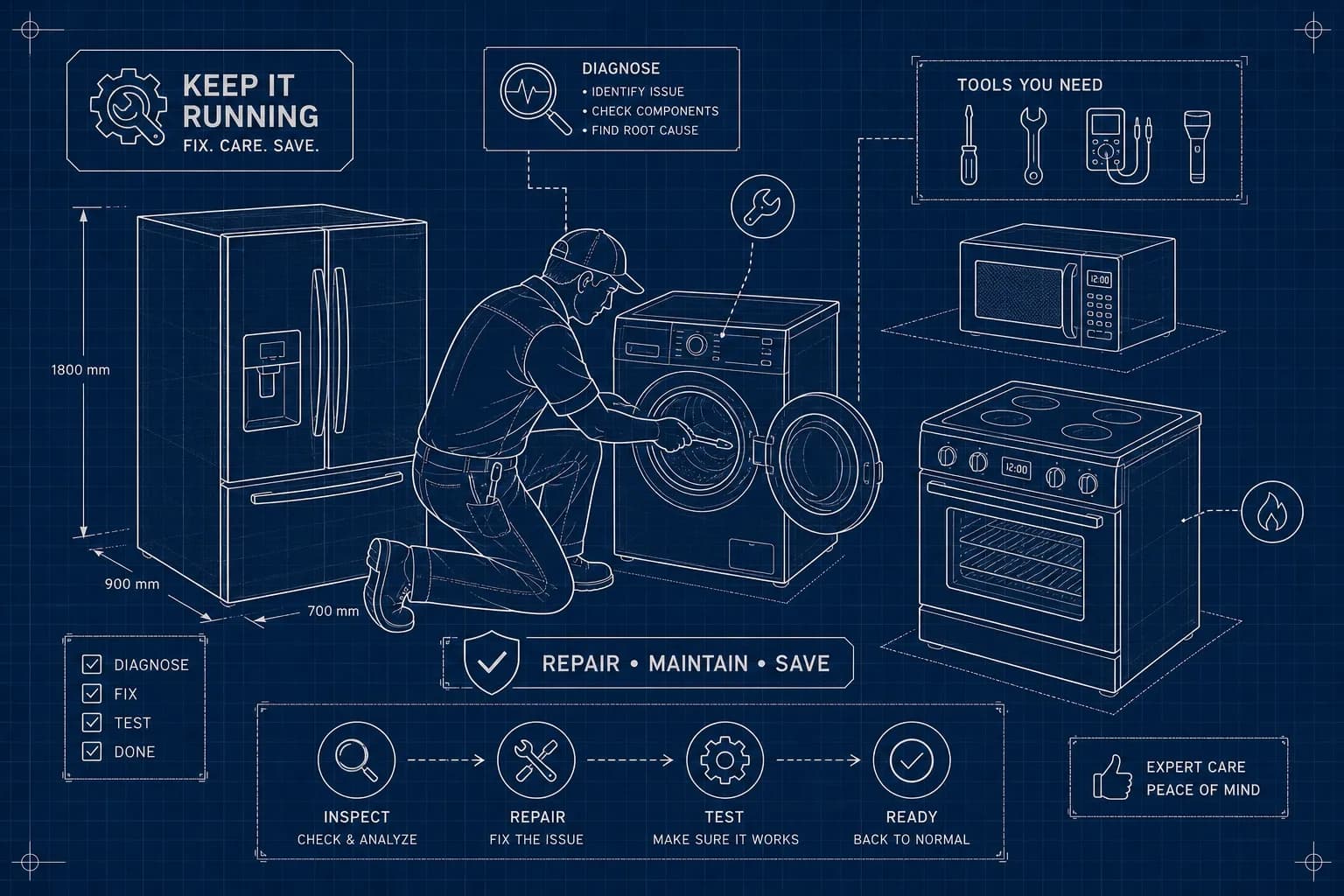
Practical domestic appliance repair guide for UK homes: quick checks before you call, realistic 2026 costs, repair-or-replace guidance and engineer vetting tips.
Domestic appliance repair covers the diagnosis, parts and labour needed to restore washing machines, dishwashers, ovens and fridge-freezers to working order. Many faults are resolved on the first visit when a suitably qualified engineer attends. Alpha Appliances Ltd, for instance, completes 78% of repairs on the first visit. Knowing what questions to ask before you book makes all the difference between a smooth repair and a costly second visit.
This guide gives you quick DIY checks to try before calling anyone, realistic 2026 cost data across the UK, a clear framework for deciding whether to repair or replace, and a practical checklist for vetting engineers.
The vast majority of call-outs begin with the simplest checks: confirm power, try a reset, inspect for obvious blockages and verify the settings. Before touching any filter, hose or internal component, switch the appliance off at the wall and unplug it. For water-connected machines, close the isolation tap too. Stop immediately if you smell burning, see scorching or notice water near electrical parts.
The three most common causes are an unbalanced load, a kinked drain hose and a blocked pump filter. Pause the cycle, redistribute the laundry evenly and remove any excess items. If water remains in the drum, check the drain hose for kinks and clean the pump filter as described in your manual, placing a towel and shallow container underneath before you open the filter cap. After clearing it, run a drain and spin cycle. If the machine hums without moving, leaks, or makes a grinding noise, those checks have reached their limit and a qualified appliance engineer is the sensible next step.
For a dishwasher that won't drain, use the Cancel/Drain function, then remove the bottom rack and clean the accessible filter and sump thoroughly. Check the drain hose under the sink for kinks or crushing. If water keeps accumulating, stop running cycles and call for service. For an electric oven that won't heat, confirm the correct mode is selected (Bake, not Warm or a timed-delay setting) and check whether a tripped double-pole breaker is the culprit. If it trips again after resetting, stop. If you can see a cracked bake element without removing panels, that is a job for an engineer. For a gas oven, any smell of gas means you shut off the supply, leave the room, avoid switches and call a Gas Safe registered engineer. Do not attempt gas work yourself under any circumstances.
Confirm the plug is secure, the breaker has not tripped and the temperature control has not been accidentally adjusted. Check that food is not blocking the internal air vents, that the door seals make firm contact all the way round, and clear any dust from accessible condenser coils at the back or underneath after unplugging. If both the fridge and freezer compartments are warm, the compressor is clicking repeatedly, or cooling does not recover after these steps, the fault is in engineer territory. Do not attempt refrigerant-system work.
These figures generally cover call-out, labour and common parts. Confirm upfront whether VAT, the diagnostic fee and any follow-up visit are included in the quote.
London engineers bill around £60–£75 per hour, according to 2026 rate data from MyJobQuote.
With hourly billing, parts and diagnostic time are itemised separately, so the final total is uncertain until the job is done. A fixed-price model gives you a confirmed total before work starts, protecting you from scope creep on straightforward faults. Ask any engineer whether the diagnostic fee is deducted from the final bill if the repair goes ahead; not all of them do this automatically, and it is worth clarifying before you agree to anything.
The practical rule of thumb is this: repair if the quoted cost is below roughly 50% of a comparable replacement and the appliance is in the first half of its expected lifespan. Washing machines typically last 8–12 years; fridge-freezers and ovens, 10–15 years. Once an appliance is past 75% of its expected life, even a repair costing only 30% of replacement value may be poor value, because other components are likely to fail shortly afterwards. A written repair quote makes this calculation straightforward.
For appliances used occasionally, such as ovens, energy savings rarely shift the decision. The environmental case for repair is strong: it avoids the embodied carbon of manufacturing and transporting a new appliance. Repair remains the greener choice unless the old unit is exceptionally inefficient, runs continuously, and the replacement will realistically be kept for most of its expected lifespan.
For any work on a gas appliance, Gas Safe registration is a legal requirement in the UK, not an optional extra. Ask for the engineer's seven-digit licence number and check it on the Gas Safe Register's official "Check an engineer" tool, or text "Gas" followed by the number to 85080. Confirm that the card covers the specific appliance type and fuel. The registration must apply to the individual attending, not just the business name on the invoice.
For electrical appliances, there is no single mandatory licence, but City & Guilds qualifications in electrical or consumer-appliance servicing and manufacturer-specific training from brands such as Miele, Bosch or AEG are meaningful indicators of competence. Always ask for evidence of public liability insurance showing the business name, expiry date, level of cover, and confirmation that domestic appliance repair is included. A verbal assurance is not enough; ask for the certificate.
Ask for the Gas Safe licence number, the exact qualification title and awarding body, the insurance certificate, and confirmation of who will actually attend. Engineers who cannot or will not provide these details clearly are not worth booking, regardless of how competitive their quote looks. SafeContractor accreditation, held by providers such as Alpha Appliances Ltd, adds a further layer of verified health and safety compliance that is worth looking for when comparing local services.
A reputable provider gives a confirmed price before work starts, supplies a service report afterwards, and offers a warranty on parts and labour. Turnaround times for a standard same-day or next-day appointment are typically 0–1 day with established providers, compared with 2–5 days or longer through manufacturer service channels, which can extend to two weeks when specialist parts are required. For landlords, a documented repair record is also essential for compliance purposes.
Look for fixed-price transparency, clear certification (Gas Safe, City & Guilds, SafeContractor where applicable), a trackable booking process and a published first-time fix rate. Alpha Appliances Ltd has completed over 20,000 repairs across London, Berkshire, Surrey, Hampshire and Dorset since 2010, offering a four-step online booking system, fixed prices with no hidden fees, and a 78% first-time fix rate.
Before confirming any appointment, get clear answers to these points:
Any provider that hesitates on these points is best avoided.
The approach is straightforward, and following it takes much of the stress out of the process. Start by running the safe checks to rule out simple causes, then get a fixed-price quote in writing before anyone starts work. Apply the 50% rule to decide whether repair makes financial sense given the appliance's age, and verify credentials before the engineer crosses your threshold. Choosing a provider with a documented fix rate and genuine local accountability rounds out a reliable process, one where you know exactly what you are paying and who is doing the work.
For reliable domestic appliance repair in London and the South of England, contact Alpha Appliances Ltd. We will give you a fixed price before we start, send a qualified engineer to your door, and get your appliance back to working order as quickly as possible.
Yes, a reputable provider will offer a warranty on parts and labour. Always get the warranty terms in writing so you know what is covered and for how long before you agree to the repair.
It varies between providers, so you must ask beforehand. Some engineers deduct the diagnostic fee from the final bill and others do not, so confirm this in writing before work starts.
Shut off the gas supply, leave the room, avoid using switches and call a Gas Safe registered engineer. Do not attempt any gas work yourself under any circumstances.
With established local providers, turnaround for a standard appointment is typically 0–1 day, while manufacturer service channels often take 2–5 days or longer and can extend to two weeks for specialist parts. Ask the provider for their expected timescale when you book so you can compare options.
Book a visit from a certified Alpha engineer in minutes.
TRUSTED BY HOMEOWNERS
Fast, reliable, and warranty-backed repairs for every major brand.
Discover more tips from Alpha engineers.