
Tumble Drying Symbols Explained: Complete Guide
You've just pulled your favourite jumper out of the wash, and there it is on the care label: a small square with a circle inside. Simple enough, you think. But then you notice some dots in the middle, a line underneath, and suddenly you're less sure whether it's safe to pop it in the dryer at all. This is one of the most common moments of hesitation in any household laundry routine, and it's completely understandable. Tumble drying symbols on care labels tell you whether and how to safely use a tumble dryer, and once you know the system, they're surprisingly straightforward to read.
This guide decodes every tumble drying symbol you're likely to encounter on UK clothing labels, from the basic icon to the dots, bars, and the crossed-out version that means hands off entirely. Getting these symbols wrong doesn't just ruin garments. The team at Alpha Appliances Ltd has seen first-hand how incorrect drying habits place quiet but consistent strain on appliances over time, shortening their working life in ways that often go unnoticed until something breaks. By the end of this article, you'll know exactly which dryer setting to choose for any item, and which garments should never see the inside of a drum.
Tumble drying symbols: what the basic icon actually means
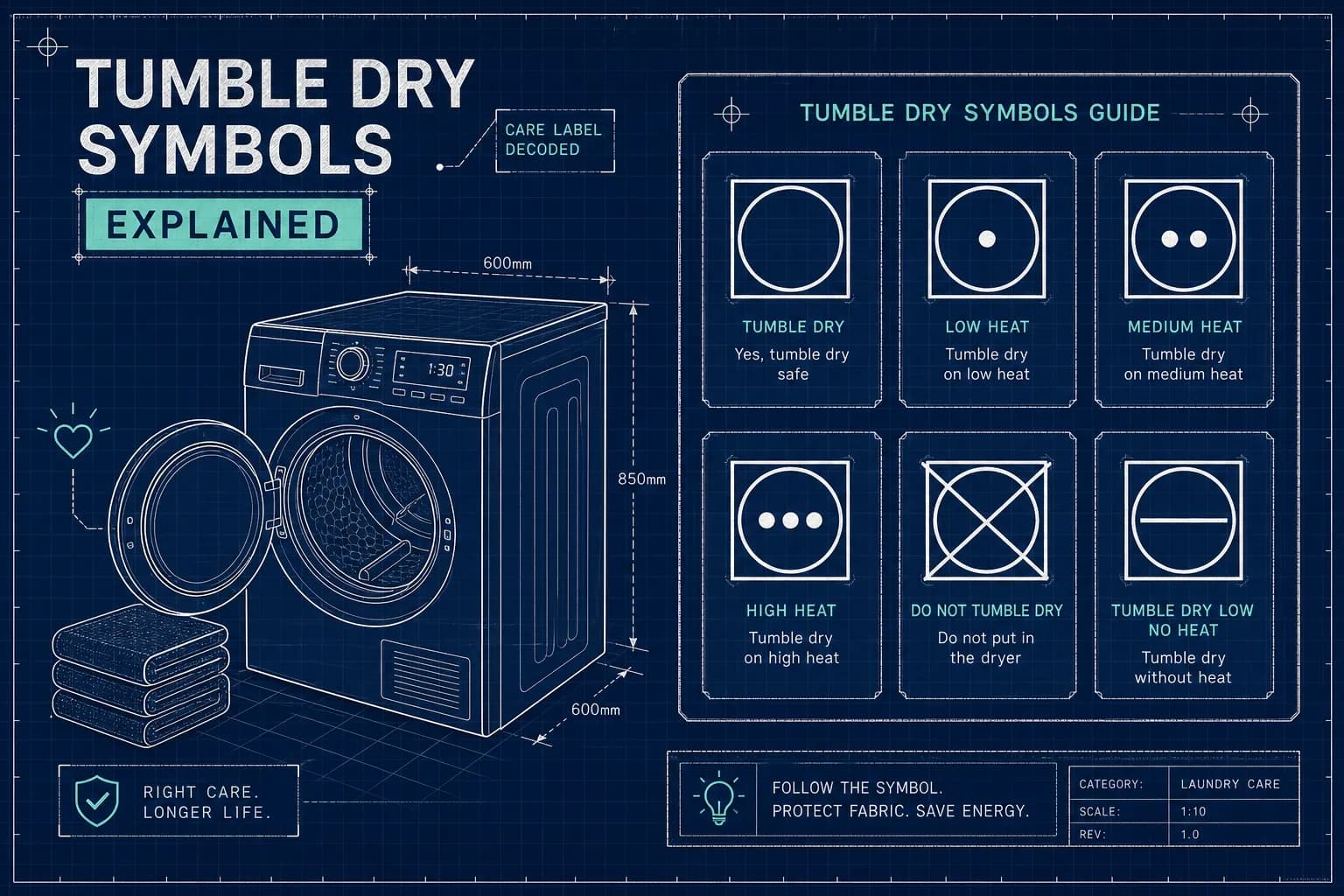
Every tumble drying symbol starts from the same base icon: a square with a circle inside it. Commonly interpreted as the dryer housing and its rotating drum, this icon is the international standard defined under ISO 3758, the same system used across UK and European clothing labels. Once you recognise this base shape, everything else on the label is simply a modifier that tells you how to use the dryer, not whether you can use it.
A square with a plain circle and no dots inside indicates that tumble drying is permitted and that the label does not specify a heat limit. These are typically robust fabrics: cotton towels, bed linen, and hardwearing cotton items. In such cases, follow your appliance's standard guidance or manufacturer recommendations for the appropriate heat setting. Understanding this base symbol is the starting point for reading the whole label correctly.
It also helps to know where the tumble-dry symbol sits in the wider care label system. Labels carry a sequence of icons covering washing temperature, bleaching, drying, ironing, and dry cleaning. The tumble-dry symbol is one chapter in that story, not the whole picture. Under ISO 3758, the pictogram standard developed by GINETEX and adopted internationally, UK labels typically carry identical symbols to those used across Europe, though some regional and market variations in labelling practice do occur. In most cases, a garment bought in Germany or France will carry the same dryer pictograms as one bought in the UK.
Tumble drying symbols chart: dots and what they mean for heat
The dots inside the circle are the heat-level indicator, and getting this right is where most people go wrong. More dots mean more heat. This is the detail that determines whether your clothes come out of the dryer the same size they went in, so it's worth committing to memory.
SymbolDotsHeat LevelTypical Dryer SettingFabric ExamplesSquare with circle, one dot●Low heatDelicates / Gentle / LowAcrylic, polyester blends, lightweight syntheticsSquare with circle, two dots● ●Medium heatPermanent Press / Mixed FabricsCotton-polyester blends, light denim, mid-weight clothingSquare with circle, three dots● ● ●High heatCottonsHeavy cotton towels, jeans, bed linenSquare with circle, no dots, No heat limit specifiedFollow appliance guidanceRobust cotton items, hardwearing fabricsSquare with crossed-out circle✕Do not tumble dryAir dry / lay flatWool, silk, linen, coated outerwear
Tumble drying symbols quick-reference chart based on ISO 3758 care label symbols. Programme names vary by brand and model, treat these as general guidance.
One dot: low heat for delicate and synthetic fabrics
One dot means low heat, which typically maps to a "Delicates", "Gentle", or "Low" setting on many UK dryers, though programme names vary between brands and models. This is the correct setting for acrylic knitwear, polyester blends, and lightweight synthetic fabrics. Running these items on a higher setting risks heat damage, pilling, and permanent distortion of the fibres.
Two dots: medium heat for everyday items
Two dots mean medium heat, which typically corresponds to a "Permanent Press" or standard "Mixed Fabrics" setting on many UK dryers. This suits the majority of everyday garments: cotton-polyester blends, light denim, and mid-weight clothing. When in doubt about a robust everyday item, medium heat is a reasonable starting point, though always check the full label before proceeding.
Three dots: high heat for hardwearing natural fabrics
Three dots mean high heat, equivalent to a "Cottons" programme on most dryers. This setting is reserved for heavy cotton items like towels, jeans, and bed linen that can withstand sustained heat without damage. Using a three-dot setting on anything synthetic or delicate will cause rapid shrinkage and fibre breakdown, often irreversibly.
What bars beneath the symbol tell you about the drum cycle
Many people focus entirely on the dots and miss the bars beneath the square. Dots and bars are two separate pieces of information, and both need to be read together for the correct programme. The dots control temperature; the bars control the mechanical action of the drum.
One bar: reduced tumbling for gentler fabrics
A single bar beneath the square means the dryer should use a gentler, reduced-tumble cycle. On most UK dryers, this corresponds to a "Permanent Press" or "Gentle" setting, which reduces the mechanical stress placed on the fabric. The specific way each machine achieves this varies by model, consult your dryer's manual if you're unsure which programme applies.
Two bars: very gentle cycle for the most delicate items
Two bars indicate an extra-gentle, minimal-tumble programme, equivalent to a "Delicate" or "Wool Care" cycle on modern dryers. This setting is used for structured garments, loose knits, and items that could lose their shape under normal tumbling action. When you read both the dot count and the bar count together, you have the complete instruction: the dots tell you how hot, and the bars tell you how gentle.
The crossed-out symbol and fabrics that must never enter the dryer
A square-with-circle crossed out by an X is the clearest instruction on any care label: do not tumble dry. There are no workarounds here, and a "quick low-heat cycle" is not an exception. This symbol appears because the fabric, construction, or coating of the garment will be damaged by heat, mechanical action, or a combination of both.
The fabrics that carry this symbol most frequently include:
- Wool and cashmere, which felt and shrink rapidly even at low temperatures
- Silk, which loses lustre and weakens under dryer heat
- Linen and loosely knitted or crocheted items, which distort under tumbling
- Waterproof and DWR-coated outerwear, which can delaminate when exposed to sustained heat
- Garments with glued embellishments, bonded seams, or structured fusing, which can peel or collapse entirely
For all of these, line drying or laying flat is the only safe option. There is also a practical reason to follow this instruction, one that goes beyond protecting your clothes. Wool fibres and fabric debris shed heavily inside the drum, clogging filters and restricting airflow. Dense, waterlogged items placed in the dryer against manufacturer advice put excessive strain on the motor. These habits build up quietly over time and can shorten the working life of the appliance considerably.
Are UK tumble-dry symbols the same as elsewhere in the world?
The UK uses the ISO 3758 international standard for care label symbols, the same system used across Europe. The pictograms were developed by GINETEX and adopted internationally, so a care label from France, Germany, or Spain will typically carry identical dryer pictograms to one produced in the UK, though some regional labelling variations do exist in practice. If you buy clothing from European retailers, online or in-store, you can read those labels with confidence using the same knowledge from this guide.
The main regional difference is between the UK/European system and the United States. US labels under the ASTM system often include written instructions alongside or instead of symbols, and several pictograms differ visually from their ISO equivalents. The wash tub design is drawn differently, temperature is shown using dots rather than numbers, and the bleaching symbol is presented differently. If you buy garments imported directly from the US or through American online retailers and the symbols look unfamiliar, check for written instructions on the label, those take precedence when the pictograms don't match the ISO versions you'd expect.
A quick pre-tumble checklist
Before loading any garment into the dryer, run through this short check:
- Look for the base symbol: a square with a circle inside confirms tumble drying is permitted
- Count the dots inside the circle and select the corresponding heat level on your dryer
- Check for bars beneath the square and adjust the cycle type accordingly
- If the symbol is crossed out, remove the item from the drum and air dry it instead
- Clear the lint filter before starting the cycle, manufacturer guidance generally recommends doing this after every use
When incorrect drying habits start wearing out your machine
Most tumble dryer faults that certified engineers are called out to inspect don't originate from manufacturing defects. They come from repeated misuse: wrong heat settings run over months, overloaded drums, filters clogged with shed fibres, and cycles run with items that should never have entered the machine. Each of these habits places stress on the thermostat, heating element, drum bearings, and motor, and the effects accumulate slowly before becoming a visible fault.
Signs that your dryer is struggling
The early warning signs are usually easy to spot if you know what to look for. Clothes taking significantly longer to dry than usual is often the first indicator, pointing to restricted airflow or a failing heating element. A drum that runs but produces no heat, unusual noise during the cycle, or the machine tripping the electrics are all clear signals that something inside needs attention. Catching these symptoms early almost always means a simpler, less costly repair.
Getting a dryer fault diagnosed and fixed properly
When a tumble dryer starts showing these symptoms, the right move is a professional diagnosis before the fault escalates. Alpha Appliances Ltd provides expert tumble dryer repairs across London and the Home Counties, with City & Guilds certified engineers, fixed-price quotes, and a strong first-time fix rate. Booking is straightforward through their online system, with next-day availability across Greater London, Berkshire, Surrey, Hampshire, and Dorset. There are no hidden fees and no guesswork: just a clear diagnosis, an honest quote, and a repair carried out by a qualified engineer.
The short version, for next time you're at the drum
Following tumble drying symbols correctly is one of the simplest ways to protect your clothes and reduce unnecessary wear on the appliance itself. The dots set the temperature and the bars control tumbling intensity, while a crossed-out symbol means the dryer is off-limits entirely. Read the base icon, count the dots, check for bars, and act on what the label tells you.
Good habits extend the life of any tumble dryer considerably. The simplest steps make the biggest difference: clear the lint filter after every cycle in line with manufacturer guidance, match the heat and cycle setting to the care label, and avoid overloading the drum. None of this is complicated, it just takes a moment's attention before you press start.
For the times when a fault develops despite best efforts, the team at Alpha Appliances Ltd offers a straightforward repair service backed by over 15 years of experience and City & Guilds certification. Whether it's a heating fault, a drum issue, or something more unusual, you can book a fixed-price diagnostic visit online and have a qualified engineer with you the following day, without the long wait typical of manufacturer service slots.
FAQ: tumble drying symbols
What does the square with a circle mean on a clothing label?
It's the base tumble drying symbol, indicating that the garment can be placed in a tumble dryer. Any dots or bars inside or beneath the symbol give further instructions on heat level and drum action.
What does "do not tumble dry" look like on a care label?
The do not tumble dry symbol is the standard square-with-circle crossed out by an X. If you see this, the garment must be air dried, either on a line or laid flat, depending on the fabric.
Are tumble drying symbols the same in the UK and Europe?
In most cases, yes. Both use the ISO 3758 pictogram system developed by GINETEX, so care label symbols are typically identical across the UK and Europe. The main exception is garments labelled under the US ASTM system, which uses different pictograms and often includes written instructions.
What does one dot in the tumble dry symbol mean?
One dot means low heat. Select the "Delicates", "Gentle", or equivalent low-heat setting on your dryer, though exact programme names vary by brand and model.
Need a repair today?
Book a visit from a certified Alpha engineer in minutes.