Understand UK fridge repair costs in 2026 with figures from Alpha Appliances Ltd. Learn typical prices, when to replace, and questions to ask an engineer.
Your fridge has stopped cooling overnight and you're standing in the kitchen wondering whether you're about to spend £100 or £500. That uncertainty is one of the most frustrating parts of any appliance breakdown, and it's why understanding the refrigerator repair cost before you call anyone matters. By the end of this article, you'll know what common faults genuinely cost in the UK in 2026, when replacing makes more financial sense than repairing, and exactly what to ask an engineer before agreeing to a single penny of work. At Alpha Appliances Ltd, that kind of transparency is simply how we aim to operate on every job.
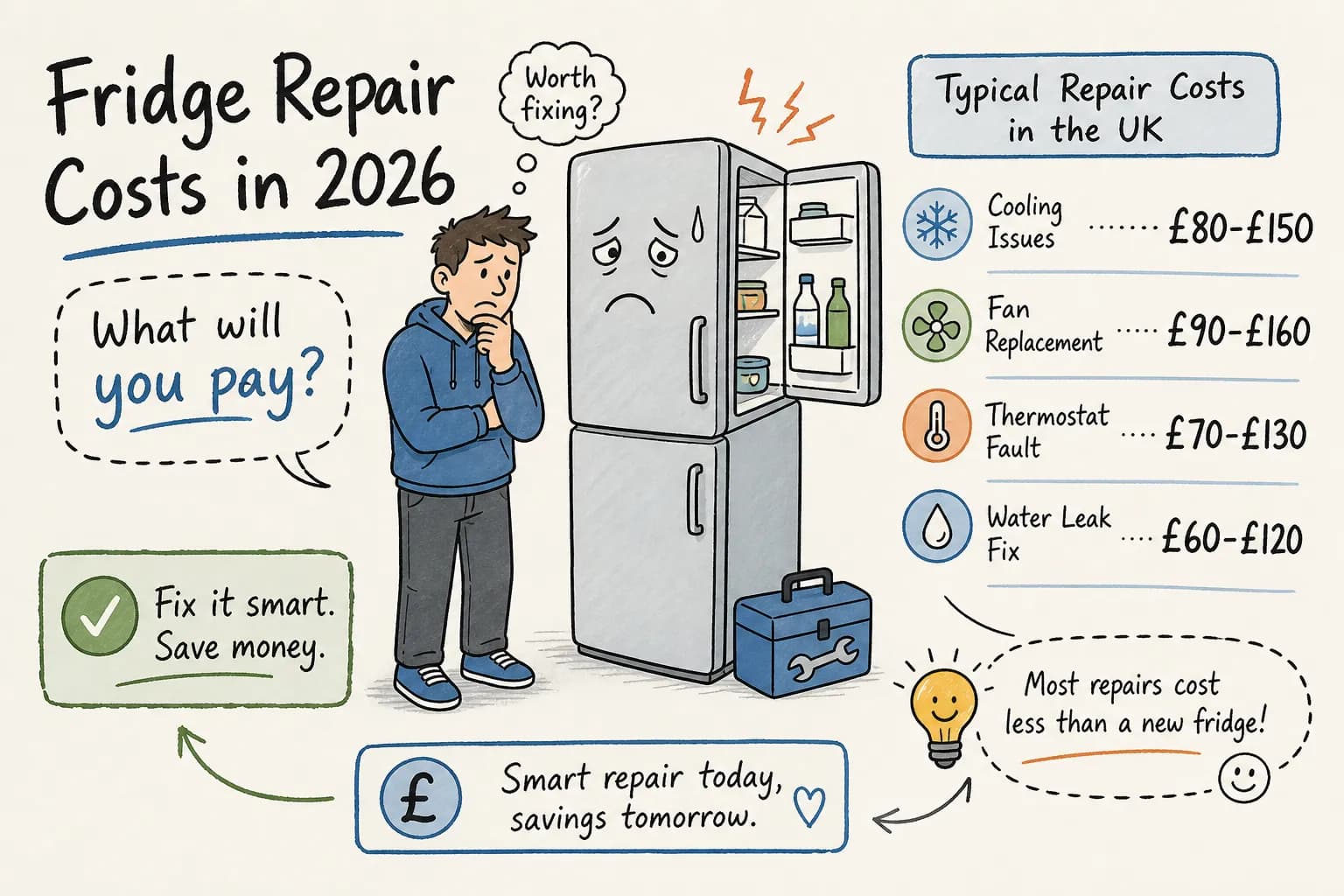
The figures below are drawn from 2026 UK repair pricing data and give you a solid anchor so no quote catches you off guard. Brand, location and parts availability all shift the final number, so treat them as reliable benchmarks rather than fixed prices. For a useful industry comparison you can consult the Checkatrade fridge repair cost guide.
Among the most frequently seen fridge faults, thermostat failure and door seal deterioration are also the most affordable to address. A faulty thermostat, which causes the fridge to run too cold, too warm, or not at all, costs around £100 all-in for parts and labour with most engineers in the UK. A worn or split door seal (also called a gasket) typically runs about £130, again including parts and fitting. Both repairs are often quick to complete, and the fridge repair cost in each case is a small fraction of what a replacement appliance would set you back.
These are the jobs where the repair decision is straightforward. The fridge itself is structurally sound; only one component has failed. Spending around £100 to restore a working appliance, compared with the cost of a comparable new model, is simply good economics. If your engineer is quoting you in this range for either fault, it is generally a sound decision to proceed, though it is still worth checking the appliance's age and whether any warranty applies before committing.
A failed compressor is the most expensive common fridge fault and the one most likely to prompt a repair-versus-replace conversation. The compressor is the heart of the cooling system. It circulates refrigerant around the evaporator coil to keep the cabinet cold, and when it fails, nothing else compensates. In the UK in 2026, a compressor repair averages around £400, with the typical range sitting between £300 and £480 depending on the brand and the engineer's rates.
The defrost heater serves a different function. It prevents ice build-up on the evaporator coil, which is the part responsible for actually chilling the air inside the fridge. When it fails, the coil ices over and the fridge gradually loses its ability to cool. Replacing a defrost heater averages around £130. It is worth knowing that refrigerant recharge (sometimes called regassing) is a separate matter entirely. Engineers only need to recharge refrigerant when there is a confirmed leak in the system; it is not a routine service item and should not appear on a quote unless there is a clear, diagnosed reason for it.
Understanding the cost structure helps you compare quotes properly. Call-out and diagnostic fees across the UK typically run from £60 to £150. In London and the South East, expect to sit at the higher end of that range. Hourly labour rates nationally are broadly £40 to £80, rising to £50 to £90 in London. These figures sit on top of parts costs, not in place of them.
Some engineers charge a diagnostic fee separately from their labour rate, while others roll both into a single charge. A few providers waive the call-out fee entirely if you proceed with the repair. Knowing which model applies to your engineer before they arrive means you can compare quotes on a like-for-like basis, rather than discovering an extra charge at the end. Always ask upfront: is the call-out fee included in the overall repair price, or is it charged in addition?
The standard rule of thumb used by consumer advisers and appliance engineers alike is straightforward: if the repair quote exceeds 50% of the cost of a comparable new fridge, replacement is usually the more rational financial decision. Below around 40% of replacement cost, repair wins clearly. The logic holds because you are not just paying for the fix, you are also buying the remaining useful life of the appliance.
A worked example helps. Say a new comparable fridge costs £600. A thermostat repair at £100 is a clear fix: you are spending 17% of replacement cost to restore a working appliance. A compressor repair at £400 is much more borderline at 67% of replacement cost, and that is before factoring in the age and condition of the fridge. The 50% mark is not a rigid cutoff, but it is a reliable filter for the majority of decisions. For further discussion on choosing between repair and replacement see this practical refrigerator repair vs replace guide.
A fridge under five years old with its first fault is almost always worth repairing, assuming the refrigerator repair cost is reasonable relative to the 50% rule. At that age, you still have the majority of the appliance's useful life ahead of you, and a single repair is unlikely to be the start of a pattern. From around eight to ten years, the picture becomes more nuanced: age, fault history and energy consumption all start to tip the balance toward replacement.
Most domestic fridges last between 10 and 15 years with normal use, and that lifespan matters in the calculation. If you want an external reference on typical service life, read more about how long fridge-freezers last. An eight-year-old fridge with its first fault remains a reasonable candidate for repair. A twelve-year-old fridge that has already had a thermostat replaced and is now showing compressor trouble is a different prospect. You may well be spending £400 to extend the life of an ageing appliance that draws more energy and is increasingly prone to further faults. Factor in age, fault history and your energy bills together before deciding.
Parts availability is one of the biggest variables in any fridge repair quote. Many engineers report that a thermostat for a Beko, Hotpoint or Indesit is a widely stocked, commodity part that can be sourced quickly and competitively. The same component for a Miele, AEG or Liebherr may need to be ordered from a specialist supplier, carry a significantly higher unit cost, and add days to the repair timeline. The labour involved is identical; the parts cost is not.
Geography adds another layer. Engineers working in Central London have higher overheads than those in rural Hampshire, and that difference flows through into call-out rates and labour charges. Knowing your appliance brand and where you live gives you a realistic benchmark for what a fair quote should look like. If a quote for a standard thermostat replacement comes in at £280 with no justification for the premium, you have grounds to question it. If you have an Electrolux model in Aldwych and want brand-specific part lead times, our Fridge Repair for Electrolux in Aldwych page outlines typical turnaround times. Brandt owners can read targeted advice on common faults via our Brandt Fridge Repairs Aldwych, Expert Appliance Care page.
Many smaller independent engineers quote an hourly rate and estimate the time the job will take. That approach leaves the final invoice open-ended: if the job takes longer than expected, or a secondary issue is found mid-repair, the total can shift. A fixed-price model works differently. The total cost is confirmed before any work begins, and nothing is added at the end regardless of how long the repair takes.
Alpha Appliances Ltd operates on a fixed-price basis for exactly this reason. Our engineers confirm the total cost after diagnosis and before any repair work starts. You are not watching the clock, and there is no incentive on our side to extend the job. That model is what makes a genuinely informed repair-or-replace decision possible: you are comparing a real, confirmed number against the cost of a new appliance, not a rough estimate that might grow once the fridge is open.
A good engineer can often narrow down the likely fault before arriving if you provide the right information upfront. Have the following ready when you call or book: the brand and model number (usually found on a label inside the fridge door), the appliance's age, whether it is still under any manufacturer warranty, and a clear description of the symptom. "Not cooling" is useful; "freezer is working but the fridge compartment is warm and there's frost on the back wall" is far more useful.
Also note when the problem started, whether it is getting progressively worse, and any error codes or warning lights on the display panel. If you can send a short video or photograph of the fault before the appointment, many engineers will use it to arrive with the most likely parts already in the van. That single step can be the difference between a first-visit fix and a return call to fit a part that was not initially anticipated.
Protect yourself with a short checklist of questions before any work begins. Ask whether the quote covers both parts and labour, or just one. Confirm whether there is a separate diagnostic or call-out fee on top of the repair price, and whether it is waived if you proceed. Ask what happens if the engineer finds a secondary fault during the repair: is that additional work quoted separately, or does it escalate the price without notice?
Also ask whether the completed repair is covered by a workmanship guarantee, and for how long. A reputable engineer will answer all of these questions clearly and without hesitation. Vague or evasive answers at the quote stage are often a good indicator of how the invoice conversation will go at the end of the job.
The Consumer Rights Act 2015 gives UK consumers clear protections when an appliance fails after purchase. If a newly bought fridge develops a fault within the first 30 days, you have the right to a full refund from the retailer. Between 30 days and six months from delivery, the law presumes the fault was present at the point of sale: it is the retailer's responsibility to prove otherwise, not yours. The retailer must therefore repair or replace the appliance at no cost to you during that window.
After six months, the burden of proof shifts to the customer. You would need to demonstrate that the fault was present or developing at the time of sale, typically with an independent engineer's report. Claims can be made for up to six years from purchase in England, Wales and Northern Ireland, and five years from when you became aware of the problem in Scotland.
The Consumer Rights Act also covers repair services directly. Any repair must be carried out with reasonable care and skill. If the same fault returns after a paid repair, you have the right to ask the repairer to rectify it at no additional charge. Contact the engineer promptly and in writing, reference the original repair invoice and any guarantee documentation, and request that they return to fix the fault under their workmanship warranty. The sooner you raise this in writing, the stronger your position.
Keep every piece of paperwork from a repair: the invoice, any job sheet, and the written terms of any guarantee. If a verbal guarantee was given, follow it up with a written message confirming what was promised. Alpha Appliances Ltd backs every completed repair with a defined workmanship guarantee as standard, and our engineers document the work carried out so both parties have a clear record if any question arises later.
Fridge repair costs in the UK in 2026 range from around £100 for a thermostat replacement to roughly £400 for a compressor job. Call-out and diagnostic fees add £60 to £150 on top, depending on location. Understanding the refrigerator repair cost landscape gives you a working framework so you are not making a decision blind when an engineer arrives at the door.
The 50% rule offers a reliable filter for the repair-or-replace question, and age tips the balance further toward replacement for fridges approaching or past the ten-year mark with a history of prior faults. Knowing what information to give an engineer upfront and what questions to ask before work begins means no invoice should ever surprise you. If a repair does not hold, UK consumer law gives you clear recourse, use it.
For homeowners across London, Berkshire, Surrey, Hampshire and Dorset, Alpha Appliances Ltd offers fixed-price fridge and fridge freezer repairs with upfront quotes and qualified engineers committed to transparent pricing. For Britannia models in the Aldwych area see our Fridge Repair for Britannia Appliances in Aldwych page. Book a diagnostic visit today and know exactly what you are paying before the engineer picks up a single tool. Every job comes with a clear written quote, no hidden fees, and no open-ended hourly billing.
Book a visit from a certified Alpha engineer in minutes.
TRUSTED BY HOMEOWNERS
Fast, reliable, and warranty-backed repairs for every major brand.
Discover more tips from Alpha engineers.