
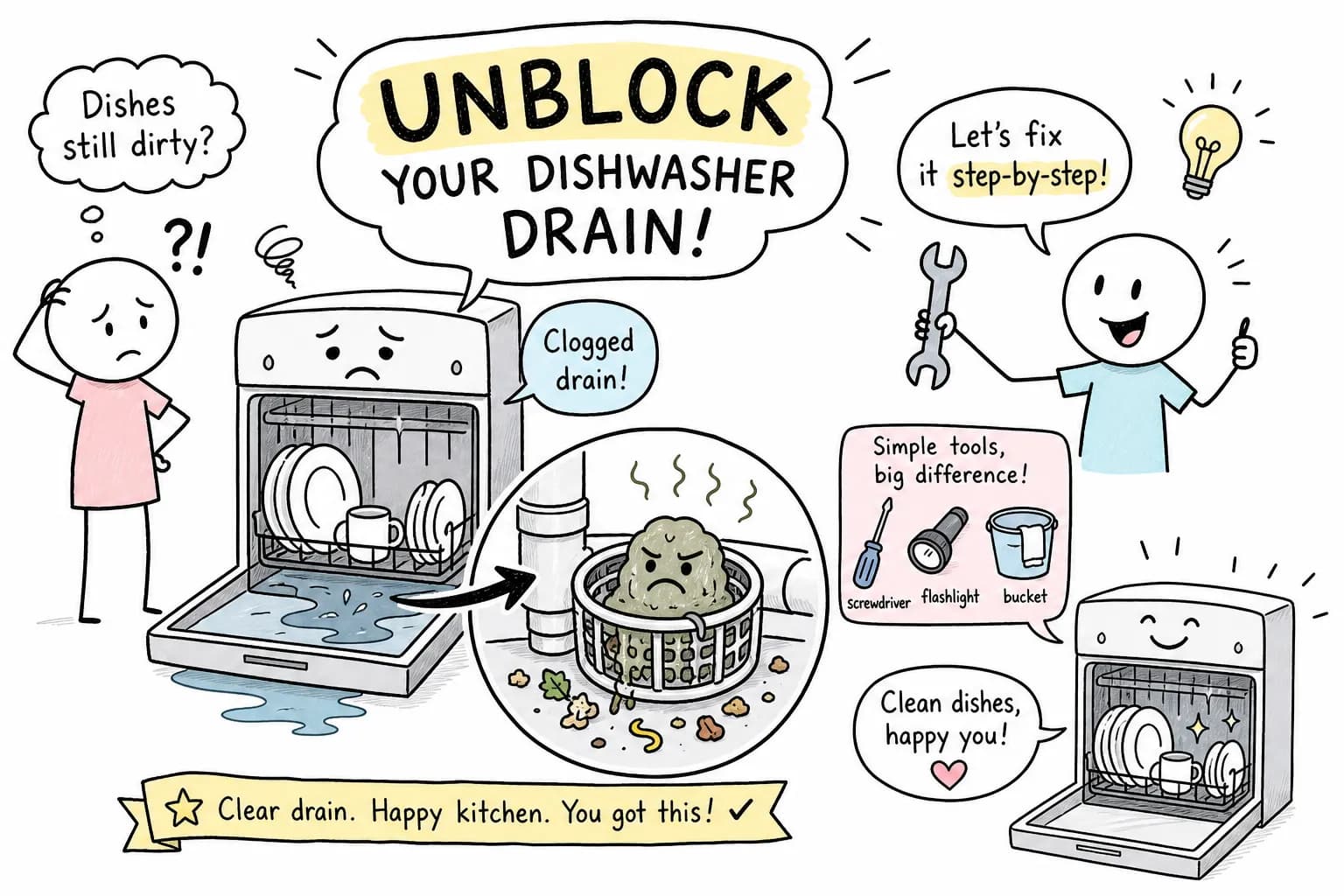
How to Unblock a Dishwasher Drain: A Step-by-Step Guide
You open the dishwasher door at the end of a cycle, expecting clean plates, and instead find a pool of murky water sitting at the bottom of the tub. If you need to unblock a dishwasher drain, the good news is that many common causes are user-fixable and often take under 30 minutes to check and clear. You don't need specialist tools for filter and hose checks, though a screwdriver or pliers may be needed for some steps, and you certainly don't need to call anyone out straight away.
This guide walks you through every likely cause in the right order, starting with the quickest fixes and working towards the more involved checks. Follow each step before moving to the next, because skipping ahead wastes time and makes diagnosis harder. By the end, you'll know exactly what's causing the problem, and whether it's something you can sort yourself or whether it needs a trained engineer. If you work through all three steps and the water is still sitting there, the blockage is likely deeper in the system, beyond the reach of a straightforward home fix. We'll cover that too, and explain what a professional repair actually involves at that stage.
Why your dishwasher isn't draining: the most likely causes
Before you start dismantling anything, it's worth understanding where the problem almost certainly sits. A clogged filter is responsible for the majority of dishwasher drainage failures in UK homes. It's the first thing to check, and in many cases it's the only thing you need to address. After the filter, a blocked or kinked drain hose is the second most frequent cause, followed by a problem at the sink waste connection, usually a clogged disposal unit or, on newer installations, a knockout plug that was never removed. All three of these are user-fixable without specialist tools.
A faulty drain pump is less common but does happen, particularly in older machines or after a foreign object such as a shard of broken glass or a small bone gets past the filter and jams the impeller. The symptoms are specific: a low humming during the drain phase with no water moving, complete silence when the machine should be draining, or a grinding noise from the base of the appliance. If you're hearing any of those sounds, keep that in mind as you work through the steps below.
A quick symptom check helps you move efficiently through the diagnosis. Standing water after every single cycle points to a persistent blockage, most likely the filter or hose. Water that drains slowly rather than not at all suggests a partial blockage, often grease buildup in the hose. A single incident after an unusually heavy load is almost always the filter. Use that context as your starting point for Step 1.
Before you start: safety steps and what you'll need
Cut the power before you touch anything inside the appliance. Unplug the dishwasher at the wall socket or switch off the relevant circuit breaker in your consumer unit. This is non-negotiable: you'll be working near water and electrical components, and skipping this step is not worth the risk. Lay old towels along the floor in front of and around the base of the dishwasher before you open the door, because water will spill as soon as you start working.
With the power off and the floor protected, remove the bottom rack and set it aside. Use a cup or ladle to scoop out the bulk of the standing water into a bucket, then switch to a sponge or old towels to absorb the last shallow layer. Once the base of the tub is dry enough to see the drain area clearly, you're ready to inspect. If the water has been sitting for a while or looks particularly unpleasant, wear rubber gloves throughout.
Gather these items before you begin:
- A cup or ladle and a bucket
- Old towels or rags for the floor and final water absorption
- A soft brush (an old toothbrush works perfectly)
- A shallow tray or pan to catch water when you disconnect the hose
- A torch or your phone's light for working inside the under-sink cabinet
- A flat-head screwdriver for hose clamps
How to unblock a dishwasher drain, Step 1: clean the filter and check the sump
The filter assembly sits at the base of the dishwasher tub, and on the vast majority of UK models it consists of two parts: a cylindrical filter that twists out, and a flat mesh plate that sits beneath it.
Step 1A: Remove the filter
Twist the cylindrical filter anti-clockwise and lift it straight out, then lift out the flat mesh filter underneath it. Both parts need to be cleaned every time you do this, not just one of them.
Step 1B: Clean the mesh and check the sump
Rinse both parts under warm running water and use a soft brush to work out any grease or trapped food from the mesh. Don't use anything abrasive, as it will damage the fine mesh and reduce the filter's effectiveness. Once both parts are clean, look into the sump area beneath where the filter sat: wipe it out with a damp cloth and remove any debris by hand.
Reassemble by placing the flat mesh filter in first, then locking the cylindrical filter back in by turning it clockwise until you feel or hear it click firmly into position. A filter that isn't fully locked is a common cause of repeat drainage problems, if it still turns freely after you've seated it, it isn't locked. Once everything is back in place, restore power and run a short cycle to test whether the machine drains normally. A large proportion of dishwasher drainage faults clear at this step alone, so always check the outcome before moving on.
Step 2: unblock the dishwasher drain hose and disposal connection
If the filter is clean and the machine still isn't draining, open the cabinet under your kitchen sink and trace the corrugated drain hose from the back of the dishwasher to its connection point. Look along the entire length for sharp bends, kinks, or pinching, particularly where the hose passes through the cabinet wall or around pipework. Even a moderate kink is enough to restrict flow significantly and leave standing water in the tub. Straighten any bends you find and position the hose so it runs freely without being compressed against anything.
If the hose looks clear of kinks, disconnect it at the sink end by loosening the clamp with a screwdriver. Hold your shallow tray underneath before you pull the hose free, because water will spill as soon as you pull it free. Inspect both the end of the hose and the fitting it connects to for compacted debris or grease buildup. Flush the hose through with hot water to shift any blockage, and if you have a flexible bottle brush, run it through the inside of the hose to dislodge any stubborn internal buildup before reconnecting.
If your dishwasher drains through a garbage disposal unit under the sink, check this connection specifically. A newly installed disposal unit sometimes has a knockout plug left in the dishwasher inlet port, if that plug was never removed, drainage is completely blocked regardless of how clean everything else is. Before checking, switch off power to the disposal unit. Then, following the disposal manufacturer's instructions, use pliers or an appropriate tool to clear the knockout plug if it's still in place. Also confirm that the disposal unit itself isn't clogged, because a backed-up disposal will prevent the dishwasher from draining even when the hose is perfectly clear. Run the disposal briefly to clear it, then retest the dishwasher.
Step 3: check the drain pump
With the filter cleaned, the hose checked, and everything reassembled, run a full cycle and listen carefully near the base of the machine during the drain phase. A functioning drain pump produces a steady hum or whirring sound, usually audible if you crouch down near the front kickplate. Silence at that point in the cycle suggests the pump isn't receiving power or the motor has failed. A grinding or buzzing sound with no water movement usually means something is caught in the impeller.
If you're comfortable doing so, remove the lower access panel or kickplate at the front of the dishwasher to inspect the pump area with a torch. Look for foreign objects, broken glass, or debris jammed around the impeller, and carefully remove anything you can see by hand. If the impeller looks intact and nothing is blocking it but the pump still won't run, the motor itself has likely failed, at that point, the repair moves beyond what a home inspection can resolve.
If you have a multimeter, you can test the pump motor: disconnect the pump's wiring connector and measure across the terminals. A working pump motor typically reads somewhere between 15 and 260 ohms, though this range varies considerably by model, so check your manufacturer's service information for the correct figure. No reading at all, or an open circuit, points to a failed motor. If the impeller spins freely, the hose is clear, and the filter is spotless but water is still standing in the tub after a cycle, the pump motor very likely needs replacing.
When to call a certified engineer, and how to stop this happening again
If you've cleaned the filter, cleared and reconnected the hose, confirmed the disposal connection is clear, and the pump is still not moving water, the fault is deeper in the system than a home fix can reliably reach. This typically means a failed pump motor, a faulty check valve, or an electrical fault on the control board. Attempting to disassemble the pump assembly without the right tools and training risks causing further damage and can void any remaining manufacturer warranty.
Alpha Appliances Ltd engineers are City & Guilds certified and carry specialist diagnostic equipment along with a comprehensive stock of genuine parts, so they can pinpoint the fault quickly and get your appliance back in service. We cover Greater London, Berkshire, Surrey, Hampshire, and Dorset. You can book online or give us a call to talk through the problem first, we provide a confirmed arrival slot rather than a vague all-day window, and all pricing is agreed upfront before any work begins.
Prevention is straightforward once you know the routine. Scrape plates before loading to keep large food debris out of the filter. Clean the filter once a month as a general guide, your machine's manual may specify a different interval depending on usage and model. Run a dedicated dishwasher cleaning product through a maintenance cycle every two to three months to break down grease in the hose and sump before it accumulates enough to cause a blockage. And never use washing-up liquid in place of dishwasher detergent: the excessive foam it produces interferes with the drain cycle and is a surprisingly common cause of standing water that many homeowners don't connect to their detergent choice.
Sorting the blockage once and for all
The majority of dishwasher drainage faults come down to a dirty filter or a restricted hose, both of which you can now tackle with confidence at home. Work through the steps in order rather than skipping straight to the pump, because the simpler causes are far more likely and always worth ruling out first. Always cut the power before you start, and keep towels on the floor throughout.
If you still can't unblock the dishwasher drain after completing all three steps, a professional diagnosis is the faster and safer route forward. Continuing to investigate beyond the pump without the right tools tends to create new problems rather than solve the original one. Get in touch with Alpha Appliances Ltd and we'll confirm a time that works for you, transparent pricing, no hidden call-out fees, and an engineer who knows exactly where to look.
Need a repair today?
Book a visit from a certified Alpha engineer in minutes.