
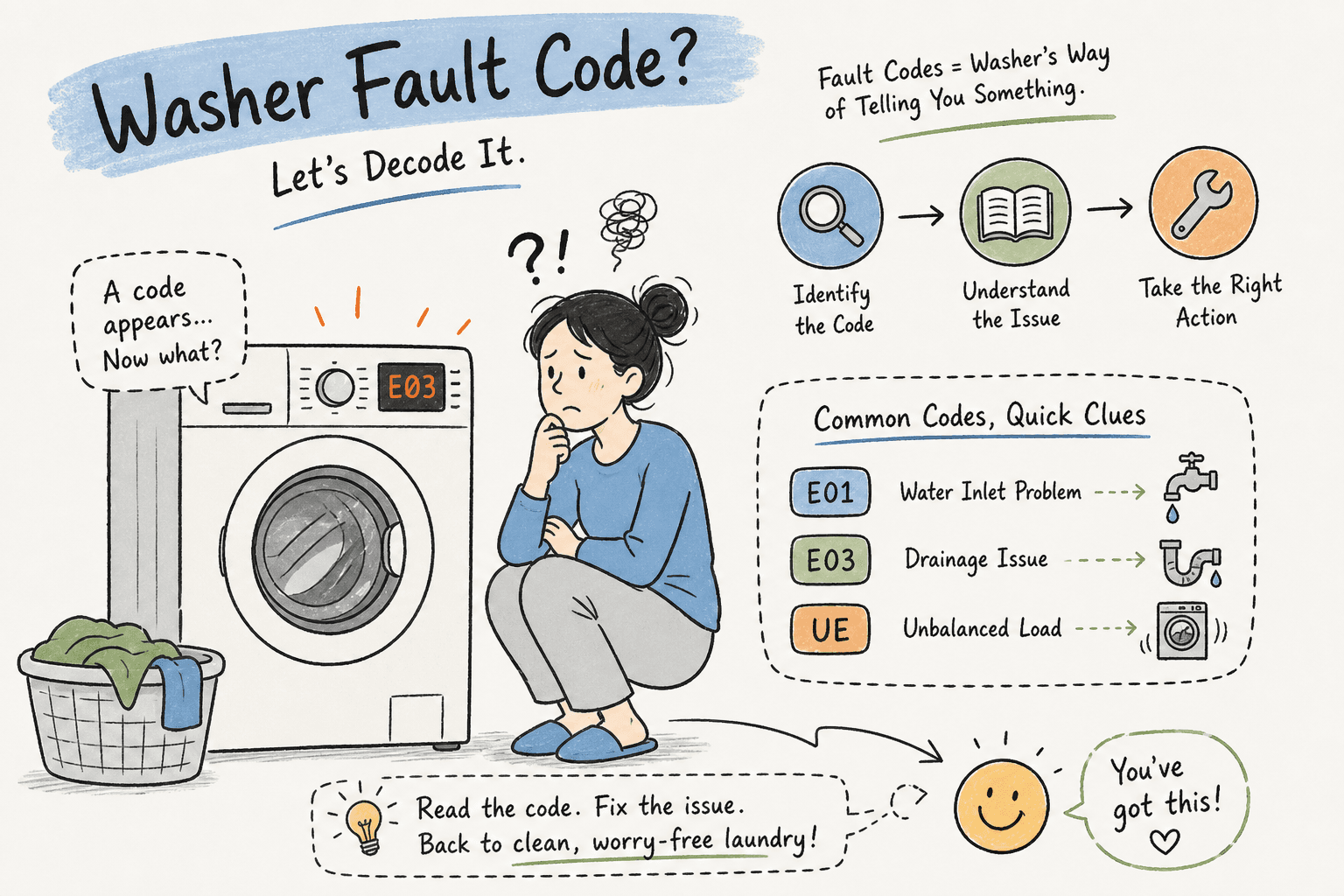
Washing machine fault codes: what they mean and what to do
Your washing machine stops mid-cycle. A code flashes on the display. The laundry is sitting in a drum full of cold water, and you have no idea what just happened. When a washing machine fault interrupts a cycle like this, most people either panic or hit the start button repeatedly hoping it fixes itself. Neither approach helps, and the second one can actually make things worse.
This washing machine repair guide breaks down the most common fault types one by one: what each symptom or error code actually means, what you can safely check yourself, and when the problem genuinely needs a qualified engineer. Drawing on extensive service experience across domestic appliances, the same handful of washing machine fault categories come up again and again. Catching them early almost always leads to a faster, cheaper repair.
What washing machine error codes actually mean
The first thing to understand is that appliance fault codes across all major brands follow the same internal logic. Whether you own a Samsung, AEG, Hotpoint, or Whirlpool, the machine categorises the fault into one of six areas: water supply, drainage, door lock, motor, heating, or leak and imbalance. The code name differs between brands, but the meaning is often identical.
This pattern is the most useful thing to grasp during any washing machine troubleshooting session. Samsung's 4E/4C, AEG's E10, and Whirlpool's F8 E1 all mean water is not entering the machine correctly. Samsung's 5E, AEG's E20, Hotpoint's F04, and Whirlpool's F9 E1 all point to a drainage problem. Door lock faults appear as dE on Samsung, F5 E2 on Whirlpool, E40/E41 on AEG, and F06 on Hotpoint. Once you see the pattern, you're not memorising codes: you're reading fault categories.
The table below gives a quick reference across the four main brands:
- Water supply: Samsung 4E/4C, AEG E10, Whirlpool F8 E1, Hotpoint (check fill hose and pressure)
- Drainage: Samsung 5E, AEG E20, Whirlpool F9 E1, Hotpoint F04
- Door lock: Samsung dE, AEG E40/E41, Whirlpool F5 E2, Hotpoint F06
- Motor: Samsung 3E, AEG E50, Whirlpool F7 E1, Hotpoint F02
- Heating: Samsung HE, AEG E60, Hotpoint F08
- Leak or imbalance: Samsung LE/UE, AEG EF0
One important caveat: the same code can mean something slightly different on older versus newer models of the same brand. Samsung's 3E is listed as a motor error on most machines, but on some series it refers to a voltage fault. Always cross-reference the code with your specific model number, especially on Samsung machines where the code family is large and model-dependent.
If a code returns immediately after a reset, the underlying washing machine fault is still active. Heating element codes (HE, E60, F08), motor codes (3E, E50, F02), and control board codes like Hotpoint's F01 are internal component failures. They are not safe or practical for DIY repair. A certified engineer with diagnostic tools can read the machine's full fault log, not just the last visible code, giving a much more accurate picture on the first visit.
Washing machine fault: washer not draining, causes and safe checks
A blocked drain filter is the single most common cause of drainage failure in any washer diagnostic guide, and it is also the easiest fault to fix yourself. Coins, lint, buttons, and small fabric items accumulate in the filter over time and eventually restrict or completely block water flow. The filter sits behind a small panel at the front bottom of the machine on most front-loaders.
How to clean the filter
Before you touch anything, unplug the machine. Grab a shallow tray and some towels, locate the access panel, and slowly unscrew the filter counterclockwise. Water will drain out as you open it. Remove whatever is in there, rinse the filter under running water, and reinsert it clockwise until secure. Run a drain-and-spin cycle to test. That single step clears the fault on a significant number of drainage call-outs. For model-specific instructions on cleaning the pump filter, refer to the manufacturer's guidance.
If the filter is clean, check the drain hose at the back of the machine. A hose that is kinked, crushed, or pushed too far down into the standpipe will restrict drainage just as effectively as a blockage. As a general guide, the hose should sit no deeper than around 15 cm into the standpipe, check your machine's manual for the exact specification, and should not have any sharp bends. Straighten it, make sure it is routed correctly, and test again. Excess suds from too much detergent are also worth considering, particularly on high-efficiency machines: the machine may be pausing the drain cycle because it has detected foam.
When a pump needs replacing
If the filter is clear, the hose is unkinked, and water still will not drain, the drain pump has likely failed. You may hear it humming without moving water, or it may be completely silent during the drain cycle. A pump replacement is a straightforward job for a trained engineer and is often completed in a single visit, subject to part availability. Recurring drainage codes after filter cleaning can also indicate a blocked pump housing, a faulty pressure switch, or a wiring fault. All are better diagnosed with the machine's service mode active rather than by guesswork. For general troubleshooting steps on a non-draining washer, see what to do when your washer won't drain.
Washing machine fault: washer won't spin, what to check first
Before assuming a mechanical washing machine fault, check three things: the load, the settings, and the door. An unbalanced or overloaded drum is the most common spin fault across all machine types. The machine pauses or cancels the spin cycle to protect itself. Redistribute the laundry evenly, reduce the load if it is overpacked, and retry. A single heavy item like a duvet or thick towel can throw the balance off entirely.
Also check that no low-spin or no-spin setting has been selected accidentally. Delicate, hand-wash, and soak programmes are designed to limit spin speed or skip it altogether. Then confirm the door is fully latched: many machines will not begin high-speed spin until the door lock sends an electrical confirmation signal. A door that looks closed but is not fully engaged will block spin completely. If there is also water in the drum, the machine is likely refusing to spin because drainage failed first, work through the drainage checks
above before returning to the spin fault.
When those quick checks do not resolve it, the fault is likely mechanical. A drum that turns slowly or vibrates excessively even with a balanced load points to drive belt wear or motor brushes nearing end of life. A drum that does not rotate at all despite the machine filling and draining normally suggests a motor, motor control board, or belt failure. A certified engineer tests each component in sequence before ordering any parts. A door that will not lock electrically (error codes dE, F5 E2, or E40) means the door interlock needs
replacing.
Any fault that requires accessing the motor, drive belt, or door interlock means panel removal. These are not dangerous jobs for a trained engineer, but they are not safe amateur territory either. Misdiagnosis is expensive: replacing a drive belt when the motor control board is the actual fault wastes both money and time.
Unusual noises: what rumbling, banging, and grinding are telling you
Noise is one of the most useful diagnostic signals a washing machine gives you, and each sound pattern points to a specific component. Banging or thumping during spin is almost always a load imbalance or a loose item caught between the drum and the door seal. Check for trapped objects before assuming a mechanical washing machine fault: a forgotten coin or underwire is a very common culprit.
Loud rumbling or grinding during spin points to drum bearings wearing out. The noise tends to worsen progressively over weeks rather than appearing suddenly. With the machine unplugged, you can spin the drum by hand: roughness or side-to-side wobble confirms bearing wear. High-pitched squealing suggests a worn drive belt or motor brushes, particularly on older machines. Humming without movement during fill or drain often means a seized pump impeller or a water inlet valve struggling to open against low water pressure; read more about the signs your water inlet valve is bad to help identify this symptom.
Bearing noise does not resolve on its own. On front-load machines, bearing replacement involves full drum disassembly and is a significant job, but it extends the machine's life considerably when the rest of the appliance is in good condition. The repair-versus-replace decision depends on the machine's age: for a machine under seven years old in otherwise good condition, bearing replacement is usually worthwhile. If you are unsure whether it is worth repairing, our engineers at Alpha Appliances Ltd give an honest assessment of whether the repair cost makes sense relative to the machine's value, with no pressure to proceed if the numbers do not stack up.
Washing machine leaks: finding the source and what it means
The location of a leak tells you a lot about its cause. A leak from the door on a front-load machine almost always comes from the door seal (gasket). Inspect the rubber seal around the door opening for tears, perished sections, or objects lodged in the folds. Mould damage can also compromise the seal's ability to close cleanly. This is a homeowner-visible check and, in many cases, a straightforward repair.
A leak from underneath at the back usually points to a loose or cracked drain hose connection or a water inlet hose that has worked loose at the machine end. Check both hose connections and tighten or replace as needed. A leak from underneath at the front, or water visible beneath the machine during a wash cycle, is more concerning: this is often the drain pump housing or its connecting hoses, and it corresponds to Samsung's LE code or AEG's EF0. Leaking from the detergent drawer usually means detergent residue has built up and is blocking water flow, causing it to overflow into the machine cabinet rather than the drum.
Any leak you cannot trace to the door seal, detergent drawer, or a loose hose at the back is internal and needs an engineer. Running a leaking machine risks electrical hazard and water damage to the floor and cabinetry. Samsung's LE code specifically means the machine has detected water in the base tray: stop running it immediately. Water sitting in the base tray can reach the motor and control board, turning a manageable repair into a much larger one.
How to reset washing machine fault codes (and when it is not enough)
A power cycle is the correct reset method for most machines, and the steps are consistent across brands. Turn the machine off, unplug it from the wall socket, and wait two to five minutes to allow residual power to discharge from the control board. Samsung's own support documentation recommends up to five minutes. Restore power, then run a short test cycle to see whether the code returns.
For Whirlpool front-load models with a touchscreen, there is an additional option under the Info menu labelled Restore Factory. For Bosch, Siemens, and Neff models, some series use a dial sequence to clear codes: the exact steps vary by model, so check the manual rather than following a generic procedure that may apply to a different series. For AEG, press On/Off to switch the machine off, wait two minutes, then switch it back on and reselect the programme. For further detail on brand-specific error listings, consult an AEG washing machine error codes reference.
The critical point to understand: a reset clears the display, not the fault. If the code returns within the same cycle or the next one, the underlying washing machine fault is still present. Samsung specifically warns against repeatedly clearing the same recurring code because doing so erases fault history that an engineer would otherwise use to diagnose the machine accurately. The more times you clear it, the less data there is to work with on the first professional visit.
A certified engineer can access the machine's full diagnostic memory via service mode, read every stored fault including intermittent ones, and test individual components directly. That is what makes a first-visit diagnosis accurate. At Alpha Appliances Ltd, our engineers carry brand-specific diagnostic equipment for exactly this reason, and we are committed to achieving a high first-time fix rate across all washing machine repairs.
When to stop troubleshooting and book a repair
A washing machine fault is rarely a mystery. The symptom, the error code, and the noise all point in a specific direction, and most of the basic checks in this washing machine troubleshooting guide will either resolve the problem or tell you clearly what you are dealing with. Clean the filter. Check the hose. Redistribute the load. Confirm the door is latched. Those steps resolve a surprising number of faults without any professional involvement.
Some faults go beyond safe DIY territory: motor failures, drum bearing replacement, internal leaks, control board faults. The honest advice is to draw that line early. Running a faulty machine through repeated reset attempts risks turning a straightforward part replacement into a more extensive repair, particularly with leaks or electrical fault codes.
If the code keeps returning or the machine is not behaving normally after the basic checks, the right move is to book an engineer for your washing machine fault. Alpha Appliances Ltd offers straightforward online booking, transparent fixed-price diagnostics with no hidden costs, and experienced engineers who can diagnose and repair most faults in a single visit. Book online in minutes and get a confirmed appointment that works around your schedule. No guesswork, no surprises on the invoice.
Need a repair today?
Book a visit from a certified Alpha engineer in minutes.