Find out the typical washing machine life expectancy in the UK and when to repair or replace. Learn lifespan by years, cycles, faults, and maintenance tips.
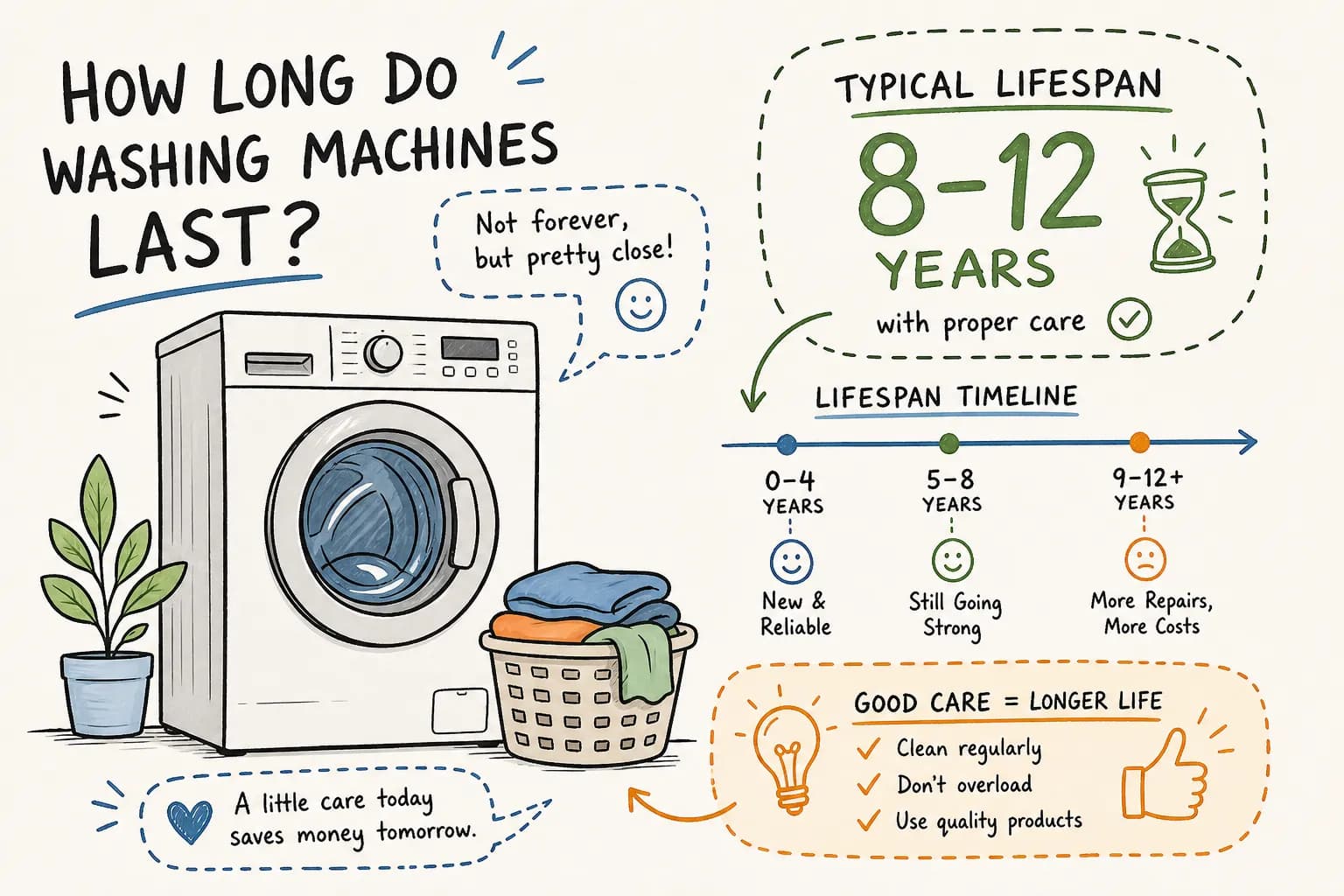
If you're wondering what is the typical life expectancy of a washing machine, the honest answer is that most models in the UK last somewhere between 6 and 10 years, with around 8 years being a fair real-world average for standard models under typical household use. Most homeowners only start asking this question the moment their machine starts letting them down, either it's given up after just a few years and the repair quote feels steep, or it's been running for a decade and they're not sure whether to fix it or finally replace it. Premium machines, well-maintained units, and lighter-use households can push comfortably beyond that 10-year mark. Budget machines used heavily may not reach six.
That range matters because it changes how you think about repairs, maintenance, and replacement decisions. A machine that breaks down at year four deserves a different response than one that develops the same fault at year nine. At Alpha Appliances Ltd, these are the conversations our engineers have with customers every week: is this worth fixing, and if so, what will it cost? This guide gives you the same clear picture so you can make that call with confidence.
Most washing machines sold in the UK carry an implied lifespan of around 10 years, but the reality for the average household sits closer to 6, 10 years. Repair data and consumer research consistently point to 8 years as a practical working average, with cheaper models from budget brands sometimes failing in as little as 4, 6 years under heavy daily use. That gap between the manufacturer's optimistic expectation and real-world performance matters, because it affects how you budget for replacements and how much weight to put on a repair quote.
A more useful way to think about washing machine life expectancy is in cycles rather than calendar years. A domestic washing machine typically handles somewhere between 3,000 and 6,000 wash cycles over its working life. A single person doing two or three loads per week will age their machine far more slowly than a family of five running a full load every day. Research suggests the average UK household runs around five loads per week, roughly 260 cycles per year, which means a machine with a 3,000-cycle capacity could theoretically last around 11, 12 years at that rate. In practice, though, calendar time brings its own threats: limescale build-up, component ageing, and the cumulative effect of even occasional overloading mean real-world lifespans typically fall below that theoretical ceiling. For data on how the average number of washing cycles per machine has evolved in Europe, see the European Environment Agency's analysis of washing-machine use patterns (average number of washing cycles per washing machine in the EU).
Machines that reach 12, 14 years of reliable service do exist, and they tend to share a few things in common: a premium brand, moderate use, consistent maintenance, and prompt attention to minor faults before they escalate. These are not flukes, they are the direct result of habits and choices, which this guide covers in the sections below. One habit that contributes noticeably to longevity is cleaning the drum filter every one to two months; it takes under five minutes and prevents a common chain of failures that can otherwise shorten a machine's life considerably.
Overloading is one of the most damaging habits for a washing machine, and one of the most common. Cramming a drum beyond its rated capacity puts serious strain on the bearings, motor, suspension, and drive belt, particularly during the spin cycle where centrifugal forces peak. A household running heavy, overfilled loads daily will age a machine significantly faster than the manufacturer's rated lifespan assumes, and the damage is cumulative rather than immediately obvious.
Many parts of the UK, particularly London, the South East, and the Home Counties, have notably hard water, which increases limescale risk. Limescale builds up inside the drum, on the heating element, and through the internal pipes, quietly reducing efficiency and accelerating component wear with every cycle. Using too much detergent compounds the problem. Residue settles in the drum seal, filter, and dispenser drawer, leading to blockages, mould, and eventually mechanical faults preventable with basic cleaning. For a clear explanation of how hard water affects washing machines and what you can do, see this expert guide on does hard water affect washing machine.
Small faults that go unattended are perhaps the single biggest contributor to early machine failure. A slightly noisy drum bearing, a filter that hasn't been cleaned in a year, or a door seal with a minor tear are all fixable at low cost when caught early. Left alone, each one tends to cause secondary damage. A worn bearing eventually damages the drum shaft and rear housing, turning a £175, £225 repair into a write-off.
The machine doesn't fail all at once. It is usually a series of small neglected issues that combine into something terminal.
Bosch consistently sits at the upper end of washing machine durability in independent reviews, with typical lifespans quoted between 10 and 14 years. Premium brands such as Miele are frequently reported to last significantly longer, though they carry a price tag that reflects their build quality and component specification. Both brands use higher-grade parts and tighter manufacturing tolerances, which translates directly into fewer breakdowns and a longer service life for the average household. If longevity is a priority and budget allows, these are the brands the data supports.
LG and Samsung generally fall in the 10-year range based on retailer and independent review data, performing well relative to their price bracket. Beko sits comfortably as a mainstream mid-range option, typically landing in line with the general 8, 10 year average. Indesit and Hotpoint are often quoted at around 7, 8 years in independent guidance, reflecting their positioning as affordable entry-level machines. For a light-use household, that may be perfectly acceptable. For a large family running daily loads, it is worth factoring into the purchase decision rather than discovering it three years in.
A grinding or rumbling noise during the spin cycle almost always points to worn drum bearings. Excessive vibration, a drum that feels loose when pushed by hand, or a machine that moves across the floor during the spin are all signs that the suspension or bearings are failing. These symptoms tend to worsen quickly. On modern machines with welded plastic outer drums, a bearing failure can mean replacing the entire drum assembly, making the repair cost more than the machine's residual value. Catching it early, before the drum shaft or housing sustains secondary damage, is the difference between a fixable fault and a write-off.
Water pooling under or in front of the machine typically signals a failing door seal, a damaged drain hose, or a pump fault. Persistent error codes that clear briefly but keep returning often point to a failing control board or door lock interlock. If your machine stops mid-cycle regularly, takes noticeably longer than it used to, or leaves clothes wetter than normal after the spin, something fundamental is deteriorating. These symptoms in a machine over 8 years old warrant a professional diagnosis before you spend money on parts or dismiss the machine entirely. For a practical list of common washing machine problems and how they present, Which? provides a useful overview of common washing machine problems.
The most widely used rule of thumb in the appliance repair industry is straightforward: if the repair cost exceeds 50% of the price of a comparable new machine, replacement is usually the better financial decision. With mid-range washing machines in the UK currently retailing at around £500, £600, that puts the practical threshold at roughly £250, £300. Any repair quote above that range on a mid-range machine deserves serious scrutiny before you proceed.
Age shifts that calculation considerably. For a machine under five years old, you can afford to be more generous with the threshold, because a successful repair leaves you with a machine that still has substantial life ahead of it. For machines over 8, 10 years old, the bar should be lower, a successful repair leaves you with an ageing machine that is likely to need further attention before long, and those cumulative costs add up quickly. A machine that has already had two or three repairs across different components is usually a reliable indicator that general wear has caught up across the whole unit, not just one isolated part.
Before committing to a £400-plus replacement, it is worth having a certified engineer assess whether your current machine still has viable life in it. At Alpha Appliances Ltd, our engineers carry out honest, Expert Washing Machine Repairs across London with fixed-price diagnostics that give you a clear picture of what a repair would involve and whether it stacks up financially against the cost of a new machine. That kind of informed assessment costs far less than buying a replacement you didn't need, or discarding a machine that had years left in it.
A few consistent habits make the largest difference to how long a washing machine lasts. Running a hot maintenance wash, commonly recommended at 60°C or above, every four to six weeks, with a proprietary washing machine cleaner or plain white vinegar, is one widely advised approach for removing detergent residue, limescale, and bacteria from the drum and heating element. In hard water areas, this kind of routine is particularly important, as limescale build-up is one of the most consistent causes of reduced washing machine life expectancy. Cleaning the rubber door seal after every few washes takes under a minute and prevents mould from establishing itself in the folds, where it can eventually degrade the seal and cause leaks.
Always follow the drum's rated load capacity, printed on the door frame or in the manual. Use the correct amount of detergent for your water hardness and load size, using more than recommended does not clean better and contributes directly to internal build-up. Leave the door slightly ajar between washes so the drum and seal can dry out properly, which reduces the risk of mould and seal deterioration over time. These habits take almost no effort once they become routine, and research into appliance maintenance consistently links them to reduced failure rates and improved longevity.
So, what is the typical life expectancy of a washing machine for a UK household? For most homes, a realistic working life is 6, 10 years, with 8 years being a fair average for standard models. Premium brands and well-maintained machines can push to 12, 14 years; budget machines under heavy daily use may struggle past six. Knowing where your machine sits in that range, recognising the early warning signs of decline, and following a basic maintenance routine are the most effective things you can do to protect what is, for most households, a genuinely essential appliance. For an authoritative manufacturer's perspective on how long washing machines last, LG's guidance is a useful reference.
If your machine is approaching the 8, 10 year mark and showing signs of trouble, get a professional assessment before committing to a replacement or an expensive repair. A qualified engineer can tell you exactly what you are dealing with, and sometimes the answer is simpler and cheaper than you would expect. Sometimes it is not, and knowing that early saves you money either way.
If you're based in London, Berkshire, Surrey, Hampshire, or Dorset and your machine is giving you cause for concern, Alpha Appliances Ltd offers fixed-price diagnostics carried out by City & Guilds certified engineers. Before you make any decisions, book an assessment and find out exactly where things stand, it's usually the most cost-effective first step you can take. We also operate local pages for specific repair needs such as Britannia Washing Machine Repairs Aldwych, Next-Day and Wolf Washing Machine Repair Aldwych | Alpha Appliances to make it easier for customers in those areas to get a fast response.
Book a visit from a certified Alpha engineer in minutes.
TRUSTED BY HOMEOWNERS
Fast, reliable, and warranty-backed repairs for every major brand.
Discover more tips from Alpha engineers.