
How to Fix a Washing Machine That Has Stopped Rotating
If your washing machine is not rotating, the laundry will sit in a pool of water, and the temptation, understandably, is to call someone immediately or assume the machine is done for. Before you do either, it is worth knowing that the vast majority of drum faults fall into a small number of categories, and several of them can be sorted at home with nothing more than a towel and a coin. This guide walks you through the most common reasons a drum stops rotating, the free checks you should try first, how to spot a drainage or mechanical fault, and what UK repair costs look like when a professional is the right call.
The engineers at Alpha Appliances Ltd see these exact faults week in, week out across London and the South of England, so everything here is grounded in what actually happens in practice.
Why your washing machine is not rotating
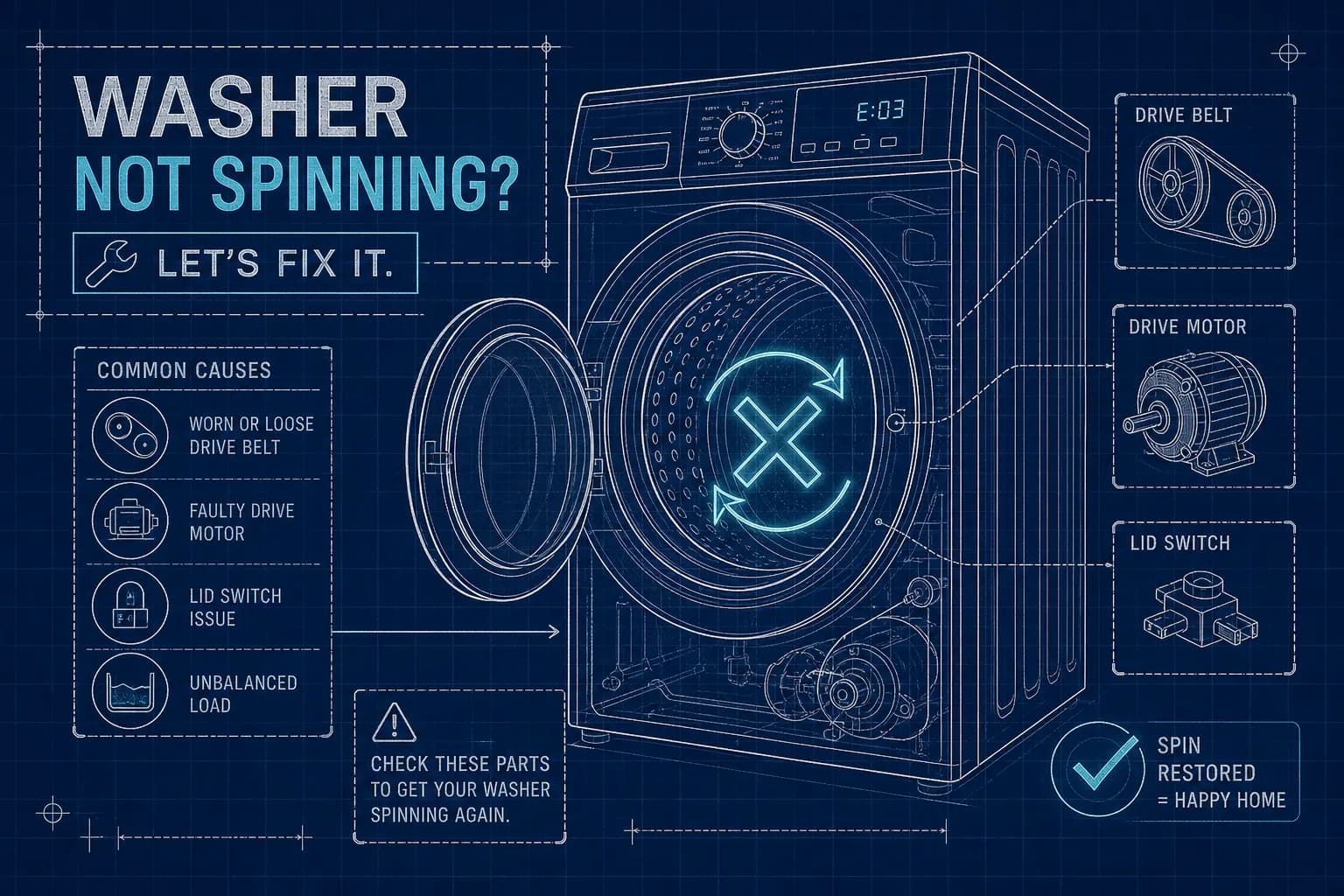
A washing machine drum stops rotating for several distinct reasons, and identifying which one applies changes everything about how you respond. The six most common culprits are: an overloaded or unbalanced load, a failed door lock or lid switch, a drainage blockage, a worn or snapped drive belt, worn carbon motor brushes, and a control board or sensor fault. That range matters because some of these are free to fix in five minutes, while others genuinely need a certified engineer.
One thing worth understanding from the start: modern washing machines are designed to stop the drum deliberately when a safety interlock is triggered. A stopped drum is not always a sign of something broken. It can be the machine doing exactly what it is supposed to do, waiting for a condition to be met before it continues.
Reading the symptoms: water, sounds, and error codes
Before touching anything, take stock of what you can see and hear. Is there still water sitting in the drum? A full drum at the end of a cycle almost always points to a drainage problem rather than a motor fault. Is the machine making a low hum with no movement? That suggests the motor is receiving power but something is blocking it mechanically. Is there complete silence? That is a different signal altogether, often pointing to a control or power issue.
Check the display panel for an error code. Bosch machines show F21/E21 for motor faults and F43 specifically for a drum that is not rotating. Samsung and LG both use UE or Ub for an unbalanced load, which simply means the machine has paused the spin cycle for safety. Hotpoint uses F05 and F11 for drainage faults that can prevent spinning. Your model's manual will translate the exact code, and a quick search for your model number alongside the code will usually confirm it within seconds.
The difference between a safety stop and a mechanical fault
A safety stop is recoverable. An unbalanced load, an unlatched door, or a temporary drainage delay can all trigger the machine to pause mid-cycle. Redistribute the load, close the door firmly, and restart, and the machine often picks up where it left off. A mechanical fault, by contrast, will not resolve itself: a snapped belt stays snapped, and worn motor brushes do not regenerate. The checks below help you work out which category you are dealing with.
Washing machine not rotating, simple checks that cost nothing
A significant proportion of non-spinning faults are resolved by the checks in this section, with no tools required. Work through them in order before assuming anything mechanical has failed.
Is an unbalanced load stopping your drum?
An unbalanced or overloaded drum is one of the most common reasons a washing machine won't enter the spin cycle. A single heavy item, a duvet or a large bath towel, for instance, can clump to one side and cause the machine to abort the spin as a protective measure. Pause the cycle, open the door, and redistribute the clothes evenly around the drum. If you are washing one heavy item on its own, add a couple of lighter items to help balance the load, then restart. If the machine repeatedly stops at the same point in the cycle, the load is the likely cause.
Checking the door lock and lid switch
Most washing machines will not enter spin mode unless the door lock or lid switch has fully engaged. On a front-loader, close the door firmly and listen for the click of the interlock engaging before starting the cycle. If the machine shows a door error or will not start even with the door pressed shut, the lock mechanism may be faulty. On a top-loader, the lid switch is a small plastic component that is depressed when the lid closes; if it is visibly cracked or the lid does not push it down fully, the machine reads the lid as open and refuses to spin. Inspect it carefully without forcing anything.
Power supply, settings, and machine levelling
Check that the machine is plugged directly into a wall socket rather than an extension lead, and that the circuit breaker has not tripped. An interrupted power supply mid-cycle can leave the machine in a confused state; switching it off at the socket for 60 seconds and restarting can clear this. Also check that the machine is sitting level on all four feet. An unlevel washer rocks during the drum's acceleration and can trigger an imbalance fault before the spin cycle even begins. Place a spirit level across the top of the machine and adjust the levelling feet until it sits flat.
How to clear a drainage blockage safely
Many faults where the drum won't rotate are drainage faults in disguise. Most modern washing machines will not enter the spin cycle if water cannot drain, because spinning a full drum puts extreme stress on the motor and bearings. If there is still water in the drum at the end of a cycle, drainage should be your first suspect.
How to locate and clean the pump filter on a front-loader
On most front-loading washing machines, the pump filter sits behind a small access panel or kick strip at the lower front of the machine, usually on the right-hand side. Open it with a coin or flat-headed screwdriver. Before unscrewing the filter cap, place a shallow tray and some towels directly underneath. Many machines also have a small drain hose tucked behind the same panel: pull this out, remove its cap, and drain the residual water into your tray before touching the filter cap itself. If the machine has recently run a hot cycle, allow the water to cool first.
Turn the filter cap slowly anticlockwise. Expect more water to come out as you do this. Once it is removed, pull out any lint, coins, hair, or debris you find, and rinse the filter under a tap. Check the housing behind it for anything lodged in the impeller. Reinstall the filter hand-tight, replace the drain hose cap, and close the access panel. Run a short cycle to confirm the fault is cleared.
Checking the drain hose and standpipe for blockages
Pull the machine forward slightly and inspect the drain hose at the back for any kinking, crushing, or tight bends. The hose should sit no deeper than 15cm into the standpipe and should not be sealed airtight, as this prevents the siphon break that allows draining. Pour water directly into the standpipe to confirm it drains freely. If yours is a top-loader and you are seeing drainage problems, bear in mind that many models do not have a user-accessible pump filter, check your manual before removing any panels.
How to spot a drive belt or motor brush failure
Once drainage is ruled out and the door lock is functioning correctly, the fault is more likely mechanical. The two most common internal failures that leave a washer that won't agitate or spin are a worn or snapped drive belt and worn carbon motor brushes.
What a worn or broken drive belt looks and feels like
The drive belt transfers power from the motor to the drum. When it snaps or wears through, the drum loses drive entirely. The clearest test for a broken belt is simple: unplug the machine, then try rotating the drum by hand. If it spins with almost no resistance and you can feel it moving freely with very little effort, the belt has likely gone. A healthy drum has noticeable resistance from the motor. Drive belts typically last five to ten years under normal use, but frequent heavy loads or overloading can shorten that to three to five. Squealing during the spin cycle, clothes coming out unusually wet, or a faint burning rubber smell are early warning signs the belt is wearing. Inspecting it requires removing a rear or side panel after unplugging the machine fully at the socket.
Signs of worn motor brushes and why they stop the drum rotating
Carbon motor brushes conduct the electrical current that makes the motor run. As they wear down over years of use, they make less consistent contact with the motor's commutator, and the motor loses the ability to generate enough torque to turn the drum. The tell-tale signs are distinct from a belt failure: the drum may turn slowly and inconsistently rather than stopping dead, or you may notice a crackling or sparking sound during the wash cycle, or a burning smell that is not rubber. Motor brush replacement involves working directly near electrical components, and this is firmly the point where most homeowners should stop and hand the job to a certified engineer. Amateur work here risks making the fault worse or creating a safety hazard.
What UK washing machine repairs typically cost
Typical fitted costs for the most common drum faults
The table below gives realistic fitted cost ranges for UK repairs in 2026, including parts and labour. These are the figures you should use when deciding whether repair makes financial sense.
RepairTypical fitted cost (UK)Typical labour timeDrive belt replacement£70, £150Under 1 hourDrain pump replacement£90, £18030, 60 minutesDoor lock replacement£65, £1501, 2 hoursMotor replacement£150, £4001, 3 hours
Labour time matters because some services charge a separate call-out fee on top of the repair cost. Fixed-price providers include diagnostics in the quoted repair price, so there are no surprises when the engineer arrives. A belt or pump swap is often completed in a single visit lasting under an hour, making these repairs straightforward value compared to the cost of a replacement machine.
Is it worth repairing or replacing your washing machine?
A useful rule of thumb: if the repair cost exceeds 50% of the price of a comparable new machine, replacement deserves serious consideration, particularly on a machine that is over eight years old. For a belt or pump fault on a five-year-old appliance, repair almost always wins on cost. For a motor replacement on a ten-year-old budget machine, the maths often tips the other way. A certified engineer can give you an honest assessment on the first visit, and reputable services will tell you clearly if replacement makes more financial sense than repair.
When a certified engineer is the right call
Signs it is time to stop diagnosing and call a professional
There are clear signals that you have reached the limit of safe DIY. If the drain is clear, the load is balanced, the door lock is engaging, and the drum still will not rotate, the fault lies inside the machine. If the symptoms point to motor brushes, the motor itself, or the control board, amateur investigation risks making the fault worse, voiding any remaining warranty, or, in the worst case, creating an electrical hazard. At that point, a professional diagnosis is simply the faster and safer route to a working machine.
What to expect from a fixed-price professional repair
Alpha Appliances Ltd offers fixed-price repairs with same-day or next-day availability across London, Berkshire, Surrey, Hampshire, and Dorset. Every repair is carried out by City & Guilds certified engineers with no hidden call-out fees, and a strong first-time fix rate means the great majority of faults are resolved in a single visit. You will receive a clear diagnosis before any work begins, so you can make an informed decision with no pressure. To book, get in touch with the team directly through the website or by phone.
Frequently asked questions
Why is my washing machine not rotating even though it powers on?
A washing machine that powers on but will not rotate is most commonly caused by an unbalanced load, a door lock that has not fully engaged, or a drainage blockage preventing the spin cycle from starting. Work through the free checks in this guide before assuming the motor or control board has failed.
My washing machine drum is stuck and won't move at all, what should I check first?
If the drum is completely stuck, first unplug the machine and try turning the drum by hand. If it moves freely with almost no resistance, a snapped drive belt is the most likely cause. If it will not budge at all, there may be a foreign object, a coin or underwire, for example, lodged between the drum and the cabinet.
Why has my washing machine stopped mid-cycle with water still inside?
This almost always indicates a drainage fault. Check the pump filter for lint and debris, inspect the drain hose for kinks, and confirm the standpipe is not blocked. Most machines will not spin until the drum has drained, so clearing the blockage is usually enough to get the cycle moving again.
Can washing machine error codes tell me why the drum won't spin?
Yes. Washing machine error codes are one of the quickest diagnostic tools available. On Bosch machines, F43 indicates a drum that is not rotating; Samsung and LG use UE or Ub for an unbalanced load; Hotpoint F05 and F11 point to drainage problems. Check your manual or search your model number alongside the code for a precise explanation.
Conclusion
Work through the diagnostic order and you will know quickly where the fault lies. Check the load and door lock first; if those are fine, move to drainage and clean the pump filter; then look for signs of a belt or motor brush fault. Catching a problem early, whether that means clearing a blocked filter yourself or booking an engineer before a minor fault becomes a major one, almost always costs less than leaving it.
If the checks in this guide have not resolved the problem, the fault is most likely mechanical and needs a trained eye. In most cases a washing machine not rotating is a diagnosable, fixable fault, not a write-off. Alpha Appliances Ltd can send a certified engineer to diagnose and repair it the same day or the next, at a fixed price, with no surprises. Get in touch with the team to book your appointment.
Need a repair today?
Book a visit from a certified Alpha engineer in minutes.