Is it time to replace your washing machine? Learn the key signs, cost rules, and when repair is worth it to make the right choice and save money.
How do I know if my washing machine needs replacing? It's a question that tends to hit at the worst possible moment: mid-cycle stop, a grinding noise that wasn't there last week, or water spreading across the kitchen floor. The decision feels more complicated than it should, do you fix this, or do you finally walk away and buy a new one?
At Alpha Appliances Ltd, we've been answering that exact question for more than 15 years and more than 20,000 repairs across London and the South of England. Some machines that looked finished were back running within the hour. Others that owners had been nursing along for months were quietly costing far more than a replacement would have. The difference almost always came down to four things: age, fault type, repair cost, and running cost. Here's how to work through each one.
Most front-loading washing machines are designed to last roughly 8 to 12 years, while top-loaders typically run for 7 to 10 years. In practice, UK consumers often begin experiencing problems after 6 to 7 years, though quality models from brands such as Bosch or Miele can comfortably exceed a decade with proper use and regular maintenance. The point is not that age alone determines whether you repair or replace, but that age completely reframes what a repair cost actually means. Manufacturers also publish guidance on how long a washing machine lasts, which can help set realistic expectations.
A £200 repair on a three-year-old machine is a straightforward yes. The same repair on a ten-year-old machine with two prior fixes behind it is a very different conversation. Once a washing machine passes the eight-year mark, the probability of further component failures rises sharply, because parts age together. If a pump fails on an older machine, the motor bearings and control board are often not far behind. Engineers refer to this as the cascade failure pattern: one component gives out and, rather than being a one-off, it signals that the whole machine is entering its final phase. Age combined with a significant fault is almost always grounds for replacement; age alone rarely is.
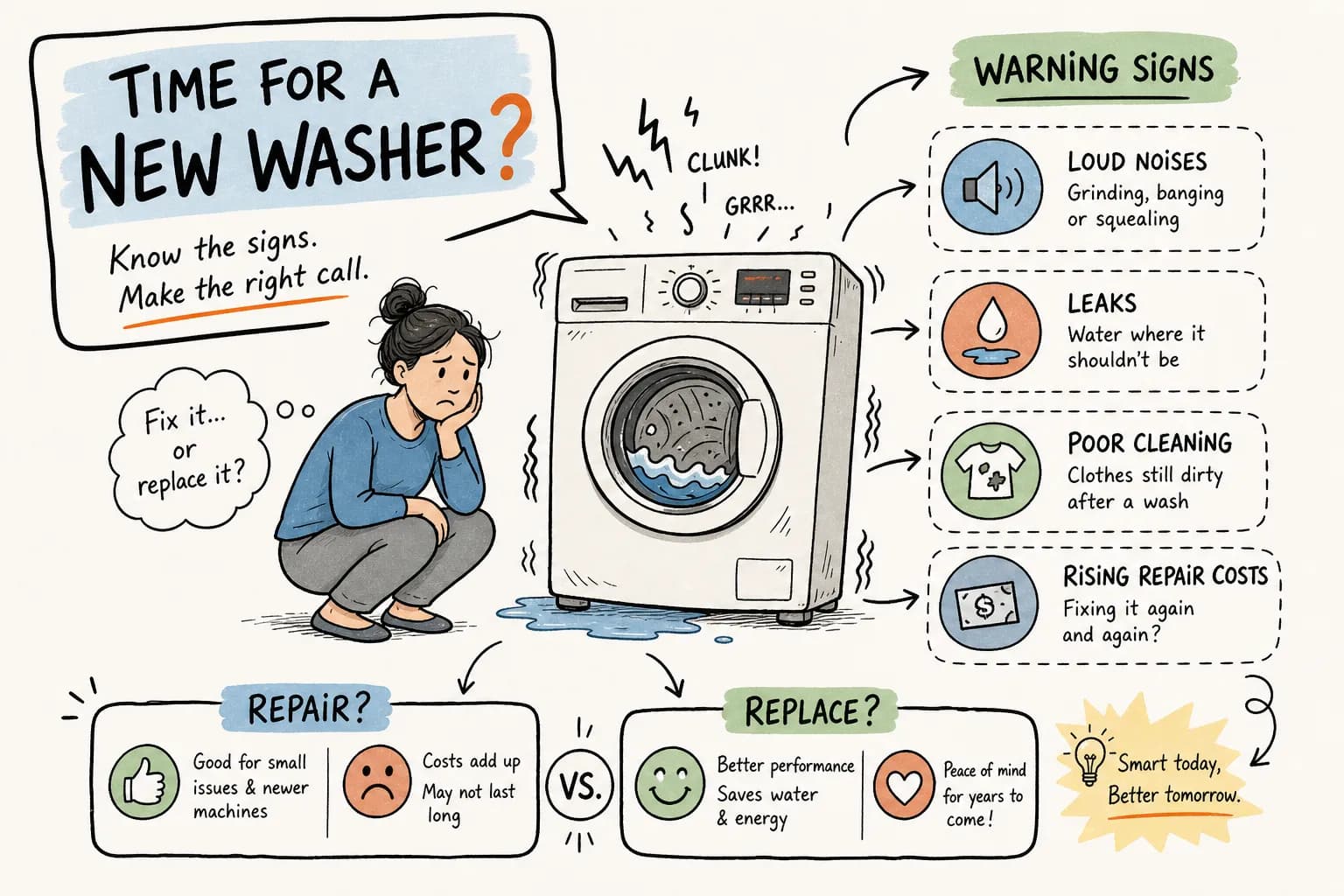
A washing machine that has started grinding, rumbling, or producing loud vibration during the spin cycle is almost always showing early bearing wear. If the drum wobbles when you push it by hand, or you can hear a metallic grinding noise that worsens with a heavier load, the main drum bearing is likely deteriorating. These are not noises to monitor for a few more weeks; they are a mechanical warning that the machine is heading toward a significant repair bill.
Persistent leaks from the door seal, the pump housing, or the drum itself are another clear signal, particularly when the seal has split or water pools on the floor repeatedly after each cycle. A machine that won't drain fully, leaves standing water in the drum, or takes multiple attempts to complete a wash is also telling you something is structurally wrong, not just temporarily confused by an unbalanced load.
Recurring error codes that return after a reset are one of the most telling signs that a control board or sensor is failing rather than triggering a one-off fault. Clothes coming out visibly dirty, fabric damage during the wash cycle, or failure to heat water correctly all point to sensor failure, drum damage, or a failing heater element. A machine that trips your home electrics during operation is a safety concern that needs immediate professional attention, full stop.
Before you can apply any cost rule, you need realistic numbers. In the UK, common washing machine repairs currently cost roughly: a pump or drain fault at around £85 on average; a door lock replacement at £150 to £250 fitted; an electronic control board at £100 to £300 depending on the model; and a motor replacement between £250 and £390. Drum bearing repairs sit at £105 to £255 for simpler jobs, but if the main bearing has fully seized, the repair can reach £500 to £1,000, making it one of the clearest cases for replacement in the entire fault catalogue. For a broader breakdown of typical repair costs see a washing machine repair cost guide.
The broadly accepted threshold in the repair industry is that repair costs exceeding 30% of a comparable new machine's price are the point at which replacing rather than repairing makes financial sense. Some guides use a 50% threshold, but 30% is where the decision genuinely stops being close. A new mid-range washing machine in the UK currently retails at around £400 to £700, with many decent models sitting near £500. If your repair quote is £175 or above on a machine over seven years old, you are in replacement territory. The calculation becomes even clearer when you factor in that one significant repair on an ageing machine rarely means no further repairs for the next several years.
A fully failed drum bearing is the fault that most commonly tips the decision toward replacement. The repair requires dismantling most of the machine, labour costs alone are significant, and on older models the inner basket or drive shaft is frequently found to be corroded during disassembly, adding further cost. The observable signs of irreparable bearing damage are specific: constant grinding that worsens under load, a drum that wobbles or shifts when pushed by hand, visible discoloration or heat damage around the back of the drum, and roughness or binding when the drum is rotated manually. These are not early-stage symptoms that a service call will resolve; they indicate structural deterioration.
Motor failure is similarly expensive and, on an older machine, rarely cost-effective. Motor replacements average between £250 and £390 in the UK, and a machine old enough to have a dead motor is usually not worth that investment. Recurring control board faults present a different problem: even after an expensive board replacement, if the underlying cause (a wiring fault, water ingress, or power surge) is not resolved, the new board will fail again. A certified engineer can identify this quickly during diagnostics; most homeowners cannot.
A washing machine that is ten or more years old can use significantly more energy per cycle than a modern equivalent. The UK's 2021 energy label rescaling introduced an A to G rating scale, and efficient A-rated machines now consume around 51 kWh per 100 wash cycles, compared with roughly 90 kWh per 100 cycles for a lower-rated older model. That gap reflects the broader picture: newer efficient machines use roughly 20 to 33% less energy and 30 to 50% less water than older models, and at current UK energy prices, the difference adds up to a meaningful annual cost on top of any repair bills you're already absorbing. If you are weighing replacement partly on energy savings, guidance on buying a more energy-efficient appliance is worth a look.
If your machine is already borderline on the repair cost threshold, the energy savings argument can be the deciding factor. A new mid-range machine bought for £400 to £500 that saves you £50 to £80 a year in running costs, while also removing the risk of further repair bills, can pay for itself faster than most people expect. This is worth including in your total calculation alongside any repair quote, particularly if your current machine is pre-2015 and carries a D rating or below.
The single biggest mistake homeowners make is deciding to replace a washing machine based on a fault symptom alone, without getting a professional assessment first. Some faults that sound catastrophic, including strange grinding noises, failure to drain, and mid-cycle stops, have straightforward, low-cost explanations. A blocked filter, a failed door latch, or worn carbon brushes can each cause dramatic symptoms that resolve with a simple repair under £100. You could be about to spend £500 on a new machine for a £65 fix.
Before you shop for a replacement, get a certified engineer to assess the machine. A qualified technician can tell you exactly what the fault is, what it will cost to fix, and whether fixing it is worth it given the machine's age and condition. Independent analysis also shows that cost considerations strongly influence whether consumers choose repair or replacement; understanding those trade-offs before you decide helps avoid an unnecessary purchase. For more on the economics behind repair decisions see this consumer repair cost analysis. At Alpha Appliances Ltd, that diagnostic is fixed-price with no obligation to proceed. Our City and Guilds certified engineers are trained to give you an honest answer rather than a repair bill you don't need. We also carry out brand-specific repairs, see our pages for Hotpoint washing machines in Aldwych, Leisure washing machine repair in Aldwych, and Siemens washing machine repair in Aldwych if you need brand-specific information.
If the machine is beyond economical repair, we will tell you directly. If it can be fixed cost-effectively, you will know exactly what that looks like before you spend a penny on a new appliance.
Knowing whether your washing machine needs replacing comes down to four questions: how old is it, what does the fault actually cost to fix, is this fault a structural end-of-life signal, and is the machine already costing you more to run than it should? If the repair cost clears 30% of the replacement value on a machine over seven years old, the drum bearings or motor have failed, or you are fixing the same fault for the third time, replacement is usually the right call.
Still asking yourself, how do I know if my washing machine needs replacing? Don't make that call without a professional assessment first. A proper diagnostic from a certified engineer costs far less than an unnecessary new appliance and removes the guesswork from what is often a significant financial decision. If your machine is playing up and you're not sure where you stand, book a fixed-price diagnostic with Alpha Appliances Ltd and get a straight answer before you decide.
Book a visit from a certified Alpha engineer in minutes.
TRUSTED BY HOMEOWNERS
Fast, reliable, and warranty-backed repairs for every major brand.
Discover more tips from Alpha engineers.