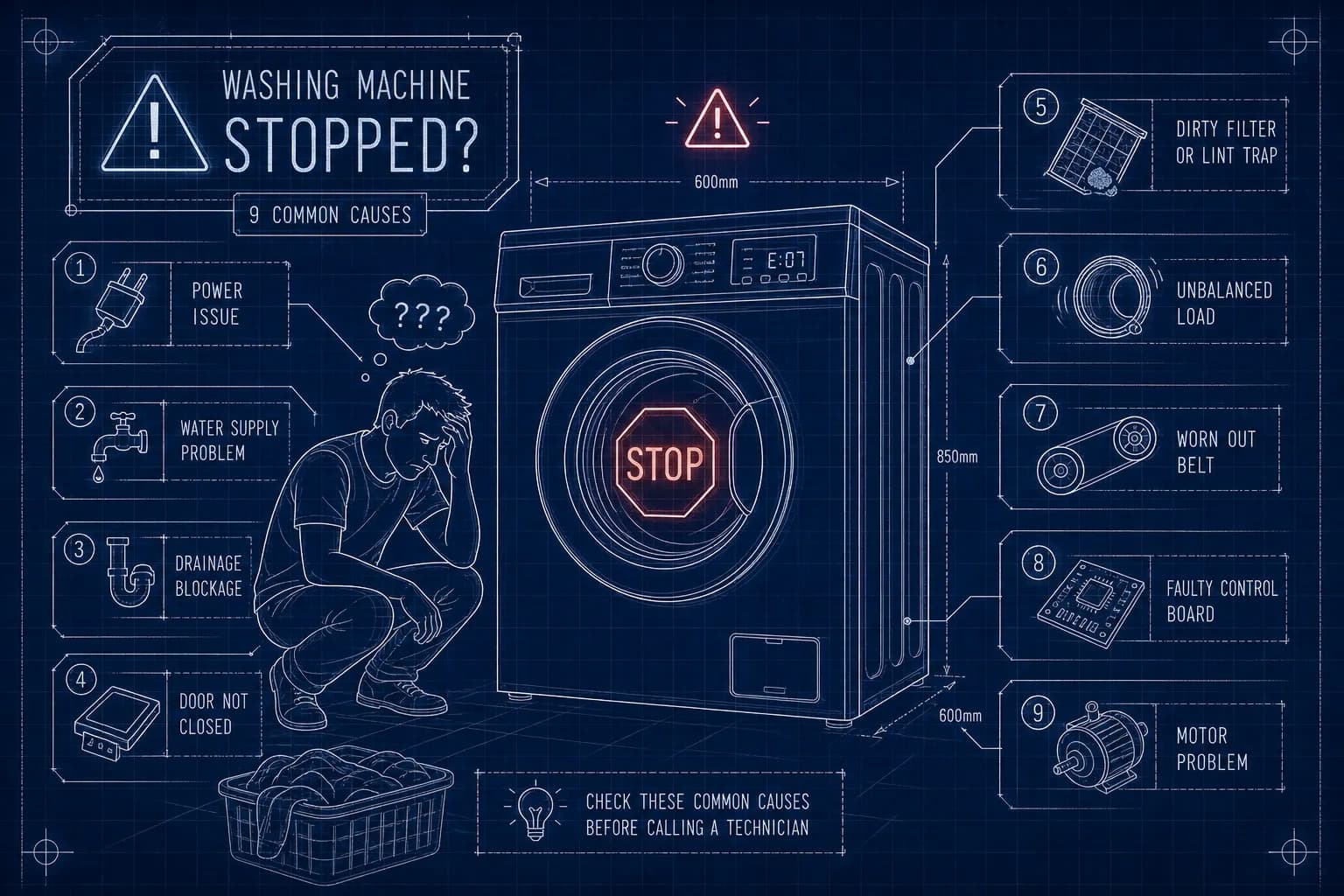
Discover nine reasons your washing machine stopped, from power and drainage faults to motor problems, plus safe checks and when to call an engineer.
If you are wondering what causes a washing machine to stop working, the answer is usually one of a handful of well-understood faults: a power or door-lock problem, a drainage blockage, an unbalanced load, motor trouble, or a failed control board. Several of these are straightforward to identify without any tools. This guide walks through every likely cause, what to look for, and what you can safely check yourself. By the end, you will know exactly what has probably stopped your machine, and whether it is a quick fix or a job for a qualified engineer.
The nine causes below follow a diagnostic hierarchy: start at the simplest and cheapest, work towards the more involved. Most washing machine stoppages fall into the first three categories, so the answer is often closer than you think.
A completely unresponsive machine almost always starts at the power source. Test the wall socket with another device, check whether the 13A plug fuse has blown, and look at your consumer unit to see whether the circuit breaker has tripped. Washing machines draw a surge at start-up and again during spin, which is enough to trip an older or shared circuit. If the breaker trips repeatedly, that is a signal to stop resetting it and arrange a professional inspection.
Less obvious is the internal thermal fuse, which cuts power to protect the machine when it overheats. If the display is blank and everything else checks out, this component is worth having a qualified engineer test.
Every front-loader has a safety interlock: the machine will not start, and will stop mid-cycle, if the door is not detected as fully closed and locked. The signs are a door that feels loose, a latch that clicks but does not hold, clothing trapped in the rubber seal preventing a proper close, or a lock assembly that has failed mechanically. This is one of the most common faults engineers see on front-loading machines, and it is worth checking the seal carefully before assuming the worst.
Never force the door open while water remains inside the drum. A locked door during a cycle is often a deliberate safety response, not a mechanical failure on its own.
The tell-tale symptoms of a drainage problem are water sitting in the drum after the cycle ends, clothes coming out wetter than normal, a humming or grinding sound during the drain phase, gurgling noises, and a drainage error code on the display. The pump filter is typically located behind a small panel at the front bottom of the machine. Before opening it, lay a towel down and have a shallow tray ready: residual water will spill out.
Common obstructions include coins, hair clips, lint, and small clothing items. Clearing the filter takes only a few minutes and costs nothing. If the filter is clear but the pump still hums without draining or makes a grinding noise, the pump itself may need replacement. A drain pump replacement typically costs £110 to £200 in the UK. At Alpha Appliances, a fixed booking fee of £95 inc VAT covers attendance, diagnosis and most repair labour; any parts or additional work are quoted before we proceed.
If the machine pauses very early in the cycle, it may be waiting for water that is not arriving. Check that both inlet tap valves are fully open, that the inlet hose is not kinked or pinched behind the appliance, and that the small filter screens inside the hose fittings are not blocked with sediment. Low household water pressure can also cause fill pauses on modern pressure-sensing machines.
If the inlet valve itself has failed, no amount of cleaning will resolve it: the valve needs replacing, which is a job for a qualified engineer. Inlet valve replacement is a relatively quick workshop task, but it does require isolating the water supply and disconnecting the hose fittings safely.
Modern machines use sensors to detect uneven weight distribution, particularly during the spin ramp-up. When the drum cannot balance itself after repeated attempts, the machine stops to protect the bearings and drum suspension. The fix is straightforward: open the door once the drum has stopped, redistribute the laundry evenly, and restart. Heavy single items such as duvets, bath mats, and large towels are particularly prone to balling up on one side and should ideally be washed with a balancing item or on a dedicated programme.
Excess detergent generates foam that interferes with water-level sensing, drainage, and cycle progression. Modern high-efficiency machines use very little water, so even a standard dose of the wrong detergent can create too much foam. The machine may pause repeatedly or add extra rinse cycles automatically without any visible fault code. The fix is to reduce detergent, use the dose shown on the pack for your load size and water hardness, choose a low-foam detergent made for automatic front-loading machines, and run an empty drum-clean cycle to clear residual soap build-up.
Washing machine motors have a thermal cutout that shuts the machine down if the motor runs too hot, often after a long or particularly heavy cycle. The machine may appear completely dead but will restart after a period of cooling; the time required varies by model. If this happens regularly, the motor or its cooling pathway needs professional assessment. A burning smell is a more serious warning: switch the machine off at the wall immediately and do not use it again until a qualified engineer has inspected it.
Broader motor failure signs include a drum that refuses to turn at all, or loud humming with no rotation: a sign the motor is running but mechanically jammed.
Brushed motors gradually lose their carbon brushes over time, causing intermittent spinning failures or a drum that spins weakly. On belt-driven models, a snapped or stretched drive belt produces a drum that turns freely by hand with no resistance at all. These are relatively low-cost repairs when caught early. Motor brush replacement typically costs between £70 and £120, considerably less than a full motor swap. A drum that makes a rumbling or grinding noise during spin often points to worn bearings, which is a more involved repair. If the machine is over seven or eight years old, it is worth comparing the repair cost against that of a newer appliance.
Fault codes are the machine's built-in diagnostic shortcut. Before touching anything else, note the code or flashing-light pattern and check your appliance manual. The list below covers the most common codes for door-lock and drainage faults on the brands we see most frequently.
Once you have the code, you know which system to check first rather than guessing. A door code means inspect the latch and seal; a drainage code means start with the filter. A code pointing to the control board (PCB) or motor is a signal to stop DIY investigation and arrange a professional assessment. Attempting repairs on these components without the right diagnostic kit can turn a repairable fault into a more expensive one. Codes also vary between model generations, so the printed manual or the manufacturer's support page for your exact model number takes priority over any general list.
The universal power reset works on almost every brand: stop the cycle, wait for the drum to stop completely, turn the machine off, then unplug it from the socket with dry hands. Wait at least one minute; five minutes is better if the control panel is frozen. Plug back in, switch on, and run a short rinse or spin test. This clears a temporary software glitch and nothing more: it will not fix a blocked drain, a failed lock, or a motor fault.
There are some brand-specific nuances worth knowing. Bosch machines often reset by turning the selector dial to Off, waiting briefly, and selecting the programme again. Samsung and LG respond well to unplugging for several minutes, with LG sometimes requiring you to hold the Power and Start/Pause buttons for about five seconds while disconnected. Hotpoint and Indesit generally need at least two minutes disconnected from the mains before retrying.
Be direct with yourself about the warning signs that mean the machine should not be used again until it has been inspected: the breaker trips repeatedly, there is a burning smell, you see sparking, water appears on the floor, or the fault code returns immediately after a reset. At this point, continued DIY attempts risk turning a straightforward repair into a significantly more expensive one.
At Alpha Appliances Ltd, every repair comes with a fixed price agreed upfront, so there are no surprises on the invoice. With a 78% first-time fix rate and over 20,000 repairs completed across London and the South of England, we have the experience to handle the full range of faults covered in this guide.
Knowing what causes a washing machine to stop working makes it far easier to reach a diagnosis without wasted time or unnecessary expense. Start with power and the door, then check drainage, then consider load and detergent, then look at the motor, and finally interpret any fault code the machine displays. Most stoppages fall into one of these five categories, and many can be resolved quickly with no tools at all. Work through the list in order and you will either find a quick fix or arrive at a clear diagnosis before spending anything.
When the basic checks have ruled out the simple causes, the fault is usually internal and needs a qualified engineer with the right equipment. Alpha Appliances Ltd has a 78% first-time fix rate. Alpha Appliances Ltd offers next-day appointments across Greater London, Berkshire, Surrey, Hampshire, and Dorset, with City and Guilds certified engineers and transparent fixed pricing from the moment we walk through the door. Get in touch with our team to book your appointment.
No, you must not force the door open while water remains inside the drum. We emphasise that a locked door during a cycle is often a deliberate safety response rather than a mechanical failure, so forcing it risks injury and damage. If water is present, wait for the machine to drain or arrange a qualified engineer if the door will not release safely.
Wait until the motor and machine have cooled down before attempting to restart, and that cooling time varies by model. We note that the machine will usually restart after a period of cooling but if the shutdown happens regularly or you detect a burning smell you must switch the machine off at the wall and book a qualified engineer inspection.
No, a power reset only clears temporary software glitches and will not fix a blocked drain, a failed lock, or a motor fault. We recommend using the reset as an initial step for frozen control panels, but start physical checks of the drain filter or door latch if the problem points to those systems, and call a professional for electrical or mechanical faults.
Book a visit from a certified Alpha engineer in minutes.
TRUSTED BY HOMEOWNERS
Fast, reliable, and warranty-backed repairs for every major brand.
Discover more tips from Alpha engineers.