
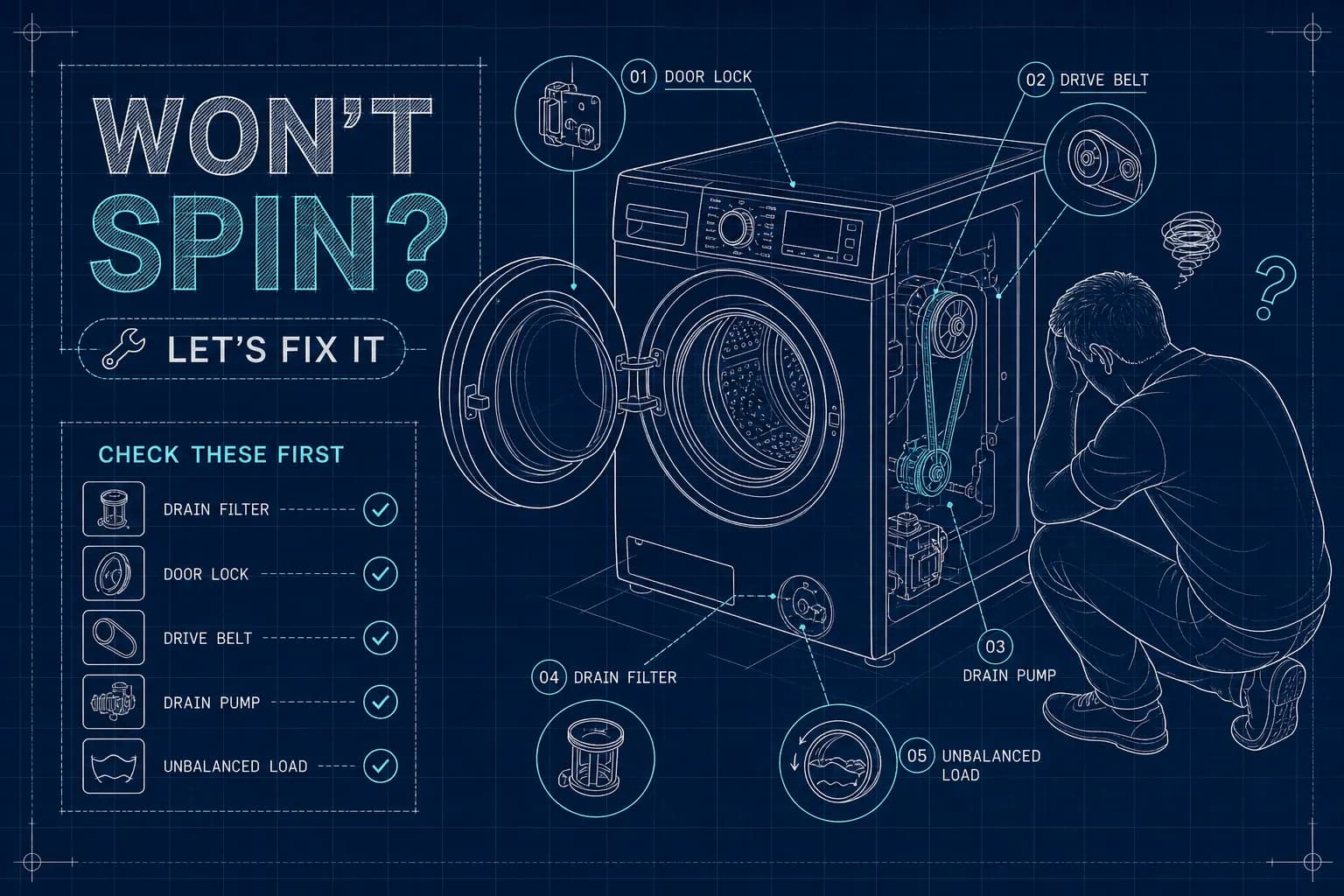
How to Fix a Washing Machine That Won't Spin in the UK
You open the washing machine door expecting damp but wrung-out laundry. Instead, the clothes are soaking wet, water is sitting in the drum, and the machine has done nothing useful since you pressed start. It is one of the most frustrating moments in any household, and the temptation to assume the worst is understandable. The good news is that a drum refusing to spin nearly always has one of a handful of diagnosable causes, and most of them have a straightforward fix. This guide walks you through exactly how to fix a washing machine that won't spin in the UK, starting with the checks that cost nothing and moving through to the faults that need a professional.
Drainage problems are among the most commonly cited causes of spin failures in UK homes. One regional report from Kent found that drainage faults accounted for roughly 60% of spin-related call-outs, and experienced engineers across the country consistently report a similar pattern. That figure is worth holding onto, because it means there is a strong chance the problem is a blocked filter rather than a failed motor. This article takes you through a logical sequence of checks, starting with the ones that require no tools whatsoever and moving through to component faults that need a professional. At Alpha Appliances Ltd, our engineers have worked on spin-cycle faults across many thousands of UK homes, and the pattern of causes is remarkably consistent. By the end of this guide, you will know exactly what is wrong and what to do next.
How to fix a washing machine that won't spin in the UK: quick checks first
Before touching a single part, three basic checks resolve the majority of spin failures. These are the same two-minute checks our engineers run through at the start of every call-out, because skipping them and going straight to the motor is how you waste an hour and feel foolish afterwards.
Is the load unbalanced or overloaded?
Mixing heavy and light items in the same wash is the most common cause of a drum that refuses to spin. Towels and t-shirts washed together tend to clump, with the heavy items settling to one side of the drum. The machine's sensors detect excessive wobble during the build-up to spin speed and abort the cycle as a safety response to protect the bearings and suspension springs. The fix is simple: open the door, redistribute the laundry by hand, remove a few items if the drum is packed tight, and restart on a rinse-and-spin programme. If the drum is under half full and the laundry is spread evenly, the machine will often complete the spin without issue, though bear in mind that drainage, belt, or motor faults can still prevent spinning even with a well-balanced load.
Is the machine sitting level?
An unlevel machine amplifies drum vibration at speed, triggering the same imbalance sensors even when the load itself is perfectly distributed. Run a quick rocking test by pressing alternate corners of the machine: if it moves at all, the feet need adjusting. Use a spanner to loosen the lock nut on each foot, raise or lower the foot until the machine sits firmly without any movement, then tighten the lock nuts back against the base. A short test spin on an empty drum confirms whether the levelling has resolved the problem.
Is excess detergent causing suds build-up?
Using more detergent than the dosing guide recommends creates excess foam inside the drum. That foam interferes with the drain cycle, and a machine that has not fully drained will not spin. Run an empty hot rinse cycle to clear the residue, then switch to the correct dose going forward. Modern concentrated detergents require far less than people expect, and the marks on the cap or drawer are worth following carefully.
How to fix a washing machine that won't spin: clearing a blocked drain filter
If the quick checks above did not resolve the problem, the most productive next step is checking drainage. When water cannot fully exit the drum, the machine's safety logic locks out the spin cycle to prevent wet laundry being flung at high speed. Engineers consistently point to drainage blockages as a leading cause of spin failures, making the filter the single most productive component to check after load balance.
Finding the filter on a front-loading machine
On most front-loaders, the pump filter sits behind a small access panel on the lower front of the machine, typically bottom right or centre. Some Samsung and LG models locate the filter behind the detergent drawer rather than a front panel, so check the manual if you cannot find an access door at the bottom. Before opening anything, have a shallow tray and a couple of old towels on the floor underneath: residual water will come out, and it is better to be ready for it.
Step-by-step: draining and removing the filter safely
- Unplug the machine from the wall before doing anything else.
- Open the access panel using a coin or flat-head screwdriver in the notch provided.
- If there is a small emergency drain hose clipped inside the panel, pull it out, remove the cap, and let residual water drain into the tray before proceeding.
- Turn the filter anti-clockwise and pull it straight out.
- Remove lint, coins, and debris by hand, then rinse the filter under running water with a soft brush until it is clear.
- Reinsert the filter and turn it clockwise until it is firm. A loose filter will leak immediately once the machine runs.
- Close the panel, restore power, and run a short rinse-and-spin cycle to test.
Checking the drain hose for kinks
A kinked or crushed drain hose at the back of the machine stops water flow entirely, producing exactly the same symptoms as a blocked filter. Pull the machine slightly forward from the wall and check the hose along its full length for tight bends or crushing against a cabinet edge. Straighten any kinks and reroute the hose if needed. If the hose feels brittle, cracked, or has a section that will not hold its shape, replacement is the right call and a straightforward job.
Symptoms that point to a mechanical or electrical fault
If the load is balanced, the machine drains normally, and the drum still will not spin, the fault has moved into component territory. These issues do not resolve with a rearranged load or a clean filter, but identifying which component is failing tells you whether a DIY fix is realistic or whether a certified engineer is the smarter call.
A faulty door lock or interlock
The symptom pattern here is specific: the machine fills and heats normally but will not progress to spin, or it pauses mid-cycle without explanation. Many modern machines display error codes when the interlock fails. Hotpoint machines, for example, may display F06 to indicate a door lock fault. Bosch models use their own code system that varies by model range, consult your machine's manual or the manufacturer's website for the specific interlock code, as these differ from drainage or load-balance codes. Even if the door feels solidly shut, a faulty lock mechanism signals "open" to the control board, which prevents spin as a safety measure. Repeated clicking or buzzing when the machine attempts to lock is a reliable tell-tale sign that the interlock is the culprit.
A broken or slipping drive belt
The distinction here is clear: the motor hums and runs normally, but the drum stays completely still. Occasionally a squealing or slapping sound accompanies the motor movement, which is the belt riding loose on the pulley before it loses contact entirely. Drive belts in UK household conditions typically last between five and eight years under standard use, though heavy loading accelerates wear significantly. Once the belt snaps or stretches off the pulley, the motor runs uselessly and no amount of redistributing the laundry will help.
Worn carbon brushes and motor failure
In older UK machines with universal motors, carbon brushes wear down gradually over time. The drum may spin slowly at low speeds but fail to reach the high spin speeds needed to wring out clothes properly, or it may cut out entirely on fast spins. A burning smell or grinding noise from the motor points more to motor failure itself rather than brush wear alone. These two faults look similar from the outside but carry very different repair costs, which is one reason misdiagnosis at this level is an expensive mistake.
Which repairs are safe to do yourself and which aren't
Some of these fixes are safe for a competent homeowner with basic tools; others carry a real risk of making the fault worse or creating a safety hazard. Being clear about that boundary saves time and money.
What you can safely handle at home
Redistributing and rebalancing the load, adjusting the levelling feet, cleaning the drain filter, and clearing a kinked drain hose are all within reach for most people. So is a visual check of the door seal and lock for obvious damage. These tasks require no electrical knowledge and carry no meaningful risk, provided the machine is unplugged before you open any access panel.
The filter clean alone resolves the majority of spin failures without any further work needed.
What needs a certified engineer
Drive belt replacement, carbon brush replacement, motor diagnostics, PCB faults, and door interlock replacements all require the back or front panel to be removed and electrical components to be handled. Mistakes at this level can damage the control board or create a genuine shock risk. A misdiagnosed motor fault, where the problem is actually worn brushes, can cost double if the wrong part is ordered and fitted. This is where bringing in a qualified engineer is usually worth the call-out cost. At Alpha Appliances Ltd, our manufacturer-trained engineers carry a strong first-time fix rate across all brands, meaning the vast majority of spin-cycle faults are diagnosed and resolved in a single visit rather than stretching across multiple appointments.
What these repairs actually cost in the UK
Knowing the likely bill before a technician arrives helps you decide whether a repair makes financial sense or whether replacement is the smarter move. The figures below reflect realistic UK cost ranges for parts plus labour in 2026, and will vary by region, brand, and individual engineer.
It is always worth confirming whether a call-out fee is included in the quoted price before you book.
When the repair bill exceeds the machine's value
The practical rule of thumb is straightforward: if the repair cost exceeds £200 to £250 on a machine that is more than eight years old, replacement often wins on long-term value. For machines under five years old, even a motor repair usually makes economic sense, since a new machine of comparable quality will cost significantly more than the repair bill. Brand matters too: a Miele or Bosch machine that is six years old is worth repairing at a higher threshold than a budget machine of the same age, simply because the replacement cost is considerably greater.
When to stop troubleshooting and call an engineer in the UK
If the quick checks and filter clean have not resolved the fault, and the symptoms point to a belt, brushes, interlock, or motor, the diagnostic equipment and parts access of a certified engineer will resolve the problem far more efficiently than continued DIY investigation.
Signs the fault is beyond DIY
Four symptoms are clear signals to stop and call a professional:
- The drum stays completely still while the motor hums, points to a broken or slipped drive belt, or worn carbon brushes.
- The machine pauses mid-cycle and displays an error code, suggests an interlock or control board fault.
- A burning smell or grinding noise from the motor area, indicates motor wear or failure requiring immediate attention.
- Water remains in the drum at the end of the cycle despite a clean filter, points to a failed drain pump.
These are not edge cases or faults that might improve with another attempt. They are component failures that need proper diagnostics to resolve correctly the first time.
Booking a certified engineer for a spin-cycle fault
Alpha Appliances Ltd serves UK homeowners dealing with exactly these faults across London, the Home Counties, and the South of England. Our City & Guilds certified engineers carry all major parts on the van and work to clear, fixed pricing, so there are no surprises on the day. Next-day appointments are available in most areas, meaning you are not waiting weeks for a manufacturer's service team to fit you in. Book online in minutes and receive a confirmed appointment reference the same day.
How to fix a washing machine that won't spin: the logical sequence, summarised
Start with load balance and levelling, these two checks cost nothing and resolve a significant proportion of spin failures in UK homes. If the machine drains but will not spin, clean the filter before assuming anything is broken. If the filter is clear and the drum still refuses to spin, look for the symptom pattern that points to a belt, brushes, interlock, or motor, and match that against the cost guide above to make an informed decision.
A washing machine that won't spin is a solvable problem in almost every case. Working through this sequence puts you firmly in control of what happens next. Whether that turns out to be a five-minute fix at the filter panel or a booked visit from a certified engineer who carries the right part on the van, you are no longer standing in front of a drum full of soaking clothes wondering where to start.
Frequently asked questions
Why won't my washing machine spin?
The most common reasons a washing machine won't spin are an unbalanced or overloaded drum, a blocked drain filter, a kinked drain hose, or a faulty door interlock. Less commonly, a broken drive belt, worn carbon brushes, or a motor fault may be responsible. Work through the checks in order, most spin failures are resolved at the filter or load-balance stage without any specialist help.
Can I fix a washing machine that won't spin myself?
Yes, in many cases. Rebalancing the load, cleaning the drain filter, clearing a kinked hose, and adjusting the levelling feet are all safe DIY checks that require no electrical knowledge. Always unplug the machine before opening any access panel. For component-level faults such as drive belts, motor issues, or PCB problems, a certified engineer is the safer and more cost-effective option.
How much does it cost to fix a washing machine that won't spin in the UK?
Repair costs in the UK typically range from £60 to £300 depending on the fault. A door lock repair or drive belt replacement usually falls at the lower end; motor replacement on a premium appliance can reach £400. If the repair cost exceeds roughly £200 to £250 on a machine older than eight years, replacement may be the more sensible long-term choice.
How do I know if my washing machine drum is not spinning because of a belt or a motor?
If the motor hums but the drum stays completely still, a broken or slipped drive belt is the most likely cause. If the drum spins slowly but cannot reach high spin speeds, and there is a burning smell or grinding noise, worn carbon brushes or motor failure is more likely. Both faults require panel removal to confirm, so a certified engineer is recommended for accurate diagnosis.
Need a repair today?
Book a visit from a certified Alpha engineer in minutes.