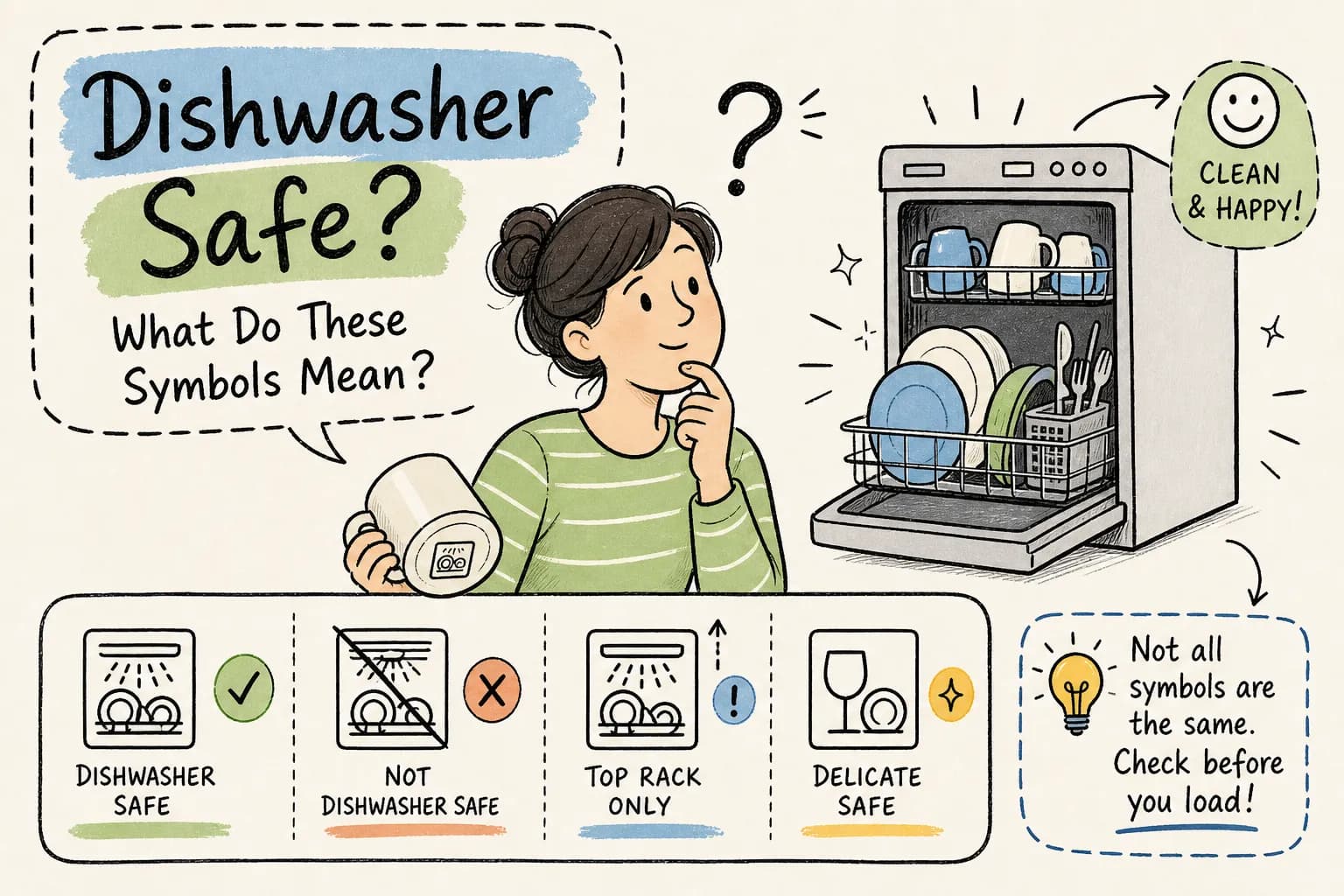
Learn how dishwasher safe symbols protect your crockery and plastics. This guide explains each pictogram, material tips, and what to do with unmarked items.
Dishwasher safe symbols tell you whether crockery, glassware, and plastics can go in the machine, and knowing what dishwasher safe symbols actually mean can save you from warped containers, etched glassware, and damage that's entirely avoidable. A square icon showing plates with spray lines means the item is dishwasher safe. That same square with a diagonal slash or X through it means hand-wash only. A bold line across the top of the square means top rack only, which is conditional rather than fully safe anywhere in the machine. These three icons cover the majority of what you'll encounter on everyday crockery, food containers, and plastics.
The complication is that these symbols are not standardised across manufacturers. Two products from different brands can carry almost identical-looking icons with subtly different conditions attached. After years of repairing dishwashers across London and the South of England, the engineers at Alpha Appliances Ltd have seen the consequences: warped containers, etched glassware, and machine faults that trace directly back to items being loaded without a check of the markings.
This guide covers every common symbol you're likely to see, what each one means for different materials, and what to do when there's no marking at all.
The most common form is a square outline containing one or two plate silhouettes with spray lines, dots, or water drops above them. This is the nearest thing to a universal "safe to wash" marking, confirming the item has been designed to tolerate hot water, detergent, spray pressure, and drying cycles. The exact design varies by manufacturer: some use dots falling from above, others use diagonal spray lines, and some combine a glass shape alongside the plates. The core meaning is consistent across all of them.
A second common form shows a square containing a plate alongside a glass or beaker shape, again with spray or water-drop lines above. This version appears frequently on glassware, food storage containers, and dinnerware sets. It carries exactly the same meaning as the spray-and-plates version: fully dishwasher safe under normal conditions, with no additional restrictions implied by the different pictogram design.
Unlike the food-contact symbol, the wine glass and fork, which is formally defined under EU Regulation 1935/2004 and retained in UK law, there is no legally mandated international dishwasher safe symbol. Manufacturers use whichever pictogram they choose.
The EN 12875-1 test standard does exist, but it only becomes meaningful when a number appears alongside the symbol to indicate how many dishwasher cycles the item was tested for. In practice, always cross-reference with the product instructions rather than relying on the icon on the base alone.
Two versions appear regularly. The first is a pictogram showing a dishwasher interior with a bold or highlighted upper rack line, indicating that only the top zone is permissible. The second is plain text, "TOP RACK ONLY", printed on packaging or moulded into the base of the item. Both carry the same instruction: the item is conditionally dishwasher safe, not cleared for use anywhere in the machine.
The heating element in most dishwashers sits beneath the lower rack, which means the bottom zone runs noticeably hotter and receives more intense spray pressure. Items placed in the lower rack, particularly plastics, experience sustained temperatures that the material was never tested to handle. "Top rack only" is effectively a lower-temperature instruction. Ignoring it is one of the most common reasons plastic containers warp, lids distort, or printed labels fade prematurely after just a handful of cycles. It also puts stress on the machine itself: items that soften or deform can obstruct the spray arms and disrupt cleaning performance across the whole load.
Two icons carry this warning. The first is a diagonal slash through the spray-and-plates square; the second is an X overlaid on the same image. Both mean the same thing: do not put this item in the dishwasher, regardless of cycle or rack position. The slash version is more common on European-made products, while the X appears more frequently on imports from Asia and North America, a genuine source of consumer confusion when items from mixed-origin kitchenware sets sit side by side.
This icon shows a hand shape beneath running water or inside a basin, indicating manual washing with mild detergent only. Manufacturers use it on items where the dishwasher's combination of heat, detergent chemistry, and high-pressure spray would damage the finish, decoration, or structural integrity over time. It appears most often on non-stick coatings, decorated ceramics, and items with bonded rubber seals.
A crossed-out wine glass or cup specifically warns against machine washing for fragile or decorative glassware. Hand-painted pieces, crystal, antique items, and anything with metallic trim often carry this marking. Etching, cloudiness, and flaking of decorative finishes can begin after just a handful of dishwasher cycles, and the damage is irreversible. This is the marking most frequently misread or ignored entirely.
The short answer is yes. The "dishwasher safe" claim applies to the finished item, not simply the raw material it's made from. Wall thickness, pigments, seals, lids, and bonded components all affect real-world behaviour in ways that a single symbol cannot capture. The table below covers the six material types you'll encounter most often.
For plastics specifically, a recycling code alone does not confirm dishwasher safety. A PP container may technically tolerate the heat, but its wall thickness, lid seal, and pigment additives all affect how it behaves after repeated hot cycles. For PET and PS, the conservative rule is straightforward: if the item carries no dishwasher safe marking from the manufacturer, hand-wash it.
The absence of a dishwasher safe symbol is not permission to machine-wash. It simply means the manufacturer has not tested or confirmed the item for dishwasher use. For unmarked ceramics, glassware, or plastics, hand-washing is the conservative and correct choice. If the item is a plainly durable, fully glazed ceramic with no decoration and no metallic trim, many experienced cooks treat it as safe on a normal cycle. That is a judgement call, not a manufacturer guarantee.
A genuinely common frustration: the marketing copy on the box says "dishwasher safe," but the care guide inside says "top rack, low heat only." Follow the most restrictive instruction every time. Similarly, a container may be dishwasher safe while its lid or rubber seal is not, check each component separately rather than treating the item as a single unit.
For older or cracked plastic items in particular, repeated dishwasher cycles accelerate surface degradation. This raises legitimate food-safety concerns that are worth taking seriously, especially for containers used daily.
This symbol confirms the item is approved for food contact under UK and EU law. It does not mean it is dishwasher safe. The two symbols serve entirely different purposes and are frequently confused on product listings and in consumer advice. Seeing the wine glass and fork on a piece of cookware tells you the material won't contaminate your food; it tells you nothing at all about whether the item can go in your machine.
You've checked every symbol, loaded the machine properly, selected the right cycle, and the results are still poor. Correct loading is essential, but it doesn't protect against mechanical faults. Spray arm blockages and limescale build-up on the heating element are typical culprits that have nothing to do with loading.
A cloudy film on glasses, dishes coming out lukewarm, or standing water in the base are signs the machine itself needs attention. For homeowners across London, Berkshire, Surrey, Hampshire, and Dorset, a certified repair is usually the faster and more cost-effective solution compared with a full replacement. Alpha Appliances Ltd resolves most common dishwasher faults in a single visit, with a 78% first-time fix rate, fixed-price diagnostics, and no repeat call-out fees. Get in touch with our team to book a next-day appointment and have a City & Guilds certified engineer assess the problem directly.
Always check dishwasher safe symbols before loading, follow the rack instruction precisely, treat unmarked items as hand-wash candidates, and call a certified engineer when the machine itself is the source of the problem. Getting these steps right protects your crockery, your glassware, and the appliance itself.
Yes, printed markings and labels can fade or wear off after just a handful of cycles. I have seen printed labels and pigments fade prematurely, which is why I advise checking component markings regularly and treating unmarked items cautiously.
No, a recycling code alone does not confirm dishwasher safety. I note that PP (code 5) tolerates dishwashers best while PET (code 1) and PS (code 6) generally should be hand-washed unless the manufacturer explicitly marks them as dishwasher safe.
Treat each component separately and follow the most restrictive instruction. I recommend checking lids and rubber seals individually because a container may be dishwasher safe while its lid or bonded seal is not, and ignoring that can cause warping or seal failure.
An EN 12875-1 number indicates how many dishwasher cycles the item was tested for. I explain that the standard only becomes meaningful when a number appears alongside the symbol, so always cross-reference with the product instructions rather than relying on the base icon alone.
Book a visit from a certified Alpha engineer in minutes.
TRUSTED BY HOMEOWNERS
Fast, reliable, and warranty-backed repairs for every major brand.
Discover more tips from Alpha engineers.