
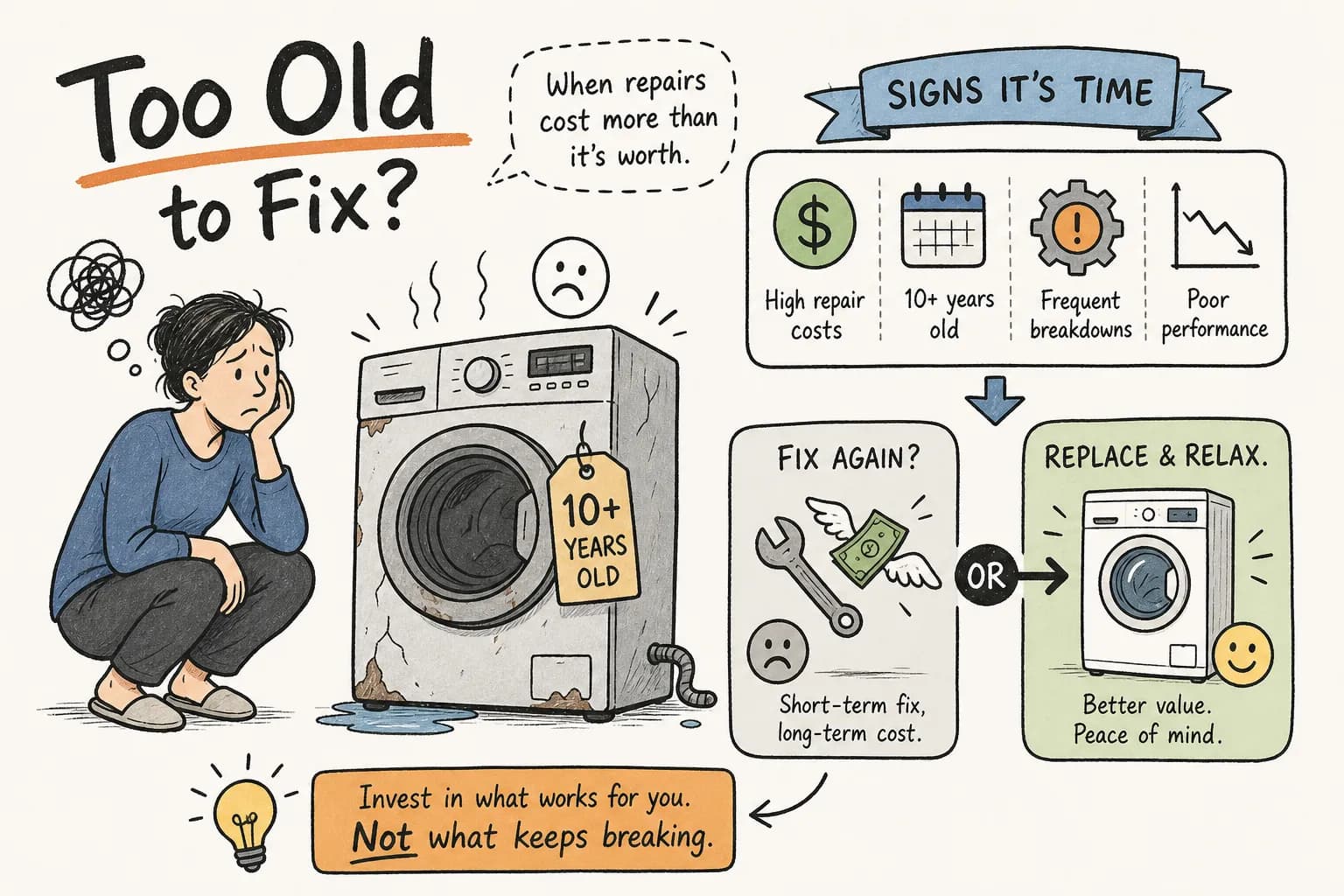
How to Tell When an Appliance Is Too Old to Fix
The washing machine grinds to a halt mid-cycle. The fridge starts making a noise you've never heard before. The first question is always the same: do I fix this, or buy a new one? Knowing how to decide when an appliance is too old to fix is something most homeowners work out without any real framework, which is why so many end up spending money on a machine that had no future, or binning one that had years of service left in it.
Engineers use the phrase "beyond economical repair" when a fault is technically fixable but the cost of doing so makes no financial sense. The calculation comes down to four things: how old the appliance is, what the repair costs relative to replacement, how much the old machine is adding to your energy bills, and whether genuine parts are still available. Get those four factors right and the decision becomes straightforward.
The team at Alpha Appliances Ltd regularly sees the same mistakes repeated: homeowners repairing machines that aren't worth saving, and replacing ones that had plenty of life left. This guide gives you the framework to avoid both errors.
How long should your appliance actually last?
Realistic lifespan benchmarks by appliance type
UK industry guidance and manufacturer data suggest broadly consistent figures for how long a well-maintained domestic appliance should remain serviceable. Fridge-freezers typically run for 10 to 15 years; washing machines and tumble dryers for 8 to 12 years; dishwashers for 9 to 12 years; and cookers and ovens for 13 to 15 years. These ranges give you the window during which deciding whether an appliance is too old to fix becomes a genuine question worth working through carefully, rather than an obvious answer in either direction.
Think of these figures as your first reference point. An appliance in the first half of its expected lifespan is a strong repair candidate from the outset. One approaching or beyond the outer edge of that range requires a harder look at the other three factors before you commit to any repair spend.
Why age is the starting point, not the whole answer
Age tells you the context; it doesn't make the decision for you. A nine-year-old washing machine experiencing its first fault is a fundamentally different proposition from a nine-year-old machine on its third breakdown in two years. Both are the same age, but only one of them represents good repair value.
The pattern of faults matters as much as the calendar. An appliance that has run reliably for a decade and developed a single, clearly diagnosed fault is often worth repairing. One that has become a recurring problem is telling you something about its remaining reliability, regardless of how old it is on paper.
How to decide when an appliance is too old to fix: the 50% rule
What the rule actually says and how to apply it
The 50% rule is the most widely used heuristic in appliance repair, referenced consistently across UK consumer guidance and industry advice: if the cost of the repair approaches or exceeds half the price of a comparable new machine, replacement deserves serious consideration. It works because it anchors the decision to real monetary value rather than instinct. To apply it, you need two figures: a genuine repair quote and a realistic replacement price for an equivalent model.
Using current UK figures, common repair jobs such as pump replacements, heating elements, and door seals typically land in the £70 to £200 range. A new entry-level washing machine starts at around £250 to £300, while a mid-range model sits between £400 and £700. So if a washing machine repair comes in at £160, you're well inside the threshold on a £500 replacement. If the same repair comes in at £280, you're looking at 56% of a new mid-range equivalent, and replacement starts to make more sense.
When to adjust the threshold up or down
The 50% figure is a starting point, not a hard rule. For premium appliances such as Miele or AEG, where a new equivalent costs £800 to £1,200, the threshold can reasonably stretch higher. Genuine parts are well-supported for these brands, the machines are built to longer service lives, and the gap between a £350 repair and a £1,000 replacement is substantial enough to make repair the clear winner in most cases.
For older budget-brand machines already at the far end of their expected lifespan, a tighter threshold of 30 to 40% makes more sense. There is also a cumulative factor to account for: if the appliance has already had two paid repairs in the past two years, add those costs to the current quote before you apply the rule. The total spend on keeping an ageing machine running is what matters, not just today's invoice.
The running cost you're probably not accounting for
How much an old appliance actually costs to run each year
Older appliances were designed to older energy standards, and the difference shows up on your electricity bill month after month. A fridge-freezer more than ten years old can consume around 110 kWh more per year than a modern A-rated equivalent. At current Ofgem rates (approximately 24p per kWh as of Q3 2026), that translates to roughly £26 a year in wasted energy from a single appliance. Upgrading from an older tumble dryer to a modern A+++ model can save around £40 to £50 per year.
These aren't dramatic numbers in isolation, but they compound over the remaining life of the appliance. A machine you keep running for another five years at £30 a year in excess energy costs has effectively added £150 to the repair side of the ledger before you've counted a single breakdown.
When energy savings tip the decision toward replacement
Consider a 12-year-old dishwasher that needs a £180 repair. A modern equivalent would save approximately £30 per year in running costs. On energy savings alone, the repair pays for itself inside six years, which sounds reasonable. But if that same appliance is likely to need another repair within two years given its age and fault history, the maths shifts decisively toward replacement.
Always factor the annual running-cost difference into your calculation before committing to a repair. The simplest way to do this is to estimate the energy saving over a realistic remaining service life and subtract that from the effective replacement cost. It often moves the numbers further than people expect.
When parts availability or safety takes the decision out of your hands
Discontinued parts and obsolete components
UK regulations now require manufacturers to keep spare parts available for between seven and ten years after a model is discontinued, depending on the appliance type. Dishwasher components must be available for seven to ten years; fridge parts for eight years. In practice, however, once a model has been out of production for several years, sourcing critical components becomes progressively harder.
Control boards, drum bearings, and compressors are the components most likely to become unavailable first. If a certified engineer cannot source genuine parts for your appliance, that is a definitive signal that the machine has reached the end of its serviceable life, regardless of its age on paper. Reconditioned parts with no manufacturer warranty are often less reliable and are worth approaching with caution, they are generally not a sound basis for a meaningful long-term repair.
Safety issues that rule out repair entirely
Some faults move the conversation beyond repair entirely. Appliances flagged in active safety recalls, units with obsolete refrigerants that cannot be legally re-gassed, and electrical faults where the underlying component presents a fire risk all require replacement rather than repair. No repair quote makes financial sense if the appliance has an unresolved safety issue sitting underneath it.
The UK Government's product recall checker (gov.uk) and Electrical Safety First's recall register are practical first steps when an older appliance develops an unexplained fault. Several major brands, including Hotpoint, Indesit, and various Haier-manufactured appliances, have had active recall notices covering washing machines, tumble dryers, and gas hobs. Check your model number against those resources before booking any engineer, and disclose any known history when you do.
A straightforward checklist before you make the call
Signs the appliance is worth repairing
The positive indicators all point in the same direction: the appliance is within the first two-thirds of its typical lifespan, the current fault is the first significant one it has developed, and the repair quote sits comfortably below 40% of the cost of a new equivalent. Add to that confirmation that genuine parts are available and no open safety recalls are listed against the model, and you have a strong case for repair.
When all or most of these factors apply together, a repair carried out by a certified engineer is almost always the better financial decision. The machine has demonstrable remaining life, the fault is contained, and the cost is proportionate. Replacing it at that point is simply unnecessary spending.
How to decide when an appliance is too old to fix: the replacement signals
The signals pointing toward replacement are equally clear when they cluster together. Rather than isolated red flags, it's the combination that matters:
- The appliance is at or past the outer limit of its expected lifespan.
- The repair quote exceeds 50% of the replacement cost, or, when cumulative repair spend is included, the total approaches that threshold.
- This is the second or third repair in under two years.
- Parts availability is uncertain or dependent on reconditioned components with no warranty.
- There is a safety concern the repair cannot resolve.
If three or more of these apply at the same time, replacement is the right call, and in our experience, that's a reasonable editorial threshold rather than a hard statutory rule, though it aligns with how most consumer guidance approaches multi-factor appliance decisions. One indicator on its own rarely tells the whole story; the combination is what matters. A machine that is old, repeatedly faulty, and facing a large repair quote has given you all the information you need.
Getting an honest diagnosis before you decide anything
Why the quality of the assessment matters as much as the decision
A repair-versus-replace decision is only as good as the diagnosis it is based on. A vague quote from an unqualified tradesperson doesn't give you the information you need to make a confident call. A certified engineer, qualified to City and Guilds standards with genuine access to manufacturer parts data, can identify the true fault, give you a realistic parts cost, and assess whether further issues are likely given the machine's age and repair history.
The difference between a proper diagnostic and a rough estimate matters enormously here. Two quotes of identical cost can represent very different situations: one for a straightforward, well-supported repair on a reliable machine, and one for a complex fault on an ageing appliance with limited parts availability. Only a thorough assessment tells you which you're dealing with.
What an honest assessment looks like in practice
Alpha Appliances Ltd has built its service around exactly this kind of transparent diagnostic. Engineers carry out a full fault assessment on the first visit, present a fixed-price repair quote with no hidden fees, and will tell you directly when a machine isn't worth the cost of repair, because the goal is never to push a repair that doesn't make financial sense for the customer. That is the company's stated approach and the principle its engineers work to on every job.
If the appliance is beyond economical repair, that assessment is delivered clearly before any money changes hands. Customers across London, Berkshire, Surrey, Hampshire, and Dorset rely on that honest approach to make informed decisions rather than expensive ones. A diagnostic visit is the most efficient way to know exactly where you stand before committing to any spend.
How to decide when an appliance is too old to fix: making the call with confidence
Knowing how to decide when an appliance is too old to fix doesn't have to mean guesswork. Check its age against the typical lifespan for its type, apply the 50% cost rule to the repair quote, factor in the annual energy savings a new model would deliver, confirm that genuine parts are available, and run a quick check for any active safety recalls. Work through those five steps in order and the right answer usually becomes clear.
If you've worked through all five steps and still feel uncertain, the most useful next move is a professional diagnosis from a qualified engineer. Whether the appliance needs a repair or has genuinely reached the end of its useful life, a thorough and honest assessment saves you from overspending on a machine that's past it, or replacing one that had years of reliable service ahead of it.
Use this guide as your starting framework, get a proper diagnosis if the situation isn't clear-cut, and make your decision from a position of real information rather than frustration or guesswork.
Need a repair today?
Book a visit from a certified Alpha engineer in minutes.