
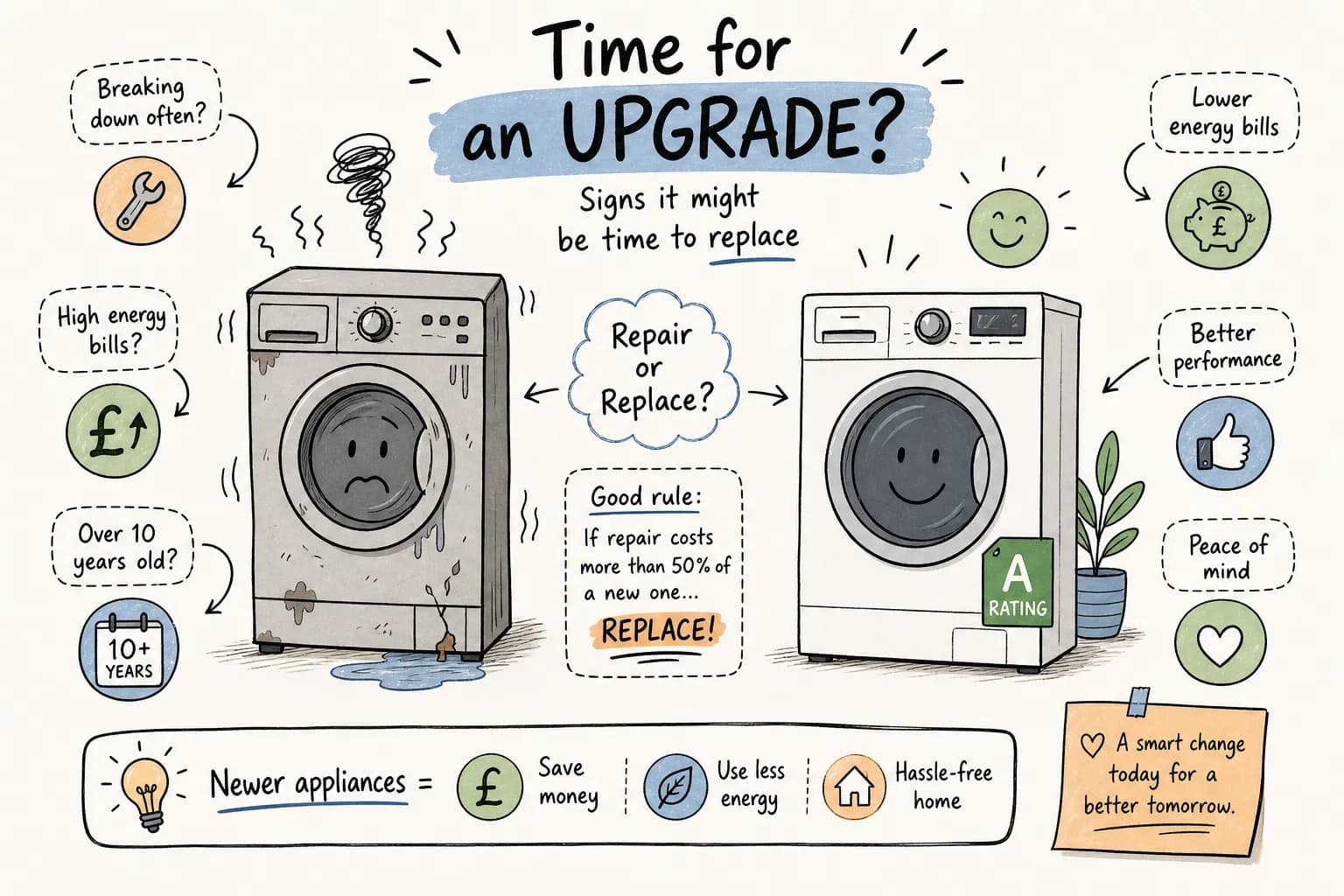
When to replace appliances: your no-nonsense UK guide
Not sure when to replace appliances in your home? Many UK homeowners either replace them too early or keep them running far too long. That decision, made on gut feeling rather than facts, costs real money either way. Replacing a washing machine that needed a £130 pump repair is an expensive mistake. So is pouring money into a 13-year-old fridge with a failing compressor when a new one could pay for itself in energy savings over time.
This guide gives you four clear tests to apply to any major household appliance before you spend a penny: how old it is relative to its expected lifespan, how the repair cost stacks up against buying a replacement, how much running an inefficient machine is adding to your electricity bill, and whether any of the symptoms you are seeing are actually a safety issue. Work through each one in order and you will have a far clearer picture of the right call for your specific situation.
When to replace appliances: how long should they actually last?
Before any other calculation makes sense, you need a realistic baseline. Many homeowners assume a 7-year-old washing machine is ageing badly; others assume a 14-year-old fridge is perfectly fine because it still runs. Both assumptions regularly lead to the wrong decision.
Here are the typical appliance lifespan ranges for major UK household appliances under normal use:
ApplianceTypical UK lifespanFridge / freezer10, 15 yearsWashing machine7, 12 yearsDishwasher9, 12 yearsCooker / oven13, 15 yearsTumble dryer8, 12 yearsMicrowave7, 10 yearsBoiler10, 15 years
These are median ranges, not guarantees. A well-maintained appliance from a reliable manufacturer (Miele, Bosch or AEG) will often reach the top of these ranges with no drama. A budget model running at high intensity may not hit the midpoint. Usage matters enormously: a washing machine doing two full loads a day ages considerably faster than one doing four loads a week. Adjust the benchmark to your household's actual usage, not the theoretical average.
Here is the key point: age alone should never decide the outcome. A 10-year-old fridge that runs quietly, holds temperature reliably and seals properly is not automatically due for replacement. Age matters most when it combines with another signal, a recurring fault, a rising electricity bill, or a repair estimate that makes your eyes water. On its own, age is a tiebreaker, not a verdict.
The repair cost rule every homeowner should know
When to replace appliances: repair vs replace
Once you have a sense of where your appliance sits within its expected appliance lifespan, the next question is straightforward: what does the repair actually cost relative to buying a replacement?
The standard industry benchmark is the 50% rule. If the repair quote exceeds 50% of the cost of a comparable new appliance, replacement is usually the better financial call. To make it concrete: if a new mid-range washing machine costs £500 and you have been quoted £280 for a repair, you are sitting right on the line, and the age of the machine should tip the decision. Some engineers apply a stricter 30% threshold for appliances already past the midpoint of their lifespan, reasoning that a repair this expensive on an older machine often precedes another expensive fault within 12 months.
For most everyday faults, repair wins clearly. The figures below show typical UK repair costs in 2026 against what a replacement would set you back:
- Washing machine: average repair £125, £250; replacement from £250 upward
- Dishwasher: average repair around £200; replacement from £250 upward
- Fridge / fridge-freezer: average repair around £150; replacement from £300 upward
- Oven / cooker: average repair around £130; replacement from £200 upward
Thermostats, pumps, door seals, heating elements and drain pumps are all relatively inexpensive to fix and almost always worth repairing if the appliance has plenty of life left in it. The faults that change the maths are the major ones: drum bearing assemblies on washing machines (£300, £600 fitted), compressors on fridges (£250, £500), and control board failures on most appliances (£150, £350). These repairs on older machines are where the 50% rule genuinely earns its place.
Do not forget to factor in the full repair history. If an engineer has already visited twice in the past 18 months, the cumulative spend belongs in the calculation. Repeated call-outs also signal a machine that may be entering a broader decline, where one fault tends to precede another. Parts availability is a practical concern too: for appliances over 10 to 12 years old, some components are discontinued, and sourcing them adds both time and cost.
Is your old appliance quietly inflating your electricity bill?
Energy savings and payback: when to replace appliances on efficiency grounds
Energy inefficiency is the most overlooked reason to replace an appliance, because the cost is invisible. Nobody receives a bill line that reads "old fridge: extra £70 this year," but that money is leaving your account every month regardless.
A fridge or freezer from 10 to 15 years ago typically uses between 1.5 and 3 times more electricity than a modern equivalent with a current energy rating. In practical terms, an older fridge-freezer might consume 500 to 700 kWh per year; a modern A-rated equivalent often runs at 150 to 250 kWh. At current UK electricity rates (around 25p/kWh in 2026), that difference translates to roughly £50, £110 per year, depending on the models being compared. Over a 10-year period, that is a meaningful sum sitting quietly on your electricity bill.
Washing machines and tumble dryers tell a similar story for high-use households. On the current UK A to G energy label, an A-rated washing machine uses around 49 to 51 kWh per 100 cycles; a C-rated model uses around 67 to 68 kWh for the same cycles, and E-rated machines can reach 90 kWh per 100 cycles. If your household runs 300 washes a year, the difference between an A and an E-rated machine adds up to a noticeable annual gap.
Run a simple break-even calculation before assuming an upgrade makes financial sense. If replacing an old fridge saves £80 per year in electricity and the new fridge costs £600, the payback period is roughly seven to eight years. Whether that makes sense depends entirely on how much useful life the old machine has left. Energy savings are a genuine reason to consider replacement, but they work best as supporting evidence rather than the sole argument.
Warning signs that mean stop using it now
Some situations bypass the cost calculation entirely. Certain symptoms indicate that an appliance is a safety risk, and in those cases the right response is disconnection first, not a repair quote.
For any electrical appliance, the non-negotiable red flags are: visible sparking or arcing, scorch marks on the appliance or the socket, a burning smell during operation, or an appliance that repeatedly trips the circuit breaker. Any of these means disconnect the appliance immediately and do not use it again until a certified engineer has inspected it. These are signs of a fault that can cause a fire, not minor wear to be monitored.
For gas appliances, including cookers, hobs and boilers, the warning signs are even more urgent. A smell of gas, a yellow or unstable flame, or a pilot light that will not hold are all signals to stop using the appliance straight away, ventilate the room, and call a Gas Safe registered engineer. Do not attempt to diagnose or reset the appliance yourself.
Performance collapse is a separate category but still a serious signal. An appliance that has broken down two or more times in the past 12 months, or that can no longer perform its core function reliably, a fridge that cannot hold temperature, a washing machine that fails to clean properly, a dishwasher that leaves every load dirty, has usually passed the point where further repair investment is worthwhile. Persistent fault codes, sluggish controls, grinding or unusual vibration, and unusual smells during operation all indicate internal wear that tends to accelerate rather than stabilise on its own.
Why a professional diagnostic changes everything
This is the step that many homeowners skip, and it is often the one that saves the most money. Before you commit to a replacement or authorise a major repair, a professional diagnostic inspection from a certified appliance engineer gives you something no retailer ever will: an honest, technical assessment of exactly what is wrong with your specific machine and whether fixing it is genuinely cost-effective.
A good diagnostic tells you two things clearly. Either the fault is straightforward and repair makes strong financial sense, in which case you have avoided an unnecessary £600 purchase. Or the appliance has a fault that makes further investment inadvisable, in which case you have avoided spending £250 on a repair that will be followed by another fault in three months. That independent verdict removes the guesswork from a decision that, made without proper information, can easily go wrong in either direction.
At Alpha Appliances Ltd, every engineer visit includes a transparent, fixed-price diagnostic from around £36 including VAT, with no obligation to proceed. The team of City & Guilds certified engineers will give you a straight answer: repair is viable and here is the cost, or this appliance has reached the end of its useful life and here is what to look for when you replace it. There is no incentive to recommend a repair that will not hold, and no pressure to replace when repair makes sense. That kind of independent assessment is often the missing piece, and at a fraction of what either a premature replacement or a failed repair would cost.
Putting it all together: knowing when to replace appliances
The four tests work best as a sequence. Start with age: where does your appliance sit within its expected lifespan range? Apply the 50% cost rule to any repair quote you have received. Factor in the annual energy cost of running an inefficient older machine and run the break-even calculation honestly. And take any electrical, gas or persistent performance warning signs seriously enough to act on them promptly.
Knowing when to replace appliances is rarely obvious from the outside, and the stakes are real on both sides. Replacing an appliance you did not need to costs hundreds of pounds. Repairing one that is already beyond economical use means you will be back in the same position within months. Use these checks to decide when to replace appliances in your home, and where you need a clearer picture, a diagnostic inspection from a certified engineer at Alpha Appliances Ltd, serving London, the Home Counties, Surrey, Hampshire, Berkshire and Dorset, resolves the uncertainty quickly and at low cost.
Book your diagnostic online at Alpha Appliances Ltd and get a clear answer before you spend a penny more than you need to.
Need a repair today?
Book a visit from a certified Alpha engineer in minutes.