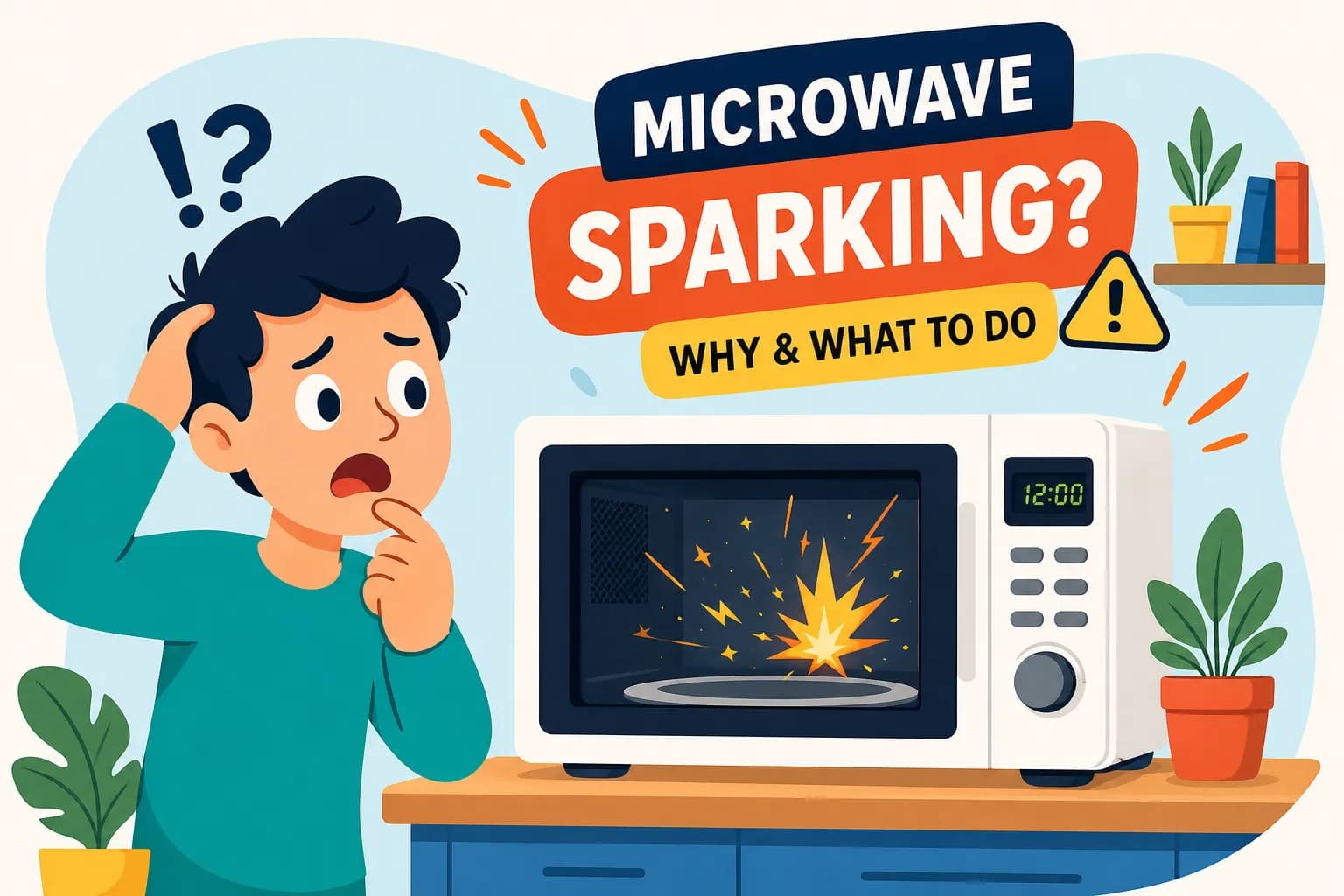
Microwave sparking? Learn quick, safe steps to stop arcing, identify causes like metal, damaged waveguide, chipped paint or rust, and when to call an engineer.
You are standing at your kitchen counter when the interior of your microwave lights up with a flash of blue-white light. There is a sharp crackling sound, and the smell of something burning hits you almost instantly. Your instinct is correct: that is not normal, and it is not safe. If your microwave is still running right now, press stop immediately and keep the door closed.
Microwave sparking is one of the most searched appliance safety queries in the UK, and it is searched for good reason. It looks dramatic and smells alarming, and most people have no idea what caused it or what to do next. If your microwave sparks inside, what should you do? This guide explains exactly what is happening inside the cavity, how to safely inspect the appliance, which causes you can fix yourself for next to nothing, and when the honest answer is to stop using the machine and call a qualified engineer. Everything here is drawn from over a decade of hands-on domestic appliance repair experience across London and the South of England.
Microwave sparking, technically called arcing, happens when electrical energy discharged by the magnetron has nowhere safe to go inside the cooking cavity. Instead of being absorbed by food or moisture, the energy builds up and releases as visible sparks. Understanding which surface or object is responsible is the key to fixing the problem or knowing when to walk away. For a manufacturer's plain-language explanation of common causes, see Why is my microwave sparking?
Metal reflects microwave energy rather than absorbing it. When electromagnetic waves bounce off a metallic surface, electrical currents build up rapidly and discharge as arcing. This applies to aluminium foil used to cover food, metallic-rimmed plates, gold or silver-edged crockery, cutlery accidentally left inside, and metal twist ties on bags. This is the most fixable cause, provided you catch it before any internal damage occurs. Remove the offending item, inspect the cavity for scorch marks, and assess whether the interior surfaces are still intact before running the appliance again.
Inside every microwave is a small, flat panel that looks deceptively like a piece of cardboard. This is the waveguide cover, made from mica, and it sits over the aperture where microwaves enter the cavity from the magnetron. Over time, grease and food splatter absorb into the mica surface. As it heats repeatedly, that residue burns, carbonises, and begins to arc. A damaged or missing mica cover will cause sparking even when there is absolutely no metal present, which is why this is the second most common cause appliance engineers encounter. If the interior of your microwave is clean but sparking persists, the waveguide cover is almost certainly the reason.
These three causes share a common thread: they all involve compromised or contaminated surfaces inside the cooking cavity. Chipped paint exposes bare metal that arcs when food splatter lands on it during cooking. Rust creates rough, pitted, conductive surfaces that respond unpredictably to microwave energy. Baked-on grease on the ceiling or walls can superheat and carbonise, producing the same electrical discharge effect as a dirty mica sheet. Severe rust or a deeply burnt cavity interior is typically a sign that the microwave is beyond safe repair. Surface-level grime is cleanable; structural damage to the cavity itself is not.
When your microwave sparks inside, what you do in the first few seconds matters. The five steps below are a sequence, not a checklist. Follow them in order, every time, without skipping.
Following these steps gives you a safe starting point. What you should never do is open the outer casing or probe any internal component. Microwaves contain a high-voltage capacitor that can retain a lethal electrical charge for hours, and in some cases days, after being disconnected from the mains. This is not a theoretical concern: direct contact with a charged microwave capacitor has caused deaths. External inspection only. If the fault requires anything beyond what you can see and reach without tools, a qualified engineer carries the right discharge equipment to do it safely. For safety guidance on the risks and procedures, see how to safely discharge a capacitor.
Once the appliance is cool and unplugged, the waveguide cover is the first thing to inspect in detail. It is the most commonly damaged component in a sparking microwave, and it is also the cheapest and easiest to fix yourself.
Open the door and look at the interior walls. The waveguide cover is typically located on the right-hand wall of the cavity, though on some models it sits on the ceiling. In good condition, it is rigid and firm, light brown or cream in colour, with a smooth, unmarked surface. A damaged cover tells a very different story: it will feel soft or flexible when pressed, and it will show discolouration, burn marks, charring, cracks, or chips. Any cover showing these signs must be waveguide cover replacement, not just cleaned. Once the mica material has been compromised by heat, cleaning the surface does nothing to restore its structural integrity or prevent further arcing.
If the cover is firm and intact but shows light grease or food residue, gentle cleaning with a damp cloth is appropriate. Do not use abrasive cleaners or anything that could scratch the surface. If there is any softness, discolouration, or burn marking, replacement is the only safe option. To replace it: unplug the microwave, remove the glass turntable and roller ring, then gently slide or unclip the mica sheet from its housing. Wipe the aperture clean behind it, then fit the replacement, either cut to size from a universal mica sheet or sourced as a model-specific part. Universal mica sheets are widely available in the UK for under £2, making this genuinely the most affordable microwave repair there is. Never run the microwave without a waveguide cover in place.
There is a clear line between DIY-appropriate fixes and professional-only territory in microwave repair, and it is worth knowing exactly where it falls.
The following fixes are safe because they require no casing removal and no exposure to high-voltage components. Replacing the mica waveguide cover is a straightforward job that takes under 30 minutes. Removing metal objects or foil that caused the arcing requires nothing more than opening the door. Cleaning food buildup and carbonised residue from the cavity interior is safe provided you use appropriate cleaning products and the cavity surface is intact. Replacing a broken inner door glass panel, provided the outer pane is undamaged, is also within homeowner territory on most models.
Magnetron faults, capacitor failure, diode breakdown, and transformer issues are all firmly in professional-only territory. These components operate at voltages that can kill, and they cannot be safely approached without specialist discharge tools and training. Interior rust that has pitted the cavity metal, and extensive burn damage across the cooking surfaces, typically make the appliance uneconomic or unsafe to repair regardless of who carries out the work. For older microwaves, particularly those eight to ten years old or more, a high-voltage component failure almost always makes financial sense to replace rather than repair. The maths rarely works in favour of an expensive fix on a low-value appliance.
Knowing what repairs typically cost in 2026 makes the decision significantly easier. Waveguide cover replacement is almost always a DIY job, with parts costing under £2 for a universal sheet. Door latch or switch repairs handled by a technician typically run between £30 and £65. Magnetron replacement pushes into the £70 to £250 range depending on the model and parts availability. Labour rates for appliance engineers in the UK average between £20 and £80 per hour, and integrated or built-in microwaves generally carry higher parts costs than freestanding countertop models. For an up-to-date UK price reference see this microwave repair cost guide.
A simple decision framework helps here: if the repair cost exceeds 50 to 60 per cent of the price of a new equivalent model, replacement is usually the smarter financial move. For a budget freestanding microwave worth £80 to £100, a magnetron repair is rarely justifiable. For a built-in or high-specification model worth £350 to £400, the same repair cost makes clear sense. Apply that logic to your specific appliance and you will have your answer without needing to overthink it.
Microwaves are a special case in domestic appliance repair: compact, relatively low value, and containing components that carry a repair risk disproportionate to the appliance's worth. Electrical arcing or sparking in other household appliances is an entirely different matter.
Electrical arcing in an oven, signs of electrical burning in a washing machine, or a fridge compressor fault are exactly the kind of jobs where professional diagnosis pays off quickly. These appliances carry a much higher replacement cost, are repairable at a fraction of that cost in the majority of cases, and the fault is typically identifiable on the first visit by an experienced engineer. Unlike microwaves, the economics of repair over replacement are strongly in the homeowner's favour across most oven, washer, and refrigeration faults.
At Alpha Appliances Ltd, our City and Guilds certified engineers carry out fixed-price diagnostics on all major domestic appliances across London, Berkshire, Surrey, Hampshire, and Dorset. With a 78% first-time fix rate, next-day availability, and no hidden call-out fees, we aim to make the repair process as straightforward as possible when you are already dealing with a broken appliance at home. Whether it is an oven arcing on the element, a washing machine showing signs of electrical burning, or a fridge that has stopped cooling, our engineers carry the right parts and the right certifications to fix it correctly, first time. Expert Microwave Repair Service, Alpha Appliances. Book online or give us a call, the diagnostic visit alone will tell you exactly where you stand.
Most microwave sparking has a simple cause. Check for metal objects first, then inspect the waveguide cover for any discolouration or damage consistent with arcing in the microwave cavity. Follow the five-step safety protocol every time the appliance sparks inside, without exception. Accept that magnetron faults and high-voltage component failures are not DIY territory, and weigh the repair cost honestly against the age and replacement value of the appliance before spending any money.
If your microwave sparks inside and the cause turns out to be something other than a piece of foil or a dirty mica sheet, stop using the appliance and get a qualified opinion before switching it on again. And if it is another appliance in your home showing signs of an electrical fault, Alpha Appliances Ltd is one call or click away, with engineers who carry the tools, the training, and the parts to sort it out properly. We also provide brand-focused help pages such as Fixing Whirlpool Microwaves Fast in Aldwych and Microwave Repairs for Electrolux in Aldgate.
Book a visit from a certified Alpha engineer in minutes.
TRUSTED BY HOMEOWNERS
Fast, reliable, and warranty-backed repairs for every major brand.
Discover more tips from Alpha engineers.