Fridge not getting cold? Learn how to identify common cooling faults, try safe DIY checks, compare UK repair costs and know when to call an engineer.
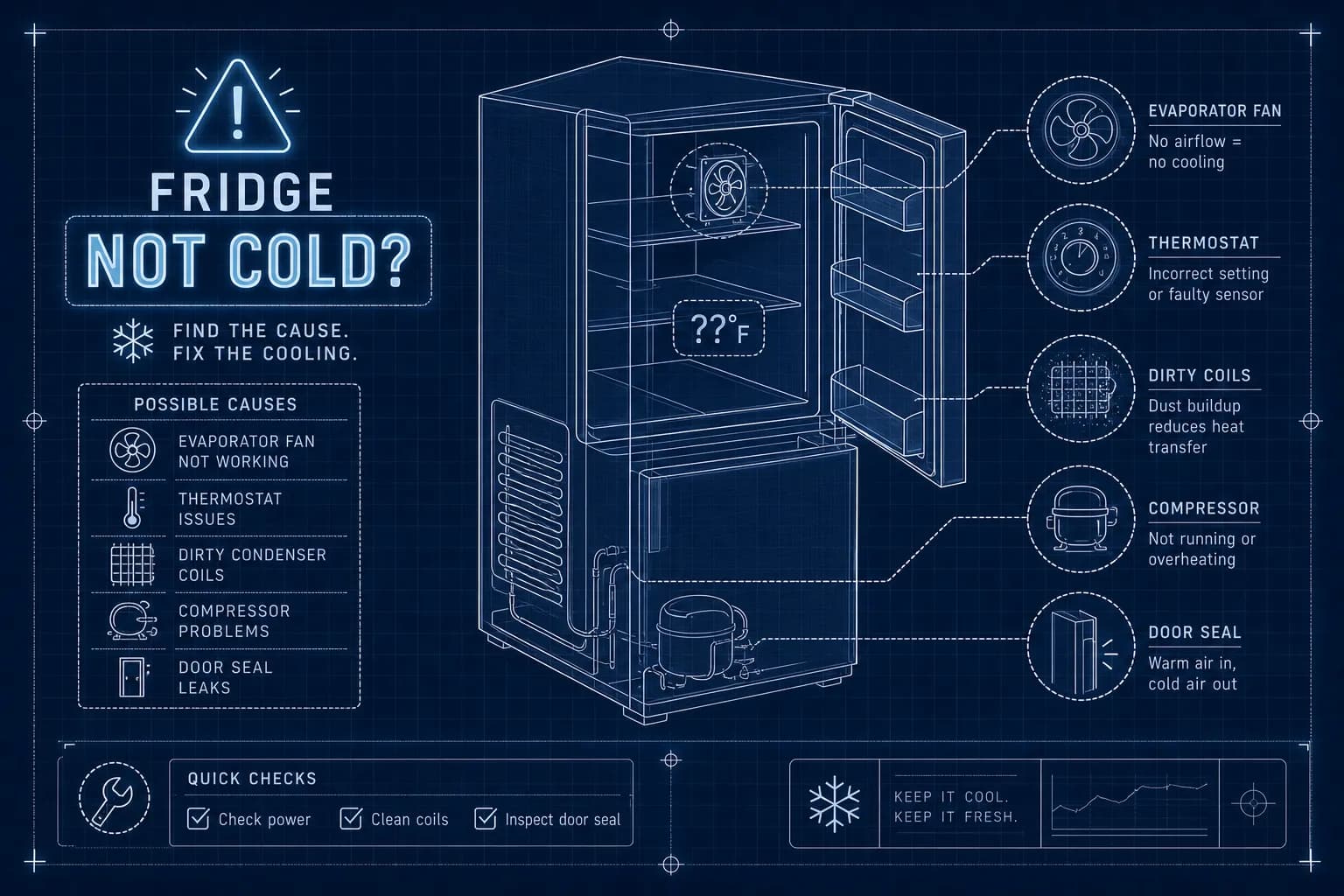
If your fridge is not getting cold, the most common causes are dirty condenser coils, a faulty thermostat, a broken door seal, a failed evaporator fan, a defrost-system fault, or a compressor problem. In most cases your symptoms point clearly to which of these is the culprit, and many can be checked with quick, simple tests at home.
Always start at the simplest end. The first thing to rule out is a power interruption or an accidentally adjusted temperature dial. A fridge left in Demo or Holiday mode will run normally but won't cool, a surprisingly common accidental cause. Once you've confirmed the power is live and the settings are correct, the next most likely culprits are dirty condenser coils and a faulty door gasket.
Dirty condenser coils are responsible for a significant proportion of warm-fridge faults. The coils release heat from the refrigerant; when they're coated in dust and pet hair, they can't do that job, and the unit gradually loses its ability to reach temperature. A failed door seal lets warm air flood in continuously, forcing the compressor to work overtime without the cabinet ever cooling properly.
Beyond those, the faults become progressively more mechanical: evaporator fan failure, defrost-system faults, thermostat or temperature-sensor problems, and finally compressor or sealed-system failure. That last category is the most serious and the most expensive, but it's also the least common starting point for a warm fridge.
The single most useful question to ask is: is the freezer still cold? If your freezer is holding its temperature but the fridge compartment is warm, the compressor and refrigerant system are almost certainly fine. If both sections are warm and you can hear the compressor clicking repeatedly every few minutes without starting, a failed start relay is the most likely explanation.
If the unit runs almost constantly but can't reach temperature, suspect dirty coils, a frost-blocked evaporator, or a sealed-system issue. A thick sheet of ice covering the freezer's rear interior panel points strongly towards defrost-system failure.
Before assuming a mechanical fault, run through the two-minute audit every homeowner can complete.
Check that the plug is fully inserted and the circuit breaker hasn't tripped. Verify the temperature dial hasn't been knocked, and confirm the appliance isn't in Demo or Holiday mode. Finally, check the ventilation gap: most manufacturers recommend around 5–10 cm of clearance at the rear for heat to escape. A unit pushed hard against a wall or enclosed in a tight recess will struggle to cool effectively.
For the door seal, fold a piece of paper and close the fridge door on it. If it slides out easily, the gasket isn't sealing properly. Work your way around the entire gasket looking for cracks, deformation, or trapped food debris. A clean, intact gasket that creates firm resistance at every point can make a real difference to how well the fridge holds temperature. While you're inspecting the inside, check that shelves aren't overpacked and that food isn't pressed against the rear vents, blocked vents can stop cold air circulating entirely. Reorganise the contents and allow 24 hours before concluding that a mechanical fault is present.
Cleaning the condenser coils is one of the most impactful maintenance tasks you can do, and it requires no technical knowledge. The coils are usually located behind the kick plate at the base of the appliance or at the rear. Unplug the fridge before moving it, then vacuum the coils gently using a brush attachment, working carefully without bending the fins. Do not use water or cleaning sprays on the coils. For most models this takes around ten minutes and can have an immediate effect on cooling performance. Doing this every 6–12 months, or more frequently if you have pets, is a habit well worth building.
A refrigerator not cooling in its fresh-food section while the freezer stays cold is one of the most reassuring fault patterns to diagnose. If the freezer is holding its temperature, you can rule out compressor or refrigerant failure with reasonable confidence. The system is producing cold air; it's just not reaching the fresh-food section. The three most likely causes of this specific pattern are a failed evaporator fan, a frost-blocked evaporator, and a stuck air damper between the two compartments. These faults are generally cheaper to fix than a compressor replacement.
Open the freezer door and press and hold the door switch to simulate a closed door. The evaporator fan should start after a brief delay. If it's silent, grinding, or intermittent, either the fan motor has failed or ice has built up around the blade. Also check the freezer's rear interior panel: a solid sheet of frost indicates defrost-system failure, meaning ice is blocking the airflow path to the fridge section.
If you find heavy frost, try a manual defrost. Unplug the fridge-freezer and leave the freezer door open overnight. Do not chip at the ice with a knife or screwdriver. If the fridge compartment cools normally afterwards, you've confirmed frost-over as the cause. However, if the problem returns within a few days, the underlying defrost fault needs professional attention. Don't delay: food safety is at stake, and a timely repair is far less costly than repeated food spoilage.
Several faults are beyond safe homeowner troubleshooting. A failed compressor or start relay, a refrigerant leak or sealed-system restriction, control board failure, and any fault involving live electrical components all require a certified technician. Many UK domestic fridges use R600a refrigerant, which is flammable: sealed-system work is regulated and requires F-Gas certification. This is not something to attempt at home, and the safety rationale is straightforward rather than alarmist.
Stop what you're doing and call a qualified engineer if you notice a burning smell, a circuit breaker that keeps tripping, oily residue near the compressor, or a compressor that clicks repeatedly every few minutes but won't start. These faults don't improve on their own, and waiting risks damaging additional components. A qualified engineer will carry diagnostic equipment to test thermistors, control boards, start relays, and refrigerant levels, removing the guesswork that delays getting your food back to a safe temperature.
At Alpha Appliances, a fixed booking fee of £95 inc VAT covers attendance, diagnosis and most repair labour; any parts or additional work are quoted before we proceed. Compressor or sealed-system work is substantially more.
The repair-or-replace decision follows a clear rule. If your fridge is relatively new, commonly cited as under around 7–10 years old, and the fault is a thermostat, fan, defrost heater, or start relay, repair will often make economic sense. If the appliance is older and the compressor or sealed system has failed, compare the full repair cost against the delivered and installed price of a comparable replacement. A widely used rule of thumb in the appliance repair industry holds that if the repair exceeds roughly half the cost of a new equivalent model, replacement becomes the more sensible option. Always confirm whether any quote includes VAT, parts, labour, refrigerant where applicable, and a warranty on the repair.
At Alpha Appliances Ltd, our fixed-price model means no hidden fees: you know exactly what the repair costs before any work begins.
If your fridge is not getting cold after working through the checks above, the fault is almost certainly mechanical and needs a certified engineer. Check the basics first, match your symptoms to the most likely fault using the guide above, and run through the safe DIY steps. If the problem persists after cleaning the coils, checking the door seal, and clearing the vents, don't put off calling a professional. Most fridge cooling problems are fully repairable, and catching a fault early nearly always keeps the cost lower.
If you're in London, the Home Counties, or across the South of England, Alpha Appliances Ltd offers next-day availability, a 78% first-time fix rate, and City & Guilds certified engineers. Our fixed-price repairs come with no surprise fees, and you'll know the full cost before our engineer arrives at your door.
Book online or call us to arrange a visit. The sooner the fault is diagnosed, the sooner your food is safe and your fridge is running as it should.
Clean the condenser coils every 6–12 months, and more frequently if you have pets. Doing this regularly, around ten minutes each time, helps the coils release heat properly and can immediately improve cooling performance.
Wait 24 hours after reorganising contents or fixing airflow to see if the fridge recovers, and leave a manual defrost overnight to confirm frost-over issues. If the fault returns within a few days or the fridge remains warm after these periods, a certified engineer is required.
No, do not use water or cleaning sprays on the condenser coils. Instead, unplug the fridge and vacuum the coils gently with a brush attachment, taking care not to bend the fins.
We offer next-day availability in London, the Home Counties, and across the South of England. Our City & Guilds certified engineers service those areas and operate under a fixed-price model with a 78% first-time fix rate.
Book a visit from a certified Alpha engineer in minutes.
TRUSTED BY HOMEOWNERS
Fast, reliable, and warranty-backed repairs for every major brand.
Discover more tips from Alpha engineers.