
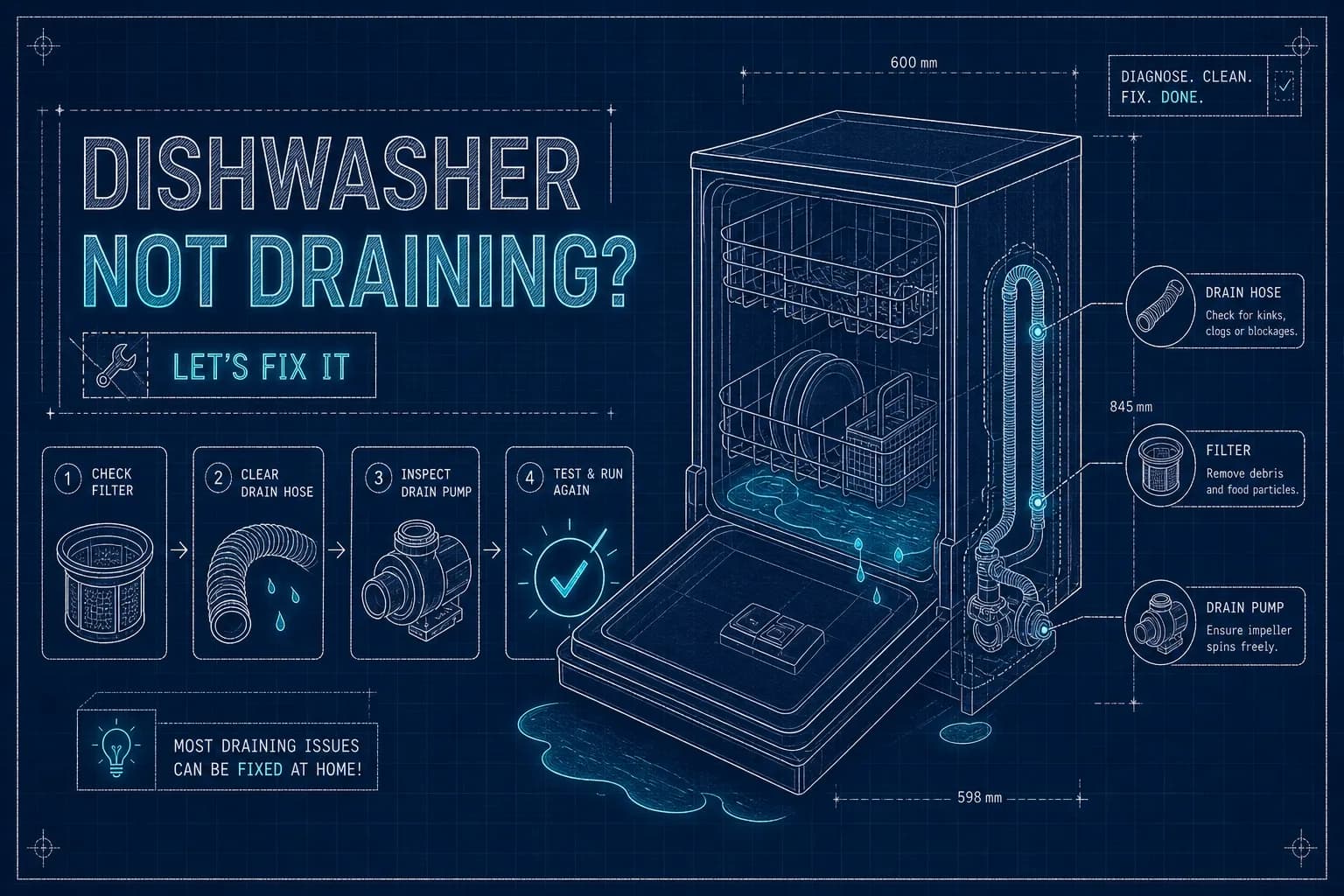
Dishwasher Not Draining? Here's How to Fix It Step by Step
If your dishwasher is not draining, you are not alone, and you are very likely looking at a fix you can complete yourself. Open the door after a full cycle to find a pool of standing water at the bottom, and it is natural to worry about an expensive repair. The reassuring reality is that dishwasher drainage faults are among the most common calls we receive at Alpha Appliances Ltd, and the majority are resolved quickly by cleaning the filter or hose. Many times, the solution takes less than 20 minutes and costs nothing at all.
There are four main culprits behind drainage failure: a clogged filter, a blocked or kinked drain hose, a connection issue with the sink or waste disposal, and a failing drain pump. This guide works through each one in order, starting with the simplest fix. Once your dishwasher drains correctly, you can stop, there is no need to go further down the list.
What's actually causing your dishwasher to hold water
Dishwasher not draining? Here are the four most common culprits
Drainage failure almost always traces back to one of four places. The filter, which sits at the base of the tub, is the single most common cause; it accounts for roughly 43, 55% of all drainage faults (a range that reflects variation across appliance brands and age groups). A blocked drain hose follows at around 24% of cases, usually caused by a kink near the cabinetry or a grease build-up inside the pipe. The sink or waste disposal connection accounts for approximately 18% of faults, often because a knockout plug was not removed during installation. Finally, drain pump failure or a jammed pump impeller makes up most of the remaining cases.
The tell-tale sounds matter too. A grinding or buzzing noise during the drain cycle points strongly towards the pump. A dishwasher that drains slowly after the rinse but leaves a shallow puddle suggests the filter or hose is the problem. Silence when you would expect to hear the pump running is a red flag for a motor or control board fault.
What the water level tells you
The depth of standing water gives you a useful first clue. A few centimetres of water pooled at the base usually indicates a filter blockage, the pump attempted to drain but could not push water through the obstruction. A completely full tub, on the other hand, can indicate the drain cycle did not run at all, pointing towards an electrical, control, or pump fault. Bear in mind that a full tub can also result from backflow via a blocked sink or disposal, or a failed check valve, so check those possibilities as well before assuming a motor fault.
Before you do anything: safety first
Turn the dishwasher off at the socket before you touch anything inside. If you are going to disconnect the drain hose, also turn off the water supply to prevent flooding. Water and a live appliance are a dangerous combination, particularly when you are removing the filter or reaching near the pump housing. This step is non-negotiable, and it takes five seconds. Once the power and water supply are isolated, you can proceed safely.
How to clear standing water fast (dishwasher not draining)
Removing the standing water without making a mess
Pull out the bottom rack and set it aside. Use a large cup or ladle to scoop the bulk of the water into a bucket, then finish with absorbent towels or a sponge. If you have a wet/dry vacuum available, it makes this step considerably quicker, direct the hose into the sump area where the water collects. Laying old towels around the base of the machine before you start will protect your floor from any spillage.
Step-by-step filter cleaning
With the water cleared, you can access the filter. Follow these steps to clean it properly:
- Locate the cylindrical filter at the centre of the tub base, usually just beneath the lower spray arm.
- Twist it anticlockwise to release, then lift it out. Some models have a two-part filter, with a flat lower section that lifts out separately; remove both pieces if present.
- Rinse both parts under warm running water to remove loose debris.
- Scrub with a soft toothbrush and a small amount of mild washing-up liquid, paying close attention to the mesh. If grease has built up, soak the filter in hot soapy water for 10, 15 minutes before scrubbing.
- Wipe the drain sump inside the machine with a damp cloth to remove any debris left behind.
- Reinstall the lower filter first, then fit the upper filter and twist clockwise until it locks firmly in place. If it still turns freely, it is not seated correctly, try again.
How to know if cleaning the filter has fixed it
Restore power and run a short rinse cycle. If the dishwasher drains completely, the job is done. Given that filter blockages account for roughly 43, 55% of all drainage faults, this single step resolves the fault for the majority of homeowners reading this guide. If water remains, move on to the drain hose.
Checking and unblocking the drain hose
Dishwasher drain troubleshooting: inspecting the hose for kinks and blockages
The drain hose runs from the pump, typically behind the machine, up to the sink waste or waste disposal unit under the counter. Pull the dishwasher out slightly to inspect the full length of the hose. A high loop in the hose under the sink is intentional, it prevents waste water from siphoning back in. What you are looking for is a crushed section, a sharp kink near the cabinetry, or a sagging portion that has dropped below the connection point. Straighten any kinks you find and check whether this resolves the drainage.
Clearing a partial blockage inside the hose
If the hose looks intact but drainage is still slow, disconnect it at the sink or disposal end and run water through it from the tap. If water flows freely, the hose itself is not the problem. If the flow is restricted, a thin flexible brush can dislodge a physical blockage, or you can flush the hose with a mixture of white vinegar and warm water to break down grease build-up. Reconnect securely and test again before moving on.
The sink and waste disposal connection
For dishwashers that drain into a waste disposal unit, check that the disposal itself is clear. Run it with cold water for 30 seconds to flush any food debris. If the disposal was recently installed or replaced, also check whether the knockout plug in the inlet was removed, this is a surprisingly common oversight that completely blocks drainage. If a countertop air gap is fitted above your sink, lift the cap and check for debris inside, as a blocked air gap produces the same symptom.
Testing the drain pump when basic fixes don't work
How to listen and look for pump problems
A healthy drain pump produces a steady, consistent hum during the drain cycle. Grinding, buzzing, high-pitched whining, or complete silence during the drain phase all indicate the pump is struggling or has seized. Once the filter is removed, you can visually inspect the pump housing. Check whether the impeller spins freely when you turn it by hand with a gloved finger. The impeller is the small rotating component housed inside the pump. If it is stiff or completely locked, something is jamming it.
Checking for foreign objects in the pump
Small items are frequently the cause of a jammed impeller. Broken glass, plastic fork tines, seeds, and even food labels can work their way past the filter and lock the pump solid. Use a torch and a gloved hand to feel carefully around the pump area once the filter is out. Removing the obstruction often resolves the fault entirely without any parts being needed. Take your time with this check, glass fragments in particular are not always visible.
What a continuity test shows (for confident DIYers)
If the impeller spins freely but the pump still fails to drain, a multimeter test can confirm whether the motor itself has failed. With the dishwasher disconnected from power, access the pump terminals and set your multimeter to the ohms setting. Place a probe on each terminal. A working pump typically reads between 15 and 200 ohms depending on the model, this wide range reflects significant variation across manufacturers, so check your specific manufacturer's service data for the precise figure. A reading of infinity indicates an open circuit; a reading of zero indicates a short. Both mean the pump motor has failed. This step is optional and intended for readers who are comfortable working with appliance electrics.
When the fault is beyond safe DIY scope
Signs that point to an electrical or motor fault
If the pump impeller spins freely, the filter is clean, the hose is clear, and the sink connection is unobstructed, but the dishwasher still will not drain, the fault has moved into electrical territory. This could be a failed pump motor, a wiring fault between the control board and the pump, or the control board itself failing to send the drain signal. None of these faults can be safely or accurately diagnosed without specialist diagnostic equipment.
Why a certified engineer makes sense at this point
Drain pump replacements on brands such as Bosch, Miele, and AEG require model-specific parts and correct reassembly to manufacturer tolerances. Fitting an incorrect part or misconnecting wiring can cause repeat failure and void any remaining manufacturer's warranty. For homeowners who have worked through every step above without success, bringing in a certified engineer is the faster and more cost-effective route at this stage. At Alpha Appliances Ltd, our manufacturer-trained engineers specialise in exactly these dishwasher drain faults, offering fixed-price diagnostics, genuine replacement parts, and next-day appointments across London, Berkshire, Surrey, Hampshire, and Dorset. Call us to confirm current availability and pricing.
Keeping your dishwasher draining properly going forward
A five-minute monthly routine that makes a difference
Clean the filter once a month, it takes less than five minutes and prevents the most common drainage fault from developing in the first place. Every six to eight weeks, place a cup of white vinegar on the top rack and run a maintenance cycle on the hottest setting to break down grease and mineral deposits in the drain path. Wipe the door seal and the area surrounding the drain regularly so debris does not accumulate silently between cleans.
What not to put in the dishwasher
Standard washing-up liquid produces excessive suds that clog the drain path and can trigger a drainage fault even in a perfectly functional machine, always use dedicated dishwasher tablets or powder. Scrape plates before loading rather than rinsing them, since large food debris is the primary cause of filter blockages. Keep a close eye on jar labels, loose plastic lids, and foil seals during cycles; these frequently peel off and drop to the tub floor, where they can block the filter or jam the pump impeller.
Fixing a draining fault: where to start and when to stop
Start with the filter, then check the hose and sink connection, then assess the pump. In the majority of cases, a dishwasher not draining after a cycle is resolved at the first or second step, with no cost and no specialist tools required. That is good news for most homeowners, and it is why this guide exists.
Some drainage faults do turn out to be pump or motor-related, and those are beyond safe DIY territory. Recognising that point is not a failure, it is the right call to make before an amateur repair causes a more serious and expensive problem. Bringing in a City & Guilds certified engineer at that stage is the sensible decision.
If your dishwasher is not draining even after working through every step above, do not persist with guesswork. A well-maintained dishwasher drains cleanly at the end of every cycle, and with a monthly filter clean and a few sensible loading habits, standing water should become a thing of the past. If it ever returns, you now know exactly where to look first.
Need a repair today?
Book a visit from a certified Alpha engineer in minutes.