
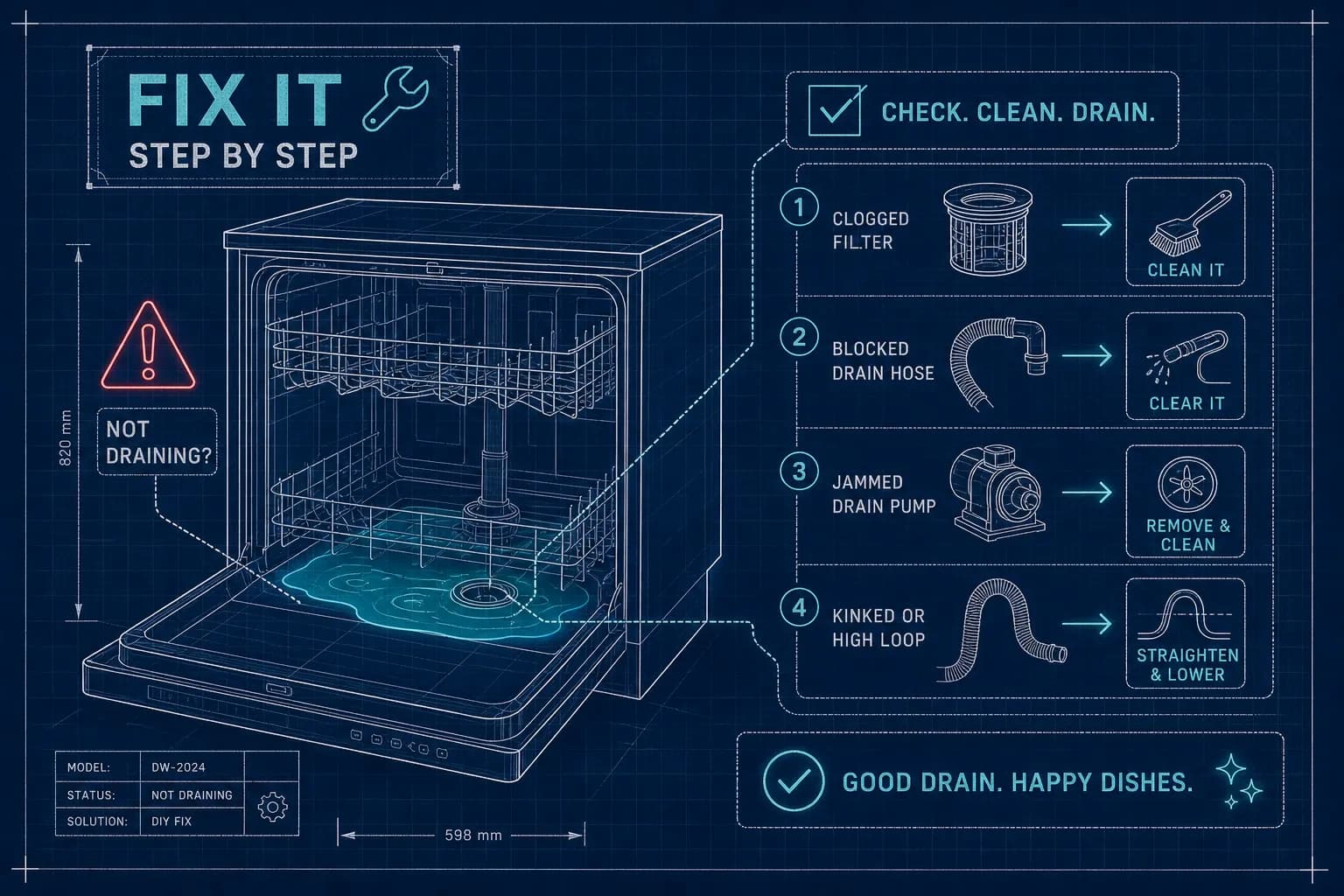
Dishwasher Not Draining? Here's How to Fix It Step by Step
If your dishwasher is not draining, you will likely open the door expecting clean, dry plates and instead find an inch of murky water sitting in the bottom of the tub. It is one of the most common fault calls received by domestic appliance engineers, and it is something Alpha Appliances Ltd engineers encounter regularly across London and the surrounding area. The good news is that when a dishwasher is not draining, the cause almost always comes down to one of a small handful of problems. Most of the straightforward faults, a blocked filter, a kinked hose, or a jammed disposal connection, can be fixed at home without specialist tools, while pump and electrical faults are best left to a professional.
This guide takes you through every likely culprit in order of probability, from the quickest checks to the more involved. Work through them in sequence and you will either solve the problem yourself or arrive at a clear diagnosis before any engineer visits.
Why your dishwasher is not draining
Around 7 in 10 drainage faults come down to a clog somewhere in the drain path, a commonly cited estimate among appliance repair engineers. The single most common cause is a blocked filter or food debris in the sump area. After that, the next most likely culprit is a kinked or clogged drain hose, then a problem with the garbage disposal connection, a blocked air gap, and finally a failing drain pump. Understanding that hierarchy matters: it tells you where to start and saves you from pulling out the machine unnecessarily when the fix is a 10-minute clean at the base of the tub.
Not all drainage faults look the same, and what you see in the tub gives you useful information before you even remove a panel. A small puddle that drains slowly suggests a partial blockage, most likely the filter or a partially kinked hose. Water that fills and stays completely still is more typical of a fully blocked dishwasher filter, a crushed hose, or a disposal connection problem. If you hear unusual humming or grinding during the drain phase and the water refuses to move, that points toward the drain pump. Keep those clues in mind as you work through the steps below.
Remove the standing water before you do anything else
Before you touch anything inside the tub, cut power to the dishwasher by either unplugging it at the wall or switching off the circuit breaker. Turn off the water supply as well. Lay old towels on the floor around the base of the machine to catch any spills. Pull out the bottom rack so you have clear access to the sump and filter area at the base of the tub. Skipping the power step is how electrical hazards and water damage happen, so treat it as non-negotiable.
Once the machine is safe to work on, scoop out the bulk of the standing water using a cup or ladle, transferring it into a bucket. When the water level drops too low for scooping, switch to a thick sponge or an old cloth to absorb the remainder. If you have a wet and dry vacuum, use it for the last centimetre of water as it is significantly faster. Do not pour chemical drain cleaner into the tub; it can damage the pump seals and other internal components. Once the tub is empty, you are ready to inspect the most likely blockage points.
Work through the most likely blockages in order
When your dishwasher is not draining: clean the filter first
A blocked dishwasher filter is the number one cause of drainage problems and also the easiest fix. The filter sits at the base of the tub and, on most modern machines, is a two-part twist-and-lift assembly, though designs vary, so it is worth checking your manufacturer's manual if yours looks different. Rotate the upper section a quarter turn anticlockwise and lift both parts out together. Rinse the filter under warm running water to remove loose food debris, then scrub away any grease or stuck residue using mild washing-up liquid and a soft brush. Do not use wire brushes or scouring pads as these will damage the fine mesh.
Reinstall the filter by placing the lower mesh flat in its housing first, then seating the upper section and twisting clockwise until it locks. For most people reading this, a clean filter is all it takes. Run a short rinse cycle to confirm the fault has cleared. To prevent the problem recurring, aim to clean the filter every one to three months, or more frequently if you run the machine daily, load heavily soiled dishes, or rarely scrape plates before loading, check your manufacturer's guidance for their specific recommendation.
Check the drain hose for kinks and blockages
With the filter clean and the machine still powered off, open the cupboard beneath the sink and trace the drain hose from the back of the dishwasher to where it connects to the sink waste or garbage disposal. Look for sharp kinks, crushed sections where stored items may have pressed against the hose, loose clamp fittings, or visible sludge around any joins. A kinked drain hose is the second most common cause of this fault, and it is often created simply by pushing the machine too far back into its housing.
If the hose looks clear externally but you still suspect a blockage, disconnect it at the sink or disposal end and flush it through with warm water into a bucket. Check that the hose follows a high-loop route before connecting to the waste outlet; without this, a siphon effect can pull water back into the machine after the cycle ends. Reattach the hose securely with the clamp firmly in place before running a test cycle.
Inspect the garbage disposal connection and air gap
If your kitchen has a garbage disposal unit, the dishwasher drain hose almost certainly connects directly to it. A disposal blocked with food debris will back water up into the dishwasher tub. Run the disposal with cold water for around 30 seconds, a commonly recommended practice, to clear any loose build-up. If the disposal was recently installed or replaced, check whether the knockout plug at the dishwasher inlet was actually removed. A missed knockout plug is a surprisingly common fault on new installations and will block drainage entirely; removing it typically takes only a couple of minutes with a screwdriver and hammer, though if you are uncertain, it is worth consulting the disposal manual.
For kitchens with an air gap fitting on the worktop or sink, remove the cap and inspect the interior for food debris or mineral build-up. Clean it out with warm soapy water and a small brush, check that the connected hoses are free of blockage, then replace the cap and run a drain test. Air gap problems are less obvious than filter clogs but are a frequent contributor to slow or incomplete draining in older kitchen setups.
Signs the drain pump has failed
If the filter is clean, the dishwasher drain hose is clear, and the disposal is working normally but the dishwasher is still not draining, the drain pump becomes the most likely culprit. The clearest sign of a pump fault is a persistent humming, grinding, or buzzing sound during the drain phase that produces no actual water movement. Complete silence when the machine should be draining is equally significant and usually indicates a dead pump motor or a wiring fault. Dirty dishes combined with standing water after every cycle, or a drain-related error code on the display, are further confirmation that the pump needs attention.
Before calling an engineer, there is one check a homeowner can reasonably carry out. With the machine fully unplugged, look into the accessible pump area near the sump for any visible obstruction such as a piece of glass, a bone fragment, or a small plastic item jamming the impeller. These can occasionally be removed with needle-nose pliers. If nothing is visible and the problem persists, a proper diagnosis requires a multimeter to test the pump motor for continuity. This is the point where DIY has delivered everything it reasonably can. A certified engineer will diagnose the fault accurately with the right test equipment and fix it faster than further trial and error at home.
When to call a certified dishwasher engineer
Stop the DIY troubleshooting and call a professional if the filter is clean, the hose is unkinked, the disposal is clear, and the machine still will not drain. Other clear signals include error codes pointing to pump or electrical faults, grinding or buzzing that continues even after obvious blockages have been removed, or any situation where you are not comfortable disconnecting hoses or accessing the pump housing. These are not failures on your part, they are simply faults that require specialist diagnostic tools and trained hands.
This is where Alpha Appliances Ltd comes in. Our City & Guilds certified engineers carry the diagnostic equipment to test pump continuity properly and arrive with the most common replacement parts already on the van. We work to a fixed price agreed before any work begins, with no hidden call-out fees, and we cover Greater London along with parts of Berkshire, Surrey, Hampshire, and Dorset. We aim for a high first-time fix rate across all major brands including Bosch, Miele, AEG, and Samsung, and we can typically offer next-day appointments where availability allows. You know exactly what you are paying before the engineer picks up a single tool. Booking is straightforward online, and the team will confirm your appointment promptly, no waiting weeks for a manufacturer service slot, and no vague pricing once the job is under way.
The short version: what to do and when to stop
Most cases where a dishwasher is not draining resolve at the filter or drain hose stage. Cleaning the filter typically takes between 5 and 15 minutes and requires only a soft brush and some washing-up liquid, usually no extra cost at all. Hose checks and disconnections may take a little longer and occasionally need basic tools, but they are still well within the reach of most householders. If those steps do not clear the fault, check the disposal connection and air gap before concluding the pump has failed. A humming or silent drain phase after all the accessible checks are done is a reliable sign that the pump itself needs attention.
Work through the steps in this order: clear the standing water safely, clean the filter, check the hose for kinks and clogs, inspect the disposal and air gap, and then listen carefully during the drain cycle for pump failure signs. If you reach the end of that list without a resolution, the fault is almost certainly mechanical and needs a trained eye to fix it properly. If your dishwasher is not draining after completing all these checks, Alpha Appliances Ltd can book a next-day visit, diagnose the problem with the right equipment, and carry out the repair at a price agreed before the work starts. Book online or call the team, and have a certified engineer at the door tomorrow.
Need a repair today?
Book a visit from a certified Alpha engineer in minutes.