
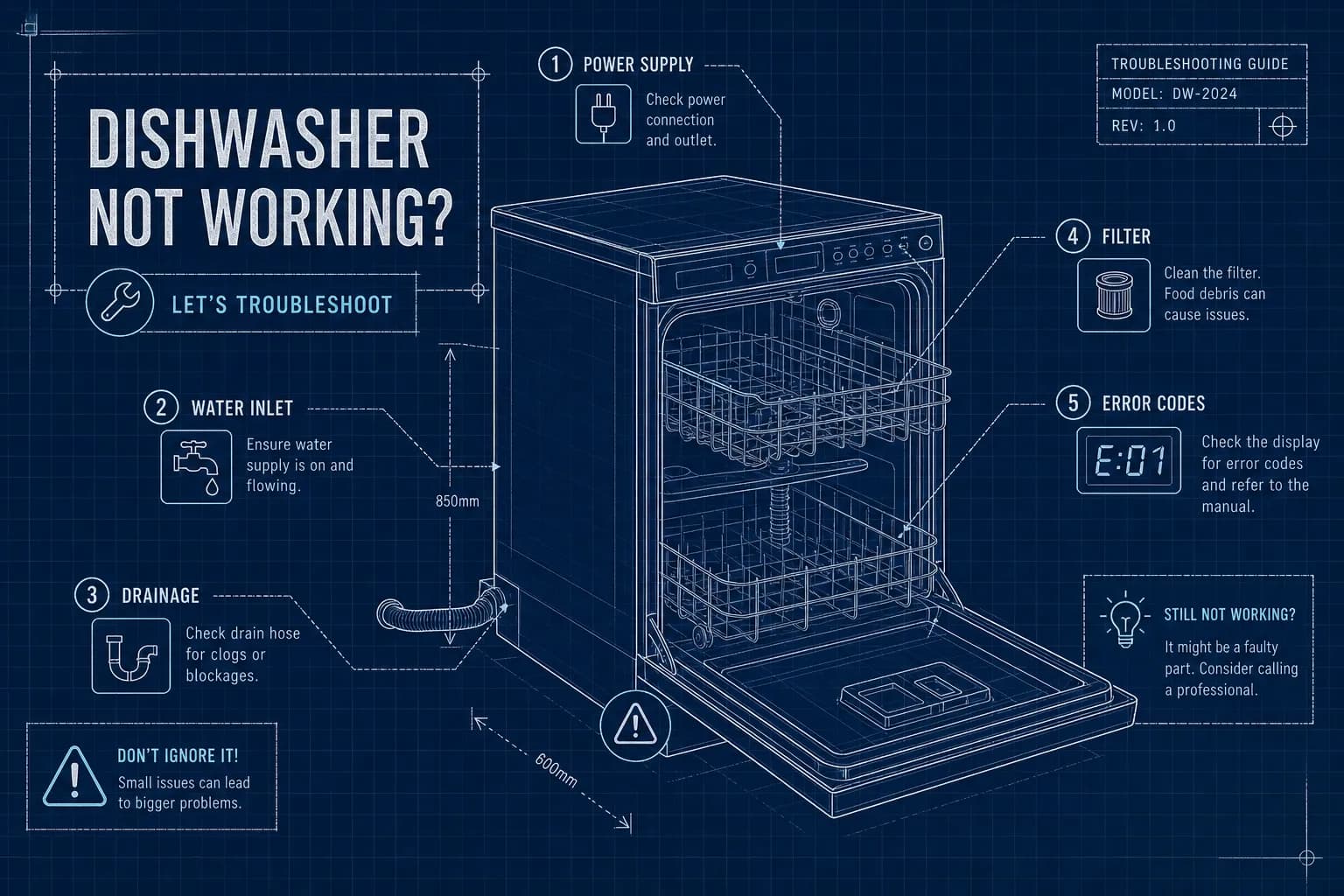
Why Has My Dishwasher Stopped Working? A Complete Troubleshooting Guide
If your dishwasher is not working, you already know how quickly a full load of last night's dishes becomes a problem. You press the start button, close the door, and wait. Nothing. No hum, no rush of water, no click of the latch engaging a cycle. At Alpha Appliances Ltd, dishwasher faults are among the most common call-outs we receive from homeowners across London and the Home Counties, and the good news is this: the cause is often identifiable with a methodical check.
Most faults come down to one of a handful of issues, and many of them don't require a repair engineer at all. This dishwasher repair guide walks you through the diagnostic process in order, from the simplest power checks through to reading error codes and cleaning internal components. By the end, you'll know exactly what the fault is, whether you can fix it safely at home, and what to do if the problem runs deeper.
Dishwasher not working? First checks to run
Before you conclude there's a serious fault, run through the basics. The majority of cases where a dishwasher appears completely dead trace back to a power interruption or a setting that's been activated without the homeowner realising.
Checking your power supply and circuit breaker
A tripped circuit breaker, a blown RCD socket, or a plug that's worked itself loose can silence a dishwasher instantly. Check your consumer unit first: look for any breaker that's tripped to the middle or off position and reset it. If your dishwasher is plugged into a socket rather than hardwired, confirm the socket itself is live by plugging in another device. Built-in dishwashers are often harder to access at the plug, so the consumer unit is your first and safest port of call.
Control lock, delay start and sleep mode
Three software settings are responsible for more dishwasher not working calls than most homeowners realise. The control lock (sometimes labelled child lock) disables all buttons entirely, making the machine appear unresponsive even though it has full power. A delay start timer, if accidentally activated, means the machine is waiting rather than running. Some models also enter a sleep or demo mode that mimics a dead appliance. Check your control panel for any lit indicator related to these functions, consult your manual for how to cancel them, and try a simple power reset: switch the machine off at the mains for five minutes, then restore power. This clears many software-related hangs, though some models require a specific reset routine rather than a straightforward power cycle.
Is your door latch the problem?
A dishwasher's start sequence is physically locked out until the door registers as fully closed. The machine won't begin filling with water until the door switch signals that the latch has engaged. This isn't a design flaw. It's a safety mechanism. When it malfunctions, the dishwasher won't respond no matter how many times you press start.
Signs of a faulty door latch or door switch
The most obvious sign is a door that closes but the machine still won't start. You might notice the latch feels loose, doesn't click firmly into place, or requires extra pressure to engage. A rack loaded too high with pans or baking trays is a common culprit that prevents the door from sealing fully. Some dishwashers will display a door-related indicator or a fault code (such as F06 on Hotpoint or Indesit models) when the door switch hasn't registered a proper close.
What you can safely inspect and adjust yourself
Disconnect power at the mains before touching any internal component, even for something as straightforward as filter cleaning. Then start by checking whether anything in the upper rack is sitting proud and pressing against the door. Visually inspect the latch mechanism at the top of the door for visible cracks, misalignment, or obvious wear. When you close the door slowly, listen for a definite click; if you don't hear it, or the control panel doesn't respond at all, the latch itself may have failed. A worn latch mechanism or a failed door switch needs a replacement part. You can test the switch for continuity using a multimeter set to ohms: a good switch reads near zero resistance when actuated and open circuit when released, though exact figures vary by model so check the manufacturer's specification before drawing conclusions. If the reading doesn't change at all, the switch is very likely faulty, confirm with a professional before ordering parts.
Dishwasher not working properly? Water filling and draining faults explained
Two of the most frequent dishwasher complaints sit at opposite ends of the wash cycle: either the machine takes in no water and the cycle stalls before it begins, or it completes the wash but leaves a pool of standing water at the bottom of the tub. Both are diagnosable at home with a few straightforward checks.
Checking the water inlet valve and supply
The first check is the simplest: locate the water supply tap, usually positioned underneath or behind the dishwasher, and confirm it's fully open. A partially closed tap restricts flow enough to trigger a fill error. Next, trace the inlet hose for any kinks that might be blocking the supply, and inspect the small filter screen inside the inlet valve connection for limescale or debris build-up. If the dishwasher hums briefly and then cuts out without filling, or the fault code points to a fill problem (Bosch E18, for example), the inlet valve solenoid may have failed. A failed inlet valve is a parts replacement job that requires the water supply to be isolated before any work begins.
Cleaning the filter, sump and drain pump
A blocked filter is one of the most common causes of poor drainage, standing water, and cloudy or food-flecked dishes. Remove the lower rack, twist out the filter assembly (most designs release anticlockwise), and rinse it under warm running water. Use a soft brush or old toothbrush to clear stubborn buildup. Never use a scouring pad or wire brush, as these damage the mesh. Wipe out the sump area where the filter sits to remove any accumulated sludge, and check the spray arm holes for blockages while you're there. Reinstall the filter and make sure it locks securely; if it still turns freely, it isn't seated correctly. If dishwasher not draining issues persist after cleaning the filter thoroughly, check the drain hose for kinks and inspect the pump impeller area for any debris such as broken glass, a pip or small food fragment, or a small utensil that's found its way through.
Dishwasher not working: reading error codes and resetting the machine
Modern dishwashers don't just stop working, they tell you why. The alphanumeric codes displayed on the control panel are a direct line to the fault, and knowing what they mean converts a confusing situation into a clear action plan. Appliance fault diagnosis becomes far more straightforward once you can read what your machine is telling you.
Common fault codes for Bosch, Hotpoint, Indesit and Whirlpool
On Bosch machines, the codes you're most likely to encounter are:
- E15, water detected in the base, indicating a leak. Stop using the machine immediately and arrange a service call.
- E18, no water fill; check the tap, hose and inlet filter.
- E22, filter blocked; clean the filter assembly.
- E24, drainage fault; clear the filter, hose and pump cover.
- E25, pump blocked or impeller jammed.
E15 in particular should not be ignored: it means water has reached the base tray and the anti-flood system has activated.
For Hotpoint, Indesit and Whirlpool dishwashers, which share a common appliance platform across much of their range, the F-code family covers the same territory:
- F01, flood or anti-flood protection; if water is present in the base, stop using the machine immediately.
- F04 / F05, drainage or pressure-sensing faults; clean the filter and check the drain hose first.
- F06, door switch fault; check the latch, close the door firmly, and inspect for wear.
- F09, control board or electronic memory fault; this is not a DIY repair.
Any fault code that returns immediately after a proper reset points to an underlying hardware problem rather than a temporary software glitch.
How to safely reset your dishwasher
The universal reset procedure works across most brands: cancel the active cycle, switch off at the mains or at the breaker, wait at least five minutes for the control board to fully discharge, then restore power and run a short test cycle. On Bosch machines, pressing and holding the Start button for four seconds cancels the active cycle and initiates a drain sequence before the reset. Whirlpool and Hotpoint machines generally respond well to a straightforward power cycle. A reset clears temporary software faults, but it won't resolve a failed component. If the fault code reappears within minutes of restarting, the problem is in the hardware.
DIY repairs that are safe to try at home
Some basic dishwasher troubleshooting is well within reach for most homeowners. Knowing where the boundary sits means you can act with confidence rather than guesswork, and avoid accidentally making a manageable fault more complex.
What most homeowners can handle safely
The following checks and actions are safe to carry out without specialist tools or electrical knowledge:
- Cleaning and reinstalling the filter assembly
- Checking and clearing blocked spray arm holes
- Confirming the water supply tap is open and the inlet hose is free of kinks
- Verifying the circuit breaker hasn't tripped
- Deactivating control lock or delay start
- Performing a mains power reset
Always disconnect power at the mains before touching any internal component.
Where DIY stops and professional diagnosis starts
Testing or replacing a door switch, water inlet valve solenoid, or drain pump motor requires a multimeter, basic electrical knowledge, and confidence working inside an appliance with the power isolated. Fitting the wrong replacement part, or misdiagnosing the fault before ordering, can create a more expensive problem than the original one. Persistent leaks, faults involving the heating element or circulation pump, and any fault that produces a burning smell are firmly in the category of professional diagnosis. The cost of a repair at this level typically falls between £115 and £250 for most common dishwasher faults in the UK in 2026, with major component replacements such as a motor or control board running from £160 to £300 fitted.
When to stop and book a certified dishwasher engineer
Some faults are beyond safe home investigation, and attempting them without the right equipment risks making the situation worse, as well as voiding any remaining manufacturer warranty. Knowing when to hand over is as important as knowing what to check yourself.
Signs that the fault is beyond DIY
Book a professional repair if you encounter any of the following:
- An error code that reappears within a short time of a proper reset
- A burning smell or visible scorch marks near the control panel
- Water appearing in the base tray (Bosch E15 or the Hotpoint/Indesit equivalent)
- The machine humming but failing to complete any stage of a cycle
- Any fault involving the heating element, circulation pump, or control board
These faults require proper diagnostic tools and certified training to resolve safely and correctly first time.
Booking a repair with Alpha Appliances Ltd
If you've worked through the checks in this guide and the fault persists, our team at Alpha Appliances Ltd is the straightforward next step. We aim to offer next-day availability across Greater London, Berkshire, Surrey, Hampshire, and Dorset, with a clear online booking process and transparent fixed-price repairs so you know exactly what you're committing to before the engineer arrives. Our City & Guilds certified engineers carry a broad range of genuine parts and consistently achieve a high first-time fix rate, which means most dishwasher faults are resolved in a single visit. There are no hidden fees and no surprises, just a documented repair from an engineer who arrives on time and explains the work clearly. Get in touch with our team to check availability and book your slot.
Pulling it all together
A dishwasher that won't work is rarely a write-off situation. Start with the power supply and check the consumer unit. Confirm no software setting is blocking the start command. Check the door latch for mechanical issues. Inspect the water supply tap, inlet hose, and filter. Read the fault code if one is displayed, carry out the safe DIY fixes that apply, and attempt a proper mains reset. Most dishwasher leaks and blockages, along with the majority of start and drain faults, resolve at one of those stages.
If your dishwasher is not working after these checks, the problem is almost certainly a component that needs professional diagnosis: a failed inlet valve, a blocked or seized drain pump, a faulty door switch, or a control board fault. The dishwasher is fixable; it just needs the right pair of hands on it. Our team at Alpha Appliances Ltd is available next day across London and the South of England, with transparent pricing and the technical expertise to sort it properly. Book online today and get your kitchen back to normal.
Need a repair today?
Book a visit from a certified Alpha engineer in minutes.