
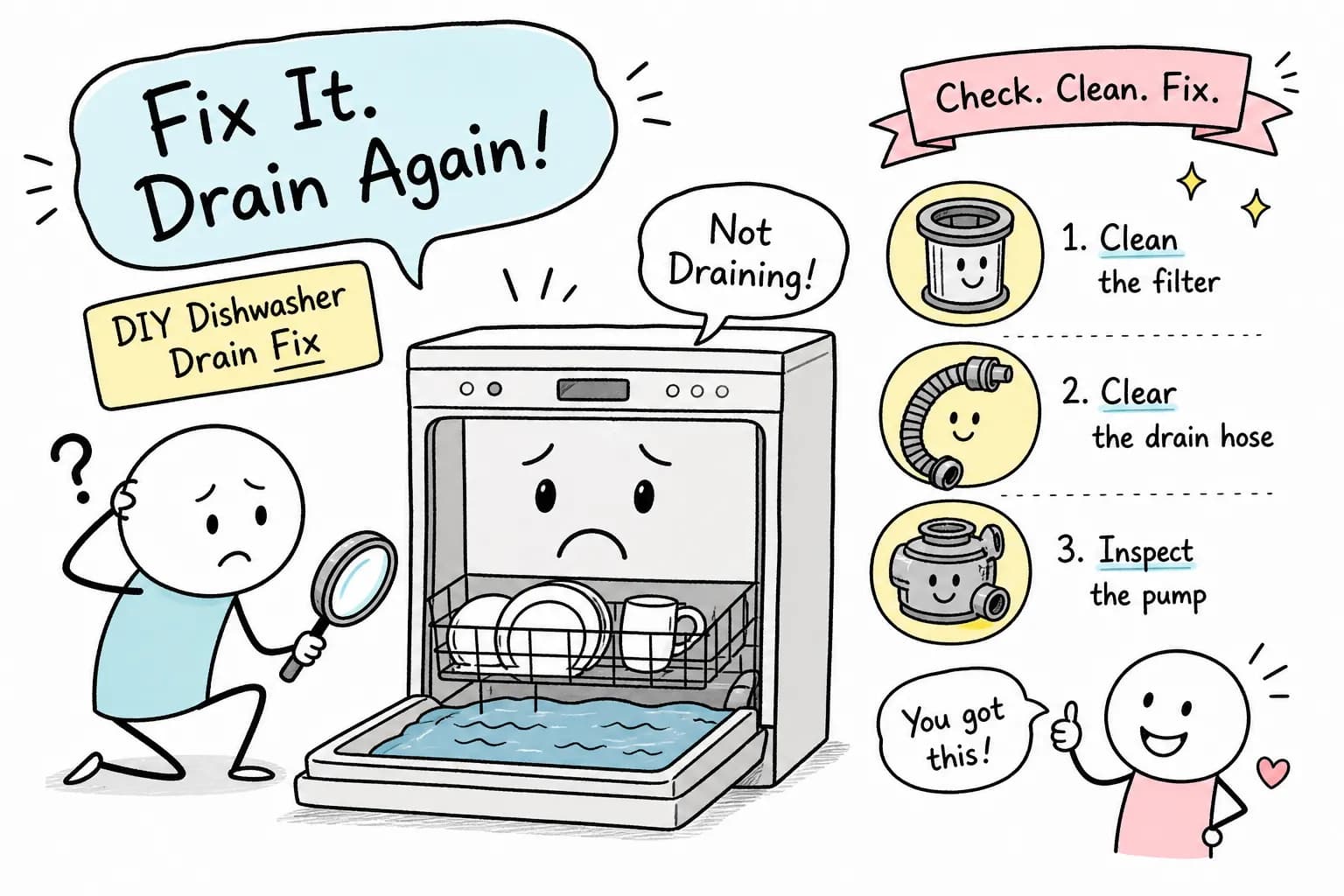
How to Fix a Dishwasher That Won't Drain at Home
You open the dishwasher door after a full cycle, and there it is: a pool of murky, greasy water sitting at the bottom of the tub. Knowing how to fix a dishwasher that won't drain at home is one of the most searched appliance questions in the UK, and for good reason. At Alpha Appliances Ltd, drainage faults are among the most frequent call-outs our engineers handle every single week, which puts us in a good position to tell you something reassuring: most of these faults are fixable at home, in under an hour, with tools you already own. That said, some causes go beyond safe DIY territory, and knowing where that line sits will save you time, money, and a flooded kitchen floor.
This guide walks you through the most likely causes in order of probability, the safety steps you must take before touching anything, and the fixes themselves. By the end, you'll know whether the job is yours to finish or whether it's time to call a certified engineer.
Why your dishwasher isn't draining: the most likely causes
Before you open the machine, it helps to understand what you're dealing with. The single most common reason a dishwasher holds standing water is a clogged filter. Food particles, grease, and fine debris accumulate in the filter mesh over time until the drainage path is effectively blocked. Most homeowners clean their dishwasher filter far less often than they should, which makes this the clear first suspect in almost every case of a dishwasher that won't drain.
After the filter, the drain hose is the next most likely culprit. This flexible hose runs from the base of the dishwasher to your sink drain or waste disposal unit, and it can become kinked behind the kickplate or blocked internally with grease and debris. A jammed drain pump is less common but more serious: broken glass, seeds, or food fragments can lodge in the pump impeller and prevent it from turning. Problems with the sink or garbage disposal connection matter too, particularly if the disposal was recently replaced and the knockout plug was never removed.
One lesser-known cause worth mentioning is incorrect detergent. Using washing-up liquid or non-dishwasher detergent creates excessive foam that prevents water from draining properly. It sounds unlikely, but it happens more often than you'd expect.
The clogged filter: why it causes most drainage faults
The filter sits at the bottom of the tub and catches food debris before it reaches the pump. When it isn't cleaned regularly, a thick layer of grease and food particles builds up until the mesh is effectively sealed. A badly clogged dishwasher filter looks unmistakable when you pull it out: a grey-brown paste, an oily film covering the mesh, and visible chunks of food stuck in the screen. It's unpleasant, but it's also the easiest fix on this list.
Hose blockages, pump faults, and drain cycle problems
A kinked drain hose restricts water flow the same way a kinked garden hose does: it doesn't have to be fully blocked to cause a problem, just sufficiently narrowed. A grease-packed hose interior achieves the same result over time. The drain pump itself can jam when debris enters the housing and locks the impeller; in these cases you'll often hear the machine making grinding or buzzing noises during the drain phase. A glitchy control board is the least common cause, but it can prevent the drain cycle from triggering at all, even when there's no physical blockage anywhere in the system.
How to fix a dishwasher that won't drain at home: before you start
None of the fixes below are safe to attempt while the dishwasher is connected to the power supply. Water and live electricity are a genuinely dangerous combination. Cut the power first by unplugging the appliance at the wall or by switching off the circuit breaker for the kitchen circuit. Then shut off the water supply valve, which sits under the sink and controls flow to the dishwasher. If the machine ran a cycle recently, give the interior a few minutes to cool before reaching inside.
Disconnecting power and water (do this first, every time)
The sequence is non-negotiable: power off, water supply off. The supply valve is typically a small isolation valve on the cold water pipe under the sink, turned clockwise to close. If you can't locate a dedicated isolation valve, turn off the main cold water supply to the kitchen instead. Don't skip this step, even if you're only planning a quick look.
How to remove standing water from the tub
Slide out the lower rack and set it aside. Use a large cup or bowl to scoop water out into a bucket, working until the level drops as far as it will go by hand. Use old towels or a sponge to absorb the remaining inch or two of water sitting in the sump recess. Lay towels on the floor around the base of the dishwasher before you disconnect anything, because water will drip when you start moving hoses. A wet-dry vacuum makes the process much faster if you have one available.
Cleaning the filter and sump: your most important first fix
Start here before you do anything else. The filter is located at the centre of the tub floor, directly beneath the lower spray arm. Remove the lower rack to give yourself clear access. On most machines, the filter lifts out with a counterclockwise twist followed by a straight lift; some models lift straight up without any rotation. Check the alignment arrows or triangle markers on your filter and housing to confirm the correct removal position. When in doubt, a quick look at the owner's manual takes thirty seconds and saves a lot of confusion.
How to locate and remove the dishwasher filter
With the lower rack out of the way, you'll see the cylindrical filter assembly at the centre of the tub base. Grip it, twist counterclockwise until it releases, then lift it free. Bosch dishwashers commonly use a triple filter system with a coarse screen, a fine mesh, and a micro filter that must be separated and cleaned individually. On other brands, the assembly is typically two parts. Handle it carefully over the sink, because a badly blocked filter will drip immediately.
Cleaning the filter and the sump housing properly
Rinse the filter under warm running water to shift the bulk of the debris. Use a soft toothbrush with a small amount of mild washing-up liquid to scrub the mesh, paying attention to the fine screen where grease accumulates most heavily. Avoid abrasive scourers or stiff brushes, as these damage the mesh and reduce its effectiveness. Once the filter is clean, wipe out the sump housing with a damp cloth and remove any food residue sitting in the recess before it has the chance to block the pump. Reinstall the filter securely, rotating it clockwise until it locks in place, then run a short cycle to test whether drainage has been restored.
Checking and clearing the drain hose and sink connection
If the filter was clean or cleaning it made no difference, the drain hose is your next inspection point. This is a common source of a clogged dishwasher drain that's easy to overlook. The hose runs from the dishwasher's drain pump to the sink drain or waste disposal unit. It's accessible from under the sink on most installations, and the connection at the pump end can often be reached by removing the lower front kick plate. Before disconnecting anything, place an old towel and a shallow pan underneath the hose connection to catch residual water.
Inspecting the hose for kinks, damage, and blockages
Run your hand along the full length of the hose, feeling for kinks, hard spots, or soft areas that indicate damage. A kinked hose is often caused by the dishwasher being pushed back slightly too far into its housing, pressing the hose against the cabinet wall. Straighten any kink by hand and check that the hose has a proper high loop before connecting to the drain, which prevents sink water from backing up into the machine. Inspect the clamps at both ends to confirm they're seated firmly and not corroded.
Flushing the hose and checking the disposal connection
Disconnect the hose carefully at one end and blow through it to check for airflow. If air doesn't pass through freely, a blockage is present. Flush the hose with warm water, or work a soft brush through it to clear interior buildup, particularly at bends where grease collects. If your hose connects to a garbage disposal unit that was recently replaced, check whether the knockout plug has been removed from the inlet port: a missing knockout is one of the most commonly overlooked causes of a dishwasher drain stuck with standing water.
If your setup includes an air gap fitting on the worktop near the tap, remove the cover, clean the interior with a small brush, and check the hose connection below for blockages. Reassemble everything securely and run a test cycle to confirm whether the drain cycle is now working.
Resetting your dishwasher to clear a software or control glitch
A hard reset takes less than two minutes and costs nothing. A software glitch in the control board can prevent the drain cycle from completing even when the filter is spotless and the hose is clear, the board essentially gets stuck mid-programme and needs clearing. Resetting forces the drain programme to restart from scratch.
How to hard reset your dishwasher (works for most brands)
Switch the machine off at the wall and leave it unplugged for a full minute before switching back on. This is the most reliable method across all brands. For brand-specific resets, follow these steps:
- Bosch and Siemens: Hold the Start or Reset button for three to five seconds until the display shows a short countdown, then power the unit off and on again.
- AEG: Hold the Cancel/Drain button for three seconds.
- Hotpoint: Follow the same Cancel/Drain button pattern as AEG, hold for three seconds, then power off and restart.
After the reset, run a rinse-only or short drain cycle to confirm whether the fault has cleared. If you've been using standard washing-up liquid instead of dishwasher tablets, run a plain hot rinse to clear the foam before testing further.
What to check if the reset makes no difference
A reset that changes nothing confirms the fault is physical rather than electronic. Go back through the filter and hose checks with fresh eyes, and look for error codes on the display panel: Bosch and Siemens use E24 for general drainage failure and E23 for a drain pump fault, Samsung displays 5C, LG shows OE, and AEG and Zanussi machines typically show i20. These codes point you directly to the component that needs attention.
When it's beyond DIY: drain pump failure and control board faults
Some dishwasher drainage faults cannot be fixed at home safely, and recognising them early prevents a manageable repair bill from turning into a water damage claim. A failed drain pump and a faulty control board are the two most common causes that fall into this category. Both require component-level access that carries real risk without the right training and tools.
Symptoms that point to a failed drain pump
The sounds the machine makes during the drain phase are the clearest diagnostic signal. A grinding or buzzing noise points to a jammed impeller caused by glass, food, or debris. A high-pitched whine suggests the motor is running under strain with worn bearings. Complete silence during the drain cycle, when you'd normally hear motor noise, indicates the pump motor has burned out entirely.
Standing water combined with any of these sounds is a strong indicator that the pump needs replacing, not clearing. A multimeter test on the pump terminals should read between 15 and 40 ohms on standard AC pump models, and 150 to 250 ohms on newer brushless DC motors found in recent Bosch machines. An open circuit reading confirms failure. Unless you're confident working with internal electrical components, this test is best left to a professional.
What a professional repair costs and why it's worth it
A drain pump replacement in the UK typically costs £40 to £120 for the part itself, with a full professional repair including labour coming in at £150 to £250 depending on the brand and location. London repairs run roughly £20 to £30 higher than the rest of the coverage area. That cost is a great deal less than the bill for water damage caused by an incorrectly reassembled integrated dishwasher.
At Alpha Appliances Ltd, our City & Guilds certified engineers carry a wide range of genuine parts, giving us a 78% first-time fix rate across all major brands. Fixed-price diagnostics, no hidden call-out fees, and next-day availability across Greater London, Berkshire, Surrey, Hampshire, and Dorset mean you get a clear answer and a working machine without the wait that comes with manufacturer service channels. Booking takes minutes through our online system.
Summing it up: your at-home drainage decision tree
If you're working out how to fix a dishwasher that won't drain at home, start with the filter. Clean it thoroughly, reinstall it correctly, and run a test cycle. If that resolves the standing water, the job is done. If not, inspect and flush the drain hose, check the sink or disposal connection, and perform a hard reset. These three steps resolve most dishwasher drainage faults at home, at no cost beyond your time.
If water is still sitting in the tub after all three steps, the fault is almost certainly mechanical. A failed drain pump is not a job to attempt without experience, and getting it wrong can cause significantly more damage than the original fault. Calling a certified engineer at that point
isn't admitting defeat, it's the decision that saves money.
If the DIY route hasn't cleared it, Alpha Appliances Ltd is the straightforward next step. Call or book online and a manufacturer-trained engineer will be with you the following day to diagnose and fix the fault properly, first time.
Need a repair today?
Book a visit from a certified Alpha engineer in minutes.