
How to Fix a Tumble Dryer: Common Faults Explained
You load the drum, set the programme, come back an hour later and the clothes are still damp. Or worse, the drum is completely silent when it should be turning. Wet laundry piling up is one of those household problems that demands immediate attention, and it rarely happens at a convenient moment.
Fixing a tumble dryer is often more straightforward than it looks, most faults come down to a small set of repeating causes, and knowing which one you're dealing with is half the battle. These faults are commonly reported across domestic dryers throughout the UK, and in most cases the diagnosis is straightforward once you know what to look for.
This guide covers the most common symptoms, how to carry out safe checks at home, realistic UK part costs, and the point at which calling a certified engineer is the smarter move than reaching for a screwdriver.
What the most common tumble dryer faults actually tell you
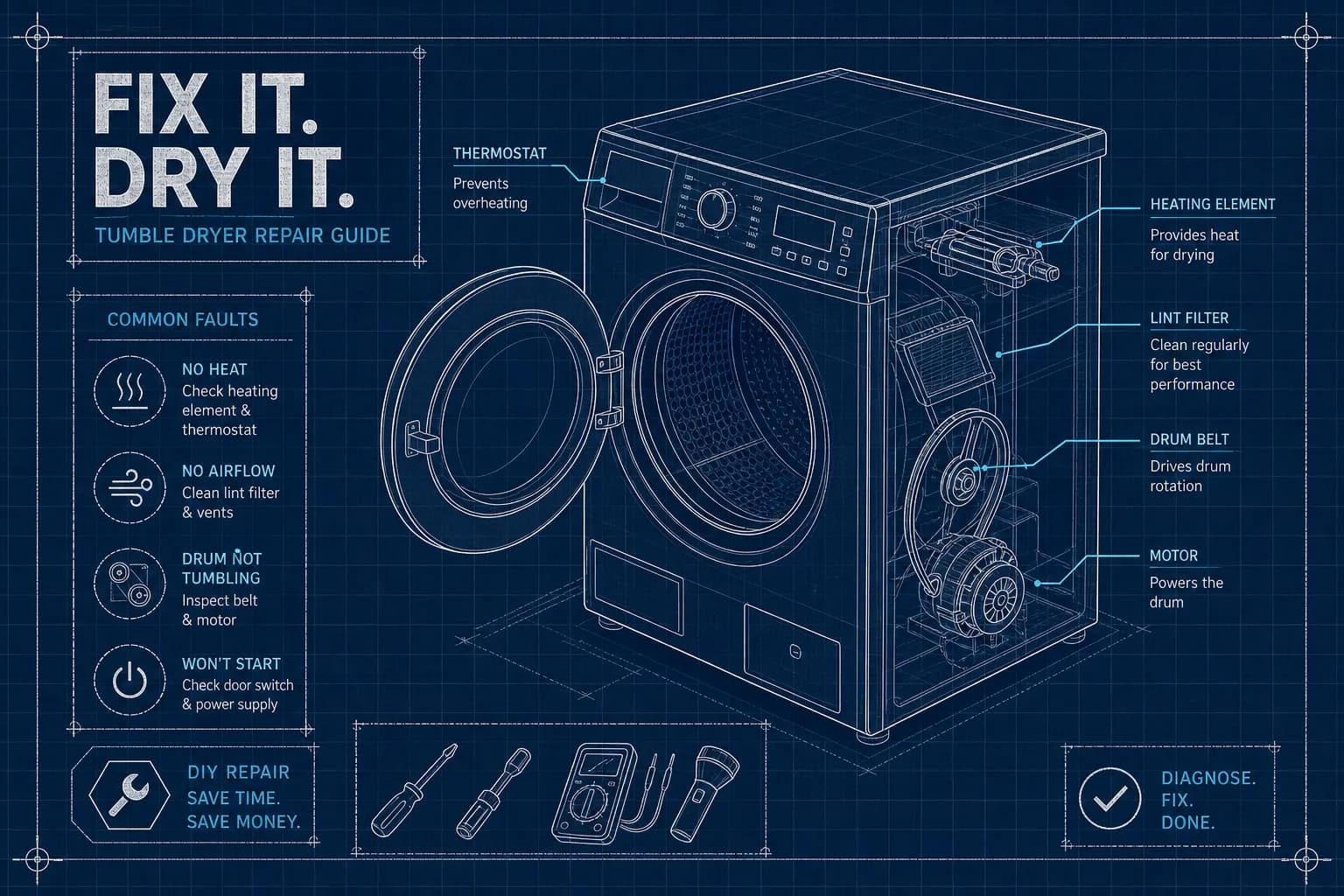
Most tumble dryer problems announce themselves through one of five symptoms: no heat, drum not turning, excessive noise, slow drying, or a tripped circuit breaker. Each symptom points toward a different area of the machine, which is why understanding the pattern behind the fault saves you from unnecessary part swaps.
Tumble dryer not heating but the drum keeps turning
When the drum turns but the clothes come out cold and damp, the most likely culprits are a failed heating element, a tripped thermal fuse, or a thermostat cut-out that has triggered due to blocked airflow. Some machines have a resettable safety cut-out button, often found on the rear panel of many models, check your model's manual for the exact location, which restores heat when pressed. If pressing it brings heat back temporarily but the problem returns, the cut-out is tripping repeatedly, which almost always points to restricted airflow rather than a failed component. Address the airflow first before replacing any parts.
Drum not turning at all
There are two distinct scenarios here, and they point to different faults. If you can hear the motor running but the drum stays still, a snapped drive belt is the most likely explanation. If the machine won't start tumbling at all, the fault is more likely a faulty door switch or a failed motor capacitor. Drive belt failure is one of the most common causes of this symptom, and replacing the belt is generally within reach of someone with basic mechanical confidence, the right tools, and a copy of the service guide for their model, provided the machine is safely isolated first.
Noisy operation, slow drying and tripped breakers
A rattling or thumping noise while the drum turns usually means a foreign object (coins, buttons, a hair clip) is loose inside, or worn drum rollers and bearings are failing. Slow drying, where clothes need two or three cycles to feel properly dry, almost always points to restricted airflow somewhere in the system. A tripped breaker is a different matter entirely: it often suggests fluff or moisture has reached electrical components, and it should not be ignored or simply reset without investigating further.
Fixing a tumble dryer by type: vented, condenser and heat-pump
The type of dryer you own determines where you start looking. The fault may be identical in symptom but completely different in cause depending on how your machine handles moisture.
Vented dryers: follow the airflow path first
On a vented dryer, the full exhaust route is your diagnostic priority. Start at the lint filter, then follow the vent hose from the machine to the exterior outlet, checking for kinks, crushes, or a flap that isn't opening properly. A blocked or partially collapsed hose is one of the most common reasons a vented dryer produces heat but dries poorly. Before assuming the heating element has failed, check the entire duct path.
Condenser and heat-pump dryers: water and airflow work together
Condenser dryers manage moisture internally, so the diagnostic checks extend beyond the lint filter. The condenser unit itself needs rinsing rather than just wiping, as lint compacts inside it over time. Also check the water tank, drain hose, and float switch. A full or partially blocked water-removal system is a regular cause of poor drying performance on condenser models.
Heat-pump dryers are especially sensitive to airflow restriction, and their dryer troubleshooting process follows a similar path. However, if there is genuinely no heat after clearing every filter and cleaning the heat exchanger, the fault may lie in the compressor or refrigerant circuit. Under UK fluorinated greenhouse gas (F-gas) rules, refrigerant handling is a regulated activity that requires a qualified technician. This is not DIY territory. Full stop.
Safe DIY checks before fixing a tumble dryer yourself
Before opening any panel, the most important step is to unplug the dryer at the wall socket. Switching off at the control panel is not sufficient: the machine can still hold live voltage at internal components. Once it is unplugged, move it away from the wall, take photos of any wiring before disconnecting anything, and keep screws organised in small labelled containers during disassembly. You will need:
- A Phillips screwdriver
- A Torx screwdriver (common on modern machines)
- Pliers
- A torch for seeing inside the cabinet
- A multimeter for electrical testing
Checking the lint filter, condenser and drive belt
Start with the lint filter. Cleaning a clogged filter often clears slow-drying and overheating faults at zero cost and in just a few minutes. On condenser models, remove and rinse the condenser unit under a tap, allow it to dry, and refit it. These two steps alone clear many faults before any parts are touched.
To inspect the drive belt, remove the access panel as described in your model's service guide. A snapped belt will be immediately visible, often sitting loose at the bottom of the drum cavity rather than running around the drum and motor pulley.
For a dryer that won't start at all, use a multimeter to test the door switch for continuity. Press the latch manually while probing the switch terminals. A switch that doesn't change state when the latch is engaged is almost certainly the cause of the no-start fault. This is a straightforward test that can save you ordering parts you don't need.
Parts, tools and what tumble dryer repair realistically costs in the UK
Knowing what parts cost before you commit to a repair helps you decide whether fixing the machine makes financial sense, especially on older appliances.
Typical UK part prices to budget for
Drive belts for most common brands fall between £8 and £16. Heating elements typically run from £10 to £37. Thermal fuses and thermostats are usually £5 to £20, and drum rollers or bearings are generally £5 to £15. These are the parts most likely to need replacing, and all of them sit within a sensible budget for DIY repair.
More complex assemblies require a different calculation. Control boards, motor assemblies, and condenser units can reach £40 to well over £100. At that price point, the age of the appliance matters: repairing a seven-year-old mid-range dryer with a £90 control board may not be the best use of money compared to a replacement.
For sourcing parts, always locate your model number from the appliance's rating label before ordering. Reliable UK suppliers include eSpares, Ransom Spares, PartsCentre, and official brand stores such as Bosch UK and Hotpoint UK. Use the manufacturer part number or PNC code from the rating plate to confirm compatibility before you order.
How long DIY repairs take vs. a professional visit
A lint filter clean or drive belt inspection takes under 30 minutes. Replacing a belt or thermal fuse with the part already in hand typically takes one to two hours for someone doing it for the first time. Professional engineers in London and the South East typically charge a call-out fee of around £60 to £150 and a labour rate of approximately £60 to £100 per hour. Most common repairs settle in the £80 to £200 range for parts and labour combined, depending on the fault and the engineer's travel costs.
When DIY puts your warranty and safety at risk
There are clear boundaries between what is safe to attempt and what is not. Crossing them can mean more than a botched repair.
The faults you should not attempt without professional help
Any fault pointing to the compressor or refrigerant circuit on a heat-pump dryer must be handled by a qualified engineer with F-gas certification. This is a legal requirement in the UK, not a recommendation. Similarly, if you see burnt wiring, smell burning, notice the machine arcing, or if the circuit breaker trips repeatedly, stop immediately. These are safety issues, and continuing to probe the machine without professional assessment puts you at risk.
Error codes on modern Bosch, Miele, Samsung or AEG dryers that relate to the control board, motor driver, or sensor array typically require manufacturer diagnostic tools to interpret accurately. For Bosch dryers, codes such as E08, E09, E24, E25, and E90 all point to electronics faults. Codes in this category are not resolvable through standard home checks.
How unauthorised repairs affect your warranty
Many manufacturer warranties include a clause that may void coverage if the appliance has been opened or repaired by an unqualified person, though the precise impact depends on the warranty wording and whether any DIY action caused further damage. It is worth reading your warranty terms carefully before proceeding. Under UK consumer law, your statutory rights under the Consumer Rights Act sit separately from a manufacturer's guarantee, but if a DIY repair causes further damage, those rights may also be weakened.
For landlords, this matters doubly. An appliance repaired without a documented service record can create compliance gaps in a rental property. A documented report from a qualified engineer helps with compliance and provides the paper trail a landlord needs for tenant records.
When a certified engineer is the smarter call
There is a point in every repair where honest assessment matters more than persistence. Knowing when to hand over to a professional is part of good maintenance practice, not a failure.
What a first-visit professional diagnosis looks like
A certified tumble dryer engineer arrives with a van stocked for the most frequent faults. Belt replacement, heating element swaps, thermostat testing, and door switch repairs are typically diagnosed and resolved on the same visit without a return trip. At Alpha Appliances, every repair is quoted at a fixed price before any work begins, no surprise invoices, and no estimate that doubles once the engineer is already in your home.
Booking a repair and knowing what to expect
Booking with Alpha Appliances takes just a few minutes online. The engineer arrives in the agreed slot, diagnoses the fault honestly, and only proceeds once the cost is agreed. If the repair is not worth doing given the appliance's age or the cost of the part required, you will be told that clearly rather than pushed into an unnecessary fix. For an appliance as central to daily life as a tumble dryer, that transparency matters more than headline call-out rates.
The diagnosis in summary
When fixing a tumble dryer, always start with the lint filter and airflow path, most slow-drying faults resolve here at no cost. If the drum is not turning, inspect the drive belt visually and test the door switch with a multimeter before ordering anything. Test thermostats and thermal fuses for continuity before replacing them, and work methodically through simple checks before moving to component replacement.
Be honest about your limits. Heat-pump refrigerant faults, burnt wiring, persistent error codes, and repeated breaker trips sit outside safe DIY territory. Pushing past that boundary risks both safety and warranty coverage, and in some cases creates a legal issue where a regulated activity is concerned.
If the fault is beyond a basic check, if the machine is still under warranty, or if you simply want it fixed correctly the first time, get in touch with the Alpha Appliances team. Book online, get a confirmed slot, and have a certified engineer diagnose and fix your tumble dryer on a fixed-price basis, no guesswork, no surprises.
Need a repair today?
Book a visit from a certified Alpha engineer in minutes.