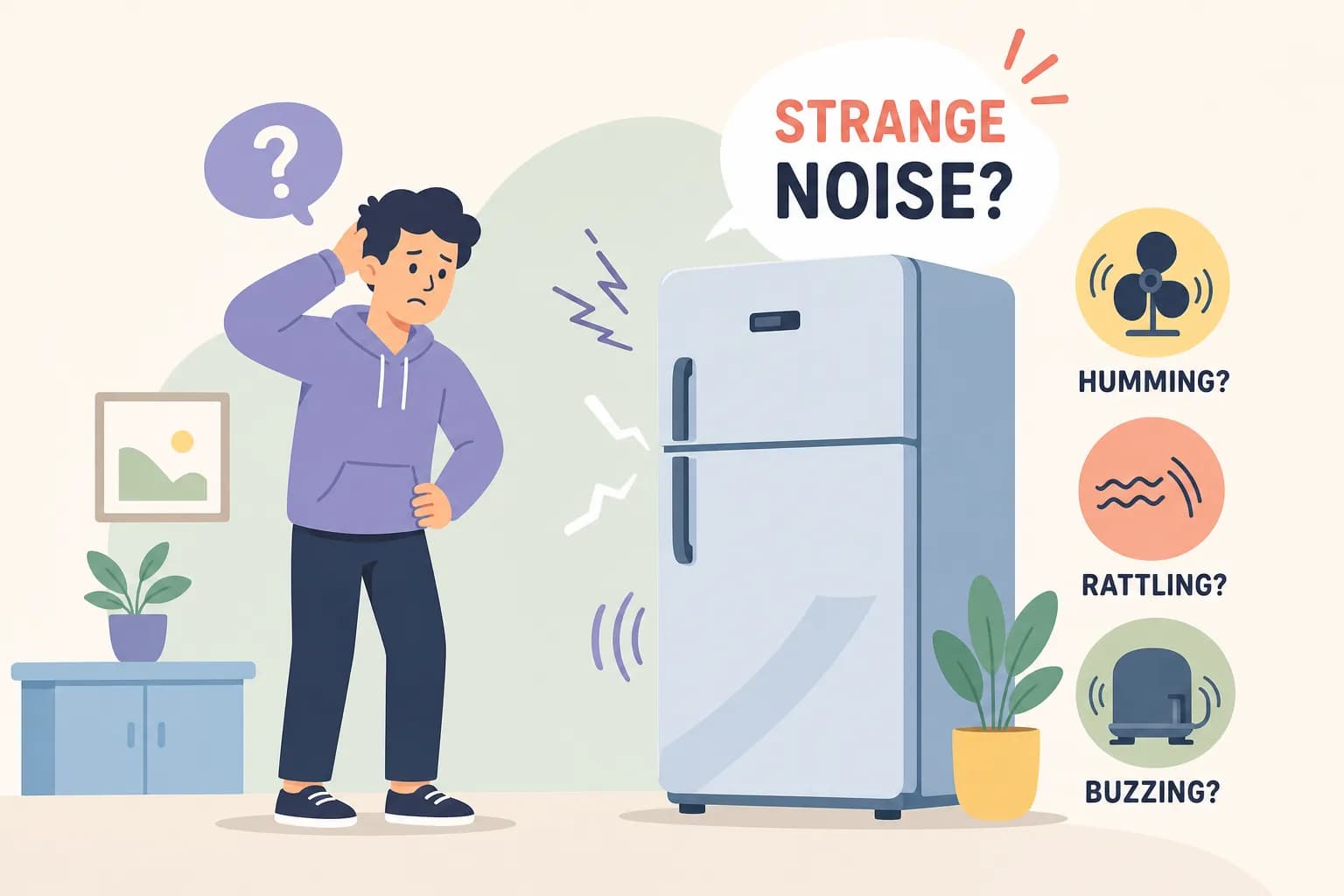
Discover why your fridge is making a strange noise, what each sound signals, simple DIY checks, and when to call Alpha Appliances Ltd for professional repair.
It always seems to happen on a quiet evening. You're sitting in the kitchen, the house is finally calm, and then your fridge starts making a noise you've never noticed before. A strange hum. A clicking that just won't stop. Your first instinct is to wonder whether something's about to break, whether the food inside is safe, and how much this is going to cost you.
If your fridge is making noise that's new, persistent, or simply not right, you're not alone. The team at Alpha Appliances Ltd hears this concern from homeowners every week, noisy fridges are one of the most common reasons people pick up the phone. The honest answer is that most fridge sounds are harmless, part of the normal rhythm of an appliance that runs every hour of every day. But some noises genuinely are the fridge's way of waving a red flag, and knowing the difference could save you a significant amount of money and worry.
This guide walks you through exactly what each sound means, what you can safely check yourself, and when it's time to call in a professional. No scaremongering, no jargon. Just practical, honest advice.
Before you start worrying, it helps to understand what a fridge is actually doing all day. It's a mechanical appliance running a continuous cooling cycle, with a compressor, fans, and refrigerant all working together. Background noise is simply part of the deal. The problem is that most people have never been told what "normal" actually sounds like, so any new sound can feel alarming.
A steady, low hum is the compressor doing its job. You'll hear it in virtually every fridge, and it tends to come and go as the cooling cycle runs. A faint bubbling or gurgling sound is refrigerant moving through the system, which is completely standard. For context, a typical domestic fridge runs at roughly 32 to 47 decibels, around the same level as a quiet library. If it's not much louder than a gentle background hum, it's almost certainly fine.
Your fridge has a built-in defrost cycle that runs periodically, and it creates its own set of sounds. A click when the compressor starts or stops is normal. Hissing and popping during defrost are standard too, caused by frost melting and water draining away. Keep in mind the difference between sounds that are occasional and brief versus sounds that are persistent and getting worse. That distinction matters a great deal when you're deciding whether to act.
So you've heard something that doesn't match the normal baseline. Maybe it started recently, or maybe it's a sound you've never noticed before. Here's what the most common noises indicate, starting with the least worrying and working up.
There's a clear difference between the soft hum of a working compressor and a louder, more insistent drone that seems to have appeared out of nowhere. Louder-than-usual humming often means the compressor is working harder than it should be, usually because the condenser coils are clogged with dust and restricting airflow. A struggling fan motor can cause the same thing. If the humming has become noticeably louder and your food isn't staying as cold as it should, treat that combination as a real signal worth investigating promptly. If you want practical steps to troubleshoot a noisy unit, a manufacturer's guide on how to fix a noisy refrigerator can be a useful reference.
A buzzing sound most often comes from a fan motor working against ice buildup around the evaporator coils, or from a fan blade catching on frost or debris. It can also come from an ice maker solenoid or auger motor if your fridge has one. There's a useful test you can do right now: open the freezer door and listen to whether the buzzing changes or stops. If it does, the evaporator fan is the most likely source. That's genuinely helpful information before you do anything else. For additional repair pointers and common causes of noisy fridges, a general repair guide such as the one at Fix.com's noisy refrigerator advice can help you narrow down possibilities.
A single click when the compressor starts or stops is completely normal, as explained above. The noise that deserves attention is repeated clicking that doesn't settle, particularly if it sounds as though the fridge is trying to start and failing. This pattern can indicate a worn compressor start relay, which is a small component but an important one. A compressor that's struggling to get going will keep trying and clicking until it either succeeds or fails entirely, so don't ignore this one.
Rattling is by far the most frequent noisy fridge complaint, and it's also the most likely to have a straightforward fix. Loose shelves, an unsecured drain pan, items stored on top of the fridge, or the unit not sitting level on the floor are all common culprits. Before you assume the worst, rattling is worth investigating yourself, in many cases it costs nothing to resolve and takes about ten minutes.
These checks are safe for any homeowner to carry out without specialist tools or technical knowledge. The rule is simple: if a check requires opening a sealed component, testing electrical parts, or removing a fixed service panel, it's outside DIY territory. Always unplug the fridge before touching anything mechanical.
Place a spirit level on top of the unit. If it's not sitting evenly, adjust the front levelling feet until it is stable and not rocking. Even a slight tilt can cause the compressor and fans to work harder and vibrate more than they should. If the fridge sits on a hard floor such as tile or laminate, rubber vibration pads under the feet can make a surprisingly noticeable difference to the noise level in the room.
Open the fridge and check that all shelves, door bins, and the ice bucket are properly seated and not loose. Pull the fridge slightly away from the wall and check whether any accessible rear cover or lower trim panel is vibrating against the cabinet. Also check that the fridge isn't pressing against adjacent cabinetry or a wall, even slight contact can transmit vibration and create rattling sounds throughout the kitchen.
Dust-clogged condenser coils force the compressor to work harder, making it run louder and less efficiently. For most homes, an annual clean is sufficient. In households with pets that shed, or in dusty kitchens, cleaning every three to six months is better. To do it safely: unplug the fridge first, locate the coils at the back or base of the unit, and use a vacuum with a brush attachment or a soft coil brush to remove the dust. Clear any visible debris from the fan area too. Don't bend the fins, and don't disturb any wiring near the coils. If you need step-by-step manufacturer's guidance on how and when to safely clean the condenser coils, the official advice is worth following.
If the checks above haven't changed anything, or if the sound matches one of the following descriptions, the problem is likely internal. These are not situations where further DIY investigation helps. Trying to go deeper without the right training and tools tends to make things worse and more expensive.
A healthy compressor cycles on and off throughout the day. One that runs continuously, especially when paired with a loud hum and food that isn't staying cold, is one of the clearest signs of compressor failure or a refrigerant issue. This fault doesn't resolve itself. Leaving it means spoiled food, a higher electricity bill, and a repair bill that only grows over time. For technicians and experienced owners, a troubleshooting resource about a compressor running but not cooling can offer useful diagnostic pointers, but this type of fault typically needs a certified engineer.
If clearing the fan area doesn't stop a persistent buzzing or grinding sound, the fan motor itself is likely failing. Both the evaporator fan (inside the freezer compartment) and the condenser fan (at the rear of the unit) are replaceable components, but accessing them correctly requires a technician. The evaporator fan in particular is housed behind a sealed panel, and disturbing the defrost system components incorrectly can create a secondary fault.
A knocking or vibrating sound coming from the rear lower section of the fridge, particularly during startup, can point to loose or failing compressor mounts. This is distinct from a loose drain pan or shelf rattle. If the sound is clearly coming from the compressor itself rather than from anything you can see or touch, it needs a professional assessment. Compressor faults don't improve on their own.
Some faults are genuinely difficult to diagnose without training and the right equipment. A noise that sounds like a rattle might actually be a compressor vibrating through the cabinet. A hum you've assumed is normal might be a compressor that's been struggling for weeks. Getting the diagnosis wrong means either paying for a part you didn't need or missing a fault that gets more serious and more expensive with every passing day.
There are clear moments when it's time to stop troubleshooting and book an engineer. If two or more of the following apply, don't wait:
At Alpha Appliances Ltd, our City & Guilds certified engineers carry out a precise fault diagnosis before any part is ordered, no guesswork, no unnecessary costs. We cover Greater London and across the South of England, including Surrey, Berkshire, Hampshire, and Dorset, with same-day and next-day appointment availability for urgent situations. We also serve central local areas such as London Bridge | Appliance Repairs.
Every repair is fixed-price and quoted upfront, so you know exactly what you're committing to before any work begins. With a 78% first-time fix rate across more than 20,000 completed repairs, our engineers have seen virtually every fridge fault there is and know how to find the source of a noise quickly and accurately. We regularly respond to calls from customers across north and east London, including Ponders End | Appliance Repairs.
The good news is that the vast majority of fridge noises have a straightforward cause and a straightforward fix. A rattle is usually something loose. A hum is usually the compressor doing its job. A buzz often points to ice or a fan that needs attention. Start with the safe checks in this guide and you'll either solve the problem yourself or arrive at a much clearer picture of what's actually wrong.
The noises that don't have a simple explanation are worth catching early. A fridge that's failing quietly in the background will eventually fail loudly at the worst possible moment, usually when it's full of food and you're heading out for the weekend. If something still sounds wrong after working through this guide, trust that instinct.
If your fridge is still making noise after these checks, you can book a diagnostic visit with Alpha Appliances Ltd online in four simple steps, with no obligation and no hidden call-out fees. Sometimes a fridge just needs someone who knows what they're listening for. For local homeowners seeking a reliable in-home visit, our Hacton Appliance Services to Resolve Your Issues page explains how our booking and service process works.
Book a visit from a certified Alpha engineer in minutes.
TRUSTED BY HOMEOWNERS
Fast, reliable, and warranty-backed repairs for every major brand.
Discover more tips from Alpha engineers.