
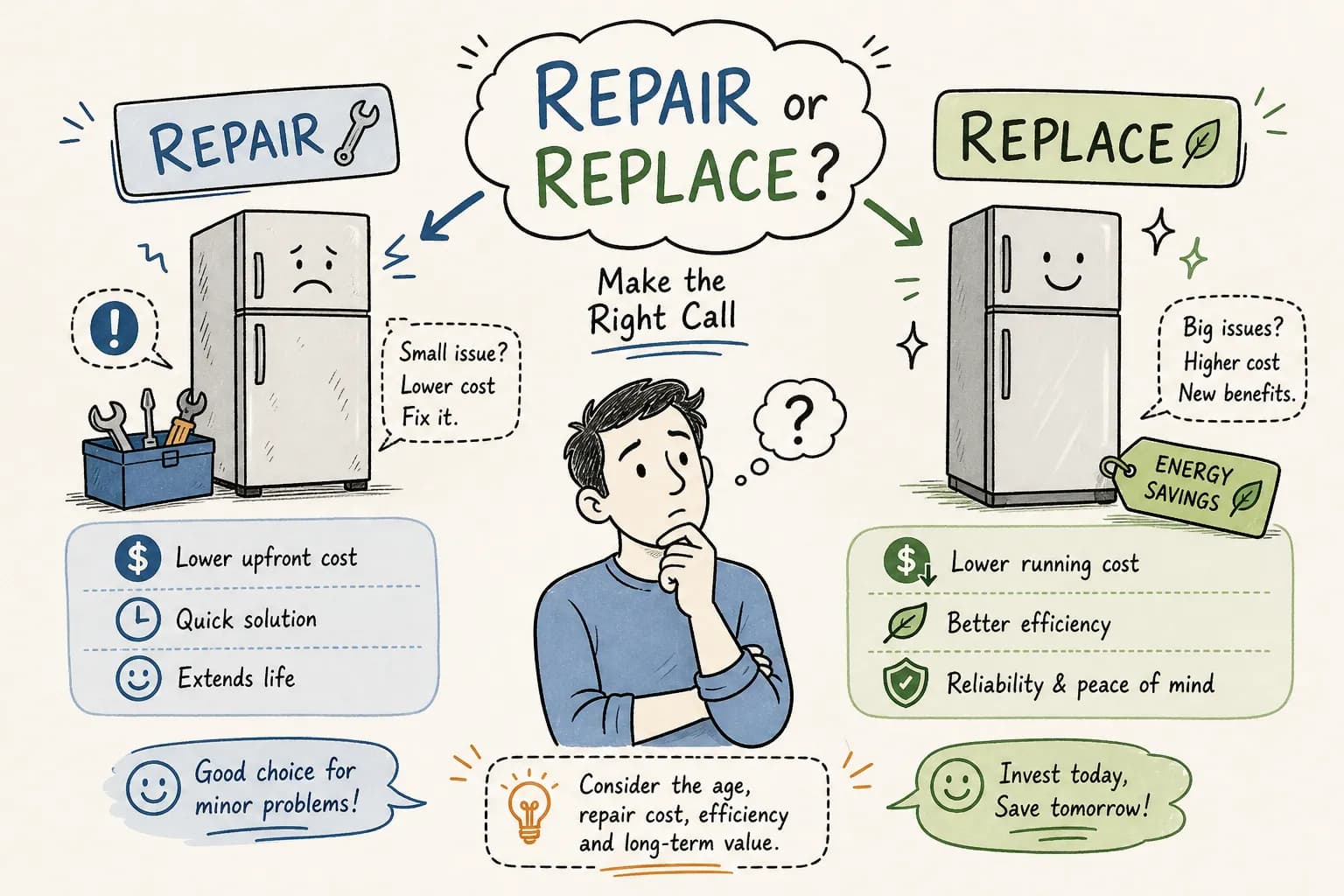
Fridge Repair vs Replacement: How to Make the Right Call
Is it worth repairing a fridge or buying a new one? It is the question every homeowner faces when the fridge starts running warm, a strange gurgling noise comes from the back, the leftovers in the salad drawer are not quite cold, and somewhere in the kitchen a growing pile of food is becoming questionable. It is a stressful situation, and the answer is rarely obvious at first glance.
This guide walks through the exact factors that matter: fault type, realistic UK repair costs, fridge age, energy savings, and brand reliability. Before you commit to either path, the smartest first move is getting a transparent, fixed-price diagnostic from a certified engineer. That single step transforms an emotional, gut-feel decision into a straightforward financial one. Without a real repair figure in hand, you are comparing a guess against a known replacement price, and that is not a fair comparison.
Work through the sections below in order and you will arrive at a clear answer, not just a feeling.
Run this quick fridge troubleshooting checklist before you do anything else
Not every fridge fault is a crisis. A warm fridge can mean a blocked drain, a failing thermostat, or a compressor on its way out, three very different problems with very different costs. Identifying where your fault sits on that spectrum is the first useful thing you can do before picking up the phone.
What a minor fault looks like
If the fridge section is too warm but the freezer is still working properly, the most likely culprits are the thermostat or the evaporator fan. A pool of water under the salad drawer usually points to a blocked defrost drain, a common and often inexpensive fix. A fridge that is noisier than usual but still cooling reliably may have a fan motor beginning to fail. These are real faults, but they are the kind a certified engineer can typically resolve at a reasonable cost without replacing the appliance.
Warning signs the fridge is in serious decline
Some fault patterns signal deeper trouble and raise the appliance repair vs new fridge question seriously. If the compressor is running continuously but the fridge is still not reaching the right temperature, the sealed system may be compromised. Excessive frost building up on the back wall of the fridge section, or an unusual burning smell, both warrant careful thought before spending money on a repair. Around the 10-year mark, a second significant fault within a short period is a further signal that the machine may be approaching the end of its economic life, research consistently points to 10 years as the crossover point at which major repairs become harder to justify.
Why a professional diagnosis beats a symptom search
The problem with diagnosing fridge faults from search results is that the same symptom, say, a warm fridge, can point to a £90 thermostat job or a £400 compressor repair. Without a proper assessment, you are working with imaginary cost figures. A fixed-price diagnostic from a certified engineer gives you an actual repair figure to work with before you make any decision. That figure anchors every other calculation in this guide.
What fridge repairs actually cost in the UK
Knowing realistic UK repair costs before applying any decision rule makes the rest of this guide far more useful. Costs vary by fault, brand, part availability, and location, but the ranges below give a solid working basis for most households.
Common faults and their typical UK price ranges
These figures cover parts and labour combined, based on current UK repair market data:
- Thermostat replacement: £60 to £180
- Fan motor replacement: £120 to £250
- Compressor repair or replacement: £180 to £480
- Refrigerant leak and regas: £180 to £350
- Blocked drain or minor leak: £80 to £150
Treat these as starting points rather than fixed quotes. Premium brands, older parts, and London postcodes all push costs toward the upper end of these ranges. A manufacturer-trained technician sourcing genuine parts for a Miele or Bosch appliance will price differently from a generalist working on a budget own-brand model.
Call-out fees and labour rates to factor in
Most appliance repair engineers charge a call-out or diagnostic fee of £50 to £125, on top of labour running at roughly £40 to £80 per hour across the UK. London and the South East typically sit at the upper end of that range, often 10 to 30% above the national average. Some engineers include the diagnostic cost within the first hour of labour if the job proceeds; others charge it separately. Knowing this in advance means you can budget accurately and compare quotes on a like-for-like basis.
When the quote changes the decision entirely
A compressor repair at £350 on a 12-year-old fridge is a very different proposition from the same fault on a 4-year-old premium appliance that still has a decade of useful life ahead. The fault type and the repair cost together are only part of the picture. Age and replacement cost complete it, and the next two sections deal with exactly that.
Is it worth repairing a refrigerator or buying a new one? The 50% rule explained
Once you have a real repair quote, there is a simple and widely used benchmark that cuts through most of the uncertainty. It is called the 50% rule, and it gives you a concrete number to compare against rather than a vague sense of whether the repair feels expensive.
How the 50% rule works
If the repair costs more than 50% of the price of a comparable new fridge, replacement is generally the better financial decision. If it costs less than 50%, repair is usually worth proceeding with. UK consumer guidance consistently references this threshold as a practical heuristic, not a legal rule, but a reliable anchor point when the numbers feel unclear. It works because it forces you to compare the repair cost against what you would actually spend to solve the problem permanently.
Applying it to a real fridge scenario
A mid-range freestanding fridge freezer in the UK costs roughly £400 to £800 in 2026. Using £550 as a midpoint, the 50% threshold sits at £275. A thermostat repair at £130 clears that threshold comfortably: repair makes sense. A compressor repair at £400 does not: replacement becomes the stronger financial case. The rule collapses a vague cost-benefit exercise into a single, concrete comparison.
Why age adjusts the threshold downward
The 50% rule assumes the appliance still has a reasonable lifespan ahead. A 10-year-old fridge changes the maths, because the probability of another significant fault within the next 12 to 18 months rises sharply with age. For an older machine, it is reasonable to apply a stricter threshold, as a rough heuristic, some engineers suggest comparing the repair cost against 30 to 40% of replacement cost rather than 50%, to account for the compounding risk of further failures on ageing components. Treat that as a conservative guide rather than a fixed rule.
How fridge age changes the calculation
Age is not just one variable among many. It is a multiplier on every other risk factor in this decision, and it is the single most common reason a repair that looks affordable on paper still turns out to be the wrong financial choice.
The average UK fridge lifespan and what it means
A household fridge in the UK typically lasts 10 to 15 years, with the average sitting around 10 to 13 years depending on brand and usage patterns. Under seven to eight years old, most faults are worth repairing: the appliance has substantial life ahead, parts are generally available, and repair costs are proportionate. Around the 10-year mark, the calculation shifts. Components wear out, parts become harder to source, and labour costs per repair rise because more is often disturbed to reach the failed part.
The 10-year crossover point
At roughly 10 years old, a fridge facing a major repair, such as a compressor replacement, refrigerant regas, or control board fault, is often better replaced than fixed. A successful repair does not reset the clock on the other ageing components around it. Minor repairs on a 10-year-old fridge, a door seal, a thermostat, a drain clear, are still reasonable. Major repairs on the same machine are harder to justify. Age is not a dealbreaker in isolation, but it significantly raises the bar that a repair quote needs to clear.
Brands that hold up longer
Appliance reliability varies meaningfully by manufacturer. Miele and Bosch typically offer longer reliable lifespans than budget-tier appliances, and manufacturer-trained engineers are better placed to source genuine parts for premium brands when repairs are needed. A 12-year-old Miele fridge may still represent a stronger repair candidate than a 7-year-old budget supermarket model built to a lower specification. Brand matters to the lifespan conversation, and it should factor into your repair threshold calculation accordingly.
The hidden cost of running an old fridge
Energy efficiency is the factor most homeowners overlook when weighing up repair against replacement, yet it can genuinely shift the decision when repair costs are hovering close to the threshold.
How much energy an older fridge actually uses
A fridge that is 10 or more years old typically uses 300 to 400 kWh per year, with some older models consuming up to 450 kWh annually. A modern, highly efficient fridge, rated A+++ under the previous EU labelling scheme or equivalent under current UK labelling, uses approximately 150 kWh per year. At the current UK electricity unit rate of around 26 pence per kWh (based on the Ofgem price cap for the period 1 July to 30 September 2026), that gap represents a meaningful, ongoing difference in your electricity bill.
Estimating your potential annual saving
The annual electricity saving from replacing a 10-year-old fridge with a modern, efficient model sits roughly between £40 and £65 per year. Over five years, that is £200 to £325 back in your pocket, before factoring in any improvement in reliability or the avoidance of future repair bills. On its own, this figure does not force a replacement decision, but it is a genuine financial factor that belongs in the calculation, not an afterthought.
When energy savings change the outcome
If the repair quote is sitting at 40 to 50% of replacement cost and the fridge is already nine to ten years old, factor energy savings in directly. A replacement that costs £200 more than the repair could recover that difference in electricity savings within four to five years, and then deliver another decade of reliable, efficient service. This is the scenario where the energy argument genuinely changes the right answer. It is also worth noting that newer appliances typically come with a two-year manufacturer warranty as standard, adding a further layer of financial protection in the early years.
Making the call: repair or replace your fridge?
You now have four clear variables: repair cost, fridge age, the 50% threshold, and the energy saving factor. Here is how they come together in practice.
When repair is clearly the right answer
Repair makes strong financial sense when the fridge is under eight years old, the fault is a thermostat, fan motor, or door seal, and the repair quote comes in well under 50% of the cost of a comparable new appliance, with some guidance suggesting under 40% as a conservative target for those wanting more headroom. In this scenario, repairing
saves money, preserves a working appliance, and avoids the environmental cost and inconvenience of disposal and delivery.
When replacement makes more financial sense
Replacement becomes the stronger call when the fridge is 10 years old or more, the fault is a compressor or refrigerant issue, the repair quote exceeds 50% of new-fridge cost, and the appliance is not a premium brand with a well-documented longer lifespan. At that point, you are funding a temporary fix on a machine with ageing components throughout. The energy savings from a new, highly efficient model will begin offsetting the replacement cost within a few years, and research on appliance lifespans suggests a well-chosen replacement significantly reduces the likelihood of further major repairs in the short to medium term.
Get the diagnosis before you decide anything
The single most important first step is getting an accurate repair quote from a certified engineer, not an estimate built on a symptom search or a neighbour's experience with a different brand. Alpha Appliances Ltd offers fixed-price, transparent diagnostics across London, Berkshire, Surrey, Hampshire, and Dorset, with every assessment carried out by a qualified engineer who provides a clear repair cost upfront. That figure is what makes the 50% rule work. Without it, you are making a financial decision based on guesswork, and that is rarely the cheapest way to resolve anything.
The bottom line
Four variables drive this decision: your repair quote, your fridge's age, the 50% cost threshold, and the long-term energy saving from a modern replacement. None of these works in isolation, but together they give a reliable answer in most cases. When the numbers point clearly to repair, book it and get it done properly. When they point to replacement, start shopping with confidence rather than guilt.
Whether it is worth repairing a refrigerator or buying a new one comes down to a single starting point: a firm, honest diagnostic figure. Everything else in this guide flows from that number. Book a fixed-price assessment with Alpha Appliances Ltd, get the real cost in writing, and then apply the framework above. You will have your answer within the hour.
Frequently asked questions
Is it worth repairing a refrigerator or buying a new one in the UK?
In most cases, repair makes sense if the fridge is under eight years old and the repair quote comes in below 50% of the cost of a comparable new appliance. If the machine is over 10 years old and facing a major fault such as a compressor failure, replacement is often the more cost-effective long-term choice.
How much does it cost to fix a fridge in the UK?
Fridge repair costs in the UK typically range from £60 to £480 depending on the fault, with call-out fees of £50 to £125 on top. A thermostat replacement sits toward the lower end; a compressor repair or refrigerant regas sits toward the upper end. London and the South East generally attract higher rates.
How long do fridges last in the UK?
Most household fridges last between 10 and 15 years, with the average sitting around 10 to 13 years. Premium brands such as Miele and Bosch often exceed this range; budget appliances tend to reach the lower end of it.
What is the 50% rule for appliance repair?
The 50% rule states that if a repair costs more than half the price of a comparable new appliance, replacement is generally the better financial decision. It is a widely used heuristic in UK consumer guidance and provides a straightforward benchmark when weighing up fridge repair cost against buying new.
Need a repair today?
Book a visit from a certified Alpha engineer in minutes.