Fix common Samsung fridge freezer faults yourself: safe DIY checks, signs that need a pro, typical UK repair costs in 2026, and booking questions.
A warm fridge or a puddle spreading across your kitchen floor demands immediate attention, especially when you have food at risk. The good news is that most Samsung fridge freezer faults fall into a small handful of categories, and a surprising number can be resolved without anyone coming through your front door. Many owners call out an engineer before trying the obvious checks first, a straightforward waste that this guide helps you avoid.
What follows covers the four most common Samsung fridge freezer faults and their causes, safe DIY steps to try before you book anyone, a clear comparison of authorised Samsung repair versus a local engineer, what UK repair typically costs in 2026, and the questions that protect you before you confirm a booking. Read the relevant section for your situation and skip the rest.
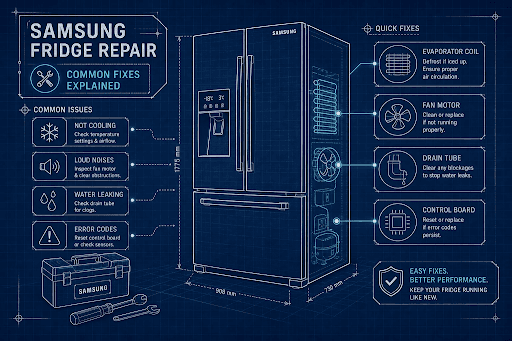
Getting to grips with the most common faults means you can self-diagnose before spending anything. Samsung fridge freezers share a consistent set of recurring issues across their range, and knowing which category your problem falls into points you toward the right fix.
A common cause of a Samsung fridge not cooling is something surprisingly simple: Cooling Off Mode being activated accidentally, perhaps by a child pressing the control panel or a button being held during cleaning. Beyond that, blocked internal vents restrict airflow and prevent the unit from maintaining temperature. Frost buildup around the evaporator is another frequent culprit, particularly in models a few years old. A failing compressor is the worst-case scenario and the most expensive, but it is also the least common cause of mild cooling issues.
Samsung's display codes can help narrow things down quickly. The code OF OF or O FF confirms the unit is in Cooling Off/Demo Mode rather than broken. Codes like 5E or SE point to a defrost or temperature sensor fault, while 83E, 85E, and 86E all relate to the compressor and need professional attention.
Internal leaks near the salad drawer are commonly caused by a blocked defrost drain. As the unit runs its defrost cycle, meltwater that cannot drain properly pools at the base of the fridge compartment instead. On American-style Samsung models with ice makers, a loose or kinked water supply line behind the unit is the other common source. Levelling is worth checking too: a unit that tilts forward slightly can disrupt drainage and cause water to collect where it should not.
A scraping or vibrating noise from the rear of the freezer compartment is a well-documented Samsung fridge issue caused by frost accumulating on the evaporator fan blades. As the frost builds up, the blades clip against it on each rotation. Before assuming a mechanical fault, also check whether items stored in the fridge are touching the back wall and whether any loose shelving or fittings are vibrating with the compressor cycle. In practice, these minor causes are responsible for many noise complaints that initially seem like mechanical faults.
This section is worth reading carefully because it resolves a significant number of Samsung fridge freezer complaints without any cost or engineer involvement. Work through these in order before picking up the phone.
Start with the control panel. On most Samsung models, Cooling Off Mode is displayed clearly on the screen. Exiting it is a matter of pressing and holding the correct button combination. Check your model's manual for the exact sequence, as it varies between models. Once confirmed that the fridge is set to cool normally, move to the door gaskets. The paper test is straightforward: close a sheet of A4 paper in the door so half is inside and half is outside, then pull gently. If the paper slides free without resistance, the gasket is not sealing properly and needs replacing. A failing gasket is one of the most common causes of poor cooling and is a straightforward, low-cost fix.
Unplug the unit from the wall socket or switch it off at the circuit breaker and leave it for at least two minutes before restoring power, the exact recommended interval can vary by model, so check your manual if you are unsure. This clears minor electronic faults and resets the control board. If you have frost-related noise or a cooling issue, go a step further: switch the fridge off completely, open both doors, and leave it to defrost naturally for a few hours with towels laid on the floor to catch the meltwater. This single step often resolves Samsung fridge not cooling complaints, particularly on units that have been running for several years without a full defrost cycle.
Stop here if the basic checks do not resolve the issue. Anything involving refrigerant, the compressor, the control board, or internal wiring carries a genuine risk of injury or further damage. Attempting to work on refrigerant lines without the correct equipment, for instance, can result in punctured lines and a gas release, while probing a live control board risks a short circuit that turns a manageable repair into a write-off. These jobs require a qualified Samsung appliance repair service. Attempting them without the right training also affects your consumer rights if a related fault develops afterwards. For guidance on using warranties and guarantees, consult Citizens Advice on claiming under a warranty.
This is the decision that matters most for readers ready to book a repair. Both routes are legitimate; the right choice depends on your warranty status, how urgently you need the fridge back, and your budget.
If your appliance is still within its manufacturer warranty or covered by Samsung Care+, the authorised route is the correct one. Repairs through Samsung's My Repair portal use genuine parts as standard and carry a 12-month warranty on parts and labour. Using an independent engineer during the warranty period does not automatically void your statutory rights under UK consumer law, but it may give Samsung grounds to decline a warranty claim if the repair is listed as an exclusion in their terms.
To book, go to samsung.com/uk/support/repair, select your appliance type, work through the troubleshooting guide, and proceed to the booking flow. If the portal is offline, Samsung's Expert chat is the fallback. Entering your postcode on the repair page also surfaces the nearest in-store repair location. The realistic turnaround time for authorised repairs is 7 to 14 days across the UK, including collection and return. You can also consult Samsung's troubleshooting guide for model-specific display codes and basic diagnostic steps.
For out-of-warranty repairs, an independent local engineer is almost always the better option. Most offer same-day or next-day availability, attend on-site, and complete common repairs such as thermostat replacements, door seal fitting, or defrost heater work within an hour. Labour rates are generally lower than Samsung's authorised network, and for these routine faults, using non-genuine parts has a smaller impact because the manufacturer warranty is already expired. A good independent engineer will also carry common Samsung parts in the van, avoiding the need for a second visit.
Understanding the cost structure before anyone arrives protects you from overcharging and makes it easier to decide when repair tips into replacement territory.
Almost every engineer charges a call-out or diagnosis fee before any work begins, typically in the range of £60 to £150, though this will vary by region and trader. On top of that, labour runs at roughly £40 to £80 per hour. Some Samsung-authorised partners advertise all-inclusive pricing from around £90 for straightforward faults, which can represent better value than paying a separate call-out fee plus hourly labour on a simple job. Always confirm whether the call-out fee is deducted from the final repair cost or charged in addition to it, and ask for a written breakdown before work begins.
For common repairs, here is what total costs (parts and fitting combined) typically look like in the UK in 2026. A thermostat replacement usually lands between £60 and £130. Door seal or gasket replacement runs from £95 to £150. A defrost heater repair sits in the £80 to £165 range. Ice maker repairs vary considerably, from around £70 for a minor fix to £420 if the full assembly needs replacing. Compressor replacement is the point where repair versus replacement becomes a genuine conversation, with costs typically falling between £300 and £480. At that price, factoring in the age and condition of the appliance makes sense before committing.
For a broader breakdown of typical repair costs and what to expect from tradespeople, see Checkatrade's fridge repair cost guide. Going into the repair process with that cost context in place makes the whole thing considerably less stressful, you will know immediately whether a quote falls within normal range or warrants a second opinion.
Knowing the right questions before you confirm a booking protects you from call-out-fee traps, hidden charges, and unreliable traders.
Go to samsung.com/uk/support/repair, select your product category (home appliances), and use the troubleshooting guide. If a repair is still needed after the guide, proceed into the booking flow, where you will be asked about your purchase details and given the option to choose a collection date.
Samsung's courier partner collects the appliance and returns it once the repair is complete. If the online booking service is unavailable, Samsung's UK Expert chat is the direct fallback route.
Whether you are booking an authorised Samsung repair or an independent local engineer, these questions protect you before anyone arrives:
Do you offer a fixed-price quote before starting work, or will costs be confirmed after diagnosis?
Is there a warranty on parts and labour, and how long does it last? (12 months is standard from reputable traders.)
Do you use genuine Samsung parts, or compatible alternatives?
What is the likely turnaround time from first visit to completed repair?
Are you experienced with my specific Samsung model?
Genuine Samsung replacement parts are readily available in the UK and are not difficult to source. Samsung's spare-parts portal covers a wide range of fridge freezer components. Authorised retailers such as samsungspares.co.uk and BuySpares stock original components with next-day delivery on common parts, and many come with a 12-month retailer warranty, though it is worth confirming this directly with the retailer when you order.
Samsung's official portal is the most reliable starting point for confirming that a part matches your exact model number. Authorised retailers like samsungspares.co.uk carry factory-original components and can usually confirm compatibility before you order. For common parts such as door gaskets, thermostat sensors, and defrost heaters, next-day delivery is widely available. In some cases, a same-day engineer visit can be completed in a single visit if the part arrives that morning, though this depends on the engineer's schedule and whether they already carry the component.
Fitting non-genuine parts can void Samsung's manufacturer warranty on the affected component or, in some cases, the whole appliance. Genuine Samsung parts carry UKCA/CE compliance for electrical safety; non-genuine alternatives may not, and that gap in compliance limits your ability to claim under the Consumer Rights Act 2015 if a related fault develops later. For out-of-warranty repairs, the impact is smaller, but fit, reliability, and potential firmware incompatibility are still valid concerns worth weighing against the cost saving.
The decision framework is straightforward. Try the safe DIY checks first: confirm settings, test door seals, power-cycle the unit, and defrost manually if frost buildup is visible. Those steps alone resolve many Samsung fridge freezer faults without any cost. If the appliance is still under warranty, book through Samsung's My Repair portal or Expert chat and factor in a 7 to 14-day turnaround. If the warranty has expired and speed matters, a qualified local fridge freezer engineer will almost always be faster and cheaper.
Before anyone sets foot in your kitchen, ask the five questions above. A fixed-price quote, a clear guarantee on parts and labour, and confirmed experience with your Samsung model are what separate a reliable engineer from an expensive surprise.
Book a visit from a certified Alpha engineer in minutes.
TRUSTED BY HOMEOWNERS
Fast, reliable, and warranty-backed repairs for every major brand.
Discover more tips from Alpha engineers.