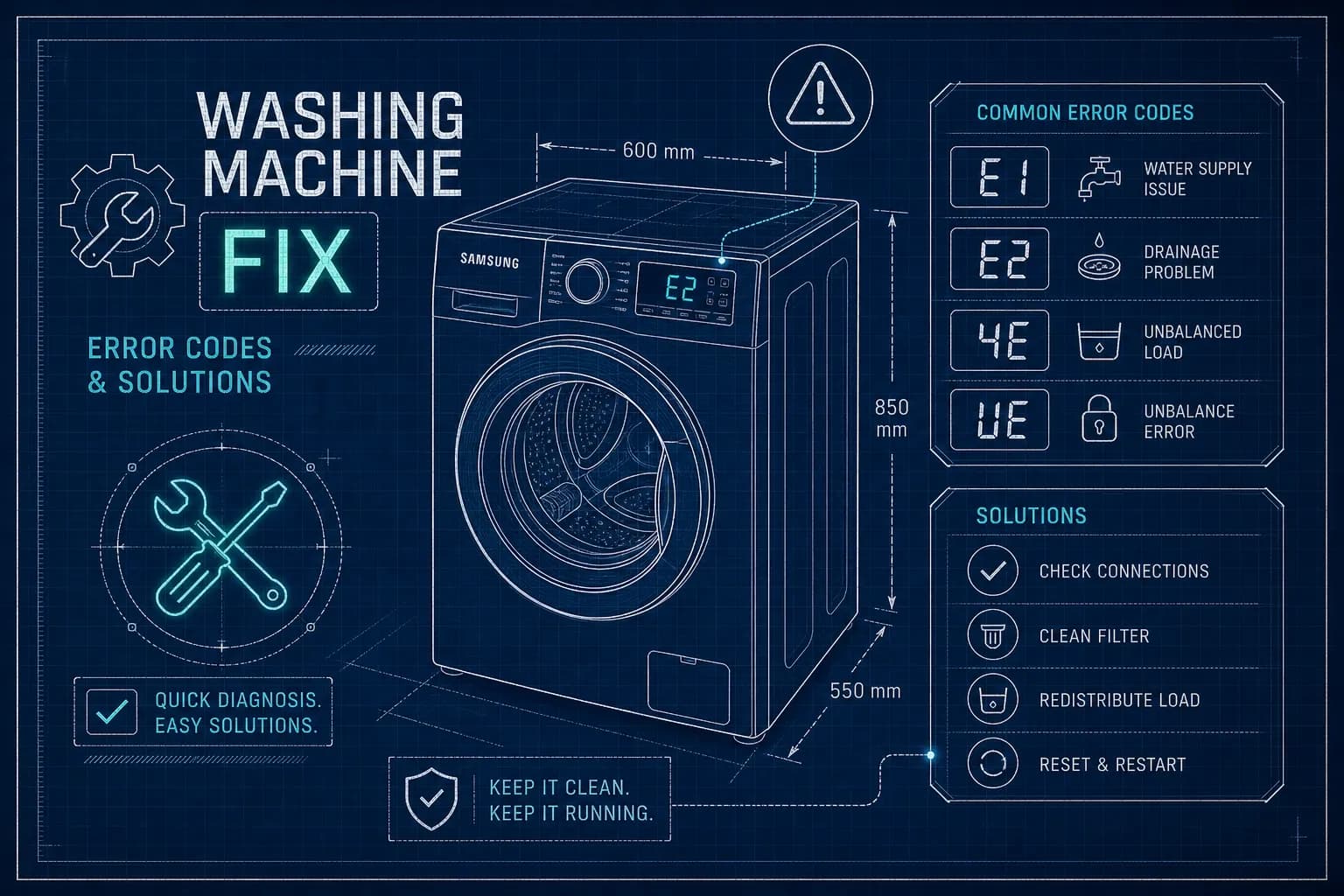
Decode Samsung washing machine error codes and learn how to fix drainage, spin and door faults safely, plus when to call a qualified engineer.
This Samsung washing machine fix guide covers the faults that appear most often on Samsung front-loaders and top-loaders: a drain error (5C or 5E), an unbalanced load (UB or UE), a door lock fault (dE or DC), or a drum that refuses to spin. The reassuring truth is that most of these faults have a safe, straightforward check you can run before spending a penny. Alpha Appliances Ltd engineers report that the majority of these call-outs resolve with a few targeted steps, not a replacement machine.
This guide walks through each fault area in order: what the error code means, what to check first, and what the fix looks like. It also covers the point at which DIY reaches its sensible limit, so you finish with a clear decision rather than a half-dismantled washer and more questions than you started with.
Samsung error codes are the machine's way of narrowing down a fault to a specific system. Rather than a vague "something is wrong," each code points to water supply, drainage, the door, load balance, or electronics. The same underlying problem can display as different codes depending on the model, which is why the machine's manual always takes priority over a generic list.
The table below covers the Samsung washer error codes you are most likely to encounter on a front-loader or top-loader sold in the UK.
Unplugging the machine for one to two minutes counts as a genuine diagnostic step, not just a hopeful guess. It clears temporary sensor readings and is worth doing before anything else. For codes like SUD or UB, a reset after correcting the underlying cause (too much detergent or an uneven load) is often all the machine needs.
Where a reset falls short is with persistent fault codes. A 5C that returns after two minutes of normal running points to a blocked pump filter or drain hose, not a sensor glitch. Codes like AC, 3E, or 9C1 that return immediately after a power cycle point to a genuine electrical or motor-level fault that will not resolve itself. The critical habit is to note the exact code before resetting: that code gives any attending engineer precise diagnostic information and can save time and money on a first visit.
A 5C or 5E error is most commonly caused by a blocked pump filter or drain hose. This small filter, located behind the lower front panel on most Samsung front-loaders, collects lint, coins, hair clips, and small items of clothing before they can reach the pump impeller. When it blocks up, water cannot exit and the machine stops the cycle to protect itself.
You will need only towels, a shallow container, and a coin or flathead screwdriver to open the access panel, typically a straightforward task once you have done it once. Safety first: never remove the filter while water in the drum is hot, and always unplug the machine before you start.
Samsung recommends cleaning the filter at least monthly, or roughly every 40 washes. Making this a regular habit prevents most 5C errors before they start.
If the filter is clear and the drainage fault persists, the drain hose is the next place to look. Check your model's manual for the exact outlet height specification, as guidance varies by model, a common cause of problems is pushing the hose too far into the standpipe, which creates an airtight seal that interferes with drainage. While you are at the back of the machine, look for any kinks or crushed sections along the hose where it connects to the machine body; even a partial restriction is enough to trigger the 5E code.
A quick gravity test settles the question of where the blockage sits: disconnect the hose from the standpipe and place it into a bucket at floor level. If water drains freely under gravity, the blockage is in the standpipe or the plumbing, not in the machine itself. If nothing drains, the pump or internal hose is the source of the problem.
Samsung washers halt or significantly reduce spin speed when they detect standing water, an unbalanced load, or a door that has not locked correctly. Working through these causes in order resolves the majority of spin faults without touching a single component.
Start with the load itself. Untangle any twisted items, redistribute laundry evenly around the drum, and remove some items if the drum is packed tightly. If a single heavy item such as a bath mat or duvet has clumped to one side, adding a few smaller items counterbalances the weight and allows the spin cycle to proceed. Samsung recommends leaving roughly a hand's width between the laundry and the top of the drum for best results.
Next, check the machine's level. Place a spirit level on top, front-to-back and side-to-side. Adjust the levelling feet with a wrench until the machine sits completely firm without rocking, then lock the feet if locking nuts are fitted. An unstable machine regularly cuts spin speed mid-cycle to protect the drum and bearings. Running an empty spin cycle after levelling confirms whether the fault was positional. Finally, with the machine unplugged and empty, rotate the drum by hand. It should turn smoothly with light resistance. A drum that is seized, scrapes heavily, or has noticeable vertical play points to a deeper mechanical fault.
Certain symptoms signal a part-level fault rather than a simple user correction. Humming with no drum movement suggests the motor is receiving power but the drum is not turning, which points to a worn or broken drive belt. A grinding or scraping sound during attempted spin suggests bearing damage or a foreign object lodged between the drum and tub. Repeated clicking from the motor area, or a drum that turns smoothly by hand but refuses to move on a cycle, indicates a Hall sensor, motor, or control board fault.
These are the points where Samsung washing machine troubleshooting reaches its natural limit for DIY. Investigating motor, belt, or bearing faults safely requires removal of rear or front panels and, in some cases, specialist tools to split the tub. Attempting this without the right training risks personal injury, water damage, and voiding any remaining warranty.
A dE or DC code means the machine does not believe the door is fully latched and locked. Until it receives confirmation that the door is secure, it will not start or complete a cycle. A significant proportion of these faults are not caused by a broken interlock at all, so it is worth running through the basic checks before ordering any Samsung washing machine parts.
Work through these before ordering any parts:
If the door is locked shut at the end of a cycle and will not release, the cause is usually a failed solenoid inside the interlock, not a mechanical jam. In this situation, most Samsung front-loaders have an emergency release cord located beside the pump filter; the machine's manual will show its exact position.
Replacing a Samsung door interlock is a feasible DIY repair for a methodical homeowner on most front-loader models. The process involves folding back the front lip of the door seal after removing the retaining wire clamp, removing two or three screws holding the lock to the front panel, transferring the electrical connector to the new unit, and refitting the clamp. Photograph every step before disassembly: connector orientation, clamp position, and seal routing all matter when it comes to reassembly.
A multimeter is a worthwhile investment before ordering parts. Testing the old interlock for continuity across its terminals (with the machine unplugged) confirms it has actually failed, rather than the fault lying elsewhere. Always match the replacement part number to the full model code, not just "Samsung door lock." Common UK part references include DC64-01538A and DC64-02589A, but compatibility varies by exact model revision; verify against a reputable UK supplier's fit list.
Some Samsung washing machine faults are genuinely outside safe DIY scope, and attempting them without the right training creates more risk than it resolves. Persistent electrical codes (AC, AE, 9C1, 9C2) that return after a power reset point to control board or wiring faults. Motor codes (3C, 3E, EA) that recur after restarting the cycle indicate a component failure that requires live-voltage testing to diagnose accurately. Bearing failure, identified by deep rumbling during spin, noticeable drum play when lifted, or rust-coloured water, requires multi-hour tub disassembly. Any leak originating from the tub seal, pump housing, or detergent drawer also needs professional attention, as the source can be misleading and water damage escalates quickly.
The 50% rule is a reliable guide: if the repair estimate exceeds roughly half the cost of a comparable new machine, replacement is usually the better financial decision. A Samsung washer under 8 to 10 years old with a single repairable fault (a pump, door interlock, sensor, or drive belt) is almost always worth fixing. Typical UK costs for common repairs in 2026 range from around £95 to £200 all-in for a pump or door lock replacement, rising to £220 to £400 or more for drum bearings, where sealed-tub models can make the repair uneconomical.
Alpha Appliances Ltd engineers are equipped to carry out a same-visit diagnosis and, in many cases, complete the repair in a single call-out. If the checks in this guide have not resolved the fault, contacting a certified engineer with genuine parts to hand is often the faster and more cost-effective next step. Get in touch with the Alpha Appliances Ltd team to book a convenient appointment at a fixed price before any work begins.
Most Samsung washing machine faults follow a clear diagnostic path. Error codes narrow the fault area, the pump filter and drain hose cover the majority of drainage issues, and load balance resolves most spin problems. The door lock checks in this guide take minutes and rule out the most common false alarms before any parts are ordered.
The basic checks described here are safe for most homeowners to carry out, provided the safety steps are followed. The moment a fault involves the motor, drum bearings, or sealed electrical components, stop and contact a qualified engineer, pushing beyond that boundary risks injury, water damage, and a significantly higher repair bill than if the fault had been caught at the right stage.
If your Samsung washer is still displaying an error code after working through these steps, a same-visit Samsung washing machine fix from a certified engineer is the straightforward next move. Book a diagnosis with Alpha Appliances Ltd and get a fixed price with no surprises before any work begins.
The emergency release cord is usually located beside the pump filter on most Samsung front-loaders. I advise checking your machine's manual for the exact position before attempting to use it so you do not risk damaging the seal or fittings.
Yes, using an extension lead can contribute to mains voltage irregularity codes such as 9C1 or 9C2. I recommend checking the socket and avoiding extension leads to reduce the chance of those faults.
Yes, a SUD code indicates excess suds and I recommend using less detergent or switching to a high-efficiency (HE) formula. Reducing the detergent used and choosing an HE detergent normally clears the fault without further work.
Yes, continuing beyond basic checks into motor, bearing or sealed electrical work risks voiding any remaining warranty. I advise stopping and calling a qualified engineer once the fault clearly involves those components to avoid injury, water damage and invalidating cover.
Book a visit from a certified Alpha engineer in minutes.
TRUSTED BY HOMEOWNERS
Fast, reliable, and warranty-backed repairs for every major brand.
Discover more tips from Alpha engineers.