
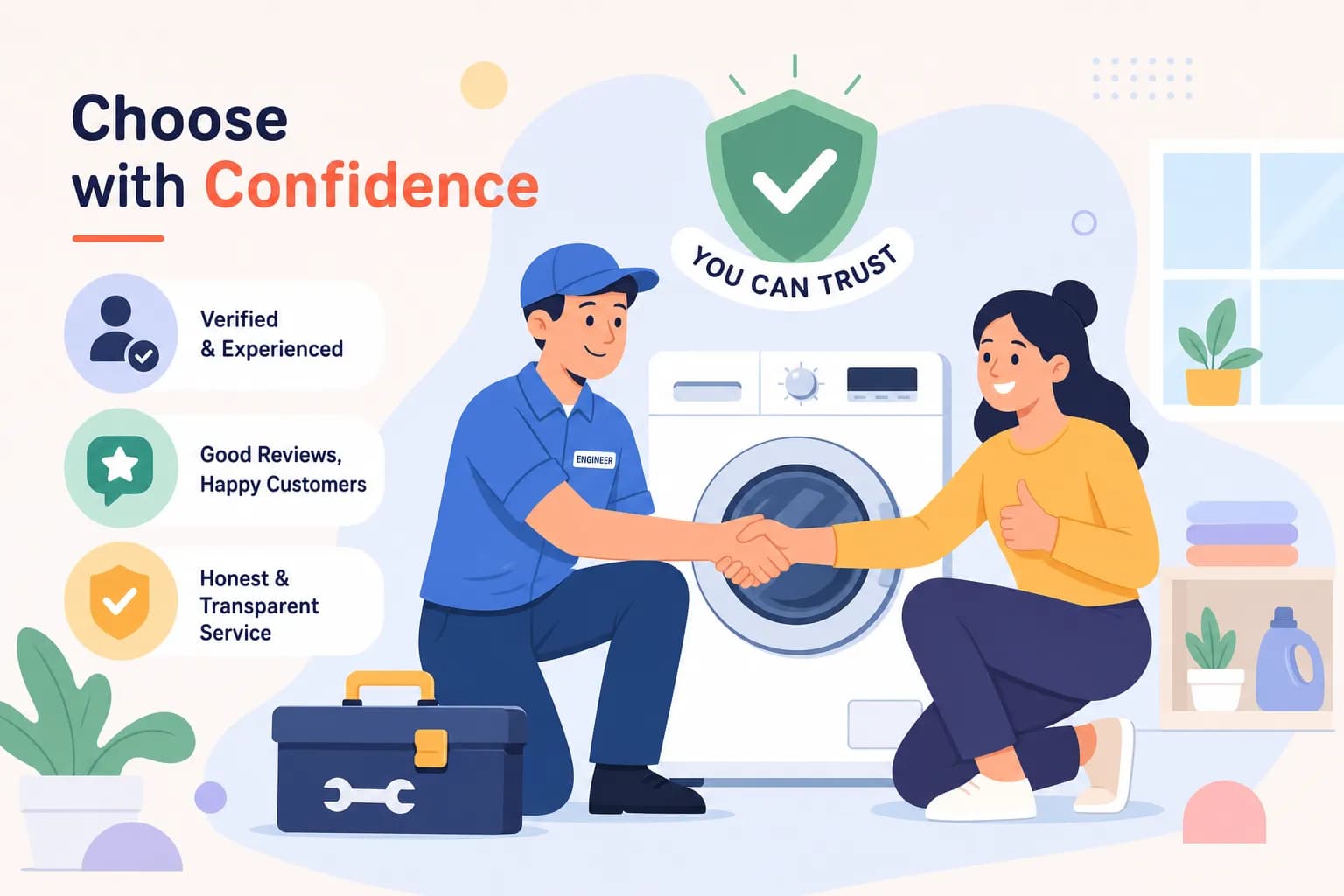
How to Choose a Washing Machine Engineer You Can Trust
When your washing machine stops dead mid-cycle, the first thing you need is a reliable washing machine engineer, not just the cheapest name on a search result. Your clothes are sitting in cold, soapy water. You grab your phone, search for a local repair technician, and immediately face a wall of listings with identical five-star reviews, no verifiable credentials, and pricing that ranges from suspiciously cheap to eye-watering. The question is not whether you can find someone; it is whether you can find someone worth letting into your home.
Here is the problem most people do not realise until it is too late: there is no mandatory licence to repair washing machines in the UK. Unlike gas appliances, where Gas Safe registration is a legal requirement, electric appliance repair sits in an unregulated space. Anyone can print a business card and call themselves an appliance technician. That puts the entire verification burden on you. This guide removes the guesswork, use it to find a qualified washing machine engineer you can trust before you commit to a booking. Start here: credentials first.
Why the engineer's credentials matter more than you think
Because washing machine repair sits outside any legal licensing framework, a washing machine technician with no formal training can trade entirely legally. They can advertise, charge a call-out fee, and take your money without ever having sat a qualification. That reality makes consumer due diligence the only protection you have, and credentials are the first filter worth applying.
City & Guilds and IWGE: qualifications to ask any washing machine engineer for
City & Guilds 221 and 224 are the industry-recognised vocational qualifications for appliance engineers in the UK, covering electrical servicing, fault diagnosis, and mechanical repair principles. They are the baseline you should expect. Beyond that, membership of the IWGE (Institute of White Goods Engineers) is widely regarded as a strong marker of competence for independent engineers: it focuses on practical repair ability, not just theory, and members are listed on the Appliance Safe Register, which you can search online to verify a technician's status. Any properly qualified washing machine service engineer should be able to show you these credentials without hesitation. If they cannot, that tells you something important.
Public liability insurance: the non-negotiable
Reputable washing machine engineers carry public liability insurance, typically with a minimum of £1 million in coverage, a level widely expected by trade bodies and many retailers, even if not a statutory requirement for all sole traders. This protects you if the engineer accidentally damages your property during the repair, whether that is a cracked worktop, a flooded floor, or a damaged appliance connection. Asking for proof of insurance is entirely reasonable, and any legitimate washer repair professional will provide it immediately. If they hesitate or deflect, that alone is reason enough to call someone else.
Manufacturer-approved status for premium brands
If you own a Miele, Bosch, AEG, or Samsung appliance, manufacturer-approved or manufacturer-trained status is worth specifically asking for. Brand-specific training means the engineer understands the exact diagnostics system for your machine and uses compatible components, not generic substitutes. On a high-value appliance, a botched repair with the wrong part can create a secondary fault that costs more to fix than the original problem. When comparing washing machine repair services, ask directly whether their engineers hold manufacturer training for your specific brand.
How to choose a washing machine engineer: reading the pricing before you agree
One of the most consistent complaints about appliance repair services is unexpected costs that only appear on the invoice. The fix is straightforward: know the typical numbers before you book, and understand which billing structure actually protects you financially.
Typical call-out fees and total repair costs in 2026
According to Checkatrade's 2026 cost guide and Which? pricing data, the average call-out fee across the UK sits at around £60, with a typical range of £45 to £120 depending on the provider and location. In London, call-out fees run higher, often between £60 and £110, with total standard repairs averaging £175 to £250 all-in. Nationally, a complete repair typically lands between £70 and £400 depending on the fault and parts required. Labour rates outside London run £40 to £80 per hour; inside the city, expect £80 to £180. These figures reflect current market rates rather than outdated estimates, so use them as a benchmark when comparing quotes from any washer repair service.
Fixed-price billing vs hourly rates: which protects you
With hourly billing, a repair that turns out to be more complex than initially assessed becomes an expensive surprise. Labour overruns, additional diagnostic time, and separately invoiced parts can push a seemingly affordable job well beyond what you budgeted. Fixed-price services quote a total cost upfront that covers diagnostics, labour, and parts together, you know exactly what you are committing to before the engineer sets foot in your home. For complex faults where diagnostic time is unpredictable, that certainty is worth a great deal. When you contact a washing machine engineer, ask directly whether they offer fixed-price repairs before agreeing to anything.
Red flags that should make you put the phone down
Some signals are instant disqualifiers. Regardless of how competitive the quote sounds, the following mean you should move on and find another washing machine engineer. Ignoring these warnings can cost you significantly more, financially and in wasted time, than taking a few extra minutes to verify credentials upfront.
No proof of qualifications or insurance
If an engineer cannot name a specific qualification, such as a City & Guilds number or IWGE membership, or declines to confirm they carry public liability insurance, that is a clear and serious signal. Legitimate appliance repair professionals expect these questions. They answer them readily because they have nothing to hide. Evasion on either point should end the conversation.
Vague quotes and "we'll see when we get there" pricing
Any engineer who refuses to give a call-out fee upfront, or who deflects cost questions with vague language, is a financial risk. Transparent pricing is a basic professional standard, not a special feature. Be especially cautious of services that quote low but leave labour and parts as open-ended unknowns. Low initial quotes can sometimes mask later price increases or the use of lower-quality generic parts that fail within weeks.
No service report or written guarantee offered
A trustworthy washing machine service engineer provides a written service report after every repair and backs their work with a guarantee covering both parts and labour. If no documentation is offered, you have no recourse if the fault reappears within days. A verbal promise has no standing. Written guarantees are a basic marker of professionalism, and their absence is a reliable indicator that you are dealing with someone who does not expect to be accountable for the outcome.
Common faults and what a competent repair actually involves
Knowing the most common faults helps you judge whether a diagnosis makes sense and whether the quoted cost is proportionate. It also helps you have a useful conversation with the engineer when they arrive.
The faults that account for most repair calls
Door and lid switch failures are the single most frequent fault, making up around 26% of repair calls. Drain pump issues account for 18%, water inlet valve problems for 14%, and belt or motor faults for 11%. Most professional repairs take between one and two hours; control board or motor jobs may run to three. A competent appliance engineer diagnoses the fault on the first visit rather than ordering parts blindly and returning days later. That first-visit diagnosis is one of the clearest indicators of genuine technical experience, and a good question to ask any washing machine technician before you book.
Repair vs replace: the honest calculation
The standard financial threshold is the 50% rule: if the repair cost exceeds 50% of what a comparable new machine costs, replacing is the smarter financial decision. For machines under five years old, repair almost always wins. For machines over eight years old facing a major component failure such as a motor, drum, or control board, any quote over £150 is a strong signal to replace rather than repair. Energy efficiency matters here too: a new machine with a significantly better energy rating may save enough on running costs to justify replacement even when the repair quote falls just under the 50% threshold. If you own a combination appliance, a specialist washer-dryer engineer will be able to advise on whether repair is viable for your specific unit.
Check your warranty and know your consumer rights before booking
Booking a paid-for washing machine engineer when the fault is still covered under warranty is an entirely avoidable expense. A few minutes of verification can save you the full cost of a call-out.
How to verify manufacturer warranty and extended cover
Locate your machine's model and serial number, found on the door frame or back panel, then gather your proof of purchase. Most major brands including Samsung, Bosch, and Miele offer an online warranty check tool on their support pages where you enter those details directly. If the manufacturer warranty has expired, check whether you paid by credit card: many card providers include automatic extended warranty coverage, often adding a year beyond the manufacturer's term. Home warranty policies may also cover washing machine faults, so review your policy documents before spending anything on a call-out fee.
What the Consumer Rights Act 2015 entitles you to
Within the first 30 days after purchase, you have the right to a full refund for a faulty appliance. Between 30 days and six months, the retailer must repair or replace it, with the fault presumed inherent at the point of sale. After six months, the burden of proof shifts to you, which is precisely where an independent engineer's written service report becomes valuable as supporting evidence. Your rights sit with the retailer, not the manufacturer, and they exist independently of any manufacturer's guarantee.
How to get the most from the engineer's visit
A well-prepared customer gets a faster, smoother repair and is far less likely to face unexpected delays or additional call-out charges. Preparation is not just logistics; it directly affects the quality and speed of the outcome.
What to have ready before the engineer arrives
Clear the area around the machine so the engineer has unobstructed access from the start. Know the make, model, and approximate age of your appliance. Note down any error codes displayed on the panel, any unusual sounds during operation, and the exact point in the cycle where the fault occurs. This information cuts diagnostic time significantly and reduces the chance of a follow-up visit.
Questions worth asking when they arrive
Before work starts, confirm the fixed price or estimated total including parts. Ask whether components used are genuine manufacturer parts or aftermarket alternatives, particularly if you own a premium brand appliance. Check the guarantee period on both labour and parts. Many reputable appliance repair engineers offer at least a 90-day guarantee on their work, and a confident professional will state that clearly without being pressed for it.
Hiring right the first time
Choosing the right washing machine engineer is not complicated once you know what to look for. Credentials (City & Guilds, IWGE membership), public liability insurance, transparent fixed pricing, and a written guarantee separate the professionals from the unqualified. Because no licence is legally required for this type of work, your own verification is the only protection you have.
Alpha Appliances Ltd offers City & Guilds certified engineers, fixed-price repairs with no hidden fees, and next-day availability across London, Berkshire, Surrey, Hampshire, and Dorset. Since 2010, they have completed washing machine maintenance and repair across London and
the South of England, with a commitment to the credentials and transparency this guide sets out.
If your machine has stopped and you need a qualified washing machine engineer, check availability and book online at Alpha Appliances Ltd. The price you are quoted is the price you pay, and the repair is backed in writing.
Need a repair today?
Book a visit from a certified Alpha engineer in minutes.