
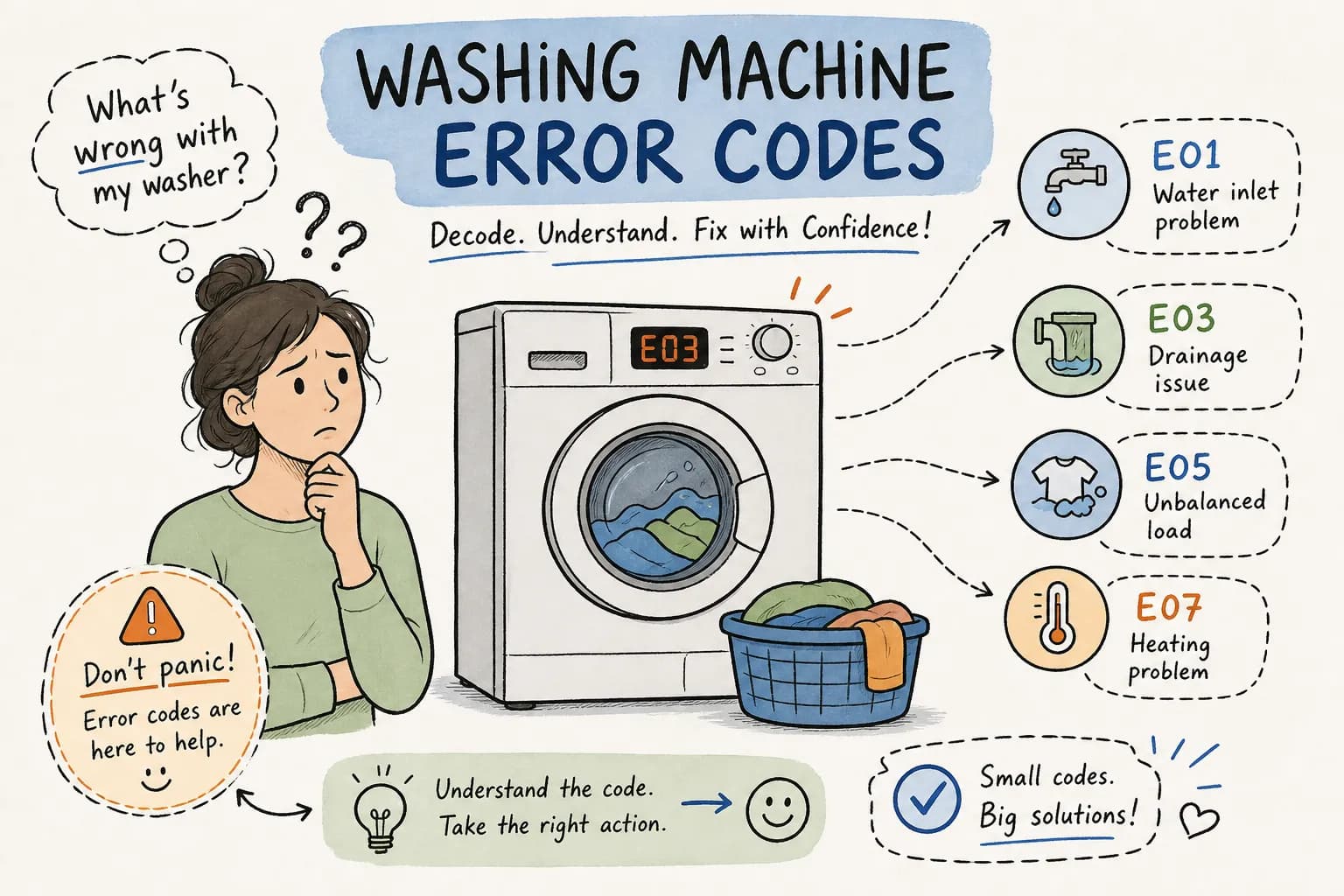
Understanding Common Washing Machine Error Codes
You pull open the washing machine door expecting clean laundry. Instead, you find a soaking drum, a halted cycle, and an alphanumeric code blinking on the display. That flash of panic is completely normal, but it does not need to last long. Understanding common washing machine error codes is far simpler than it first appears: rather than grinding on until something breaks catastrophically, your machine stops and points a finger at the problem. Once you know what the code is telling you, you have a clear starting point rather than a mystery.
The engineers at Alpha Appliances Ltd have diagnosed thousands of appliances across London and the Home Counties and see the same fault patterns surface repeatedly. A relatively small number of root causes sit behind the vast majority of error codes, regardless of brand. This washing machine error code guide walks you through what those codes mean, which checks you can safely carry out yourself, and which faults need a qualified engineer to get right the first time.
Understanding common washing machine error codes, what your machine is actually telling you
Modern washing machines run continuous internal checks throughout every cycle: water pressure, door seal integrity, drum rotation speed, and temperature. When a sensor detects a reading outside its expected range, the machine halts and displays a code rather than continuing and risking further damage. The code points your attention at a specific system, not the whole appliance. That is an important distinction: a fault code almost never means the machine is beyond saving.
Most washing machine error codes, regardless of brand or format, fall into one of five categories: water fill faults, drain and pump faults, door lock faults, motor and drum faults, and heating or temperature faults. A sixth, less critical category covers operational alerts such as unbalanced loads and excess suds. It is worth noting that some specialist or model-specific codes may not fit neatly into these groupings, but for the overwhelming majority of everyday faults this framework holds. Knowing which category a code belongs to immediately narrows the likely cause and the appropriate response. The rest of the diagnosis flows from there.
The most common washing machine fault codes decoded
Drain and fill codes: E1, E2, E10, E20, OE and 5E
Fill fault codes appear when the machine cannot draw in enough water within the expected time. You will see these displayed as E1, E10, 4E on Samsung models, or IE on LG machines. Drain fault codes mean water is not clearing from the drum fast enough, and they show up as E2, E20, OE on LG, 5E on Samsung, or F21 on certain Bosch models. Both categories are among the most frequently displayed codes across the UK, and the causes tend to be manageable: a kinked inlet hose, a blocked filter, or a failing pump.
Door, motor and heating codes: E3, E5, E6 and F01
Door lock codes, such as E5, E41, dE, and F06, appear when the interlock mechanism cannot confirm the door is properly secured. Heating codes including E3, E61, tE, and HE signal that the water is not reaching the target temperature, which usually points to a faulty heating element or a thermistor reading incorrectly. Motor and drum fault codes, covering E6, E52, F01, and F02, indicate that the drum is struggling to rotate or has stopped altogether. The underlying causes range from worn carbon brushes to a seized bearing or a motor failure. Note that F21 on Bosch models is a drain fault code and is covered in the drain and fill section above.
Load imbalance and excess suds codes: UE, DC, Sud and F0E2
These codes are not hardware faults; they are operational alerts. An unbalanced load code, shown as UE, DC, or E4, fires when the machine detects uneven weight distribution during the spin phase. An excess suds code, displayed as Sud, Sd, or F0E2, appears when too much detergent, or the wrong type for a high-efficiency machine, produces foam the machine cannot rinse away. Both are resolved without any parts or tools: redistribute the load or reduce your detergent quantity and restart the cycle.
How codes differ across Bosch, Miele, Samsung and AEG
There is no industry-wide standard for washing machine error codes, which is where most homeowners get caught out. The code OE on an LG machine means water is not draining; on a Samsung, the same two letters flag an overflow. E20 on a generic or older appliance typically points to a drain fault, but on certain Bosch models it signals a motor or drum issue instead. Always cross-reference any code against your specific model number, not just the brand name.
The four major brands sold in the UK each use a distinct format. Bear in mind that code meanings can also shift between model generations, so your model number is always the most reliable reference point:
- Bosch and Siemens:Compound codes using E and F prefixes, for example, E17 for fill timeout, E18 for drain fault, and E23 when a water leak is detected inside the machine.
- Samsung: Two-character codes such as 4E or 4C for an inlet fault, 5E or nd for a drain fault, and dE for a door lock issue.
- LG: Short letter codes, IE for inlet, OE for drain, UE for imbalance, and dE for the door lock.
- AEG and Electrolux: Numerical E-codes that can vary significantly between model generations, making the model number essential for accurate interpretation.
Miele uses its own proprietary fault system and typically displays descriptive text messages alongside short codes, which makes interpretation more accessible. Miele codes beginning with F cover everything from F10 (water intake fault) and F11 (drainage difficulty) to F20 (heating malfunction) and F34 (door cannot lock). Even so, parts and repairs on Miele appliances should be handled by a manufacturer-trained technician to protect both the machine and any remaining warranty.
Understanding common washing machine error codes: safe checks you can do at home
Drain and pump checks
Before assuming a hardware fault, check the filter. On most front-loaders, the filter access panel sits at the bottom front of the machine, usually behind a small rectangular cover. Clear any debris, check the small drainage hose beside it for blockages, and run a short cycle. If the drain code returns, inspect the drain hose at the back of the machine for kinks or blockages where it connects to the standpipe, and confirm the hose sits at least 60 cm above floor level with no more than 10 cm inserted into the drain pipe. These two checks alone often clear many common drain fault codes without any tools or parts.
Door lock and water inlet checks
For a door lock code, open and firmly close the door, then restart the machine. If the code persists, check that nothing is caught in the door seal and that the seal itself is not torn or displaced. For a fill fault code, confirm the inlet tap behind the machine is fully open and that the inlet hose is not kinked. Check the small mesh filter inside the inlet hose connection at the back of the machine. Limescale can restrict flow in hard-water areas and may trigger fill error codes, this is a particular consideration if you are in Greater London or the South East, where water hardness levels tend to be higher.
The one-reset rule
Attempt one manufacturer-approved reset, and one only. Reset procedures vary by brand and model, so always check your manufacturer's manual first. Commonly, machines reset by holding the power button for around five to ten seconds or by cutting mains power for two minutes. Bosch models often require a specific dial sequence: turn the dial to the Rinse position, hold the spin button for five seconds, then move to the Drain position and return to Off. Samsung machines generally respond to a one-to-five minute power disconnect. If the same code reappears immediately after the reset, the fault is persistent and genuine. Repeated resets mask the issue, can cause further damage, and make accurate diagnosis harder when an engineer attends.
Appliance error codes that mean stop and call a qualified engineer
Some fault codes point to components that carry genuine risk or require specialist diagnostic equipment to assess accurately. PCB or control board faults, including F01 and F02 on Whirlpool-family machines, communication error codes in the E90 to E94 range on AEG and Electrolux models, and equivalent control board codes on other brands, involve the machine's main electronic circuit. Motor faults, bearing failures, and codes flagging a water leak inside the machine (E23 on Bosch, for example) all fall into this category.
Attempting to open the machine or bypass these systems without the correct training creates a real risk of electric shock and will void the appliance warranty. The correct step is to switch the machine off at the wall, note the exact code, and contact a certified engineer. A qualified technician can read the machine's full fault history via the manufacturer's service mode or diagnostic port, not just the code on the display, which often reveals secondary issues the screen alone does not show.
When a washer fault code points to a fault beyond a basic home check, booking a certified engineer removes the guesswork entirely. The team at Alpha Appliances Ltd carries diagnostic equipment that reads the full fault log, arrives with commonly needed parts, and maintains a strong first-time fix rate across all major brands. Fixed-price repairs mean you receive a clear cost before any work begins, subject to diagnostic findings and parts availability.
What the repair bill typically looks like once the fault is confirmed
Knowing the likely cost before a repair visit helps you make a clear-headed decision. Based on current UK labour and parts pricing, the most common faults fall into these approximate ranges:
- Drain pump replacement: £70, £150 all-in, one of the most cost-effective repairs available.
- Door lock or interlock: £100, £150, typically a quick job with genuine parts available for most major brands.
- Heating element: £70, £180, common on machines over five years old and well worth repairing.
- Carbon brushes (motor): £70, £120, an inexpensive fix that restores a drum that hums but will not spin.
- Full motor replacement: £150, £300, cost-effective only on machines under eight years old.
- PCB or control board: £150, £400, the most expensive common repair and rarely recommended on older machines.
A useful rule of thumb: if the repair cost exceeds half the price of a comparable new machine and the appliance is over eight years old, replacement is the stronger financial decision. For machines under six years old with a single confirmed fault, repair almost always wins on cost.
A qualified engineer should give you an honest assessment on the day, not just a quote.
Turning a blinking code into a clear plan
Understanding common washing machine error codes is the first step towards regaining control of the situation. Most trace back to one of five fault categories, and a methodical check of the filter, hose, door seal, or detergent drawer resolves more of them than you might expect. The key is working through the checks calmly and in sequence rather than hitting reset and hoping for the best.
When the code persists after your one safe reset, or when it points to electrical, motor, or control board components, that is the signal to stop and call a professional. Alpha Appliances Ltd covers Greater London, Berkshire, Surrey, Hampshire, and Dorset with City & Guilds certified engineers and fixed-price diagnostics from the first visit. You can book a repair online quickly and conveniently through the website.
Knowing what your error code means is the first step. Knowing when to hand it over to a professional is the second. Both together mean less time staring at a blinking display and more time getting on with your day.
Need a repair today?
Book a visit from a certified Alpha engineer in minutes.