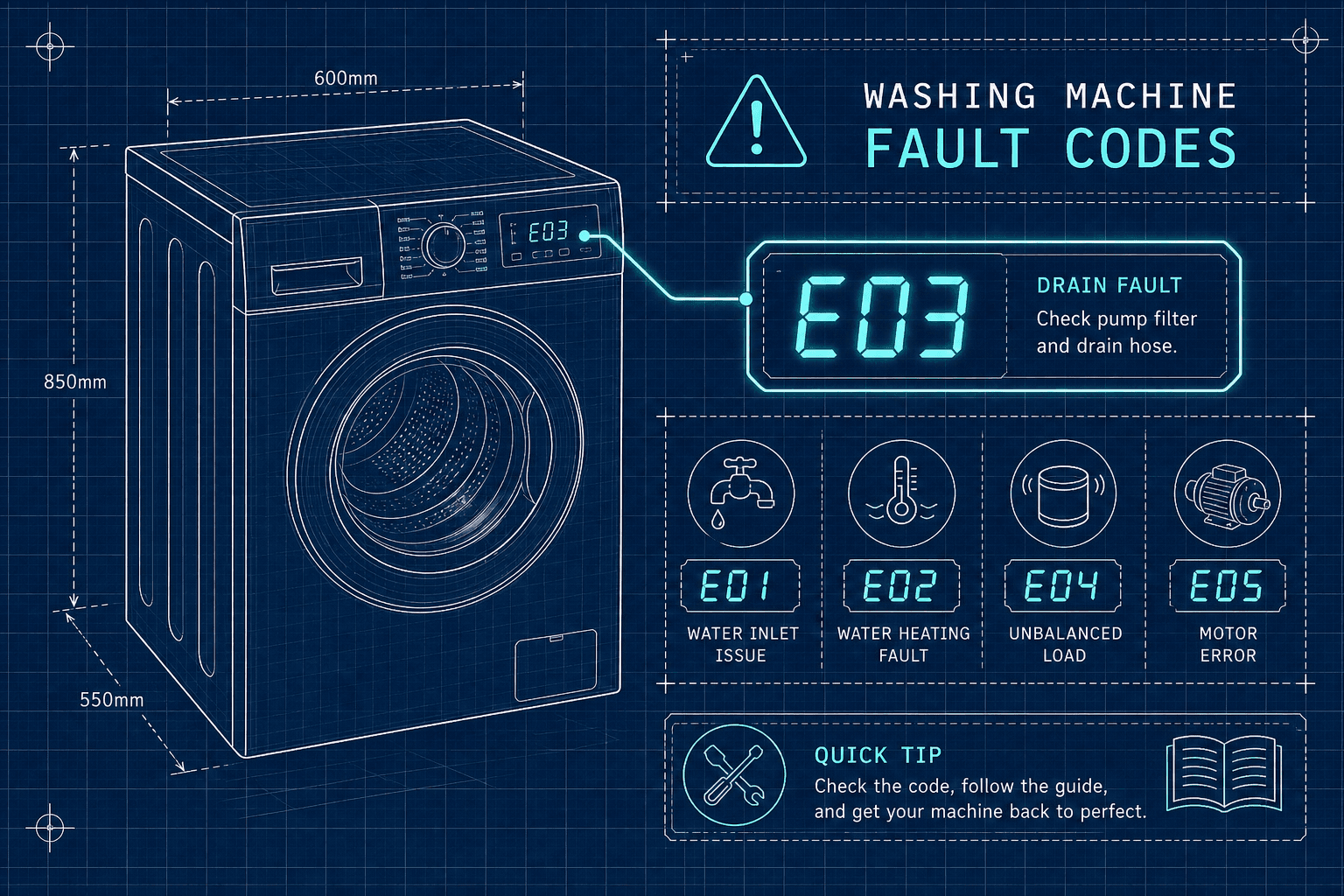
Experiencing a washing machine fault? Learn about common washing machine problems, possible causes, and troubleshooting tips to help identify and fix the issue quickly.
You open the washing machine door to find a puddle spreading across the kitchen floor. The display is flashing an error code you've never seen before, and the drum stopped mid-cycle with clothes sitting in cold soapy water. It's frustrating, and your first instinct is to assume the worst. The good news: a washing machine fault doesn't automatically mean a big repair bill. The bad news: guessing your way through it usually does.
At Alpha Appliances, we've spent over 15 years diagnosing and repairing washing machine faults across London and the South of England, and the same handful of problems come up again and again. Most of them follow a clear, predictable pattern. This guide takes you from confusion to a clear decision: what the fault is, whether you can fix it yourself, and when it's time to call a certified engineer.
A symptom is what you observe: water on the floor, clothes still soaking at the end of a cycle, a grinding noise during spin. An error code is the machine's own self-diagnosis, displayed as a number or letter combination like F05, 5E, or E17. Neither one alone gives you the full picture. Some serious faults, like a slowly failing drum bearing, produce no error code at all. Others display alarming-looking codes that turn out to have a very simple cause, like a blocked filter triggering a drainage error.
Good fault diagnosis means matching both signals together. When you know what you're seeing and what the machine is reporting, the likely cause becomes much clearer, and you avoid the most common and costly mistake: replacing a part that isn't the problem.
Take a washing machine that won't drain. That single symptom could mean a blocked pump filter, a kinked drain hose, or a failed drain pump motor. The fix for each is completely different. Cleaning a filter takes five minutes and costs nothing. Replacing a pump motor costs £90 to £160 with labour. If you skip the diagnostic step and order a new pump without checking the filter first, you've spent money you didn't need to. This is why symptom-matching, not part-swapping, is where every repair should start.
The most common cause, by a wide margin, is a blocked pump filter. Coins, tissues, small socks, and lint accumulate in the filter housing until water can no longer pass through. Based on our experience across many thousands of callouts, the majority of drainage faults come down to a blocked filter or kinked hose, both of which are user-serviceable with minimal tools (consult your manual, as some models require opening an access panel). A failed drain pump is the next possibility, but it is far less common and usually comes with a humming or grinding sound when the drain cycle runs. For a broader look at typical washing machine problems and causes, see Ariel's washing machine troubleshooting guide.
Before assuming a mechanical fault, check the load. An unbalanced drum triggers an automatic safety cut-out on most modern machines. A single heavy item like a duvet or a large towel bunched to one side is enough to prevent the spin cycle from starting. If redistributing the load doesn't resolve it, the next step is checking the drain: a machine that hasn't fully drained will refuse to spin as a safety measure. Worn drive belt or motor brush failure are further causes, but these come later in the diagnostic chain.
A torn or dirty door gasket is the most visible cause of door leaks. Mould and detergent residue building up in the rubber seal folds can prevent a proper seal forming, even without visible damage to the gasket itself. One overlooked cause is excess detergent, particularly non-HE products that generate too much foam, which forces its way past the door seal. Leaks from underneath the machine usually point to a loose drain hose connection at the back or a worn pump seal causing pressure overflow.
Banging during the spin cycle almost always points to an unbalanced load. Grinding or rumbling that builds gradually over weeks or months is the signature of worn drum bearings. The sound worsens as the bearings deteriorate. Left unaddressed, a £150, £200 repair becomes a £250, £400 one once the spider arm or drum shaft sustains damage. Intermittent clanking suggests a foreign object, usually a coin or button, trapped in the drum or pump. Run the machine empty and listen: if the noise disappears, the culprit was in the load.
F05 is a very common Hotpoint error code, and it means one thing: the machine can't drain. In the majority of cases, cleaning the pump filter clears it within ten minutes. F06 indicates a door lock fault and sits in the medium-difficulty range for DIY. F07 and F08 both point to heating circuit problems and need an engineer. F01 and F02, covering PCB and motor faults respectively, are generally professional territory, consult Hotpoint's support documentation or your manual before attempting any work. For a helpful Hotpoint error codes reference, see Hotpoint error codes explained. If you see F05 flashing on your Hotpoint, start with the filter before booking anything.
E17 or F17 means the drain cycle has timed out. Check the hose for kinks and clean the filter before assuming the pump has failed. F19 points to a heating element fault and needs professional diagnosis. E16 indicates the door was open during a programme, which is usually resolved by resetting the machine. F23 is the code that demands immediate action: it means the AquaStop system has detected a water leak. Stop using the machine straight away. Continued use risks water damage to the machine's electronics and the floor beneath it. This code always requires an engineer visit.
The 5E or E2 code is Samsung's drainage error, and it maps directly to the same causes as Hotpoint's F05: check the pump filter and drain hose first. The "nd" code means "not draining" and is frequently confused with a separate fault; it's the same problem displayed differently on older models. UE or UB signals an unbalanced load, which redistributing the laundry usually resolves in under a minute. The dL and FL codes both relate to door lock failures, while LE indicates a water level error, usually caused by a supply issue rather than an internal fault.
Start by unplugging the machine. This isn't optional: electrical safety comes before anything else. Then work through this sequence before spending any money. Check whether the machine is sitting level on the floor, an unlevel machine triggers false unbalance errors repeatedly. Check the drain hose at the back for kinks or crushing, particularly if the machine was recently moved. Verify you haven't overloaded the drum or washed a single large heavy item on its own. Finally, try a reset: unplug the machine for two minutes, then restart it. This clears temporary error codes surprisingly often and costs nothing. If you decide you need an engineer after these checks, our Hackney Appliance Repair Experts are available for local appointments and fixed-price diagnostics.
Cleaning the pump filter is a five to ten minute job that resolves the majority of drainage and spin failures. The filter sits behind a small access panel at the front base of most front-load machines. Place a shallow tray or folded towels under the panel before you open it, because water will come out. Unscrew the filter cap slowly and let the water drain into the tray. Remove the filter, clear out any lint, coins, or debris, rinse it under a tap, and refit it firmly. A filter that has never been cleaned is the single most common finding on a washing machine callout. Clean yours every one to two months as standard maintenance; Samsung recommends cleaning the pump filter regularly, and some models benefit from cleaning five to six times per year.
PCB and control board faults have no reliable DIY route without professional diagnostic tools. The same applies to motor failures, heating element issues, pressure switch faults, and AquaStop activations. Drum bearing replacement requires full drum disassembly, which typically involves removing the back panel, drum halves, and spider arm assembly. This is not a job for a first attempt at appliance repair. City and Guilds certified engineers carry manufacturer-specific diagnostic equipment that isn't available to the public, which means they can identify the root cause rather than replacing parts based on guesswork.
DIY repairs on machines still under manufacturer warranty can void your coverage, check your specific warranty documentation before opening any panels, as terms vary by manufacturer. For out-of-warranty machines, the approximate UK repair costs for common parts in 2026 are: drain pump replacement £90 to £160, PCB replacement £120 to £250, motor replacement £150 to £300, drum bearing replacement £150 to £400 depending on the machine. These figures include parts and labour. The risk of ordering and fitting the wrong part, or misdiagnosing the fault entirely, means a professional fixed-price diagnostic visit pays for itself the moment it prevents a second, avoidable repair. For an independent industry view of repair pricing, see this washing machine repair cost guide.
Some repair services charge a callout fee and then quote separately on top, which means you're committed to a bill before you know what the fault is or whether the repair is worth doing. A fixed-price diagnostic model works differently: you know the cost upfront, the engineer confirms the fault during the visit, and all repair costs are quoted before any work begins. This means you know exactly what you're paying before anything starts, and you're never committed to a repair you haven't agreed to.
An Alpha Appliances engineer arrives with professional diagnostic tools that read stored error codes, including codes the display cleared after a reset but which remain in the machine's memory. They run a diagnostic cycle, inspect the pump, hoses, door seal, drum, and electrical connections systematically, and give you a confirmed diagnosis rather than a best guess. Our engineers carry common replacement parts on the van, which supports a strong first-time fix rate across all brands. If the repair is straightforward, it's often completed in the same visit. If parts need ordering, you're given a clear timeline and a fixed quote before anything proceeds. If you need a local visit in Chelsea and surrounding areas, check our Expert Repair Services in Brompton.
You can book a fixed-price diagnostic visit with Alpha Appliances online, with next-day availability across Greater London, Berkshire, Surrey, Hampshire, and Dorset, subject to location and date. No hidden fees, no guessing, no waiting weeks for a manufacturer slot.
Most washing machine faults are fixable, and a significant number of them resolve with a filter clean, a load redistribution, or a two-minute reset. The key is accurate diagnosis: matching what you observe to what the machine is reporting, then working through the likely causes in order rather than replacing parts at random. Start with the free checks in this guide. If the fault persists, the symptoms point to electronics, sealed components, or bearings, or the machine is still under warranty, a certified engineer is the smarter option, and often the cheaper one once you factor in the cost of a misdiagnosed part.
If you're dealing with a washing machine fault that hasn't cleared after the DIY checks above, Alpha Appliances offers fixed-price diagnostics carried out by City and Guilds certified, manufacturer-trained engineers across London and the South of England. Book online or call us directly: you'll have a confirmed appointment, a clear quote, and an engineer who arrives prepared to fix it on the first visit. We also provide dedicated local coverage through our Hampstead's Trusted Appliance Engineers.
Book a visit from a certified Alpha engineer in minutes.
TRUSTED BY HOMEOWNERS
Fast, reliable, and warranty-backed repairs for every major brand.
Discover more tips from Alpha engineers.