
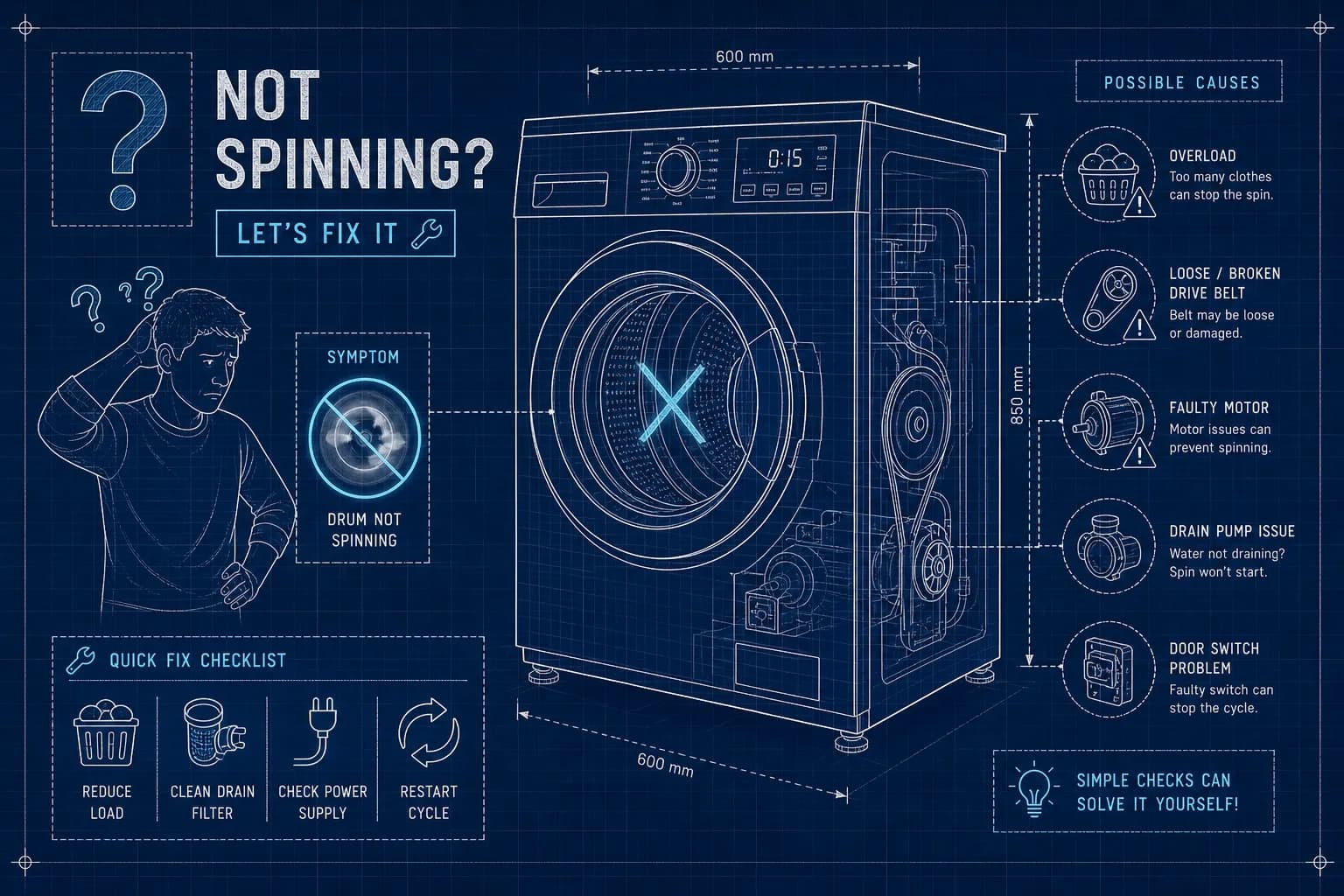
Washing machine not spinning? Here's how to fix it
You pull open the washing machine door expecting fresh, damp laundry and find a soaking wet heap instead. If your washing machine is not spinning, you're left with clothes that weigh twice what they should, a machine showing an error or sitting there silently, and no idea where to start. The drum was supposed to spin, and now it hasn't.
At Alpha Appliances Ltd, a washing machine not completing its spin cycle is one of the most frequent call-outs our engineers attend across London and the South of England. Having carried out many thousands of repairs, we've seen every variation of this fault, and here's what surprises most homeowners: many of these jobs are resolved without a single replacement part. The cause is often simpler than you'd expect, and working through the right checks in the right order makes all the difference.
This guide walks you through the most likely causes, the safe checks you can carry out right now, and the clear signs that tell you it's time to bring in a certified engineer.
Why your washing machine stops spinning: the usual suspects
Load and settings problems
The single most common reason a spin cycle fails is also the easiest to fix: the load is unbalanced, overloaded, or the machine is running a programme that doesn't include a full spin. When the drum detects an uneven distribution of weight during spin-up, a safety sensor cuts the cycle to prevent the machine from walking across the floor or damaging the suspension. A heavy single item, a duvet or a bath mat, can throw the balance off entirely, causing the machine to abort before reaching full spin speed.
On the settings side, it's easy to accidentally select a delicate, soak, or low-spin programme, particularly on machines with rotary dials or touch controls that don't give clear feedback. The machine runs a full wash and then stops, having done exactly what it was told to do. Always check the programme selector before assuming there's a fault.
Drainage and door lock faults
Most UK washing machines are designed to refuse entry into the spin cycle if they detect standing water in the drum or an unlocked door. This is a safety feature, not a malfunction. If the drain pump can't clear water fast enough, a common cause of a washing machine not draining properly, or the door interlock hasn't engaged, the machine holds at the end of the wash phase and won't proceed. A washing machine door locked mid-cycle is a frequent source of confusion, but it usually points to a drainage issue rather than a broken lock. Understanding this helps you approach the fault logically rather than assuming the worst.
Mechanical failures
When the simple checks don't resolve the issue, the fault usually lies in one of three mechanical components. Worn carbon brushes cause the motor to lose torque gradually over time. A snapped or slipped drive belt breaks the connection between the motor and drum, leaving the drum not turning at all despite the motor running. Failing drum bearings allow the drum to rotate but generate increasing resistance and noise. These faults are distinct from the checks you can do at home and are covered in detail in the professional repair section below.
Washing machine not spinning, quick checks to run first
Check cycle settings and power first
Start at the plug. Confirm the machine has a solid power supply, the plug is fully inserted, and no RCD or circuit breaker has tripped in your consumer unit. Then look at the programme dial or display: cancel any no-spin, soak, or delicate setting and switch to a standard wash or drain-and-spin cycle. If the machine has been behaving oddly in general, try a 30-second power reset by unplugging it, waiting, then restoring power. This clears temporary control board glitches that can hold the machine in an incomplete state.
Redistribute the load and test again
Pause the cycle and open the door. Spread the laundry evenly around the drum, remove a few items if the machine is clearly packed tight, and never spin a single heavy item on its own. Pairing a duvet with two or three towels gives the drum the balanced weight distribution it needs to spin safely. Once redistributed, restart and let the machine attempt the cycle from the beginning.
Check the door latch closes and locks
Close the door firmly and listen for a clear click. If the machine's display shows a door-related error code or the door feels loose, the interlock may not be engaging. Also check whether the child lock is active; on most machines this is indicated on the display and can be deactivated by holding a designated button for a few seconds (the exact duration varies by model, check your manual). Bear in mind that a short thermal delay after a cycle ends can keep the door locked for a minute or two, so wait before assuming the lock has failed.
Read this article for other ideas on why your washing machine is not spinning.
How to safely check and clear a blocked drain
Getting set up safely
Unplug the machine completely before you touch anything. This is not optional. Gather a shallow tray or baking dish, old towels, and a pair of rubber gloves. The service flap on most UK front-loading machines sits on the lower front panel, often behind a small kick-plate. If your machine has a small emergency drain hose tucked behind that flap, use it first: let the water run slowly into your tray so you don't face a sudden flood when you open the filter.
Clearing the filter and inspecting the drain hose
- Slowly loosen the filter cap a quarter-turn at a time, letting water trickle out gradually rather than removing it fully in one go.
- Once the flow stops, fully remove the filter and clean it under a tap. Coins, hair grips, and buttons are among the most common culprits.
- Look inside the pump housing and check the impeller: it should rotate freely with your finger. Any debris lodged here will prevent drainage.
- Move to the drain hose at the back of the machine. Straighten any kinks and check the outlet where it meets the standpipe or sink trap.
- Refit the filter hand-tight, making sure it seats correctly to prevent leaks, then run a short drain-and-spin cycle to test.
If your washing machine is still not draining after you've cleared the filter, or the drum still won't spin, the pump itself is likely faulty rather than simply blocked. A pump that runs but can't move water is a mechanical fault that needs a professional repair.
Is it an overloaded drum or a mechanical fault?
Run a simple small-load test
This is the most reliable way to separate a load problem from a mechanical one. Put a small, mixed load of evenly distributed items into the drum and run a normal cycle on a standard temperature. If the spin completes without issue, the fault is load-dependent: you've been overloading the machine, washing single bulky items, or letting laundry clump to one side. The fix is simply changing how you load the machine.
If the washer spin cycle is still not working on that small load, or the drum turns only weakly, the fault is mechanical. At that point, continuing to run cycles risks further damage to the motor, bearings, or drum assembly.
What the noise pattern tells you
Listen carefully during the spin phase. A loud banging or thumping that shifts when you rearrange the load almost always points to imbalance. A deep, consistent rumble or grinding noise that increases with spin speed and doesn't change regardless of what's in the drum suggests worn bearings, which typically last between seven and ten years in a UK household machine.
Weak or intermittent spinning combined with a faint burning smell points toward worn carbon brushes or a failing drive belt. Use these patterns to narrow down what you tell an engineer: they save diagnostic time and can reduce your call-out cost.
What your machine's error code is telling you
Common codes for Bosch, Samsung, Beko and Whirlpool
Error codes vary by model range, so always cross-reference with your machine's manual or the brand's support pages. That said, these are the codes most commonly linked to spin, drainage, and door lock faults on UK machines.
Bosch: E:60 or -2B typically indicates an imbalance that has interrupted the spin cycle. E16, F16, or F34 point to a door lock fault. E18, F18, E:30, and E:36 all relate to drainage issues, ranging from a blocked drain hose to a blocked pump.
Samsung: UE or UB flags an unbalanced load stopping the spin. dC or dE indicates the door has not closed or locked correctly. 5C or 5E signals a drainage problem, usually a blocked filter or faulty pump.
Beko: E18 is often linked to imbalance or a washing machine spin error. E02 or E03 generally indicate drain-related faults, though the exact mapping depends on model range.
Whirlpool: F9 E1 indicates the machine is taking too long to drain, pointing to a blockage or pump issue. F5 E2 signals a door lock failure.
What to do when a code appears
Note the code down and search it alongside your exact model number. Then work back through the checks already covered: most codes will direct you toward the drain filter, the door latch, or the load. If the same code reappears after you've completed those checks, you've isolated the fault. That's the moment to call a certified engineer, with the code written down. It removes guesswork from the diagnosis and often means the repair is completed in a single visit.
When to stop DIY and call a certified engineer
Faults that need a professional diagnosis
Some repairs go beyond what's safe or practical to attempt at home. A broken or slipped drive belt requires partial disassembly of the machine; typical repair costs in the UK run from around £110 to £230 including parts and labour, though prices vary by region and model. Worn carbon brushes, which generally last seven to twelve years depending on usage, mean accessing the motor housing and require the right tools to replace safely. Drum bearing failure produces that characteristic deep grind during spin, and if left untreated, the deterioration spreads to the drum spider arm and the outer tub, turning a manageable repair into a far more expensive one. Bearing replacement typically costs between £120 and £225 from a certified engineer, based on current UK market rates.
A persistent door interlock fault that returns after a power reset needs to be tested with a multimeter and the interlock assembly replaced if it fails. Attempting any of these repairs without proper training risks making the damage worse and could void any remaining manufacturer warranty on the machine.
Getting a fast, fixed-price repair from Alpha Appliances Ltd
We cover Greater London, Berkshire, Surrey, Hampshire, and Dorset, with rapid availability and no hidden call-out fees. Our qualified engineers carry a wide range of genuine replacement parts and aim to resolve most washing machine faults in a single visit. You receive a fixed-price quote before any work begins, no surprises.
Booking takes just a few minutes. Note down the error code, describe what you've heard and what checks you've already run, and your engineer arrives prepared. That information alone often cuts the time spent on diagnosis and gets your machine back in service faster.
Putting it all together
Working through this in order keeps the process manageable. Start with the things that cost nothing: check the programme settings, redistribute the load, and inspect the drain filter. Run the small-load test to determine whether the fault is load-related or mechanical. If an error code is showing, look it up with your model number and match it against the checks you've already completed.
Many homeowners who work through these steps either resolve the issue themselves or arrive at a clear, specific fault to hand over to an engineer. That's a better outcome than calling someone out before you've checked anything, and a much better outcome than continuing to run the machine once a mechanical fault has been identified.
If your washing machine is still not spinning after you've completed every check in this guide, the fault is almost certainly mechanical. That's exactly the point where a certified engineer pays for itself. You can book a same-week visit with us online, and we'll give you a fixed-price diagnosis before any work starts.
Frequently asked questions
Why is my washing machine not spinning?
The most common causes are an unbalanced or overloaded drum, a blocked drain filter preventing the machine from clearing water, an incorrectly selected programme, or a door interlock that hasn't engaged properly. If none of these apply, the fault is likely mechanical, worn carbon brushes, a snapped drive belt, or failing drum bearings.
What should I check first if the drum won't turn?
Start with the programme settings and power supply, then redistribute the load and check the door closes firmly. After that, clear the drain filter. If the drum is still not turning after these steps, run a small-load test to confirm whether the fault is mechanical.
Can a washing machine not draining cause it to stop spinning?
Yes. Most machines won't enter the spin cycle if they detect standing water in the drum. Clearing a blocked filter or straightening a kinked drain hose often resolves both problems at once.
When should I call an engineer for a washing machine spin fault?
Call an engineer if the drum still won't spin after checking settings, load, door, and drain filter; if a washing machine spin error code reappears after completing the relevant checks; or if you can hear a grinding noise or smell burning during the spin phase. These point to mechanical faults that require professional tools and parts to repair safely.
Need a repair today?
Book a visit from a certified Alpha engineer in minutes.