
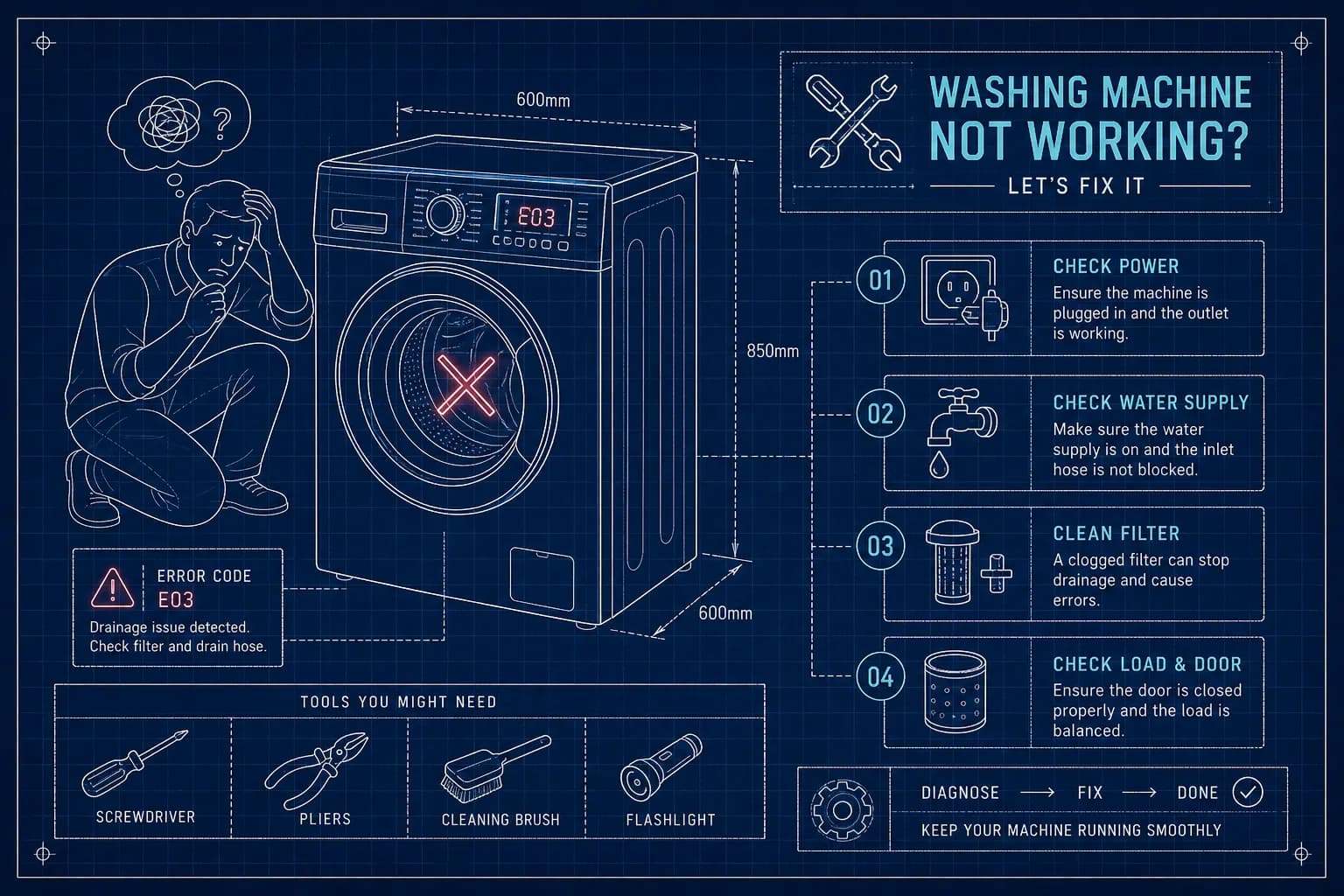
Washing Machine Not Working? Here's How to Fix It
If you need to fix a washing machine, the good news is that most faults are far more diagnosable than they first appear. It always happens on the worst possible day: you load the machine, set it running, and come back an hour later to find a drum full of wet clothes and a machine that's gone completely silent. The display is flashing something unhelpful, the door won't open, and you've got no idea where to start.
Most common washing machine faults are identifiable within minutes using checks that require no specialist knowledge and no expensive tools. This guide walks you through everything in order: safety first, then washing machine troubleshooting for the most common issues, how to read error
codes, what repairs realistically cost in the UK in 2026, and how to choose a reliable engineer when the job goes beyond a straightforward DIY fix washing machine attempt.
Stop before you start: safety checks and what you'll need
Before you touch anything on or inside the machine, two steps are non-negotiable. Unplug the appliance directly from the wall socket rather than relying on the power button, and turn off the cold water supply valve, which sits either behind or beneath the machine. These two actions take under thirty seconds and remove the two main risks: electric shock and unexpected water release.
Disconnecting power and water correctly
One point worth knowing: capacitors inside a washing machine can retain a residual electrical charge even after the plug is removed. For basic checks like clearing a filter or inspecting a hose, this isn't a concern. If you plan to open any panels or access internal components, a non-contact voltage tester is a sensible precaution, inexpensive models are widely available from most hardware shops.
Water management matters too. Disconnecting hoses without draining residual water first can release a surprising amount of liquid very quickly. Keep a shallow tray and a couple of old towels nearby before you start, particularly if you're going to access the pump filter area at the front of the machine.
Tools that make the job quicker and safer
For the checks covered in this guide, you need very little: a flat-head screwdriver, a bucket, old towels, and a torch. That's it. If you want to go further and test components, an inexpensive multimeter and a set of insulated screwdrivers are worth owning. Most common washing machine faults can be diagnosed and resolved without any specialist equipment at all.
How to Fix Washing Machine Drain and Spin Problems
These two faults account for a large proportion of repair call-outs, and both have a high success rate for DIY resolution when you work through the checks in the right order. Don't assume the worst until you've ruled out the obvious.
Clearing the pump filter: the most overlooked two-minute fix
The pump filter is at the bottom front of most front-loading machines, behind a small access flap. Open it, place your tray underneath to catch residual water, and unscrew the filter counterclockwise. What you'll typically find is a mix of coins, hair grips, fluff, and general debris that's been quietly accumulating over months of use. Rinse the filter under running water, scrub off any build-up, check the cavity behind it for obstructions, and screw it back in clockwise until it's hand-tight.
A blocked pump filter is behind a significant proportion of "won't drain" call-outs. Clean it every three to four months as standard practice, and immediately if the machine is draining slowly or smelling musty. Reinstalling the filter correctly matters: if it's not fully seated, you'll get a leak from the front of the machine every cycle.
Balancing the load, checking the hose, and the door switch test
If the machine fills and washes but won't spin, start by redistributing the load. A single heavy item like a bath mat or a duvet sitting to one side will cause the machine to detect an imbalance and abort the spin cycle to prevent damage. Redistribute the laundry evenly, close the door, and select a spin-only programme to test.
Next, pull the machine away from the wall and check the drain hose. If the hose is kinked or twisted, straighten it and ensure it sits no more than 15cm into the household standpipe, a blocked or restricted hose prevents water from leaving the drum, which in turn stops the spin cycle from starting. Finally, open and close the door firmly while listening for an audible click from the door switch. No click means the machine may not be detecting the door as properly closed, which is a common cause of both draining and spinning failures.
If you've recently installed a new machine, also check that the shipping bolts have been removed from the rear. Leaving them in place causes violent shaking and a failed spin on every cycle.
Washing machine leaking or making noise: diagnosing two more common culprits
Both faults require you to pay attention to timing and location before jumping to conclusions. Knowing when and where the symptom appears narrows the cause considerably.
Tracking down the source of a leak
Timing is everything with a washing machine leaking. Water appearing during the fill phase points to the inlet hoses or the detergent drawer. A leak during draining or spinning indicates the pump, lower hoses, or door seal. Start by inspecting the inlet and drain hose connections at both ends: look for cracks, blisters, or fittings that have worked loose. Tightening a loose connection takes seconds and costs nothing.
If the hoses look fine, remove the detergent drawer completely and clean it under the tap. Built-up fabric conditioner and detergent residue can block the drawer from draining correctly, which forces water out around the front of the machine. On front-loaders, also wipe down the rubber door gasket thoroughly and check for small tears, trapped hair, or debris that might be preventing a full seal.
What the noise is telling you
A thumping noise during spin almost always means an unbalanced load or an unlevel machine. Place a spirit level on top of the appliance and adjust the feet at each corner until the machine sits flat with no rocking. For persistent thumping with a balanced load, check for coins or small items trapped between the drum and the outer tub: rotating the drum slowly by hand while the machine is unplugged often dislodges them.
Grinding or squealing from inside the drum during a cycle is a different matter. It can indicate a foreign object trapped in the tub, but it can also mean worn drum bearings. Drum bearing replacement is firmly in professional territory. It requires dismantling the machine significantly and, done incorrectly, causes more damage than it fixes. If the noise persists after you've checked for objects and the machine is rocking on uneven feet, it's time to call an engineer.
Making sense of error codes on your machine
Error codes look alarming, but they're simply the machine's built-in diagnostic system flagging which subsystem has detected a problem. They're a starting point, not a verdict, and understanding them is a key part of any washing machine troubleshooting process.
What error codes are actually telling you
Different manufacturers use different formats: Bosch and AEG typically use E or F prefixes (E18 for a drainage fault, for example), while Hotpoint and Indesit use F codes, and Beko uses E codes. The format matters less than knowing where to look the code up. Your user manual is the fastest reference; if you don't have it, search the manufacturer's website using your model number, which is usually printed on a label inside the door frame.
Common faults behind error codes include blocked pump filters, door lock failures, heating element faults, and water pressure issues at the inlet valve. Many of these overlap directly with the DIY checks already covered in this guide.
When a reset clears it and when it doesn't
Before calling anyone, try a power reset: unplug the machine for 60 seconds, then plug it back in. This clears transient electronic glitches, communication errors between the control board and sensors, and faults caused by a cycle interruption such as a power cut. If the code doesn't reappear after a full test cycle, the issue was likely a one-off.
If the same code reappears after a reset, the machine is indicating a physical fault that requires a component to be replaced. At that point, DIY ends for most people, and the sensible next step is an engineer's diagnosis.
What washing machine repairs cost in the UK
Understanding realistic washing machine repair costs before you call anyone puts you in a much stronger position when comparing quotes.
Typical costs for common faults in 2026
For standard repairs in 2026, expect the following all-in figures including call-out, labour, and parts: door seal replacement runs £65 to £120; drain pump replacement £80 to £150; carbon brushes £50 to £100; door lock or interlock £60 to £110; and drum bearing replacement £120 to £200. PCB and control board faults sit at the higher end, typically £150 to £250, and motor replacement can reach £150 to £300. These figures reflect current market rates and should be used as a guide when assessing whether a quote is reasonable.
In London, all-in costs sit higher, typically £175 to £250 for a standard job, due to elevated labour rates and travel costs. Outside London across the rest of the UK, the average for a complete repair including call-out is around £130. Always ask whether VAT is included in the quoted figure, as some providers quote ex-VAT.
At what point replacement makes more sense
The practical rule of thumb is the 50% rule: if the repair quote exceeds half the cost of a comparable new machine, replacement is the smarter financial decision. Age matters too. Once a machine passes eight to ten years, component wear becomes widespread, and a successful repair on one part is increasingly likely to be followed by another failure shortly after.
For mid-range and premium appliances from Bosch, AEG, or Miele, the calculation often tilts further towards repair. These machines are built to last twelve or more years, parts availability is generally good, and replacement with a comparable model costs significantly more than a repair. For budget brands, the repair-versus-replace threshold arrives sooner, sometimes as early as five to seven years.
When to stop DIYing and book a certified engineer
There's a clear line between faults that are safe and practical to address yourself and those that aren't. Knowing where that line sits saves you time, money, and the risk of making the problem significantly worse.
Faults that need a professional every time
Motor failure, PCB and control board faults, drum bearing replacement, and any fault involving internal wiring or the heating element all sit outside safe DIY territory. This isn't about skill; it's about risk. Attempting these repairs without the right tools and diagnostic equipment risks causing further damage, and on a machine still within its manufacturer warranty, it can void your remaining cover entirely. A qualified engineer diagnoses and fixes these faults in a single visit far more reliably than a trial-and-error approach at home.
How to fix washing machine problems with the right professional help
When choosing an engineer, the key trust signals are straightforward. Look for City & Guilds certification, public liability insurance of at least £1 million (ask for the certificate, not just a verbal assurance), transparent fixed pricing with no hidden call-out fees, and a solid track record of verified reviews on independent platforms such as Checkatrade, Trustpilot, or Google. Avoid any company that can't confirm these details immediately.
Alpha Appliances Ltd is City & Guilds certified and Safe Contractor approved, and carries full public liability insurance. The team offers next-day availability across London and the Home Counties on a fully transparent fixed-price basis, so there are no quote surprises after the engineer has arrived. All repairs use genuine parts, and for landlords a full service report is provided after every visit for compliance documentation. If you want to know the cost before committing, book a diagnostic appointment online and the price is confirmed upfront.
The short version: what to do right now
Many of the most common faults, a blocked pump filter, a kinked drain hose, an unbalanced load, a basic error code, can be identified and resolved in a matter of minutes. Start with the pump filter, check the drain hose, redistribute the load, and look up any error code in the manual. These four steps resolve a large proportion of faults without any further intervention.
For anything beyond those basics, calling a qualified engineer is almost always faster and cheaper than further DIY that risks additional damage. The washing machine repair cost figures in this guide give you a realistic benchmark so you know whether a quote is fair before you agree to anything.
If you can't fix washing machine faults yourself, Alpha Appliances Ltd offers next-day repair appointments across London and the South of England, with fixed prices confirmed before the engineer arrives. Book online in under three minutes at alphaappliancesltd.co.uk.
Frequently asked questions
How much does it cost to fix a washing machine in the UK?
In 2026, typical all-in repair costs range from around £50 to £300 depending on the fault and your location. Common jobs such as a drain pump replacement or door seal sit in the £65 to £150 range. In London, expect to pay £175 to £250 for a standard repair; elsewhere in the UK the average is closer to £130. Always confirm whether quotes include VAT and any call-out fee.
What are the most common washing machine faults?
The most frequently reported problems are failure to drain, failure to spin, leaks, noisy operation, and error codes appearing on the display. Most of these start with straightforward checks: a blocked pump filter, an unbalanced load, a kinked hose, or a simple power reset will resolve a significant number of call-outs without any engineer visit at all.
Can I fix a washing machine myself?
Many common faults are well within DIY reach: clearing the pump filter, straightening a drain hose, rebalancing a load, and resetting the machine after a power interruption are all safe, tool-free tasks. More involved repairs, drum bearings, motor faults, PCB issues, or anything requiring panel removal, are best left to a qualified engineer to avoid causing further damage or voiding a manufacturer warranty.
How do I find a reliable washing machine repair engineer near me?
Look for engineers with City & Guilds certification, verifiable public liability insurance, and a strong track record of reviews on independent platforms such as Google, Trustpilot, or Checkatrade. Fixed-price quotes confirmed before the visit are a good indicator of a trustworthy service. Alpha Appliances Ltd covers London and the Home Counties with next-day appointments and upfront pricing, book at alphaappliancesltd.co.uk.
Need a repair today?
Book a visit from a certified Alpha engineer in minutes.