
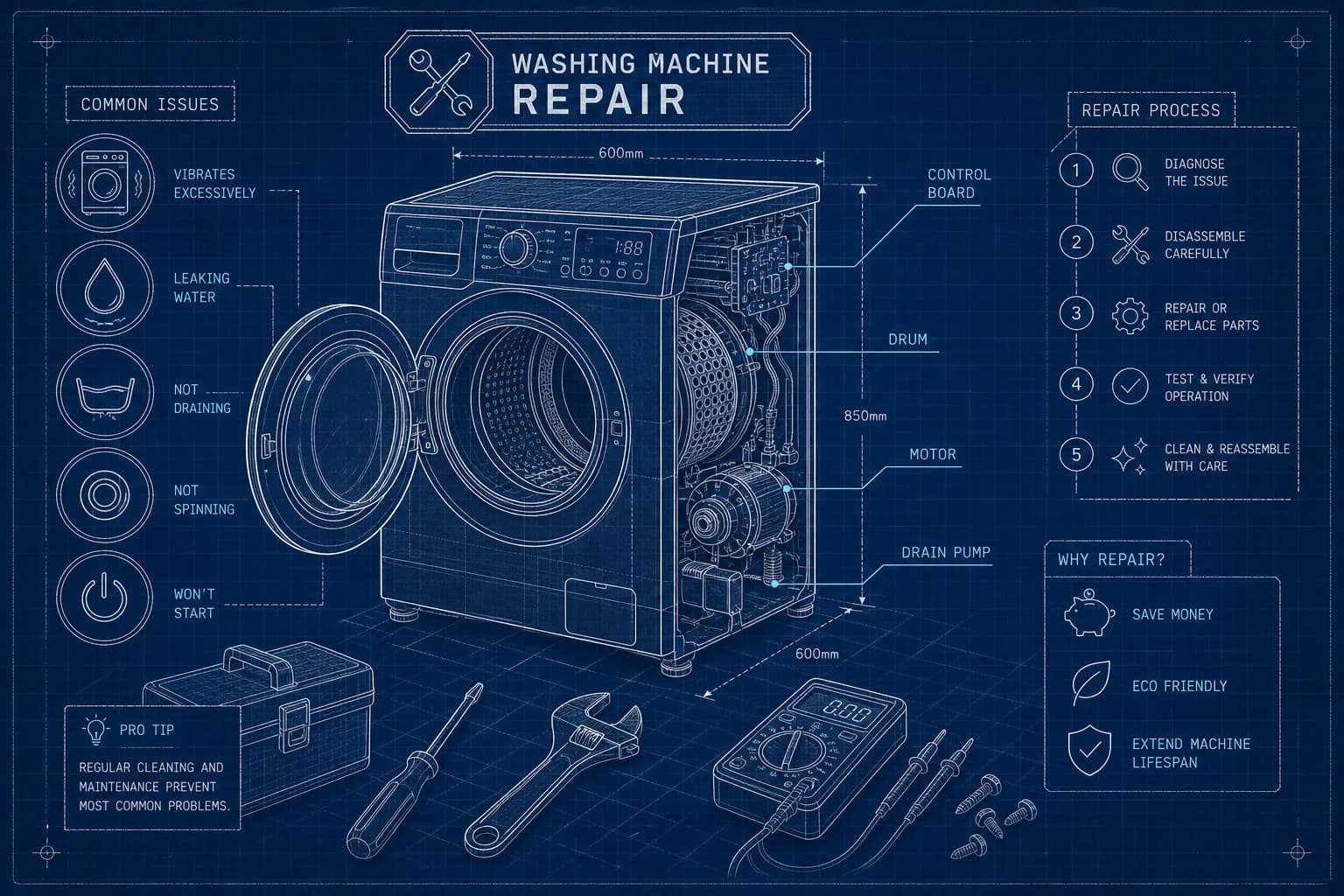
The Complete Guide to Washing Machine Repair
A broken washing machine doesn't give you much warning. One day it's running fine; the next there's standing water in the drum, an error code flashing on the display, or a grinding noise that definitely wasn't there last week. Meanwhile, the laundry pile grows, and you're left wondering whether this is a blocked filter you can sort yourself in ten minutes or a seized bearing that needs a proper engineer. That uncertainty is exactly what makes appliance faults so frustrating.
This guide cuts through it. You'll learn how to identify the most common washing machine faults by their symptoms, carry out a safe pre-check at home, understand what a professional repair will realistically cost in 2026, and verify that the engineer you book actually has the credentials to fix the job first time. The standard to aim for is straightforward: a certified engineer arriving with the right tools, carrying common parts, quoting a fixed price before touching anything, and leaving with a working machine. That's what a proper washing machine repair and service looks like, and it's the benchmark you should hold any company to.
The most common washing machine faults and what they're telling you
Drum not spinning or turning slowly
The most frequent culprits behind a drum that won't spin are worn carbon brushes on brushed-motor machines, a seized or noisy bearing, an unbalanced load triggering the machine's safety cut-out, or a faulty door interlock preventing the cycle from starting at all. The pattern of the fault tells you a lot. If the drum spins intermittently, worn brushes or a failing motor are likely candidates. If the drum is completely still and the machine is silent, the door latch or interlock is worth checking first. A drum that spins slowly but won't reach full spin speed often points to a drainage problem, since most machines refuse to ramp up until water has cleared the drum.
Won't drain or is taking too long to empty
Drainage faults are among the most commonly reported washing machine problems in UK homes, and they tend to announce themselves through specific error codes. Bosch E18 or F18 signals the machine cannot pump water out, usually because the pump filter, drain hose, or pump itself is blocked. Hotpoint and Indesit F05 means the same thing: water isn't leaving the drum within the expected time. Samsung's 5E code is its equivalent, typically caused by a blocked filter or a restriction somewhere in the drainage path. These codes are the machine's fault log telling you exactly where to look, not a death sentence for the appliance.
The usual suspects are straightforward: a blocked pump filter (the most common cause of drainage faults), a kinked or incorrectly positioned drain hose, objects jamming the pump impeller, or a blockage in the household standpipe that has nothing to do with the machine itself. Identifying which one you're dealing with is usually possible through the pre-check routine below.
Leaks, loud noises, and other warning signs
A leak from the door seal is usually visible as cracking, mould growth inside the gasket, or a watermark pattern on the door glass. A leak from the base of the machine is different and more serious: it typically indicates a loose hose connection, a cracked pump housing, or a failing inlet valve. These two fault types need different responses, so it matters where the water is actually coming from. A rumbling or grinding noise on the spin cycle is a strong indicator of worn drum bearings, a fault that worsens quickly if left and becomes significantly more expensive to repair once the bearing damage spreads to the drum shaft or rear casing. Catching bearing noise early, when the sound is faint, is typically cheaper than waiting until the drum starts moving visibly.
What you can safely check yourself before calling anyone
The safe pre-check routine
Start by cutting power at the wall socket. Do not work on a washing machine that is plugged in. Then work through the accessible checks in logical order before concluding you need an engineer.
- Inspect the drain hose at the back for kinks, crushing, or incorrect positioning. Follow your model's installation guide for the correct hose height, standard guidance advises raising the hose adequately before it enters the standpipe and avoiding deep insertion, as over-insertion causes siphoning.
- Check the door latch closes and clicks firmly. A door that isn't fully latching will stop spin and drain functions on most front-loaders without triggering an obvious error.
- If the drum has stopped mid-cycle with laundry inside, redistribute the load evenly and run a short spin-only cycle. An unbalanced load is the single most common reason a machine aborts its spin.
- Test the household standpipe separately by pouring water directly into it. If it drains slowly or backs up, the problem is in your plumbing, not the machine.
- Clean the pump filter. Put towels on the floor, have a shallow tray ready, and open the lower front access panel. Unscrew the filter slowly and counterclockwise, letting water drain into the tray gradually. Remove any lint, coins, hair grips, or fabric debris, rinse the filter under running water, and refit it firmly clockwise. If water was hot recently, wait before opening.
After cleaning the filter and rechecking the hose, run a short rinse and spin cycle and listen for a steady pump hum followed by water moving out. If that happens, the fault was almost certainly a blocked filter. If the machine still can't drain or spin, move on to calling an engineer.
How to interpret and reset error codes
Error codes are a diagnostic starting point, not a verdict. To look up your specific code accurately, find the model number on the inner door frame or the back panel and cross-reference it with the manufacturer's support page. The same code can mean different things across model families, so the model number matters. Most codes across Bosch, Samsung, Hotpoint, Beko, and Indesit cluster around drainage, door lock, and inlet water faults, which is why the pre-check routine above covers the most likely causes.
Unplugging the machine rarely fixes anything. It clears the error display temporarily, but if the underlying fault is still present, the code returns as soon as the machine tries to run again. A code that disappears after a filter clean and doesn't come back has been properly resolved. A code that returns within the next wash cycle means the fault is still active and needs professional diagnosis.
When to stop and call a certified washing machine engineer
Faults that need a professional diagnosis
Some faults are genuinely beyond what a safe home check can resolve, and continuing to investigate without the right test equipment creates more risk than it eliminates. Stop and call an engineer if you encounter any of the following:
- A burning smell at any point during the cycle
- Water leaking from inside the cabinet or from under the machine, rather than from a visible hose connection
- A tripped circuit breaker that trips again when the machine is switched back on
- A pump impeller that feels seized or won't turn freely when accessed through the filter housing
- A drum that is physically stuck or grinding against the outer casing
Also call an engineer if the fault returns immediately after you've cleaned the filter and confirmed the hose is clear. That pattern means the blockage isn't the root cause.
What a proper first-visit repair looks like
The difference between a good engineer and a cheap call-out usually becomes clear within the first few minutes of the visit. A qualified washing machine engineer arrives with diagnostic equipment, aims to carry the most common replacement parts (pump, door seals, brushes, inlet valves), and confirms a fixed price before any work begins. A reputable firm will also be transparent about which parts are stocked on the van and whether the quote covers both parts and labour, it's always worth asking upfront to avoid any confusion on the invoice.
At Alpha Appliances Ltd, that's the standard we work to. Our engineers hold City & Guilds certification in domestic appliance repair, we quote a fixed price before any work starts, and there are no hidden call-out fees. When you're comparing washing machine repair companies, those are the benchmarks worth insisting on: verifiable credentials, parts carried for common faults, and a price confirmed before anyone picks up a screwdriver.
What washing machine repairs cost in the UK in 2026
Typical repair costs by fault type
Most single-fault washing machine repairs in the UK in 2026 land between £80 and £225 all-in, including labour and parts. Call-out and diagnostic fees typically run from £40 to £110, and reputable companies deduct this from the repair cost when the work goes ahead. Here are the realistic cost ranges by fault type:
- Drain pump repair: £75, £150 all-in
- Door seal or gasket: £65, £120 all-in
- Drum bearings: £120, £200 all-in (higher labour content due to dismantling required)
- Motor brushes: £50, £100 all-in
- Control board or PCB: £150, £400 all-in, depending on the model and board availability
Repair or replace: how to make the call
The practical rule of thumb is the 50% test: if the repair quote exceeds half the cost of a comparable new machine, replacement generally makes better financial sense. A machine under eight years old with a single, well-defined fault is nearly always worth repairing. The fault types most likely to push costs toward or beyond that threshold are PCB replacements, motor replacements, and drum bearing jobs on older or budget-brand machines, where the labour cost relative to the machine's remaining value tips the balance toward replacement.
Premium appliances are a different calculation. A Miele, Bosch, or AEG washing machine that develops a drain pump fault at seven years old is in the great majority of cases worth repairing, because the build quality means it has significantly more useful life remaining than a budget machine of the same age. The repair-versus-replace decision should always factor in what the machine is, not just what the repair costs.
How to find a washing machine engineer you can actually trust
Credentials and qualifications worth checking
For a domestic appliance repair, the qualifications that carry genuine weight are City & Guilds certification in consumer electrical appliance repair (particularly Level 2 or Level 3 routes, including the City & Guilds 224 qualification) and membership of the Institute of White Goods Engineers (IWGE), which maintains a public member directory you can check before booking. AMDEA and DASA affiliation are also recognised markers of legitimate trade membership. Ask for the certificate title and number, and verify it against the awarding body's records. If an engineer claims manufacturer-authorised status for a premium brand, ask for written confirmation of that authorisation rather than taking a logo on a website as proof. Gas Safe registration is only relevant if gas appliances or gas connections are involved; it doesn't apply to washing machine repairs specifically.
Same-day repairs: what's realistic across UK regions
In London, same-day washing machine repair is genuinely achievable if you book before mid-morning, when slots are still available and an engineer can be routed to you efficiently. Book in the afternoon and next-day becomes the realistic expectation. Across the South East and Home Counties, including Surrey, Berkshire, and Hampshire, next-day is the more dependable target, though same-day is possible with early booking. In major regional cities, 24 to 48 hours is a common confirmed window. Local independent engineers can often respond faster within their immediate area and may carry common parts on the van, rather than relying on a central parts depot.
Alpha Appliances serves Greater London, Berkshire, Surrey, Hampshire, and Dorset with next-day availability and a straightforward online booking system. If your machine has stopped working and the pre-check hasn't resolved it, you can get a confirmed appointment and a fixed price through our four-step booking process without waiting on hold or navigating an automated phone system.
The bottom line
Washing machine repair is rarely worth skipping in favour of an immediate replacement, provided the fault is diagnosed correctly by a qualified professional. Start with the obvious culprits: clean the filter, check the hose, confirm the door is latching, and test the standpipe. If those checks don't resolve it, the fault needs a certified engineer with diagnostic tools and the right parts on the van.
Know your stop signs. A burning smell, a leak from inside the cabinet, a tripped breaker, or a fault that returns immediately after basic checks all signal that further home investigation creates more risk than it resolves. These faults need a professional, and they need one quickly, before a manageable repair becomes a more expensive one.
When you're choosing who to call, verify the credentials, confirm the pricing structure is fixed and transparent, and check that the engineer carries common parts for a first-visit fix. If your machine is playing up and the pre-checks haven't solved it, get in touch with our team at Alpha Appliances Ltd, a certified engineer will attend, a fixed price is confirmed before any work begins, and we aim to have your machine back in service as quickly as possible.
Need a repair today?
Book a visit from a certified Alpha engineer in minutes.